AI Hiring Roundup October 2026: Software Cost, Rollout Time and What Stays Human
The month's numbers on AI recruiting cost, implementation time and the hiring stages that still wait on a human.
AI hiring software now runs from $900 to $250,000 a year and rollouts take 2 to 26 weeks. Here is the monthly roundup of what it costs, where it breaks and what to fix first.

TL;DR
This AI hiring roundup pulls the month's numbers into one place: AI recruiting software now runs from about $900 to $250,000 a year depending on company size, and rollouts take anywhere from 2 to 26 weeks. The tooling is no longer the hard part. The hard part is the handful of stages that still wait on a human, and those decide whether your time to hire moves at all. If you only read one deep dive first, start with our AI recruiting software cost breakdown.
What is actually happening
Application volume has outrun recruiter capacity. Our guide on high-volume hiring software reports that a recruiter now handles about 746 applications a year, up from 146 in 2022. That is a fivefold jump in four years, and no headcount plan absorbed it.
Automation is the obvious response, but adoption is uneven. As we reported in AI recruiting for small business, only 43 percent of firms with two to nine employees use AI at all. The firms with the least recruiting capacity are the ones least likely to have help.
At the other end, large teams have the opposite problem: too many tools and too little calibration. Buyers are signing contracts for platforms that screen, schedule and rank, then discovering that the slow part of their funnel sits somewhere else entirely.
That somewhere else is usually the hiring manager. Per our analysis of the hiring manager bottleneck, Greenhouse's March 2026 benchmark puts interview time at 12.3 hours per hire, while SHRM has average time to hire at 41 days. The gap between those two numbers is waiting, not working.
Candidates notice the waiting. The same post cites JRG Partners research from July 2026 showing roughly 40 percent of top executive candidates withdraw from processes that run past four weeks. Speed is a quality lever, not just a cost lever.
Ghosting compounds the problem further down the funnel. Interview no-shows get the headlines, but our guide to candidate ghosting argues that the offer-to-joining gap is where it costs hiring teams the most. A candidate who vanishes after accepting wastes every week the process already spent.
Finally, there is a new integrity problem on the candidate side. Our write-up on AI interview cheating detection notes that recruiters see AI use in 35 percent of interviews, yet detectors falsely flag non-native English writers 61 percent of the time. Blunt detection trades one fairness problem for another.
The numbers
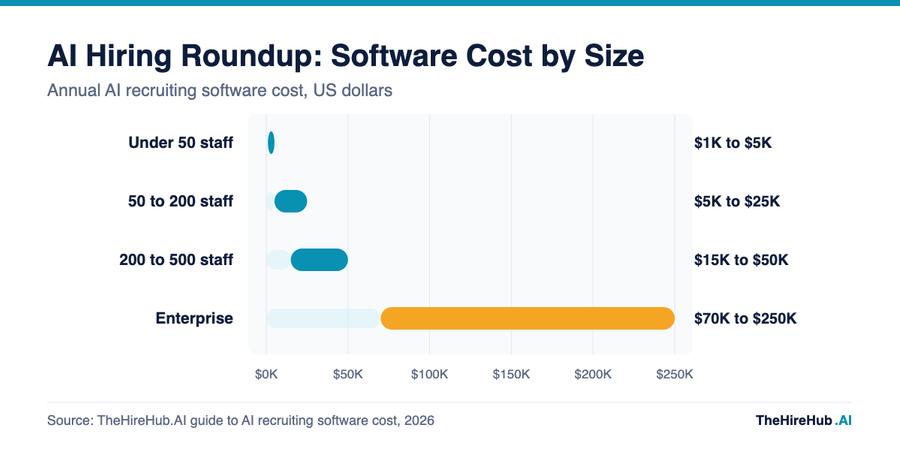
Cost is the first thing buyers ask about, and the spread is wide because vendors price on headcount rather than seats. The chart below shows the annual bands we published, from small teams to enterprise deployments.
Entry-level platforms start near $900 a year. Mid-market contracts land between $15,000 and $50,000. Enterprise deployments run from about $70,000 to $250,000 and beyond, usually with an implementation fee on top.
Timelines scale the same way. Teams under 50 staff typically go live in 2 to 4 weeks, mid-market teams in 6 to 12, and enterprise rollouts take 13 to 26 weeks, with security review the long pole.
How to read this:
- The bands are annual US dollar figures from our own published guide, so treat them as ranges to test against vendor quotes, not as price lists.
- The jump from mid-market to enterprise is mostly integration and compliance work, not extra features.
- A cheap tool with a 12-week rollout can cost more in lost hiring time than an expensive one that is live in four.
How it actually works, and where it breaks
Most AI recruiting tools do three things: they parse and rank applications, they automate scheduling and follow-up, and they summarise interviews for the hiring panel. Each one removes a manual step, and each one inherits whatever your process already does badly. The software is a multiplier, so it multiplies good process and bad process alike.
That is why two companies running the same platform can report opposite results. One had a clear scorecard, a fixed feedback window and a named owner for each stage, so automation removed friction. The other had none of those, so automation moved the mess faster.
The first failure mode is silent rejection. Our guide to AI screening false negatives cites a finding that 88 percent of employers admit qualified candidates get filtered out before a human looks. If you never sample the rejected pile, you will not know your own miss rate.
The second is the unchanged bottleneck. A faster screen feeds more qualified candidates into the same slow debrief, and the queue gets longer instead of shorter.
The third is drift. Models are tuned on your past hiring decisions, so if those decisions were narrow, the tool learns to be narrow faster.
There is also a quieter risk in how vendors describe accuracy. A tool that is right most of the time can still be wrong in a consistent direction, against one college tier, one career gap pattern or one accent in a video interview. Ask any vendor how they test for that, and ask to see the answer on your own data.
"A tool that speeds up every stage except the one with the human bottleneck has only made the queue longer."
What this means for your team
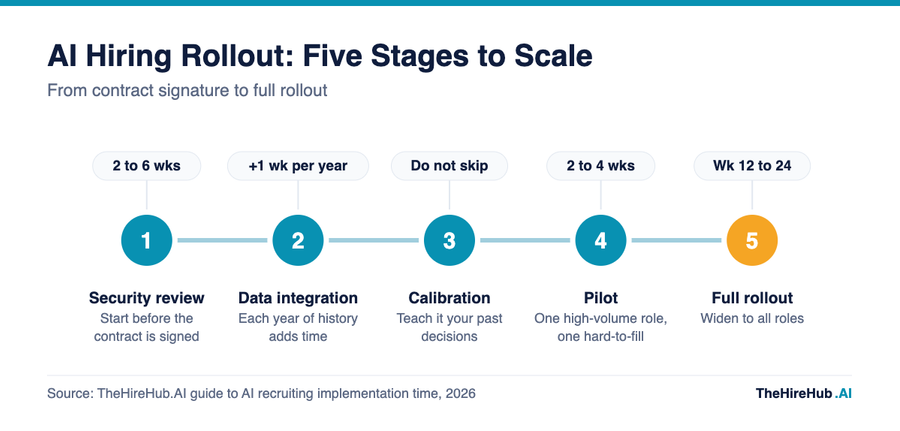
Rolling out AI hiring tooling is a sequence, and skipping stages is where the surprise delays come from. Our guide on AI recruiting implementation time lays out five stages, and the chart below follows them.
Security and legal review comes first and should start before the contract is signed, because it adds two to six weeks and cannot be rushed. Data integration follows, and each extra year of candidate history you migrate adds roughly one week.
Calibration is the stage teams skip to save time. The guide estimates that skipping it saves about two weeks and costs far more in mis-ranked shortlists later.
Then run a pilot of two to four weeks on two roles of different shapes: one high-volume, one hard to fill. Only after that do you widen to every role, with adoption reviews at weeks 12, 16 and 24.
Assign an owner to every stage before you start. Security review belongs to legal and IT, calibration belongs to the head of talent acquisition, and the pilot belongs to two named hiring managers who have agreed to give feedback inside 48 hours. Rollouts without named owners stall at the first handover, and nobody notices until the weekly numbers flatten. Review the owner list again at week 12, because people change roles and priorities quietly.
AI tooling vs the alternative
The nearest alternative to software is still the recruiting agency, and the two solve different problems. Agencies sell reach and judgement on a single hard search, with Indian fees running from 4 percent to 25 percent of first-year CTC. Software sells repeatable capacity across many roles for a subscription.
Most teams that use both treat agencies as the specialist tool for senior and niche searches and software as the default for everything else. The full trade-off is in our comparison of AI recruiting vs agency.
A second confusion is between an applicant tracking system and AI recruiting software. They overlap, but they are not the same purchase, and buying one expecting the other is a common and expensive mistake. Our explainer on ATS vs AI recruiting software draws the line.
How to actually do this (and the four traps)
Start from the stage that is slowest in your own funnel, not from the vendor demo. Then buy for that stage and measure it weekly. These are the four traps we see most often.
- Buying before mapping. Teams sign a platform before measuring where days are lost, then find the tool speeds up a stage that was never the problem. Map the gaps between stages first.
- Skipping the sample audit. If nobody reviews a monthly sample of rejected candidates, false negatives stay invisible. Keep a person in the loop, as we argue in human in the loop hiring.
- Ignoring the manager queue. Faster screening only helps if managers give feedback inside a set window. Put a service level on debrief scheduling.
- Treating the pilot as a formality. A two-role pilot with defined success measures is the cheapest insurance you can buy. Without one, rollout problems surface in front of the whole company. Write down in advance what a good pilot looks like, such as shortlist acceptance rate, days from application to first screen, and manager feedback turnaround, and agree the thresholds before the first candidate is scored.
"Buy the workflow you are willing to change, because software only automates the process you already have, including its flaws."
The one thing every hiring leader should take from this
The month's data points in one direction: capacity is no longer the scarce resource, attention is. Tools can screen thousands of applications in minutes, but a shortlist still sits in a queue until a manager decides, and candidates leave while it waits. Fix the queue first, buy tooling second, and audit what the tooling rejects.
This week, pull the last twenty closed roles and mark how many days each spent waiting on a person rather than a process. Rank the stages by waiting time, and pick the single worst one to attack first. That one exercise will tell you more about what to buy than any vendor comparison, and it costs nothing but an afternoon. If you want to talk through where your own funnel loses days, we look at this stuff all day.
Frequently Asked Questions
It is a monthly summary of the numbers and lessons from our recent AI hiring coverage: what AI recruiting software costs, how long rollouts take, and which stages of hiring still depend on people.
Published bands run from about $900 a year for entry-level platforms to $70,000 to $250,000 for enterprise deployments. Mid-market contracts sit between $15,000 and $50,000, and pricing is usually set by headcount rather than seats.
Teams under 50 staff typically go live in 2 to 4 weeks, mid-market teams in 6 to 12 weeks, and enterprises in 13 to 26 weeks. Security and legal review is usually the longest single stage.
Calibration. Teams skip it to save roughly two weeks, then pay for it later in mis-ranked shortlists because the system never learned from their past hiring decisions.
Most of the delay is waiting rather than working. Interview time is a small share of the total, while handovers, manager availability and debrief scheduling consume the rest, so screening tools alone do not fix it.
They are qualified candidates rejected by automated filters before a human reviews them. The only way to measure your rate is to audit a regular sample of rejected applications.
Detection is unreliable. Reported detectors falsely flag non-native English writers at a high rate, so most teams do better with structured, conversational interview formats than with detection software alone.
Often yes, but adoption is low among the smallest firms. A flat-rate stack with a short rollout is usually the right fit, as long as you define what a good pilot looks like first.
Not entirely. Agencies sell reach and judgement on a single hard search, while software sells repeatable capacity across many roles. Many teams use agencies for senior or niche searches and software for the rest.
Pull your last twenty closed roles, mark the days each spent waiting on a person, and attack the single slowest stage first. That tells you what to buy before you talk to any vendor.

