
AI Recruiting vs Agency: What Each Actually Costs and Delivers in 2026
Agency fees scale with salary, software scales with headcount, and the right answer is decided role by role.
Indian agencies charge 4% to 25% of first-year CTC while AI recruiting software runs on subscription. Here is how the cost, speed and quality trade-off actually breaks down.

TL;DR
The AI recruiting vs agency question has a boring answer that most vendors will not give you: they are priced on completely different axes, so the comparison only works role by role. An Indian recruitment agency charges a percentage of the hire's first-year CTC, roughly 4% to 7% on an RPO arrangement and 15% to 25% at the executive search end, and that fee is a function of salary rather than of effort. AI recruiting software charges a subscription, commonly $15 to $75 per user per month for small teams and $200 to $600 per user per month at enterprise tier, which decouples spend from how many people you hire. Automation wins decisively on repeatable, high-volume roles; agencies still win on confidential, scarce and senior mandates. Before you budget either one, read what executive search fees in India actually cover.
What is actually happening
Two things changed at once in the Indian market, and most hiring plans have only absorbed one of them. The first is that agency fees have held steady while salaries have not. When you pay 8.33% of CTC, which is the long-standing single-month-salary convention, a role that paid ₹18 lakh three years ago and pays ₹26 lakh today just repriced your recruiting cost by more than 40% for identical work.
The second change is that the tooling stopped being a filter and started being a worker. Sourcing tools that used to return a list now write the outreach, chase the reply and book the call. That moves a real slice of what a contingency recruiter was being paid to do inside the company's own perimeter.
The result is not that agencies are dying. It is that the roles they are worth paying for have narrowed. Volume roles, where the constraint is throughput rather than access, are the first to move in-house because the marginal cost of the fifth screen on a subscription tool is close to zero and the marginal cost of the fifth agency placement is another full fee.
Where agencies have held ground is the opposite profile: a small number of senior roles, often confidential, where you are paying for a specific person's network and their willingness to make an awkward call on your behalf. No amount of automated outreach substitutes for a partner who can tell a sitting CFO privately that a board is looking. That is a different product wearing the same word.
The confusion in the market comes from vendors on both sides pretending the two overlap more than they do. Agencies pitch AI-assisted sourcing as though it justifies the same fee. Software vendors pitch total agency replacement as though senior search is a throughput problem. Neither claim survives contact with a real hiring plan.
The numbers
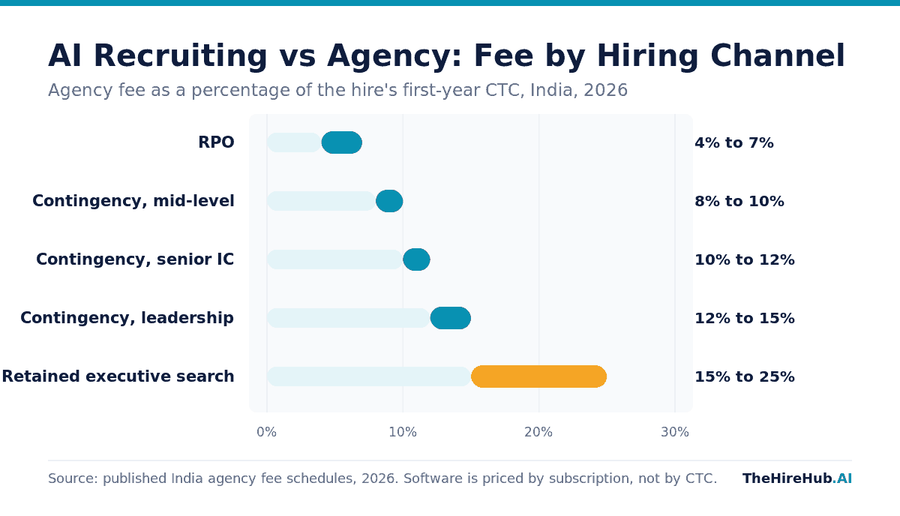
Indian agency pricing is unusually legible because the conventions are stable. The floor is the 8.33% single-month-salary contingency fee, which is what most agencies quote for entry and mid roles. It scales upward with seniority: roughly 8% to 10% for mid-level positions with two to five years of experience, 10% to 12% for senior individual contributors, and 12% to 15% once you are hiring people who manage teams. Retained executive search sits at 15% to 25%. RPO, where you buy recruiter capacity rather than individual placements, prices lowest as a percentage at roughly 4% to 7%, or on a per-recruiter monthly retainer of about ₹80,000 to ₹2,00,000.
Software pricing does not map onto that curve at all. Global list prices for recruiting and AI recruiting platforms run about $15 to $75 per user per month for small teams, $100 to $200 per user per month in the mid-market (roughly $300 to $600 a month for a small multi-user plan), and $200 to $600 per user per month at enterprise tier, with heavily customised deployments going higher. Those are global figures, not India-specific list prices. Buyers also consistently report that implementation, integrations and training add meaningfully on top of the subscription line, so the contract price is not the budget.
On speed, the picture is less flattering to the automation pitch than the marketing suggests. Indian white-collar hiring averages roughly 35 to 45 days from approval to acceptance, with mid-level roles at 28 to 35 days and leadership roles at 48 to 55 days. Employers using recruitment agencies typically fill roles 20% to 35% faster than those running fully in-house without support.
How to read this chart:
- The percentages are of first-year CTC, so the same fee band costs very different absolute money at ₹12 lakh and at ₹1.2 crore.
- Executive search is highlighted because it is the band where the fee is buying access, not throughput, and therefore the band automation does not compress.
- RPO looks cheap per placement but is usually sold with volume commitments, so the effective cost per hire depends entirely on whether you fill the committed pipeline.
How it actually works, and where it breaks
The agency mechanism is simple and its incentive is the important part. A contingency recruiter is paid only on placement, so their rational strategy is to send you plausible candidates fast and move on if you look slow or indecisive. That produces speed, and it also produces the classic failure mode: a shortlist optimised for acceptance probability rather than for fit, because a declined offer pays the recruiter nothing.
The AI mechanism is different. Parsing turns unstructured CVs into comparable fields, matching ranks them against a requirement, and sequencing tools run the outreach. The throughput gain is real and it is largest exactly where a human recruiter is worst: the two hundredth profile of the day. If you have not sanity-checked how your own stack does this, our guide to AI resume screening is the place to start.
It breaks in three specific ways, and none of them announce themselves. The first is silent false negatives: a strong candidate with a non-standard title or a career break gets ranked low and nobody ever sees the rejection, because there is no reviewer for the people who did not make the list. The second is outreach fatigue, where automated sequencing at volume trains a candidate pool to ignore your company's name entirely.
The third is the one that costs money later. Automation makes it cheap to run a very wide funnel, which quietly shifts the bottleneck from sourcing to interviewing. Teams that automate the top of the funnel without adding interview capacity end up with a longer time to hire than they started with, because the queue moved rather than disappeared.
"The agency fee is priced on the candidate's salary and the software fee is priced on your headcount, which is why comparing them per hire flatters whichever one you already prefer."
What this means for your team
The teams that get this right do not run a bake-off. They segment the requisition list first, decide which segment each channel owns, and only then buy anything. A realistic sequence for a company currently spending most of its recruiting budget on contingency fees looks like this.
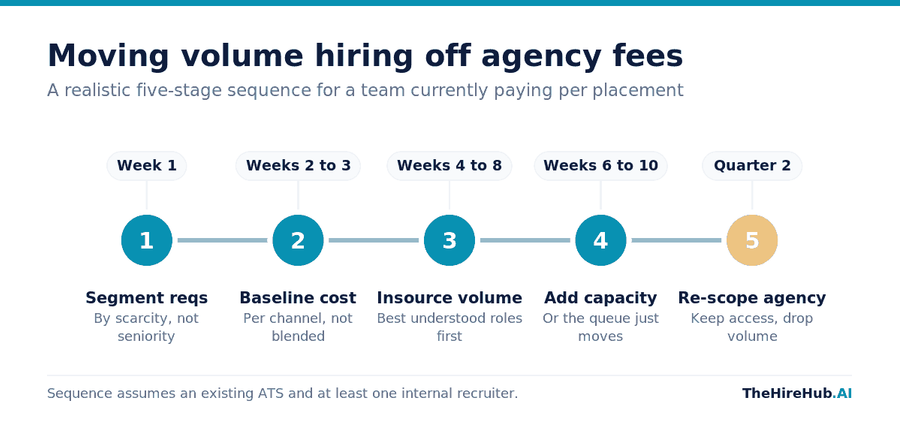
A few practical notes on running that sequence:
- Segment by scarcity, not by seniority. A hard-to-find mid-level specialist can justify an agency fee more easily than an abundant director-level role.
- Keep at least one agency relationship warm even after you insource volume hiring, because the searches you will need them for are the ones you cannot plan.
- Measure cost per hire per segment, not blended. A blended number will always make the cheap channel look like it caused the savings.
- Do not cut agency spend and headcount in the same quarter. Insourcing volume hiring requires coordinator time that the tool does not provide.
AI recruiting vs the agency model
The cleanest way to hold the distinction is that an agency sells you access and accountability, while software sells you capacity. Access matters when the candidate you need is employed, senior, not looking, and reachable only through someone they already trust. Capacity matters when the candidates exist in quantity and the problem is getting through them without losing two weeks.
That is also why the model comparison inside the agency world still matters once you have automated the volume layer. If you are choosing between engagement models rather than between software and humans, retained vs contingency search is the decision that actually changes your outcome, and executive search vs RPO covers the capacity-versus-access split on the services side.
How to actually do this (and the four traps)
- Comparing a subscription to a fee per hire. A ₹40,000 a month tool and a ₹2,00,000 agency fee are not comparable until you fix the denominator. Divide the annual software and internal recruiter cost by the hires that channel actually closed, then compare that to the fee. Most teams that do this honestly find the crossover point sits somewhere between eight and fifteen hires a year per recruiter, not at the first hire.
- Buying automation for a hiring volume you do not have. If you close fewer than roughly two roles a month, the fixed cost of implementing, integrating and learning a platform is unlikely to be recovered inside the contract term. Run the arithmetic before the demo, using our recruitment ROI calculator rather than the vendor's.
- Letting the tool own the rejection. Whatever you automate, keep a human sampling the rejected pile weekly. It is the only cheap way to catch a scoring model that has quietly learned to filter out a whole category of good candidate.
- Treating the agency fee as the total agency cost. The fee is visible; the internal hours spent briefing, chasing and correcting a mismatched shortlist are not. Teams that log those hours usually discover the effective cost of a bad agency relationship is well above the invoice, which is the real argument for insourcing the roles you understand best.
"Insourcing works when you already know what good looks like for a role, and fails precisely when you are hiring your first one of something."
The one thing every hiring leader should take from this
Stop asking which is cheaper and start asking which roles each channel should own. Segment your requisitions by scarcity, give the abundant ones to automation and the scarce ones to a partner with a real network, and hold both to a cost per hire measured inside their own segment. If you want a sanity check on where that line sits for your own plan, or on how your AI candidate sourcing stack is performing against it, TheHireHub does this work daily.
Hiring shouldn't have to feel harder just because the talent market is more competitive.
At TheHireHub.ai, we help hiring teams simplify the process from finding the right candidates to assessing and ranking them, so your team can spend less time managing the hiring process and more time making the right decisions.
If you're looking to make hiring easier, faster, and better, we'd be happy to help.
Frequently Asked Questions
The long-standing convention is 8.33% of first-year CTC, equal to one month's salary, for entry and mid-level roles. Fees scale with seniority to roughly 8% to 10% for mid-level, 10% to 12% for senior individual contributors and 12% to 15% for people-management roles. Retained executive search runs 15% to 25%.
It depends entirely on hiring volume. Software is a fixed subscription, so cost per hire falls as you hire more, while an agency charges a fresh fee for every placement. Below roughly two hires a month, the fixed cost of buying and implementing a platform is usually harder to recover inside the contract term.
Not for every role. Automation replaces throughput work: sourcing at volume, screening, scheduling and first-touch outreach. It does not replace the access an experienced search partner has to senior candidates who are not looking and will only take a call from someone they trust.
Global list prices run about $15 to $75 per user per month for small teams, $100 to $200 per user per month in the mid-market, and $200 to $600 per user per month at enterprise tier. Implementation, integrations and training typically add a significant amount on top of the subscription.
White-collar hiring in India averages roughly 35 to 45 days from approval to acceptance. Mid-level roles land around 28 to 35 days and leadership roles around 48 to 55 days. Teams using agency support typically fill roles 20% to 35% faster than those running entirely in-house.
Keep the roles where scarcity, not throughput, is the constraint: confidential replacements, first-of-a-kind leadership hires, and niche skills where the qualified population is small and largely passive. Give the abundant, well-understood, repeatable roles to automation.
Silent false negatives. A qualified candidate with a non-standard title, an unusual career path or a break gets ranked low and is never seen, because nobody reviews the rejected pile. Sampling rejections weekly is the cheapest control against this.
Only if interview capacity grows with it. Automation widens the top of the funnel, which moves the bottleneck to interviewing and decision making. Teams that add sourcing volume without adding interviewer time often end up with a longer time to hire than before.
Fix the denominator first. Divide the annual software cost plus the internal recruiter cost by the hires that channel actually closed, then compare that figure to the agency fee for the same segment of roles. Compare within a segment, never as a single blended cost per hire.


