High-Volume Hiring Software in 2026: 10 Tools Compared for Bulk and Frontline Hiring
Applications per recruiter have risen fivefold since 2022, so the tool you pick has to screen, schedule and interview without a human in every loop.
Recruiters now handle 746 applications a year, up from 146 in 2022. Ten high-volume hiring tools compared by the funnel stage they fix, from screening to onboarding.

- 1TL;DR
- 2What is actually happening
- 3The numbers
- 4How it actually works, and where it breaks
- 5What this means for your team
- 6The 10 high-volume hiring tools worth shortlisting
- 7High-volume hiring software vs your ATS
- 8How to actually do this (and the four traps)
- 9The one thing every hiring leader should take from this
TL;DR
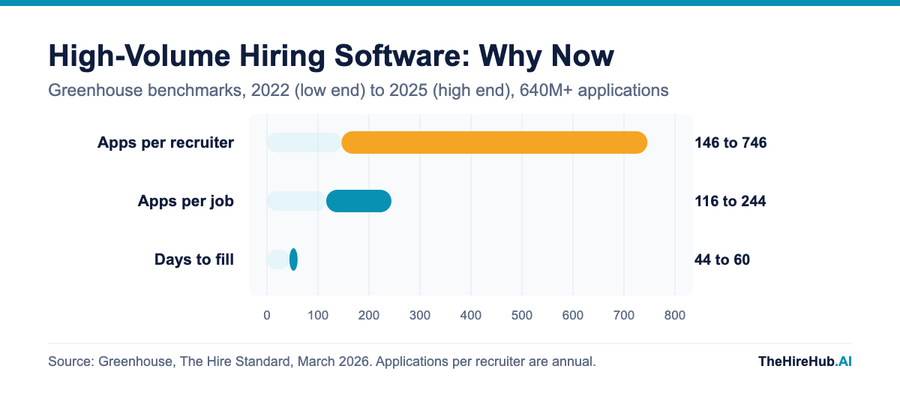
High-volume hiring software exists because the maths of bulk hiring broke. Greenhouse's benchmark of more than 640 million applications shows the average recruiter handled 746 applications in 2025, up from 146 in 2022, while recruiters per organisation fell from 10.43 to 4.62. No team screens that by hand. The ten tools below split into four jobs (conversational screening, assessments, async interviews, and engagement), and the right pick depends on which stage of your funnel is leaking, which our guide to high-volume hiring with AI walks through in detail.
What is actually happening
Volume went up and headcount went down at the same time. In the Greenhouse data, applications per job rose from 116 in 2022 to 244 in 2025. Days to fill rose from 43.64 to 59.67 over the same period. Recruiters are hiring more people each month (4.9 against 2.2), but the pipeline behind each hire is far larger.
Frontline and bulk hiring feel this hardest. In iCIMS's 2025 State of Frontline Hiring survey of 1,000 US hourly workers and 1,000 hiring managers, 60% of workers said they had started an application and not finished it. In hospitality the figure was 68%. And 91% of frontline hiring managers reported urgency in filling roles.
The losses are not only at the application form. The same survey found the biggest drop-off at the interview stage (32%), followed by scheduling (20%), onboarding (18%) and the application itself (14%). That is the core insight for anyone buying software: the leak is usually after the candidate has already said yes once.
The vendor market has consolidated around this problem. Workday completed its acquisition of Paradox on October 1, 2025. Humanly bought three companies in October 2025, and Phenom acquired assessment firm Plum in April 2026. Buyers now choose between broad suites and specialist tools that do one stage very well.
The numbers
Here is the shift in the Greenhouse benchmark from 2022 (low end of each bar) to 2025 (high end). It is the clearest case for why high-volume hiring software has moved from nice to have to necessary.
How to read this:
- Applications per recruiter is the number that matters. A fivefold increase in workload per recruiter cannot be absorbed by working harder. It has to be absorbed by automating the first screen and the scheduling.
- Slower time to fill is a warning, not a verdict. Days to fill rose even as hires per recruiter grew. Teams are processing more, but the extra volume is slowing decisions down.
- This is a knowledge-worker skewed dataset. Greenhouse's customers lean towards salaried roles, so frontline and campus hiring teams usually face even steeper volume. Use it as direction, and check your own ATS.
How it actually works, and where it breaks
Almost every high-volume tool automates the same three moments. It captures the application with as few steps as possible (often by text or a mobile chat), it screens against hard requirements like location, shift, licence or availability, and it books the next step without a recruiter touching the calendar. The better tools then add a structured assessment or an asynchronous interview so a human reviews fewer, better candidates.
The first failure mode is security. In July 2025, researchers found that the admin test account behind McDonald's McHire site, built on Paradox, used "123456" as both username and password, exposing a database of about 64 million applicant records. Paradox said the account had not been used since 2019 and only the researchers accessed it. When a vendor holds millions of candidate records, their access controls become your risk.
The second failure mode is scoring you cannot explain. HireVue dropped facial analysis from its assessments in 2021 after public criticism and a complaint to the US Federal Trade Commission. Any tool that ranks candidates needs an audit trail a regulator, or a rejected candidate, can follow.
The third failure mode is integrity at scale. Async and AI interviews are now targets for proxy candidates and AI-assisted answers, which is why proctoring and identity checks have become their own category. Our guide to AI interview cheating detection covers what works without punishing honest candidates.
"Bulk hiring software is judged by the candidates it keeps, not the applications it collects."
What this means for your team
Map the tool to the leak before you map it to a vendor. The flow below shows the five stages every bulk hire passes through, with the iCIMS drop-off rates where they were measured.
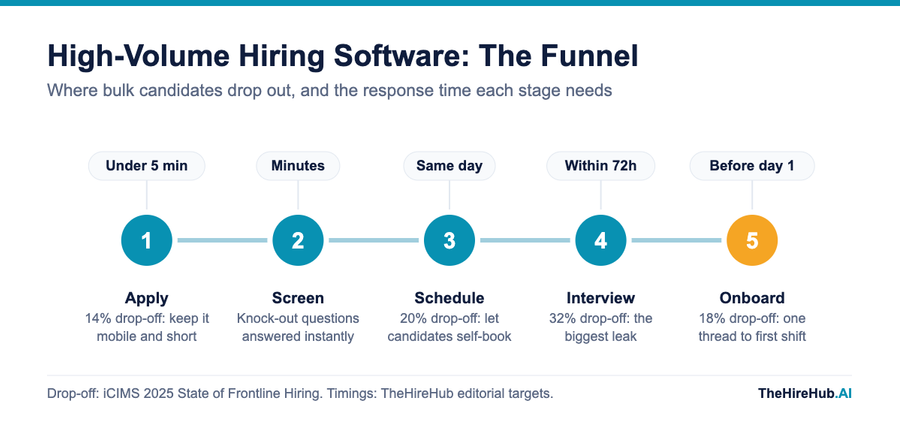
- Apply. Cut the form to what you need to make a first decision. Text-to-apply and mobile chat are the default for hourly roles.
- Screen. Knock-out questions on location, shift and eligibility, answered in minutes rather than days.
- Schedule. Candidates pick a slot themselves. Every day between yes and a booked slot is a day a competitor can call.
- Interview. This is the biggest leak at 32%. Reminders, flexible async options and a short, structured format matter more than clever scoring.
- Onboard. Offer, documents and first-shift details in one thread, so an accepted offer turns into a person who actually arrives.
The 10 high-volume hiring tools worth shortlisting
None of these vendors publishes list pricing on its website, so budget from quotes; our breakdown of AI recruiting software cost explains the pricing models. Customer outcomes below are the vendors' own published claims.
1. Paradox (Workday)
A conversational assistant, Olivia, that screens, schedules and onboards over text and chat. Built for enterprise hourly hiring in food service, retail and franchises. Paradox says Compass Group hires 120,000 workers a year with 20 recruiting staff. Now sold alongside Workday Recruiting; see our Paradox comparison for how it stacks up.
2. HireVue
Async video interviews, game-based and skills assessments, and a voice AI interviewer. Strongest in enterprise campus and hourly programmes, and the company says 40% of the Fortune 100 use it. It publishes a case of Swire Coca-Cola reaching 3.5 days from application to offer.
3. Fountain
A frontline hiring platform with text-to-apply, an applicant tracking system, onboarding and shift tools, plus AI agents for screening and candidate support. Fits delivery, logistics, retail and gig workforces. Fountain reports that LSG Sky Chefs cut time to hire by 80%.
4. Harver
Predictive pre-hire assessments (cognitive, situational judgement, chat simulations, language) with automated prioritisation and scheduling. It absorbed Outmatch, pymetrics and Checkster. Best for contact centres, BPOs and retail, with customers including Teleperformance and Booking.com.
5. Humanly
A conversational AI recruiter that screens and schedules across SMS, email, chat and voice, now with an AI interviewer and talent CRM after acquiring Sprockets, Qualifi and HourWork in 2025. Fits mid-market and enterprise volume in healthcare, restaurants and logistics. It says Mutual of Omaha cut time to screen from five days to five hours.
6. Sense
Engagement and automation for staffing firms: mass SMS and WhatsApp, a screening chatbot, voice AI screening, scheduling and a CRM on top of your ATS. The most agency-native tool on this list. Sense reports Staffmark cut time to match by 30%. Our Sense comparison covers where it fits and where it does not.
7. Talview
AI interviewing and proctoring with identity verification against proxy candidates, positioned as trust infrastructure for high-stakes hiring and testing. It claims more than 20 million secure sessions across 120+ countries. Choose it when integrity is the problem; it is less of a full volume workflow.
8. HirePro
An Indian assessment, proctoring and interview platform with full-service campus drive management, including college relations and logistics. It suits IT services and BFSI campus and mass hiring, including Tier II and III outreach. Axis Bank runs its skills-based college hiring programme on HirePro.
9. Phenom
A talent experience suite whose high-volume module covers a careers-site chatbot with prescreening, scheduling, one-way video, broadcast SMS and assessments. Suits large enterprises that want careers site, CRM and volume hiring in one platform. It added Plum's psychometric assessments in April 2026.
10. iCIMS Text Engagement
Text-to-apply, bulk SMS and WhatsApp messaging, and automated scheduling inside the iCIMS ATS. The natural choice if you already run iCIMS. iCIMS says 75% of The Cheesecake Factory's applications arrive through a text-to-apply campaign.
High-volume hiring software vs your ATS
An applicant tracking system is a system of record. It stores candidates, stages and compliance data, and it is excellent at reporting what happened. It was not built to hold 5,000 simultaneous conversations or to book 400 interviews by Friday.
High-volume hiring software is the layer that does the talking and the sorting. Most of the tools above sit on top of an ATS rather than replacing it, which is why integration depth matters more than feature lists. If you run a staffing firm, start from our guide to the best ATS for staffing agencies and add a volume layer only where the ATS runs out.
How to actually do this (and the four traps)
Pick the one stage where you lose the most candidates, and run a 30-day pilot on a single high-volume role. Measure completion rate, time from apply to booked interview, and interview show rate before and after. Then watch four traps.
- Buying for the demo, not the leak. A slick chatbot will not fix a 32% interview drop-off. Choose the tool that attacks the stage your data says is failing.
- Ignoring the vendor's security posture. Ask for SOC 2 or ISO 27001 evidence, admin access controls and data retention terms before you load millions of candidate records.
- Scoring nobody can explain. If the tool ranks or rejects people, insist on documented criteria, human review of edge cases and bias audits, especially where regulation requires it.
- Automating the funnel but not the follow-up. Candidates who hear nothing after an interview drop out or accept elsewhere. Automated status updates and reminders are the cheapest retention you will buy.
"The best high-volume stack is the one that answers a candidate within minutes, at every stage, without waiting for a recruiter to wake up."
The one thing every hiring leader should take from this
Bulk hiring is now a throughput problem, and throughput problems are solved by removing waiting time, not by adding recruiters. Pick the stage that leaks, fix it with the narrowest tool that works, and measure show rates rather than application counts. If you want AI that sources, screens, interviews and schedules in one flow, with humans kept in the loop for the decisions, that is what TheHireHub was built for, and we look at this stuff all day.
Frequently Asked Questions
High-volume hiring software automates the repetitive stages of bulk hiring: capturing applications, screening against basic requirements, scheduling interviews, running assessments or async interviews, and keeping candidates informed. It usually sits on top of an applicant tracking system.
There is no fixed threshold, but it usually means filling many similar roles at once or continuously, such as hourly retail, contact centre, logistics, healthcare support or campus hiring, where each opening attracts hundreds of applicants.
An ATS records candidates, stages and compliance data. High-volume tools handle the conversations, screening and scheduling at scale, then write the results back to the ATS.
Staffing firms usually need strong mass messaging, redeployment of existing candidates and ATS integration. Sense is built specifically for staffing, while conversational screening tools such as Humanly or Paradox suit agencies with large hourly desks.
HirePro offers end-to-end campus drive management with assessments and proctoring, and HireVue and Talview are also used for campus assessment and interviewing. Check proctoring, language support and college outreach coverage.
None of the ten vendors listed publishes list pricing on its website. Pricing is typically quoted per hire, per location, per employee or as an annual platform fee, so request quotes built on your expected hiring volume.
In iCIMS's 2025 frontline survey, the largest drop-off was at the interview stage (32%), followed by scheduling (20%), onboarding (18%) and the application (14%).
It is legal in most markets but increasingly regulated. Rules such as New York City's Local Law 144 and the EU AI Act require bias audits, transparency or human oversight for automated hiring decisions, so check obligations in each market you hire in.
It depends on ATS integration and scope. A single-stage tool such as text-to-apply or self-scheduling can often run a pilot within weeks, while suite-wide rollouts across locations take longer.
Track application completion rate, time from application to booked interview, interview show rate, offer acceptance, first-day attendance and recruiter hours per hire, compared against a baseline taken before launch.

