AI Interview Cheating Detection in 2026: What Works, and What Just Punishes Non-Native Speakers
Recruiters now flag AI use in roughly a third of interviews, but the detectors doing the flagging are wrong often enough to cost you good hires.
Recruiters see AI use in 35% of interviews and Gartner expects 1 in 4 profiles to be fake by 2028, but detectors falsely flag non-native English writers 61% of the time.

TL;DR
AI interview cheating detection has become standard equipment in hiring, and it is failing in both directions at once. Recruiters report seeing candidates use AI during interviews in 35% of cases, according to Greenhouse's 2026 candidate AI interview research, while Gartner projects that 1 in 4 candidate profiles worldwide could be fake by 2028. The tools sold to catch this are unreliable in a way that matters enormously for Indian hiring: Stanford researchers found that seven leading AI text detectors misclassified non-native English writing as machine generated 61% of the time. The practical answer is not a better detector. It is an interview your candidate cannot outsource in the first place. If your concern is synthetic identity rather than live assistance, start with our guide to deepfake candidates.
What is actually happening
The honest version of this story is that two separate problems got collapsed into one word, and the collapse is causing bad decisions. The first problem is assistance: a real candidate, applying for a real job, running a second screen with an LLM feeding them answers. The second problem is impersonation: the person on the call is not the person who will do the job, or does not exist at all. These need completely different responses, and most teams have bought one tool and pointed it at both.
The assistance problem is now genuinely mainstream. Greenhouse's 2026 research found 91% of recruiters and hiring managers have spotted or suspected candidate deception, with AI-generated resume exaggeration the most commonly observed form at 63%, fake references at 48%, and live AI use during interviews at 35%. That last number is the one people mean when they say "cheating," and it describes ordinary candidates, not criminals. In the same research, 74% of recruiters said they are more worried about fake credentials than they were a year ago.
The impersonation problem is smaller but far more serious. In a Gartner survey of 3,000 job candidates, 6% admitted to participating in interview fraud, either by posing as someone else or having someone else pose as them. Gartner's senior research director in the HR practice, Jamie Kohn, put the stakes plainly: candidate fraud creates cybersecurity risks that can be far more serious than making a bad hire. A bad hire costs you a quarter of salary and some goodwill. A planted identity inside your systems costs you something you cannot easily price.
Here is the part almost nobody puts in the vendor deck. Candidates are not the only ones using AI, and they know it. Greenhouse found 63% of job seekers have now been interviewed by an AI, up 13 percentage points in six months, and that 70% were never clearly told upfront that AI would be evaluating them. One in five only found out once the interview had started.
That asymmetry is doing real damage to the thing detection is supposed to protect. Gartner found only 26% of applicants trust AI to fairly evaluate them, and only half of candidates believed the jobs they were applying for were even legitimate. When a candidate assumes an unaccountable model is screening them, and assumes the posting might be fake, using AI to answer stops feeling like cheating and starts feeling like matching the house rules. Four in ten candidates told Gartner they already use AI during the application process.
The numbers
The quantitative core of this is not one number, it is a spread, and the spread is the finding. What recruiters observe, what candidates admit, and what software flags are three different measurements of three different things, and they are routinely quoted as if they were the same. Below is what hiring teams actually report seeing, from the Greenhouse 2026 dataset, which is the cleanest single source on observed behaviour.
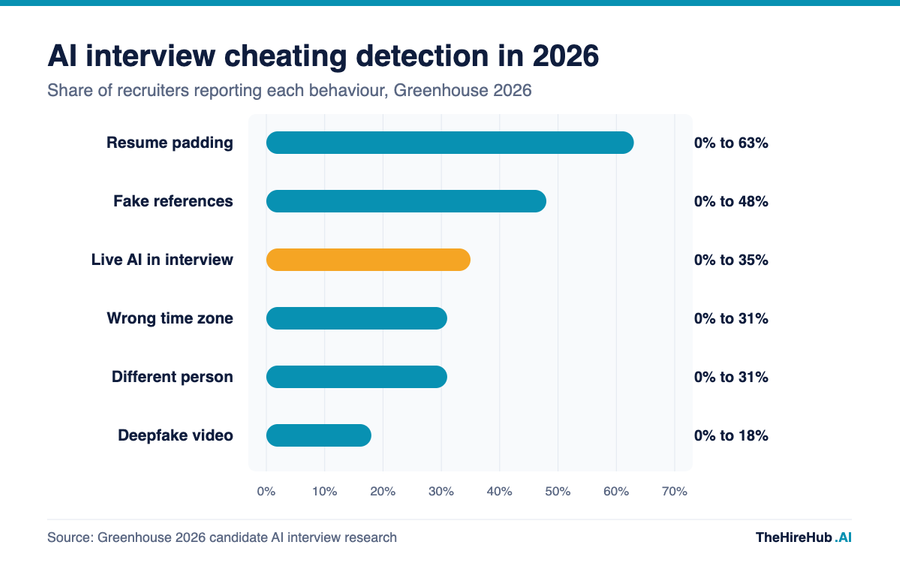
How to read this:
- These are recruiter-observed rates, not confession rates. Self-reported figures run far lower, with Gartner's 3,000-candidate survey putting admitted interview fraud at 6% against the 31% of recruiters who report seeing a different person interviewed than the one who applied.
- Resume exaggeration at 63% is not an interview problem and no interview tool will fix it. It is a verification problem that belongs earlier, in how you check claims before anyone books a call.
- Deepfake video at 18% is the lowest bar on the chart and absorbs the most attention. Spend proportionally: the 35% live-assistance case is twice as common and much cheaper to design around.
How it actually works, and where it breaks
Detection tools work on signal, not proof. Text detectors score perplexity and burstiness, essentially asking whether writing is statistically too smooth to be human. Video and audio tools watch for gaze drift, unnatural pause structure before answers, keystroke patterns, and lip-sync artefacts. None of these observe cheating. They observe correlates of cheating, and then a threshold turns a correlate into an accusation.
The first failure mode is the one that should stop an Indian hiring team cold. In research published in the Cell Press journal Patterns, Weixin Liang and colleagues at Stanford ran seven widely used GPT detectors against 91 human-written TOEFL essays and 88 essays by US eighth graders. The detectors were near-perfect on the American students. On the non-native English writers they produced an average false positive rate of 61.22%, and 97.8% of those TOEFL essays were flagged as AI-generated by at least one detector.
The mechanism matters, because it means this is not a bug awaiting a patch. Essays that were unanimously misclassified had significantly lower perplexity, meaning the detectors were penalising writers with a narrower range of linguistic expression. Fluency in a second language reads, statistically, like a machine. When the researchers used an LLM to enrich the essays' vocabulary, the false positive rate fell from 61.3% to 11.6%, which tells you the tool was measuring vocabulary range and calling it authorship.
The second failure mode is that detection creates an arms race you lose on economics. Adding a detector raises the cost of casual cheating slightly and the cost of determined cheating not at all, because the countermeasures are free and widely shared. Meanwhile every false flag costs you a real candidate, and you never learn which ones you lost. The people your detector rejects do not appear in any report you read.
The third failure mode is procedural. A detector score is a probability, and probabilities do not survive contact with a hiring committee that wants a yes or a no. Once a number is on a scorecard, it gets treated as a finding, which is exactly how a 61% false positive rate turns into a rejection letter.
"A detector does not catch a liar, it catches an unusual sentence, and an unusual sentence is what a second language sounds like."
What this means for your team
The teams handling this well have stopped trying to detect and started trying to make cheating pointless. That is a process change, not a purchase, and it runs in a defined sequence. Each stage below is cheap on its own, and the order matters more than the individual steps.
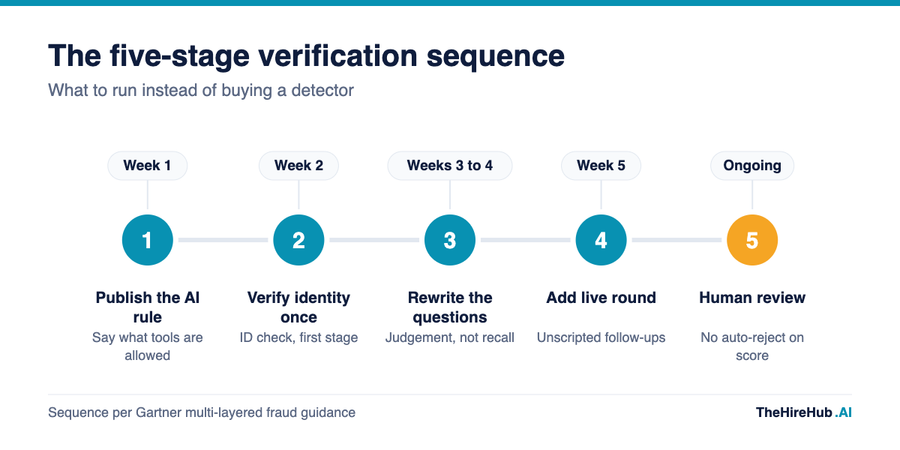
A few notes on running this in practice:
- Stage 1 is the highest-leverage and the one most teams skip. Telling candidates what AI use is acceptable, in the interview invitation itself, removes the ambiguity that produces most of the 35%.
- Stage 2 should happen exactly once, at the first live stage, and should be a real identity check rather than a behavioural guess. Identity is verifiable; intent is not.
- Stage 5 is the guardrail that makes the rest safe. If a flag can trigger a rejection without a named human reviewing the full context, you have built an automated decision system and inherited every obligation that comes with it, which our AI hiring compliance guide covers in detail.
Reordering these is where teams go wrong. Buying detection software before rewriting questions means paying a subscription to measure a problem your interview design is still creating.
Detection versus redesign: which one actually holds
The nearest neighbour to AI interview cheating detection is interview redesign, and they are not equivalent options at different price points. Detection is a filter bolted onto an unchanged process, and it inherits that process's weaknesses while adding a false positive rate on top. Redesign changes what the interview asks for, so that an LLM in a second window stops being an advantage.
Concretely, redesign means asking for judgement rather than recall. A candidate can have a model produce a textbook answer on system design tradeoffs; they cannot have it defend a decision they made on a specific project last quarter under three unscripted follow-up questions. Work samples reviewed live, with the candidate walking through choices they made and roads they did not take, are close to unfakeable in real time. This is the same shift that makes AI interview scoring more defensible: score the reasoning, not the phrasing.
Detection still has one legitimate job, and it is narrow. For identity fraud, where the question is whether this human is that human, verification is the right tool and there is no redesign substitute. Gartner's own recommendation is a multi-layered strategy: clear expectations about acceptable AI use, communicated fraud detection, assessments including in-person interviews, then system-level validation such as tighter background checks and identity verification. Note the order there too. The cheap communication step comes first.
There is a demand-side argument for redesign as well. Gartner found 62% of candidates said they were more likely to apply to a position if it required in-person interviews, which suggests the market has already priced in how easy remote processes are to game. Structured, human, in-person stages are not just harder to cheat; candidates appear to prefer them.
How to actually do this (and the four traps)
- Do not auto-reject on a detector score. This is the trap that produces measurable, invisible damage. Given the Stanford finding of a 61% false positive rate on non-native English writing, any automated rejection threshold applied to an Indian or global candidate pool is systematically discarding qualified people. Route every flag to a named human, and require corroborating evidence before the flag changes an outcome.
- Do not treat resume AI and interview AI as the same offence. Resume exaggeration shows up in 63% of recruiter observations, but a polished, AI-assisted resume is now the norm rather than a signal, and screening it out mostly filters for people who did not get the memo. Verify claims, do not penalise phrasing, which is the same principle behind good resume screening with AI.
- Do not run detection silently. Undisclosed monitoring is where the trust cost compounds, and Greenhouse found 70% of candidates were never told upfront that AI would evaluate them. Announcing that you check, and what you check for, deters casual cheating at zero cost and protects you when a candidate challenges a decision.
- Do not measure the wrong outcome. Flag rate is not a success metric; it measures your tool's sensitivity, not your hiring quality. Track whether the people you hired after this change perform better six months in, which is the discipline set out in our quality of hire measurement guide.
"If your interview can be passed by a model that has never met your customers, the problem was never the candidate."
The one thing every hiring leader should take from this
Detection is a tax you pay on a process you have not fixed. Every rupee spent on catching AI use in an interview that could be redesigned to make AI use irrelevant is a rupee spent on the symptom, and it comes with a false positive rate that lands hardest on exactly the candidates an Indian hiring team most needs to evaluate fairly. Verify identity once, properly, because that is the risk that actually threatens the business. Then spend the rest of the effort on questions that only someone who has done the work can answer. At TheHireHub we build for that second problem rather than the first.
Sources
- Greenhouse, The 2026 AI in Hiring Report
- Greenhouse, 2026 Candidate AI Interview Report
- Gartner, Just 26% of Job Applicants Trust AI Will Fairly Evaluate Them (2Q25 survey of 3,000 candidates)
- Stanford HAI, AI Detectors Are Biased Against Non-Native English Writers
Hiring shouldn't have to feel harder just because the talent market is more competitive.
At TheHireHub.ai, we help hiring teams simplify the process from finding the right candidates to assessing and ranking them, so your team can spend less time managing the hiring process and more time making the right decisions.
If you're looking to make hiring easier, faster, and better, we'd be happy to help.
Frequently Asked Questions
It is software that looks for signals that a candidate is being assisted by AI during an interview, such as gaze patterns, pause structure before answers, keystroke behaviour, or statistical smoothness in written responses. It detects correlates of assistance rather than assistance itself, which is why outputs are probabilities rather than proof.
Greenhouse's 2026 research found recruiters observed candidates using AI during interviews in 35% of cases, and 91% of recruiters and hiring managers have spotted or suspected some form of candidate deception. Self-reported rates are much lower, with a Gartner survey of 3,000 candidates finding 6% admitted to interview fraud specifically.
No, not on their own. Stanford research published in Patterns found seven leading GPT detectors produced an average 61.22% false positive rate on non-native English writing, against near-perfect accuracy on US student essays. Any rejection based solely on a detector score will discard qualified candidates at a high rate.
Because they score linguistic predictability. The Stanford study found misclassified essays had significantly lower perplexity, meaning detectors penalise writers with a narrower range of expression. When researchers enriched the vocabulary of the same essays, false positives fell from 61.3% to 11.6%, confirming the tools were measuring vocabulary range rather than authorship.
It depends entirely on whether you said so in advance. Most candidates are operating without a stated rule, and Gartner found four in ten already use AI during the application process. Defining acceptable use in the interview invitation converts an ambiguous judgement call into a clear one.
Assistance means a real candidate is getting help answering questions; impersonation means the person on the call is not the person who applied. Assistance is a process design problem best solved by better questions. Impersonation is a security problem that requires identity verification and cannot be redesigned away.
Gartner projects that by 2028, 1 in 4 candidate profiles worldwide could be fake, driven by AI-generated resumes, synthetic identities, and deepfake interviews. Greenhouse's 2026 data found 31% of recruiters had observed a different person being interviewed than the one who applied.
For final stages, there is a case for it on two grounds. Gartner recommends in-person assessment as part of a multi-layered fraud strategy, and separately found 62% of candidates said they were more likely to apply to a position that required in-person interviews.
Flag rate measures your tool's sensitivity, not your hiring outcomes. Track six-month performance and retention of hires made after any process change, alongside pass-through rates by candidate segment so you can see whether detection is filtering disproportionately by language background.
Disclosure is both the cheapest deterrent available and increasingly a compliance requirement, depending on jurisdiction. Greenhouse found 70% of candidates were never told upfront that AI would evaluate them, and undisclosed automated decisioning carries obligations under frameworks such as NYC Local Law 144 and the EU AI Act.


