
Naukri vs LinkedIn Recruiter for 2027: What Each Costs and Reaches in India
Public prices, cost per contact and a 30-day test to run before your 2027 budget is locked, checked November 2026.
Naukri and LinkedIn Recruiter are priced in different units, so seat price misleads. Here are checked public prices in ₹, cost per contact, and a 30-day test for 2027.

TL;DR
Naukri vs LinkedIn Recruiter is not a like-for-like price comparison, and a 2027 plan that treats it as one will misallocate budget. As of November 2026, Naukri publishes small-business packages from ₹3,500 for 60 CV views and keeps its Resdex database price on a sales quote. LinkedIn Recruiter Lite lists at about $140 to $170 a month, and Corporate seats list at $8,000 to $12,000 a year, which is roughly ₹7.5 to ₹11.3 lakh at ₹94 to the dollar. Naukri sells access to people who uploaded a CV to look for work, while LinkedIn sells reach into a very large profile base, so the right question is cost per reply, not cost per seat. Pair this with your recruitment budget planning sheet before the 2027 numbers are locked.
What is actually happening
Naukri is not getting cheaper to ignore. Info Edge reported recruitment solutions billings of ₹613.8 crore for the second quarter of FY27, up 12.6% on a year earlier (Staffing Industry Analysts, 9 October 2026). In late October it also said its AI and data products had reached an annualised run rate of about ₹240 crore, a high-single-digit share of recruitment revenue. Employers are still paying, and the vendor is adding AI features to the same subscription relationship.
LinkedIn's scale in India is also still growing. NewsBytes, citing LinkedIn in February 2026, put India membership at about 167 million, up roughly 20% in a year. A member count is not a reachable-candidate count, though. Many of those profiles belong to people who will never reply to a recruiter, and reach thins quickly outside the large metros and outside white-collar roles.
The two products are built for different candidate states. Naukri's Resdex is a resume database fed by people who are actively applying, and you spend credits to view or contact them. LinkedIn Recruiter is a search layer over a professional network, where many profiles belong to passive candidates, and you spend InMail credits to reach people outside your network.
Pricing is opaque on both sides. Naukri's own page says Resdex pricing is "custom, based on plan" and points buyers to sales. LinkedIn Corporate is quote-based as well. So every figure in this post is a public list price or a reported market figure, and your negotiated price will differ.
One more thing to plan for is renewal. A Cutshort author reports that Resdex renewal increases of about 15% a year were most common among the talent leaders surveyed, with 10% to 15% on larger LinkedIn deals. The survey sample and method are not published, so treat that as a direction to stress-test, not a forecast.
The numbers
Start with what each product asks you to pay, then convert it into something you can compare. The chart below puts everything on one scale: ₹ thousand per seat per year, using the public prices available in November 2026.
What does a contact actually cost on each platform?
On public list prices, a Naukri CV view costs about ₹40 to ₹58, and a LinkedIn InMail credit costs about ₹420 to ₹630. These units are not equal: a CV view lets you see a profile, an InMail credit buys one outreach message. Neither is a reply, and replies are what you are really buying.
The arithmetic: Naukri's public packs run from ₹3,500 for 60 CV views to ₹6,000 for 150, which is ₹58 down to ₹40 a view. Recruiter Lite at $140 to $170 a month with 30 InMails a month is about ₹440 to ₹530 a credit. Corporate at $8,000 to $12,000 a year with 150 InMails a month (1,800 a year) is about ₹420 to ₹630 a credit before any negotiated discount.
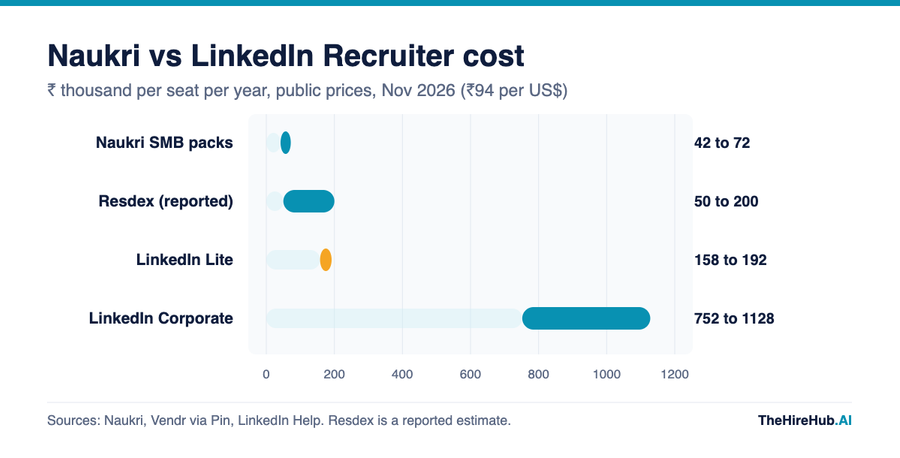
How to read this chart:
- The Naukri bar is an annualised figure: I multiplied the 30-day pack prices of ₹3,500 and ₹6,000 by twelve to show what monthly purchasing would cost. Nobody has to buy that way.
- The Resdex bar is a reported estimate for small and mid-sized employers, not a Naukri list price, because Naukri does not publish one.
- The LinkedIn bars are US list prices converted at about ₹94 to the dollar, before GST and before the 15% to 30% discount Vendr says buyers often negotiate.
Sources and method
Naukri figures come from its public small-business packages page, read on 16 November 2026, with GST extra. LinkedIn Lite pricing and InMail allotments come from LinkedIn Help pages as cited in Pin's pricing guide (updated October 2026), and the Corporate list range comes from Vendr buyer data cited there. The Resdex range is from a Cutshort pricing post that calls it an estimate. The exchange rate is the rupee's early-November 2026 level of roughly ₹94, and the chart covers list prices only: not taxes, implementation, or agency fees.
How it actually works, and where it breaks
On Naukri, credits are consumed by actions. Naukri's page says one view is deducted for each profile viewed, contacted, or downloaded, which means browsing burns the same credit as contacting. A recruiter who opens fifty profiles to find five good ones has paid for fifty. That is why per-view prices look cheap and per-conversation costs often are not.
On LinkedIn, the constraint is the monthly InMail allotment: about 30 on Lite and 150 on Corporate according to the sources above. A weak message wastes a scarce credit, so message quality matters more than search breadth. LinkedIn's own analysis of recruiter InMails (reported by SHRM, data from April 2020 to February 2021) found that messages of 400 characters or fewer performed 41% better than the longest ones, and individually written messages did about 20% better than bulk sends. That is global and dated, not India-specific.
The failure mode on both is the same: nobody measures replies by source. Without a source field on every candidate record, a renewal conversation becomes a debate about reputation. If you also run an ATS, the recruitment funnel conversion rates benchmarks show which stage to measure first.
Claims check
Competing vendors publish India price and reach figures for both platforms, often without dates. Here is how three of them compare with the sources above. This is not a judgement on those companies, only a note on what each page shows.
- Seat price with no date or source. UnoJobs, which sells a rival database, lists LinkedIn Lite at "~₹40K/seat/month" on its Resdex vs LinkedIn Recruiter page. The LinkedIn Help figures cited by Pin imply about ₹13,000 to ₹16,000 a month at current exchange rates, and no source or date is published on the UnoJobs page.
- Reach with no definition. The same page says Resdex has "90M+ India active jobseekers". It publishes no source, and does not say how "active" is defined, so it cannot be turned into a cost per reachable candidate.
- Estimates presented as ranges. Cutshort's pricing post gives Resdex at ₹50,000 to ₹2,00,000 a year for small and mid-sized employers, and labels it an estimate that varies widely. That is honest, but it means the figure is a conversation starter, not a budget line.
Ask any vendor, including these, for three things: the date of the figure, the source, and the unit (per seat, per contact, per month or per year).
"A price list tells you what access costs; only your own reply data tells you what access is worth."
What this means for your team
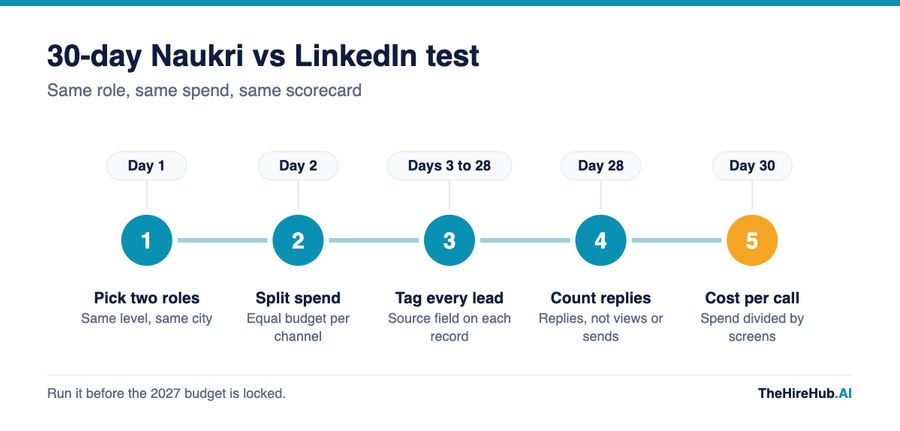
The practical sequence is a 30-day head-to-head test, run before you commit to a 2027 renewal. The point is to get your own reply and screening data, because neither company publishes India reply rates that you can verify, and the global InMail data above is relative, not absolute.
Pick two roles of similar seniority in the same city, split the spend evenly across the two platforms, tag every lead with its source, and count only replies that turn into a recruiter call. Divide spend by calls. That number, not seat price, is what you carry into the budget.
Here is a worked example with a made-up role. Say you hire a product manager at ₹18 lakh CTC. Standard contingency agency fees are reported at 8.33% of annual CTC, which is about ₹1.5 lakh for that hire (the Cutshort post is the source for the 8.33% figure). A year of Recruiter Lite at about ₹1.58 lakh costs roughly one such fee. Six top-tier Naukri packs at ₹6,000 each cost ₹36,000.
The gap between the two, about ₹1.22 lakh, is the price of keeping LinkedIn for a year. It is justified if LinkedIn produces at least one hire Naukri would not have, and unjustified if your roles are high-volume and the candidates are already on Naukri. Only the test tells you which.
Which roles should you expect to favour each platform?
Treat this as a hypothesis for the test, not a finding. High-volume, early-career and operations roles tend to suit a resume database, because candidates are already actively applying and you are paying to find them quickly. Senior, niche or passive-candidate searches tend to suit LinkedIn, because the people you want may never upload a CV anywhere. Your own split by role family is what the 30-day test should produce, and it will probably differ by city.
Naukri vs LinkedIn Recruiter vs the alternative
The nearest neighbour is AI-assisted sourcing that searches across many sources and drafts outreach for you. It does not replace either database so much as sit on top of them, and the trade-off is that you pay for software and sources rather than for access alone. Our comparison of LinkedIn Recruiter vs AI sourcing covers where that trade-off falls.
For total budget, the ai recruiting software cost guide sets out what a software-led stack costs by company size. If you are shortlisting vendors for either route, use the ai recruiting vendor checklist to separate verified claims from marketing.
How to actually do this (and the four traps)
Run the 30-day test, then decide by cost per recruiter call and cost per hire. These four traps are where teams usually go wrong:
- Comparing a view to a message. A CV view and an InMail credit are different units. Convert both to cost per reply before you compare anything.
- Annualising a pack price. Naukri's small-business packs are 30 to 60 day products. Multiplying by twelve shows an upper bound, not what you will pay on a negotiated contract.
- Ignoring renewal uplift. Reported renewal increases of 10% to 15% a year mean a 2027 budget built on 2026 list prices is already short.
- Skipping the source field. If your ATS or spreadsheet cannot say which channel a hire came from, you cannot renegotiate with evidence next year.
"Buy neither platform on reputation: run both on the same role for a month, then keep the one that books interviews."
The one thing every hiring leader should take from this
If you are finalising your 2027 plan this month, do not choose between Naukri and LinkedIn Recruiter on reputation, and do not accept a vendor's blog post as a price list. Write down the test, spend a small, equal amount on each, and let your own reply data decide how the real budget is split. Both products will still be there in January, and a renewal with evidence behind it is worth more than a discount offered without any. If you want a second pair of eyes on the channel mix, TheHireHub can help: we look at this stuff all day.
Frequently Asked Questions
Naukri does not publish a standard Resdex price. Its own page says pricing is custom and based on the plan, so you need a sales quote. Naukri does publish small-business packs, from ₹3,500 for 60 CV views to ₹6,000 for 150, plus GST, checked November 2026.
LinkedIn does not publish an India price list for the full product. Recruiter Lite is listed at about $140 to $170 a month, roughly ₹13,000 to ₹16,000 at ₹94 to the dollar, and Corporate seats list at $8,000 to $12,000 a year, before negotiated discounts.
It depends on the role mix. LinkedIn tends to help with senior, niche or passive-candidate searches, but the only reliable answer is your own reply and call data. Run a 30-day test against Naukri on a comparable role and compare cost per recruiter call.
Neither vendor has published 2027 prices as of November 2026. A Cutshort survey of talent leaders, with no published sample size, reports renewal increases of about 15% a year on Resdex and 10% to 15% on larger LinkedIn deals. Budget on current list prices with a renewal uplift scenario.
Both vendors are adding AI features. Info Edge said in October 2026 that its AI and data products reached an annualised run rate of about ₹240 crore. Expect more bundled AI search, so ask whether new features change your credits or only your price.
A CV view is a credit deducted when you view, contact or download a candidate profile through Resdex or a Naukri package. Naukri's page says one view is deducted for each profile viewed, contacted, or downloaded, so browsing burns credits as well as contacting.
Recruiter Lite includes about 30 InMails a month, and Corporate includes about 150 a month, according to LinkedIn Help pages as cited by Pin in October 2026. Allotments can change, so confirm them in your quote before budgeting.
There is no verified public India response rate for either platform. LinkedIn's global analysis, with data to early 2021, only reports relative effects: shorter, individually written messages did better. Measure your own reply rate by source.
Partly. Naukri offers one free job posting a month to verified company accounts, with limits on description length, location and applies. Free posting brings applicants to you, but it does not give you database search or outreach credits.

