LinkedIn Recruiter vs AI Sourcing: Cost, Quality and When to Use Each in 2026
What each tool does better, what each costs, and how to run a two week pilot before you sign a seat contract.
LinkedIn Recruiter or AI sourcing? Compare seat costs, search quality and outreach, see when each wins, and run a two week pilot to choose for your open roles.

TL;DR
LinkedIn Recruiter is the better tool when your hires sit inside LinkedIn's network and you want its profile data, InMail and seat controls. AI sourcing tools are the better tool when you need to search beyond one network, rank people by skills and run multi-channel outreach at a lower seat price. Most teams hiring regularly end up running both, so the real question is which one gets the first search. Our guide to AI sourcing vs manual sourcing shows where that line falls.
Not sure which mix fits your open roles? Book a 20-minute sourcing review and we will walk through it with you.
What is actually happening
Two things changed in the last two years. LinkedIn added AI features, including its Hiring Assistant, to a product that is still built around its own member database and a recruiter running the searches. At the same time, a new class of AI-native sourcing platforms started searching across several data sources and ranking candidates by meaning rather than by keyword filters.
That is why buyers now search for LinkedIn Recruiter vs AI sourcing tools. They are no longer asking whether to use LinkedIn. They are asking what to put next to it, and what that second tool should cost.
Pricing is the first friction. LinkedIn does not publish Recruiter seat prices. Comparison articles checked in September and October 2026 quote a Corporate seat at roughly $750 to $900 a month, and report that Hiring Assistant is sold only as an add-on to an existing LinkedIn Talent Solutions contract, with no public price. Treat every one of these as a buyer-reported estimate and get a written quote before you plan a budget.
AI sourcing vendors tend to publish more. SeekOut lists its Recruit Core plan at $149 a seat a month on an annual plan, and other tools in the category are reported between about $99 and $300 a seat. The gap is large, but a cheaper seat only helps if the candidates it surfaces are the right ones.
LinkedIn still has real strengths, and even the AI sourcing vendors' own comparison articles concede them. It holds the largest professional member base most recruiters can search, profiles tend to stay current because careers depend on them, and shared connections make referral-style outreach warmer. For leadership, finance and other LinkedIn-heavy segments, it is hard to replace.
Evidence on quality is thin and mostly vendor-run. A 2025 academic preprint compared LinkedIn Recruiter with three AI-native search tools using 1,735 results from 48 queries, judged by human recruiters and an LLM judge. The AI-native tools were preferred over LinkedIn Recruiter in every setting. The authors work for one of the tools tested and say so, and the study measured precision rather than recall, so read it as a signal and not a verdict.
The numbers
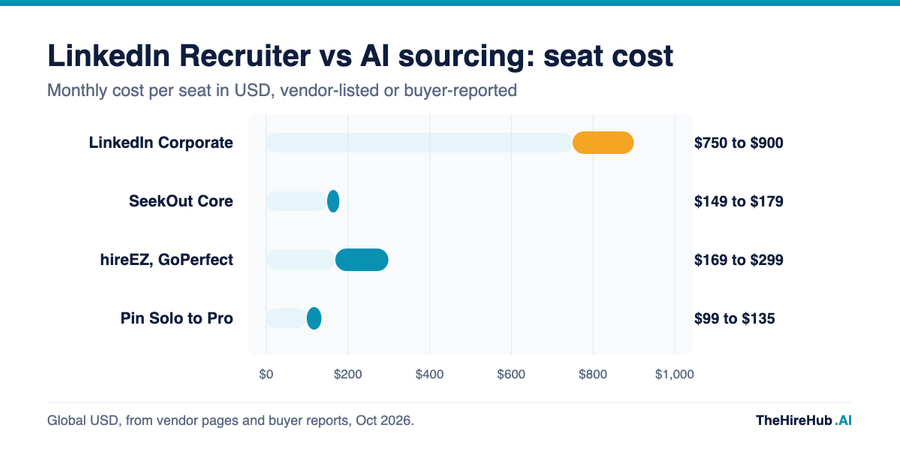
Chart 1 shows what a single seat costs per month, in US dollars. These are global figures from vendor pricing pages and buyer reports, not India-specific pricing, and they exclude credits, add-ons and annual minimums.
How to read this:
- LinkedIn's bar is the spread between two buyer-reported figures, about $750 and $900 a month. It is not a price list, so ask for a quote.
- The AI sourcing bars are vendor-listed or buyer-reported prices per seat. Check what is included before comparing them with each other.
- Seat cost is not cost per hire. One vendor claims a search takes 3 to 5 hours on LinkedIn and 20 to 40 minutes on its own platform, but those are that vendor's own estimates, so time your team's next search before you believe either number.
How it actually works, and where it breaks
LinkedIn Recruiter works as a filtered search over LinkedIn members. You set title, company, skills and location, review profiles, and reach out mostly through InMail, which is limited by credits. Its AI features speed up that process, but the core is still a person steering a database.
AI sourcing tools work from a plain-language brief. You describe the role, the system searches across several sources, ranks profiles by how well they match the skills and context, and can run outreach sequences across email and other channels. The recruiter reviews a ranked shortlist instead of building one.
LinkedIn's Hiring Assistant sits between the two. On the evidence of the comparison articles, it adds agent-style help inside LinkedIn's own ecosystem, which means it works from LinkedIn's data. That makes it a faster way to search one network, not a way to search past it.
Each approach breaks in a predictable way. Filter-based search misses strong people whose titles do not match your keywords, so a good candidate with an unusual job title never appears. Aggregated data in AI tools can be stale or incomplete, which shows up as bounced emails and outdated roles, so sample a shortlist and check it by hand.
Outreach is the third failure. Automated sequences make it easy to send far more messages than you can follow up on well, and generic volume lowers reply rates and can hurt your sending reputation. The fourth is accountability: a ranked list is not an assessment, and someone on your team still has to decide who is a fit.
"A sourcing tool decides who you see first, so its ranking logic is a hiring decision whether or not anyone reviewed it."
What this means for your team
The cleanest way to settle the question for your roles is a short pilot. Pick one live role that is hard to fill, brief both tools the same way, and let the hiring manager score the two shortlists without knowing which tool produced which.
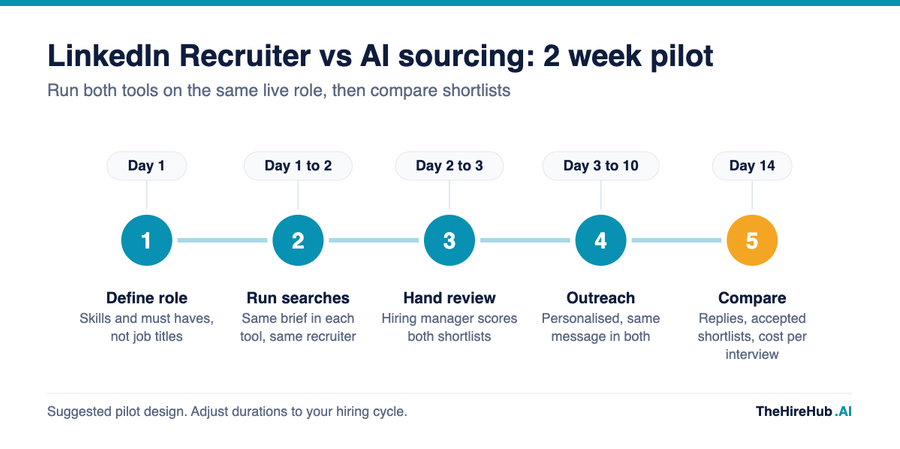
Keep the pilot honest by holding everything else constant. Use the same recruiter, the same outreach message and the same follow-up schedule in both tools, otherwise you are testing your own effort and not the software.
At the end, compare three things: reply rate from relevant candidates, how many shortlisted people the hiring manager accepted, and cost per interview scheduled. If one tool wins on all three, that is your first search. If they split, you have found how to divide the work between them.
When LinkedIn Recruiter should lead
- Your hiring is mostly referral-driven, so shared connections and warm introductions do real work.
- Your target talent is concentrated on LinkedIn, which is common for leadership and finance roles.
- You already hold large saved pools and shared project pipelines that your team uses every week.
- You need the seat controls, permissions and reporting your organisation already approved.
When AI sourcing should take the first search
- Keyword filters keep returning nothing useful because the role is niche or the titles vary widely.
- The people you want are not active on LinkedIn, such as engineers who spend their time on code platforms.
- Your seat bill is high compared with the number of hires it produces each quarter.
- You need outreach beyond InMail, with email and other channels in one sequence.
LinkedIn Recruiter vs AI sourcing vs the alternative
The nearest neighbour to both tools is not another tool. It is a person, because an agency is accountable for a placement while software is accountable for nothing. LinkedIn Recruiter is a database plus a seat. AI sourcing is software that does the first pass of search and outreach. An agency owns the outcome and charges for it.
If you are weighing a retained or contingency firm against software, our breakdown of AI recruiting vs agency compares cost, speed and quality. For roles where the best people are not job hunting, see how passive sourcing platforms differ from searching a single network.
How to actually do this (and the four traps)
- Comparing seats instead of shortlists. A cheaper seat that returns a weaker shortlist costs more in recruiter hours than it saves. Judge each tool on the people it puts in front of the hiring manager.
- Buying on a vendor's own benchmark. Most published numbers on speed, response rates and accuracy come from the company selling the product. Run your own pilot, and use our guide on AI recruiting software cost to check what a quote should include.
- Skipping the contract details. Ask about credit limits, annual minimums, auto-renewal, data export and who owns the contact data you build up. These decide the real price more than the seat figure does.
- Automating outreach before fixing the pitch. A tool that sends a weak message faster only burns your candidate pool faster. Write a specific message for the role first, then scale it.
"Cheaper sourcing only pays off when the right people reply, so judge every tool on answers from relevant candidates, not profiles found."
The one thing every hiring leader should take from this
You do not have to pick a side, and you should be wary of anyone who tells you to, including the vendors in this article's sources. Run both tools on the same live role for two weeks, let the hiring manager's scores decide, and write down what each tool is for in your process. The teams that get this right treat sourcing as a system with a first search, a second search and a human review in between, and not as a single purchase. At TheHireHub we help founders and TA leaders set up exactly this comparison before they sign a seat contract, and we look at this stuff all day.
Frequently Asked Questions
It is worth it when most of your target candidates are on LinkedIn and you use its network, referral signals and shared pipelines every week. It is harder to justify when your seat bill is high compared with the hires it produces, or when your roles sit outside LinkedIn's member base.
LinkedIn does not publish Recruiter prices. Comparison articles checked in September and October 2026 quote a Corporate seat at roughly $750 to $900 a month, which are buyer-reported estimates. Get a written quote that lists seats, credits and the renewal terms.
For some teams it can, mainly those hiring niche roles or people who are not active on LinkedIn. Many teams keep both, using AI sourcing for the first broad search and LinkedIn for referral-style outreach and leadership roles.
It is LinkedIn's AI assistant for recruiters. According to comparison articles, it has no public price and no self-serve signup, and it is sold as an add-on to an existing LinkedIn Talent Solutions contract.
Yes, that is one of their main uses, because they can search beyond one network and rank people by skills and context. Quality depends on how fresh their data is, so check a sample of the shortlist by hand before you send outreach.
One 2025 academic preprint found AI-native tools were preferred over LinkedIn Recruiter by human and LLM judges across 48 queries. The authors work for one of the tools tested and measured precision, not recall, so run your own pilot on a real role.
Two weeks is enough for one live role: a day to define the role, a few days to review shortlists, and about a week of outreach before comparing replies, accepted shortlists and cost per interview.
Ask what the seat price includes, how credits and exports are counted, whether there is an annual minimum or auto-renewal, how fresh the candidate data is, and who owns the contact data you build up in the tool.

