AI Recruiting Software Cost: What You Actually Pay in 2026
From $900 a year to $250,000, and why your total headcount matters more than any feature on the comparison sheet.
AI recruiting software runs $900 to $250,000 a year, priced on headcount not seats. Real bands by company size, plus the four costs vendors leave out.

TL;DR
AI recruiting software cost in 2026 runs from about $900 a year at the entry end to $250,000 and beyond for enterprise deployments, and the single biggest driver is not features, it is your total employee headcount. Most vendors above the self-serve tier refuse to publish a rate card at all, which means the number you are quoted depends heavily on what you know walking in. Budget roughly $1,000 to $5,000 a year under 50 staff, $5,000 to $25,000 between 50 and 200, and $15,000 to $50,000 from 200 to 500. Then add implementation, integrations and an annual renewal escalation that most buyers do not price in. If you are hiring on a tight budget, start with our guide to budget AI recruitment tools.
What is actually happening
The pricing in this category is deliberately opaque. Of the major platforms, only a handful publish a real number: JazzHR starts at $75 a month, Workable's entry tier has historically sat at $149 a month, and Ashby publishes a Foundations tier at $4,800 a year. Greenhouse, Lever, SmartRecruiters and iCIMS publish nothing and quote every deal individually.
That opacity is a pricing strategy, not an oversight. When there is no public anchor, the first number you hear is set by what the vendor thinks you can pay, which is why two companies of identical size routinely sign contracts 30% apart. Buyers who arrive with a competing quote consistently land lower.
The second thing to understand is the billing unit. Most platforms in this market price on total company headcount, not recruiter seats. A 250 person company with three recruiters pays on 250 people. That means your recruiting software bill grows every time the business hires, whether or not a single additional person ever logs in.
In India the picture is a little different at the entry end, because local and India-available tools price per recruiter. Zoho Recruit lists Standard at ₹1,500 per user per month and Enterprise at ₹3,000 per user per month, with 18% GST charged on top. For a three person talent team that is roughly ₹54,000 to ₹1.08 lakh a year before tax, which is an order of magnitude below the global mid-market platforms.
The third force is bundling. Vendors have moved AI features (matching, screening, scheduling, text engagement) out of the base tier and into modules. The base licence has stayed roughly flat while the real cost of a working configuration has climbed, which is why the advertised entry price and the invoice have drifted so far apart.
The free tier has also been quietly disappearing at the top of the market. SmartRecruiters discontinued its free SmartStart plan after the SAP acquisition and now enters around $15,000 a year, aimed at companies of 250 people and up. The practical effect is a widening gap in the middle: cheap self-serve tools below, six-figure enterprise suites above, and less and less in between.
None of this makes the category bad value. It does mean that "how much does AI recruiting software cost" has no single answer, and that anyone quoting you one without asking your headcount, your hiring volume and your existing HRIS is guessing.
The numbers
Here is what companies actually pay per year, by size. These are global figures in USD, drawn from published rate cards where they exist and buyer-reported contract data where they do not.
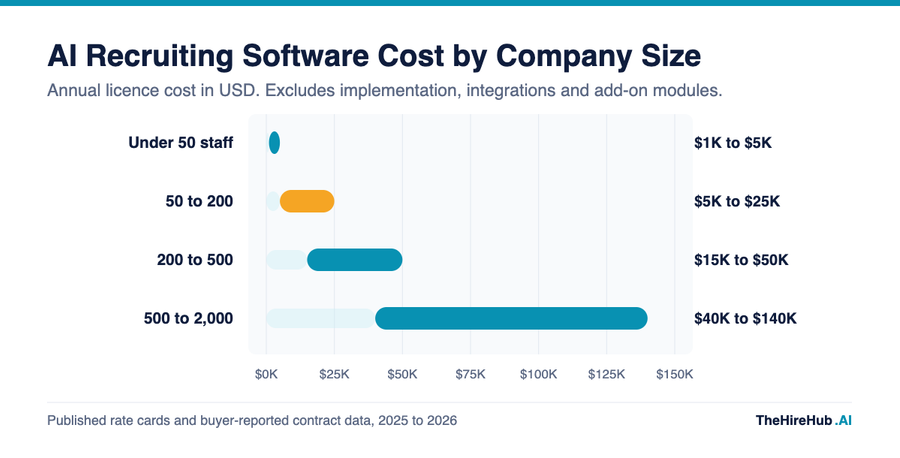
How to read this chart:
- The bands overlap, and that is the point. A well-negotiated 300 person contract can cost less than a badly negotiated 150 person one. Size sets the range; negotiation sets where you land inside it.
- These are licence costs only. Implementation, integrations and add-on modules sit on top and are covered below.
- The top of each band is not the ceiling. Enterprise deployments tied to an HCM suite run past $250,000 a year, and Workday Recruiting starts around $35,000 a year on top of the HCM licence you already pay for.
Individual platform entry prices, for anchoring: JazzHR at roughly $900 a year, Workable at roughly $1,788, Lever near $4,000, Ashby at $4,800, Greenhouse at $6,500, iCIMS at $9,000, and SmartRecruiters at about $15,000 following its move upmarket.
How it actually works, and where it breaks
The mechanism is simple. You buy a licence banded by headcount, you pay a one-time implementation fee, and you pay recurring fees for the integrations and modules that make the thing usable. Then it renews, usually at a higher number.
Four costs break the budget, and they are predictable enough that there is no excuse for being surprised.
Implementation. For enterprise platforms this typically runs 100% to 150% of the first year licence fee. JazzHR is effectively zero and Workable is close to it, but Greenhouse implementation runs $10,000 to $30,000 and Workday Recruiting for a 1,000 person company runs $100,000 to $250,000 over six to nine months.
Renewal escalation. Annual increases of 8% to 15% are standard in this category, not exceptional. Because switching costs are high, vendors price on the assumption that you will absorb it. Over a three year horizon a 12% escalator adds about a quarter to your total spend.
Modular add-ons. iCIMS is the clearest case: a $9,000 base licence becomes $55,000 to $70,000 once a mid-market team adds CRM, text engagement, video and offer management. The advertised price is rarely the working price.
Integration fees. Connecting to your HRIS or background check provider usually carries its own recurring charge. iCIMS charges $2,000 to $10,000 per integration per year, and the SmartRecruiters SAP SuccessFactors integration is a separate professional services project quoted at $75,000 to $200,000.
"The advertised price is a door charge; the real number is what you pay in year two after the headcount true-up."
What this means for your team
The buying process matters more than the shortlist. A structured eight week evaluation reliably beats a three week scramble, mostly because it gives you time to generate a competing quote.
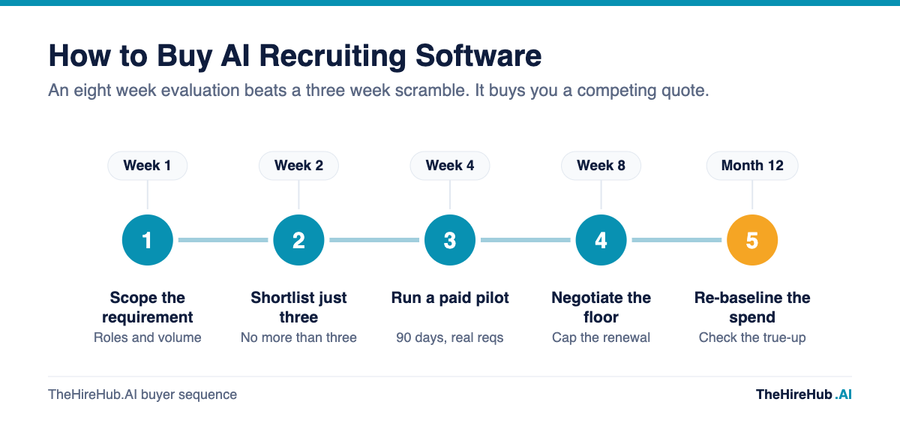
Four things to settle before you sign anything:
- A headcount buffer. Negotiate 10% to 15% above your current headcount into the initial contract so that ordinary growth does not trigger a mid-term true-up.
- A renewal cap. A 5% annual cap, or CPI if lower, is achievable on a first contract. It is very hard to win once you are already a customer.
- Implementation, not licence. Vendors resist discounting licence fees because it sets a precedent. Professional services budgets are far more flexible, so push there first.
- A ramp-down clause. If hiring volume drops, a multi-year commitment at contracted volume becomes expensive. Agree the downside before you sign the upside.
The other discipline worth imposing is deciding, in advance, what the tool has to improve. If you cannot say which number should move, you will not be able to judge the renewal either. That is the argument for pairing any purchase with a real quality of hire measurement baseline, and for running the arithmetic in our AI recruitment ROI guide before the money is committed.
AI recruiting software cost vs the agency alternative
Software and agencies are not substitutes, though they get compared as if they were. A contingency agency charges a percentage of first year salary per hire, so the cost scales directly with hiring volume and stops entirely when hiring stops. Software is a fixed annual commitment that scales with headcount whether you hire or not.
The arithmetic is worth doing properly. A single agency placement on a ₹25 lakh salary at a 20% fee costs ₹5 lakh, which is more than most mid-market platforms cost for an entire year. That comparison flatters software right up until hiring pauses, at which point the licence keeps billing and the agency fee does not.
That makes the comparison a question of hiring pattern rather than price. Steady, repeatable volume favours software, because the per-hire cost falls with every additional req. Lumpy or senior hiring favours agencies, because you pay only when you actually hire. We work through the specifics in AI recruiting vs agency, and if you are still deciding which platform tier fits, the best AI recruiting software in India comparison covers the local options.
How to actually do this (and the four traps)
- Do not buy on the advertised entry price. Every platform has an entry tier designed to get you in the door and a set of caps designed to push you out of it. JazzHR's cheapest plan caps active jobs at three. Workable's entry tier historically cut out around 21 employees. Model your cost at next year's headcount, not today's.
- Do not skip the paid pilot. A 90 day paid pilot on real requisitions gives you usage data to anchor the enterprise negotiation, and it is a reasonable ask on most platforms. Vendors who refuse a pilot are telling you something about how the product performs under real load.
- Do not let the CIO's HCM decision become the recruiting decision. Suite recruiting modules are often chosen because the payroll system is already there, not because they are good for recruiters. That is a defensible trade, but make it deliberately and price the implementation honestly.
- Do not confuse a cheap licence with a cheap system. A ₹1,500 per user tool that your team abandons in four months costs more than a properly configured platform, because the real expense in recruiting is not software, it is the cost of the hire that goes wrong. For the founder view of reading a vendor rate card, see how to read the pricing page.
"Buy for the hiring you will do next year, not the hiring you did last year, and never for the demo."
The one thing every hiring leader should take from this
The list price is the least informative number in this entire category. What determines your actual spend is the billing unit (headcount, almost always), the escalator, and whether you walked into the negotiation with a competing quote. Get those three right and a mid-market contract can land 30% below the opening number. Get them wrong and you will pay for growth you have not had yet. Before you sign anything, book a demo and we will benchmark your requirement against what comparable teams are actually paying.
Hiring shouldn't have to feel harder just because the talent market is more competitive.
At TheHireHub.ai, we help hiring teams simplify the process from finding the right candidates to assessing and ranking them, so your team can spend less time managing the hiring process and more time making the right decisions.
If you're looking to make hiring easier, faster, and better, we'd be happy to help.
Frequently Asked Questions
Entry-level platforms start around $900 a year, mid-market contracts typically land between $15,000 and $50,000, and enterprise deployments run from $70,000 to $250,000 and beyond. The main driver is total company headcount rather than the number of recruiters using the system. Licence cost is only part of it, because implementation, integrations and add-on modules are usually quoted separately.
JazzHR is the lowest price point for a functional applicant tracking system with AI features, at roughly $75 a month or $900 a year, though its entry plan caps you at three active jobs. In India, Zoho Recruit lists Standard at ₹1,500 per user per month plus 18% GST, which is often cheaper for a small team because it bills per recruiter rather than per employee.
Because an absence of public anchors lets them quote each buyer individually based on perceived budget. Greenhouse, Lever, SmartRecruiters and iCIMS all quote custom. The practical consequence is that two similar companies can sign contracts 30% apart, and buyers who bring a competing quote to the table consistently land lower.
Most global platforms price on total company headcount, not recruiter seats, so a 250 person company with three recruiters pays on 250 people. Several India-available tools, including Zoho Recruit, price per recruiter instead. This distinction matters enormously if you are growing quickly, because headcount-based billing means your recruiting cost rises with every hire anywhere in the business.
Four recur across the category: implementation (often 100% to 150% of the first year licence for enterprise platforms), annual renewal escalations of 8% to 15%, modular add-ons that can take a $9,000 base licence past $55,000, and per-integration fees that can run $2,000 to $10,000 each per year. Budget these as separate line items rather than assuming they are bundled.
It varies more than the licence does. Self-serve tools like JazzHR and Workable are effectively zero to $2,000. Greenhouse runs $10,000 to $30,000, iCIMS can reach $100,000 or more, and Workday Recruiting for a 1,000 person organisation runs $100,000 to $250,000 over six to nine months.
Yes, on the custom-quoted enterprise platforms, where there is typically 15% to 30% of room. Self-serve tools have very little flexibility because their pricing is transparent. The most effective tactics are bringing a competing quote, pushing on implementation fees rather than licence fees, and securing a renewal cap in the first contract.
A renewal cap is a contractual limit on how much the vendor can raise your price at renewal, commonly negotiated at 5% or CPI, whichever is lower. It matters because 8% to 15% annual escalation is standard in this category, and over three years an uncapped escalator can add roughly a quarter to your total spend. It is far easier to win this clause before you sign than after.
Roughly $1,000 to $5,000 a year is the realistic band, and many teams at this size are better served by a per-recruiter tool than a headcount-priced platform. The bigger risk at this stage is not overspending, it is buying a system nobody configures and then abandoning it within a few months.
It depends entirely on hiring volume, because the cost is fixed and the benefit scales per hire. A team running steady, repeatable volume will usually see the per-hire cost fall below agency fees quickly. A team hiring a handful of senior people a year often will not. Decide which metric should move before you buy, so you can judge the renewal on evidence rather than impression.


