Budget AI Recruitment Tools 2026: A Startup's Playbook for Hiring Under ₹50K/month
What to actually spend, what to skip, and the under-the-radar stack that runs competent AI-augmented hiring for under ₹50,000/month at startup volume.
What to actually spend, what to skip, and the under-the-radar stack that runs competent AI-augmented hiring for under ₹50,000/month at startup volume.

- 1At a Glance
- 2What you actually need in 2026
- 3The budget stack we recommend (under ₹50K/month, all-in)
- 4What to skip
- 5When to upgrade (and what to upgrade to)
- 6A common-trap example
- 7The AI augmentation that actually matters
- 8The one thing every startup founder should take from this
- 9Secure Your Competitive Edge with TheHireHub.ai
At a Glance
A seed or Series A startup hiring 4–12 people a year does not need an enterprise recruitment stack. In 2026 you can run a competent AI-augmented hiring function for under ₹50,000/month — sometimes under ₹20,000 — by combining a free-tier ATS, two paid tools where the leverage is highest, and a deliberate decision to skip three categories that vendors will try to sell you.
The trap most startups fall into is buying the enterprise feature set on a startup budget. The right move is the opposite: spend on the two places that move the needle, and run the rest with free tools and human discipline.
What you actually need in 2026
A modern startup recruiting stack has six functional layers. You don't need a separate tool for each — most stacks collapse to three or four tools that cover all six.
1. ATS (applicant tracking). Where applications land, where pipeline lives. Non-negotiable.
2. Sourcing / outbound. Finding passive candidates on LinkedIn, GitHub, Naukri. Necessary for any role you can't fill from inbound alone.
3. Application screening. Filtering inbound volume. Usually built into the ATS.
4. Assessment. Skills test, work sample, or async interview before recruiter time.
5. Scheduling. Calendar coordination with candidates.
6. CRM and candidate communication. Email sequences, follow-ups, talent-pool nurturing.
The seven-figure enterprise stacks buy a separate tool for each. The under-₹50K/month version uses one tool that covers 1, 3, 5, 6 — and adds focused investments in 2 (sourcing) and 4 (assessment).
The budget stack we recommend (under ₹50K/month, all-in)
This is the stack we recommend to seed and Series A founders hiring fewer than 12 people a year. Numbers are 2026 list prices in INR; expect 10–20% off via standard negotiation.
ATS layer: Workable Starter or Keka Hire Starter — ~₹8,000–₹15,000/month. Both have free trials, both handle 5–15 active openings comfortably, both have decent inbound parsing and pipeline visibility. Workable is better if you hire globally; Keka if you're India-only and may want HRMS integration later. Greenhouse and Lever are excellent but their pricing starts higher and they don't pay back at startup volume.
Sourcing layer: LinkedIn Recruiter Lite — ~₹8,000/month, single seat. The full Recruiter license at ₹25,000+/month is overkill for fewer than 10 active searches. Lite gets you 30 InMails/month, search filters, and the candidate-out-of-network access that matters. Pair with a Chrome extension like Apollo's free tier for email enrichment.
Assessment layer: TestGorilla or HackerEarth Basic — ~₹6,000–₹12,000/month. Pre-built role libraries, candidate-friendly experience, decent score export to your ATS. Choose based on role family — TestGorilla broader for ops/sales, HackerEarth deeper for engineering.
AI augmentation layer: ChatGPT Team or Claude Pro — ~₹5,000/month for one seat. Used for job description drafting, candidate outreach personalization, reference-check question generation, and structured note-taking on interview transcripts. This is the highest-leverage AI spend in 2026 — and most startups don't realize they should be buying it as a recruiting tool.
Scheduling: Cal.com free tier or Google Calendar appointment slots — ₹0. Both work fine for sub-50-interviews-a-month volume. Pay nothing here until you outgrow it.
CRM and outreach: Apollo or Lemlist starter — ~₹6,000/month, optional. Only if you're doing meaningful outbound. For pure inbound-driven hiring, your ATS does this for free.
Total: ₹27,000–₹46,000/month. Below ₹50K, comfortably.
What to skip
The three categories startups buy that don't earn back the spend at low volume:
Standalone AI-sourcing platforms. HireEZ, SeekOut, Findem are excellent — at 50+ hires/year. Below that volume, LinkedIn Recruiter Lite plus a recruiter's time delivers comparable results at one-quarter the cost. The AI-sourcing premium pays back on volume, not depth.
Automated interview platforms. For startups, candidate experience is your strongest differentiator. An async-video screen telegraphs "your role isn't important enough for a 30-minute human call." See the automated interview platforms guide — these tools are built for high-volume hiring, not the differentiated roles startups need.
Standalone interview-intelligence platforms. Metaview, BrightHire, Pillar — they're great for enterprise interview consistency. At sub-100 interviews/month, the AI-augmentation layer (ChatGPT/Claude with transcripts) covers 80% of the value at one-fifth the cost.
If you find yourself buying all three of these in your first year, the spend tells you something — either you're scaling faster than the budget suggests and should upgrade the whole stack, or you're getting talked into enterprise capabilities you don't need.
When to upgrade (and what to upgrade to)
The trigger points to look for, in order:
At 15+ open roles concurrently: upgrade the ATS. Workable Pro, Keka Hire Pro, or Greenhouse Essentials. ₹25,000–₹50,000/month. The Starter tiers start to break around this volume.
At 30+ candidate outbound messages per week: upgrade sourcing. LinkedIn Recruiter (full), Gem for sequencing, or HireEZ for AI-sourcing. ₹40,000–₹80,000/month.
At 100+ candidates screened per month: add real applicant-screening tooling. Knock-out questions and pre-screen assessments become high-leverage at this volume. See the applicant screening tools guide for what works.
At 25+ hires per year: consider a dedicated recruiter, not more tools. Tools amplify a recruiter's productivity; they don't replace the role.
At 50+ hires per year: the budget stack is no longer the right stack. You're at the volume where the enterprise tools earn their keep. Don't try to scale the budget stack past this point — the gaps cost more than the upgrade.
A common-trap example
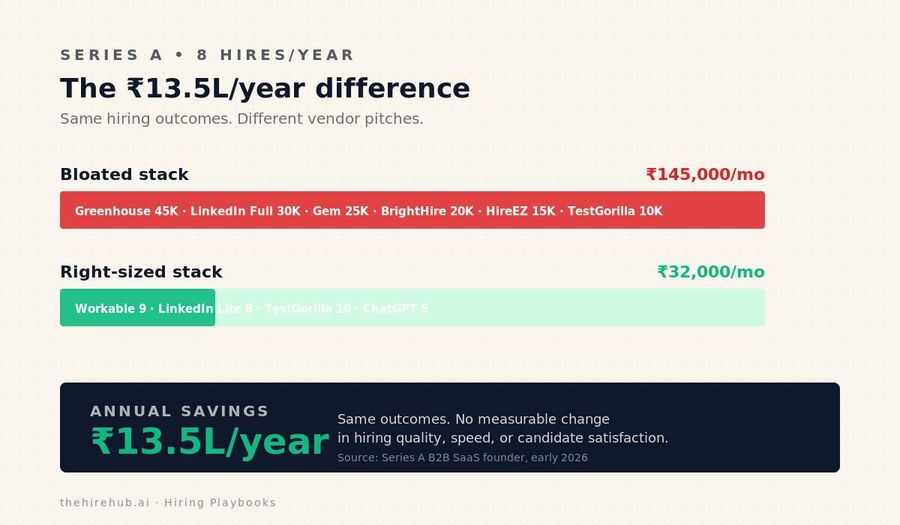
A Series A B2B SaaS founder we talked to in early 2026 was running this stack:
- Greenhouse Essentials — ₹45,000/month
- LinkedIn Recruiter (full) — ₹30,000/month
- Gem (sourcing sequences) — ₹25,000/month
- TestGorilla — ₹10,000/month
- BrightHire (interview intelligence) — ₹20,000/month
- HireEZ Starter — ₹15,000/month
Total: ₹145,000/month. Annual run rate: ₹17.4L. For a hiring volume of ~8 people/year.
They genuinely believed they needed every tool because each vendor's pitch made sense in isolation. The right stack for their volume was Workable Starter + LinkedIn Recruiter Lite + TestGorilla + ChatGPT — total ₹32,000/month. Annual run rate: ₹3.84L. Savings: ₹13.5L/year, with no measurable change in hiring outcomes.
The pattern is universal: startups over-buy because every vendor sells "what enterprise uses," and founders read that as a benchmark instead of a warning.
The AI augmentation that actually matters
The cheapest, highest-leverage AI spend in 2026 is not a recruiting-specific tool. It's a general-purpose LLM seat used deliberately for hiring tasks. What we see working:
- JD drafting. Generate a v1 from a 5-line brief; cut it down by 40% before posting. Saves 90 minutes per role.
- Outreach personalization. Paste a candidate's LinkedIn, ask for three personalized hooks. The reply rate lift is real, especially for non-native English writers.
- Reference-check question generation. Given a candidate's resume and the role JD, generate the 6 questions you should actually ask their reference. Better than the generic ones you'd use otherwise.
- Interview transcript analysis. Paste a 45-minute transcript, ask for the 3 strongest claims, the 3 weakest, and the 5 follow-up questions you should have asked. This single use is worth the entire ₹5,000/month seat.
None of these require a recruiting-specific AI tool. They require one recruiter who's built the habit of pasting things into a general-purpose LLM with a few sharp prompts.
The one thing every startup founder should take from this
The right hiring tool budget is a function of hiring volume, not of vendor pitches. At 8 hires/year, an ATS plus three focused tools plus a general-purpose LLM seat is enough — and any spending past ₹50K/month is almost certainly buying capacity you won't use for two years. Most enterprise stacks were built for companies hiring 200+ people a year; copying them at startup scale costs ₹10L+/year for capability you won't touch.
See how TheHireHub puts this into practice with its AI recruitment software, or compare it against other tools.
Secure Your Competitive Edge with TheHireHub.ai
By harnessing AI through TheHireHub.ai, HR leaders can eliminate the pain of losing top talent, slash time-to-fill and vacancy costs, and drive organizational success. Visit thehirehub.ai today to schedule a demo and experience 70% faster hiring tailored to your needs. Transform recruitment from a cost center into a strategic advantage—start now.
Stop scrolling resumes. Start hiring.
TheHireHub's AI hands you pre-screened, ready-to-interview candidates in hours, no agency fees, no signup gauntlet.
Curious how this works inside a real product? Explore TheHireHub’s agentic AI recruiting and see how it compares.
Frequently Asked Questions
For under 12 hires/year: Workable Starter or Keka Hire Starter (ATS), LinkedIn Recruiter Lite (sourcing), TestGorilla or HackerEarth Basic (assessment), and a ChatGPT Team or Claude Pro seat (general AI augmentation). Total comes in between ₹27,000 and ₹46,000 per month. Cal.com or Google Calendar handle scheduling for free.
Below 50 hires per year, no. LinkedIn Recruiter Lite plus disciplined recruiter time covers the same ground as standalone AI sourcing platforms at one-quarter the cost. The AI-sourcing premium pays back on volume, not depth.
The clearest triggers are 15+ open roles concurrently (upgrade the ATS), 30+ outbound messages per week (upgrade sourcing), 100+ candidates per month (add applicant screening), and 25+ hires per year (hire a recruiter instead of buying more tools).
For under 5 active roles, yes. Workable's free trial and several Indian ATS platforms have free or near-free entry tiers. The pain point shows up around 5–10 active roles, where pipeline visibility breaks down. Plan to spend ₹8,000–₹15,000/month from that point on.


