AI Recruiting Implementation Time in 2026: How Long Rollout Actually Takes
Vendors quote four to six weeks. Here is what the calendar actually looks like, by company size.
AI recruiting implementation takes 2 to 4 weeks under 50 staff and 13 to 26 weeks at enterprise scale. The real timeline, the five stages, and where rollouts stall.

TL;DR
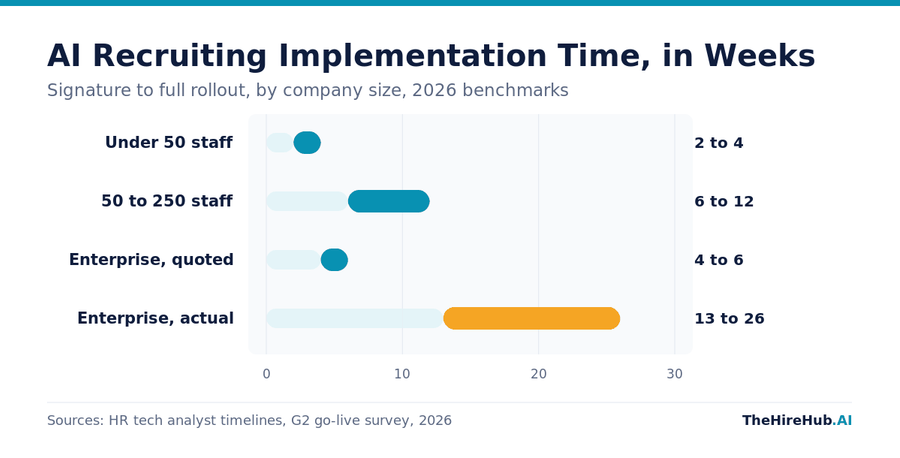
AI recruiting implementation time runs from two weeks to six months, and the spread has very little to do with the software. Teams under 50 people go live in two to four weeks. Mid market teams between 50 and 250 take six to twelve weeks. Enterprises get quoted four to six weeks and land at thirteen to twenty six, according to HR technology analyst data compiled in 2026. The delay is almost never model training. It is security review, legacy data, and the number of people who have to say yes before anything ships. If you are still deciding whether to buy at all, the honest picture of AI recruiting adoption is the better place to start.
What is actually happening
Every AI recruiting vendor has a number on its pricing page, and the number is almost always wrong for companies above a few hundred people. The quoted figure describes configuration time: how long it takes to connect the tool, set up scorecards, and turn it on. It does not describe the two things that actually consume the calendar, which are approval and data.
The approval problem got sharply worse in 2026. Legal review cycles for AI specific contracts now average 14.7 weeks, against 4.2 weeks for traditional SaaS, and 73% of enterprises report that AI procurement cycles run two to five times longer than an equivalent software purchase. The reason given is not budget. It is compliance review, driven by the EU AI Act and by state level hiring rules that classify recruitment tools as high risk. A recruiting tool is now a data protection question, an employment law question, and a security question at the same time.
The data problem is older and more predictable. Roughly 36% of buyers are replacing an existing system rather than starting clean, and moving and cleaning that history is the single most common cause of a slipped go live date. Gartner's research on enterprise data migration found that 83% of migration projects either fail outright or blow past their planned budget and timeline. Recruiting data is unusually messy: duplicate candidate records, stage names that changed three times, and requisitions that were closed in the ATS but never actually filled.
Then there is the security queue. Security review alone adds two to six weeks to enterprise deals and two to four weeks to mid market ones, and more than 70% of enterprise software purchases now require a SOC 2 report before anyone signs. None of this is visible in a demo. All of it is visible in your go live date.
The numbers
Here is the honest range, split by the segments where the published data is actually reliable. The interesting row is not the largest number. It is the distance between what enterprise buyers are told and what they experience.
For broader context: 91% of small businesses, 76% of mid market companies and 70% of enterprises get a core HR system live within three months, which tells you the three month mark is a reasonable outer bound for most buyers rather than a catastrophe. At the platform level, Greenhouse reports two to four weeks for standard configuration and Lever six to twelve weeks for full configuration, so a large part of the variance is set before you pick a vendor at all.
How to read this:
- The small team number is real and repeatable. Under 50 employees there is usually one decision maker, one data source, and no security queue, so two to four weeks is a genuine expectation rather than a marketing claim.
- The mid market number is where most readers sit. Six to twelve weeks assumes one ATS, one legal reviewer, and a named internal owner. Remove any one of those and add four weeks.
- The enterprise gap is the whole point. Vendors quote configuration time because that is the part they control. The thirteen to twenty six week figure includes the parts they do not, and you should plan against that one.
How it actually works, and where it breaks
Mechanically, an AI recruiting rollout is four things happening in sequence. You connect the tool to wherever candidate data lives. You import enough hiring history for the models to calibrate against your own past decisions rather than a generic benchmark. You run a pilot on a small number of live roles. Then you widen it to everything.
The first failure mode is calibrating on bad history. If your last two years of hiring data reflect a hiring bar that moved, or a set of roles you no longer hire for, the system learns the wrong pattern and confidently applies it. Teams that skip the calibration step to save two weeks usually spend six weeks later arguing about why the shortlists look wrong. This is also where AI screening false negatives get baked in quietly.
The second failure mode is the pilot that is not really a pilot. A genuine pilot runs two roles with deliberately different shapes: one high volume role where throughput is the question, and one hard to fill role where judgement is the question. Most teams instead run whatever requisition happens to be open, learn nothing generalisable, and then roll out on a sample size of one.
The third failure mode is the one nobody plans for, which is that nobody uses it. Gartner found the average HR information system is used by only 32% of employees. SHRM puts the rate of HR technology implementations that fail to meet expectations at one in four, and Gartner's broader enterprise software failure range sits between 50% and 75%. A tool that is live and unused is indistinguishable, on your P&L, from a tool you never bought.
"A rollout that finishes on time and changes nobody's behaviour is not a fast implementation, it is an expensive one."
What this means for your team
The sequence below is what a twelve week mid market rollout actually looks like when it goes well. The stages overlap deliberately, because the single biggest lever on total elapsed time is starting the security review before you need it rather than after.
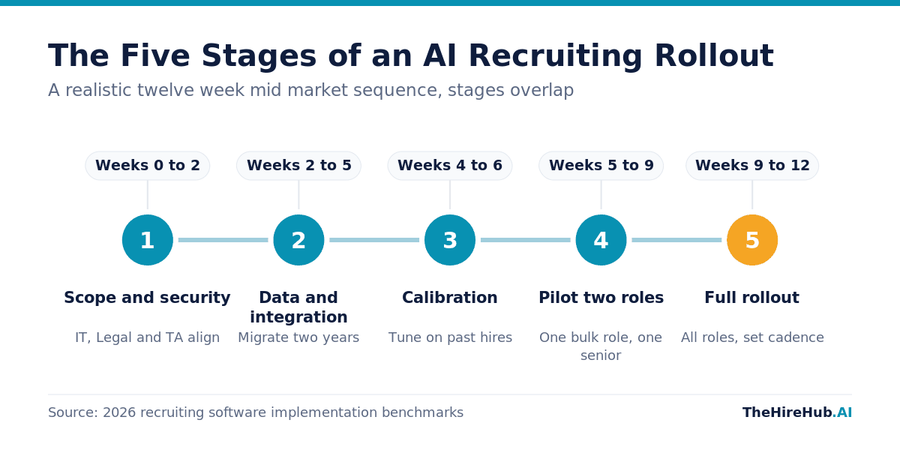
Three scheduling rules matter more than anything else in that sequence:
- Start security and legal in week zero, not at contract signature. The questionnaire is the long pole, and it runs in parallel with everything else at no extra cost to you.
- Freeze your data scope early. Decide which two years of hiring history you are migrating and leave the rest in the old system as an archive. Every extra year you insist on carrying adds roughly a week.
- Name one owner with authority. Not a committee, and not a project manager who has to escalate. Unclear internal ownership is the most common reason a rollout that could take eight weeks takes twenty.
Budget the internal cost honestly too. A twelve week rollout typically consumes 40 to 80 hours of a TA lead's time and 15 to 30 hours of IT time. That is not free, and it belongs in the same business case as the licence fee, alongside your AI recruitment ROI maths.
AI recruiting implementation vs an ATS migration
These get conflated and they should not be. An ATS migration is a system of record change: you are moving where the data lives, so the risk is data integrity and the work is mostly IT. An AI recruiting implementation is a decision process change: the data can stay exactly where it is, and the risk is whether your recruiters trust and act on what comes out.
That difference has a practical consequence. An AI layer that sits on top of your existing stack is usually faster to deploy than a replacement, because it inherits your current integrations rather than rebuilding them, which is the core of the ATS vs AI recruiting software distinction. If you are doing both at once, sequence them: migrate first, stabilise for a month, then add the AI layer. Doing both simultaneously is how eight week projects become six month projects, and it is worth reading the ATS integration detail before you commit to a combined timeline.
How to actually do this (and the four traps)
- Trap one: believing the quoted timeline. Take the vendor's number, ask specifically whether it includes security review, data migration and your legal sign off, and then plan against the answer rather than the brochure. For enterprise buyers this alone changes the plan by two months.
- Trap two: buying before you have scoped the review. Ask your own security and legal teams for their current queue length before you shortlist. If the answer is eight weeks, that is now the floor for your project, and it should shape which vendors you even consider, alongside the criteria in our guide to how to evaluate AI recruiting tools.
- Trap three: measuring go live instead of first value. Go live is when the software works. First value is when a hire happens differently because of it. Pilot data suggests teams see a 20% to 30% reduction in time spent on their first two or three hires even before full deployment, so measure that and not the switch being flipped.
- Trap four: treating training as a launch event. One session in week ten does not change behaviour. Recruiter adoption is the variable that decides whether any of this pays back, and it needs a review cadence in weeks twelve, sixteen and twenty four, not a slide deck on day one.
"Nobody has ever been fired for a rollout that took two weeks longer, and plenty have been for one that nobody used."
The one thing every hiring leader should take from this
The clock does not start when you sign. It starts when your security team opens the questionnaire, and it stops when a recruiter changes what they do on a Tuesday morning because of what the system told them. Everything between those two points is negotiable, and most of it is inside your organisation rather than inside the product. Pick a vendor who will tell you the honest range for a company your size, run the security review in parallel from day one, and pilot on two roles that are genuinely different from each other. If you want a second opinion on what your own timeline realistically looks like, we look at this stuff all day.
Frequently Asked Questions
Two to four weeks for companies under 50 employees, six to twelve weeks for companies between 50 and 250, and thirteen to twenty six weeks for large enterprises. The variable that moves the number most is internal security and legal review, not the software itself.
Because they are quoting configuration time, which is the portion they control. Security review, legal sign off, data migration and internal change management all happen on your side of the line and are usually excluded from the quoted figure.
Compliance and security review. AI specific contract review now averages 14.7 weeks against 4.2 weeks for traditional SaaS, and 73% of enterprises report AI procurement cycles running two to five times longer than an equivalent software purchase.
Yes, and for speed it is often the right call. The tradeoff is that the system calibrates on generic benchmarks rather than your own past hires for the first few months, which usually shows up as shortlists that feel slightly off for your context.
Two to four weeks, running two deliberately different roles: one high volume where throughput is the question, and one hard to fill where judgement is. A pilot shorter than two weeks rarely produces enough decisions to evaluate.
Plan for roughly 40 to 80 hours of TA lead time and 15 to 30 hours of IT time across a twelve week mid market rollout. Treat that as part of the total cost of ownership rather than a free input.
SHRM reports that one in four HR technology implementations fail to meet expectations, and Gartner's broader enterprise software failure range runs from 50% to 75%. Most failures are adoption failures rather than technical ones.
Usually no. Migrate the system of record first, let it stabilise for about a month, then add the AI layer. Combining them multiplies the number of things that can go wrong and makes it hard to diagnose which change caused a problem.
Time savings typically appear during the pilot, with a 20% to 30% reduction on the first two or three hires, and measurable ROI generally lands within 90 days of full deployment rather than at go live.
Track recruiter usage weekly and quality of hire quarterly. A system that is live but used by a minority of your recruiters has not worked, regardless of what the implementation plan says.

