AI Recruiting Adoption in 2026: Why 88% of HR Leaders See No Value Yet
Adoption is now wide and shallow, and the fix is a workflow change rather than another tool.
69% of companies use AI somewhere in hiring but only 18% have scaled it. The 2026 adoption benchmark, the failure modes, and the twelve week rollout that works.

TL;DR
AI recruiting adoption is now the majority position and it is still not paying. Sixty-nine percent of companies use AI somewhere in hiring, but only 18% use it broadly, and 88% of HR leaders told Gartner their organisation has not realised significant business value from AI tools. The gap is not model quality and it is not budget. It is that most teams bought a tool, pointed it at one task, and never rewrote the process around it. If you are still choosing what to buy, start with our AI recruiting software cost breakdown, then come back here for what happens after the contract is signed.
What is actually happening
Gartner surveyed 114 HR leaders in July 2025 and found that 88% reported no significant business value from AI tools. The same research programme surveyed 2,986 employees and found close to the opposite mood on the ground. Sixty-five percent said they were excited to use AI at work, and 77% take AI training when it is offered. Enthusiasm is not the bottleneck.
The recruiting-specific picture is sharper. iCIMS and Aptitude Research put AI use in hiring at 69% of companies in some capacity, but only 18% broadly across the process. Aptitude Research found that 44% of adopters apply AI to just 1% to 25% of their workflow, and only 6% have automated more than three quarters of it.
Where AI actually lands is predictable. Job description writing leads at 66%, resume screening at 58%, candidate communication at 54%, assessments at 50% and sourcing at 46%. Conducting interviews sits at 23%, and only 10% of teams let AI touch a final hiring decision. Most of that is content generation and triage, which is the cheapest part of the funnel to automate and the least connected to outcomes.
Meanwhile the ambition keeps climbing. Gartner reported that 82% of HR leaders plan to use agentic AI by mid 2026, while 83% still score in the lowest two of five AI maturity levels. Buying intent is running years ahead of operating capability, and that is the most useful single sentence in the 2026 data.
The skills layer explains much of the rest. A separate Gartner release in October 2025 found that only 8% of HR leaders believe their managers have the skills to use AI effectively. A tool that needs judgement to operate, handed to people who were never taught the judgement, produces exactly the results these surveys describe. The World Economic Forum's 2025 Future of Jobs report puts skills gaps at the top of the barrier list, named by 63% of employers.
One more measurement quirk is worth knowing before you benchmark yourself against anything. The Federal Reserve found that AI adoption looks like 18% when you count the share of firms, but roughly 32% once you weight by employment. The largest employers adopt most and employ most people, so "share of companies using AI" and "share of workers covered by AI" are genuinely different sentences. Most headlines quietly swap one for the other.
The numbers
Adoption rises steadily with headcount, and the spread inside each band is wide because different surveys count different things. The chart below maps the four headcount bands recruiters actually think in against the nearest published band from each source.
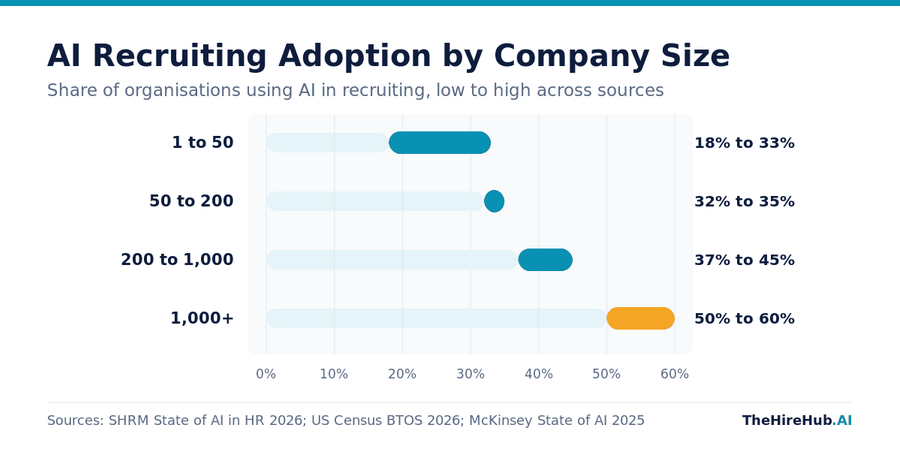
How to read this:
- Each bar is a range, not a disagreement. The low end counts any AI use economy wide (US Census), the high end counts AI inside the recruiting function specifically (SHRM).
- The 27 point gap between the smallest and largest firms is the most consistent pattern in the data, and it holds across SHRM, Census and McKinsey independently.
- Entry rate is not usage. A 1,000 person company at 60% adoption and a 40 person company at 33% can both be running AI on a single task and calling it a transformation.
The number worth chasing is not on this chart. The Josh Bersin Company reports that teams with deep AI adoption see time to hire fall by a factor of two to three. That is the prize, and the 6% of adopters who have automated most of their workflow are the ones collecting it. Everyone else is paying licence fees for a faster version of one step.
How it actually works, and where it breaks
The mechanism most teams buy is simple. A model reads unstructured candidate data, ranks or drafts against a target, and hands the output to a recruiter who accepts, edits or ignores it. That loop genuinely compresses work: Gartner found 62% of employees say AI has saved them time, with those in AI relevant roles saving an average of 1.5 hours a day.
The first failure mode is that the tool gets bolted onto an unchanged process. Gartner found 38% of employees have had to create new processes because of technology, and 41% report working around formal processes to get things done. When the old approval step, the old spreadsheet and the old handoff all survive alongside the new tool, you have added work rather than removed it.
The second is that nobody directs the time the tool frees. Only 7% of organisations provide any guidance on how employees should use time saved by AI. Hours reclaimed from screening do not automatically become hours spent closing finalists. Absent direction, they simply diffuse back into the day.
There is a related gap underneath that one. Gartner found only 42% of employees say they know how to identify where AI could improve their own work, and 7% report that AI has actually cost them time. Recruiters are not refusing to use the tool so much as failing to see which parts of their week it applies to. That is a job design problem, and it does not resolve itself with more licences.
The third is quiet distrust. Recruiters who have been burned by one bad shortlist start double checking every result, which restores the original cost while keeping the licence fee. This is where AI screening false negatives do the real damage: not the weak candidates who get through, but the strong ones who silently do not, and the confidence that drains away when a hiring manager spots one.
"The tool is rarely what fails; the process it was dropped into is almost always what fails first."
What this means for your team
The teams that get value out of this do not buy differently from the teams that do not. They sequence differently, and the sequence is boring on purpose.
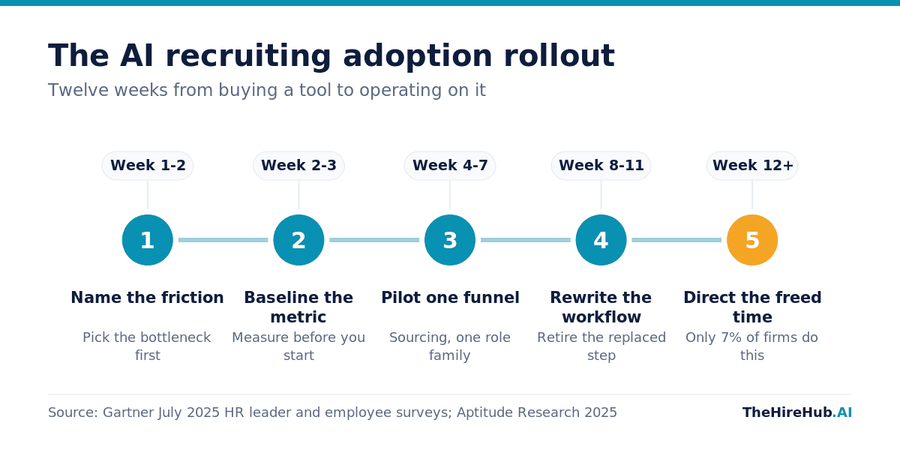
- Name the friction, not the tool. Gartner found employees are five times as likely to be heavy AI users when the tool resolves an actual work friction. Start from the bottleneck your recruiters already complain about, then go find the thing that removes it.
- Baseline before you switch anything on. If you cannot state today's time to shortlist, recruiter hours per requisition and offer acceptance rate, you will not be able to prove or disprove the tool in ninety days. Our guide to AI hiring metrics covers the short list worth instrumenting first.
- Pilot on one funnel. Sourcing is the near universal on ramp, and a single role family gives you enough volume to read a real signal without betting the whole function on it.
- Rewrite the workflow. Retire the step the tool replaced. If the old step is still standing at the end of the pilot, the pilot failed even if the tool worked perfectly.
- Direct the freed time explicitly. Decide in advance where reclaimed hours go, write it down, and tell the team. This is the step almost nobody does.
AI recruiting adoption vs replacing your ATS
These two get conflated constantly, and the confusion is expensive. An applicant tracking system is a system of record: it stores, routes and reports. AI recruiting tooling is a system of action: it produces candidates, drafts and rankings.
Replacing an ATS is a migration project with a compliance surface and a defined end date. Adopting AI is a process change with a behaviour surface and no natural end date at all. Teams that treat the second as though it were the first buy a platform, run a six month implementation, and never touch the recruiter habits that decide whether any of it gets used. Our comparison of ATS vs AI recruiting software draws the line properly, and the AI recruitment ROI model shows why the two payback profiles are nothing alike.
How to actually do this (and the four traps)
- Trap one: measuring adoption instead of depth. Percent of recruiters holding a licence is the number every vendor dashboard shows and the number that correlates least with outcomes. Count the functions genuinely running on AI instead: sourcing, outreach, screening, scheduling, analytics. If the honest answer is one, you are in the 69% who started rather than the 18% who scaled.
- Trap two: rolling out to everyone at once. A simultaneous launch across a whole talent acquisition org guarantees that the loudest sceptic and the least trained recruiter set the tone for everybody else. Pick one pod, make it work there, then let that pod train the next one.
- Trap three: leaving the human checkpoint undefined. Only 10% of teams let AI touch a final hiring decision, which is the right instinct, but most have never written down where exactly the human enters and what they are accountable for. Define it explicitly, because human in the loop hiring is now both a trust requirement and a regulatory one.
- Trap four: treating recruiter resistance as a training problem. It is usually an evidence problem. A recruiter who has watched the tool surface one absurd candidate needs to watch it surface ten good ones before the habit shifts, and no enablement deck substitutes for that.
"Every recruiter who quietly double checks the model is telling you the rollout failed, and no dashboard will report it."
The one thing every hiring leader should take from this
The 2026 question is not whether to adopt AI in hiring. Most of your peers already have, and the ones reporting no value are sitting inside that same majority. The real differentiator is depth: whether one workflow genuinely runs on AI from end to end, or five workflows have a little AI sprinkled across the top. Pick the single stage that costs your team the most hours, move it completely, retire whatever it replaced, and only then go look at the next one. That is unglamorous, it is slower than the vendor roadmap suggests, and it is the whole game. At TheHireHub we spend our days with teams making exactly that move.
Hiring shouldn't have to feel harder just because the talent market is more competitive.
At TheHireHub.ai, we help hiring teams simplify the process from finding the right candidates to assessing and ranking them, so your team can spend less time managing the hiring process and more time making the right decisions.
If you're looking to make hiring easier, faster, and better, we'd be happy to help.
Frequently Asked Questions
AI recruiting adoption describes how far a hiring team has moved AI into its actual workflow, not just whether it has bought a tool. The useful measure is depth: how many recruiting functions (sourcing, outreach, screening, scheduling, analytics) genuinely run on AI day to day.
It depends entirely on the definition. iCIMS and Aptitude Research put AI use in hiring at 69% of companies in some capacity but only 18% broadly, while SHRM finds AI adopted specifically inside the recruiting function at roughly 27% of organisations.
Gartner's July 2025 survey of 114 HR leaders found 88% had not realised significant business value. The common causes are that AI was added to an unchanged process, that only 7% of organisations direct how freed time gets used, and that recruiters quietly re-check output they do not trust.
Adoption counts whether a team has started. Depth counts how much of the funnel actually runs on AI. Aptitude Research found 44% of adopters apply AI to just 1% to 25% of their workflow and only 6% have automated more than three quarters, so most reported adoption is very shallow.
Content and triage come first. Job description writing leads at 66%, followed by resume screening at 58%, candidate communication at 54%, assessments at 50% and sourcing at 46%. Only 10% of teams let AI touch a final hiring decision.
Plan for about twelve weeks to a defensible result on one funnel: one to two weeks naming the friction, a week baselining metrics, roughly four weeks piloting on a single role family, then several weeks rewriting the workflow and retiring the step the tool replaced.
Yes on entry. SHRM's 2026 data shows roughly 33% adoption at companies under 100 employees, 35% at 100 to 499, and 60% at 5,000 plus, a 27 point gap that holds across Census and McKinsey data too. Depth of use does not follow the same pattern.
The old process survives alongside the new tool. Gartner found 38% of employees have had to create new processes because of technology and 41% work around formal processes, so if the step the tool replaced is still standing at the end of the pilot, you added work instead of removing it.
The evidence points to redistribution rather than removal. Gartner found 62% of employees say AI saved them time, averaging 1.5 hours a day in AI relevant roles, and only 10% of teams let AI make the final hiring call. The risk is a role that does not change, not one that disappears.
Baseline before you switch anything on. Capture time to shortlist, recruiter hours per requisition and offer acceptance rate first, then re-measure after ninety days. Without a pre-pilot baseline you cannot separate the tool's effect from normal variation in hiring volume.


