ATS vs AI Recruiting Software: What Each One Actually Does in 2026
One is a system of record you will still be querying in five years. The other is a judgement you can swap out next quarter.
An ATS is a system of record; AI recruiting software is a system of judgement. What each actually does, what each costs per seat, and how to buy them on different clocks.

TL;DR
The ats vs ai recruiting software question is really a question about what you are buying: a system of record, or a system of judgement. An ATS stores, routes and reports on applications. AI recruiting software makes or recommends decisions about who moves forward. Per seat, ATS pricing clusters at $30 to $100 per user per month, while AI tooling spans $15 to $600 depending on segment (global vendor data, in USD). Nearly every large employer already owns the first one: 489 of the Fortune 500, or 97.8 percent, were detected running an ATS in Jobscan's 2025 usage study. Buy them on the same contract terms and you will end up locked into the layer you should be able to replace. If the category itself is still fuzzy, start with what is an ATS and come back.
What is actually happening
The boundary between the two categories has genuinely blurred since 2024. Every major ATS shipped AI features, and every AI recruiting startup shipped enough pipeline management to look like an ATS. That is why buyers keep sitting through two demos that sound identical and cannot say afterwards which product they were comparing.
The useful distinction is not the feature list. It is custody. An ATS owns your candidate record: the application, the notes, the stage history, the audit trail, the reporting you put in front of your board.
AI recruiting software owns a judgement made inside that record. It ranks a pile of applications, runs a first round screen, drafts an outreach sequence, or predicts who will accept. Those are opinions, not records. Opinions can be swapped out next quarter without migrating anything.
The market data says the same thing from a distance. The global ATS market sat around $3.17 billion in 2026 growing at roughly 7.1 percent a year, which is the growth curve of infrastructure that almost everyone already owns. AI recruiting tooling is not on that curve at all. It is priced and sold like a discretionary line item, frequently per interview or per screened candidate rather than per seat, and it churns accordingly.
One more thing changed in 2026, and it is regulatory rather than commercial. Recruitment and candidate selection sit in Annex III of the EU AI Act as high risk uses. A pure record system mostly does not. That single asymmetry is the cleanest reason to keep the two purchases separate in your head.
The numbers
Per seat pricing is where the two categories are most directly comparable, and it is the number most vendors will quote you first. Across the established ATS field (Greenhouse, Lever, BambooHR and similar), per employee per month pricing typically lands between $30 and $100. AI recruiting tooling fans out much wider: roughly $15 to $75 per user per month for small business tiers, $100 to $200 for mid market, and $200 to $600 at enterprise, with heavily customised deployments quoted above that.
Annual contract values tell you more than the seat rate. Greenhouse Core starts near $5,100 a year for small teams and scales past $70,000 for enterprise Pro, with PriceLevel's 2025 buyer data putting the median Greenhouse contract at $12,250 a year. Lever sits around $8,000 to $15,000 a year for small companies. Workable's published entry tiers start near $149 to $189 a month.
The AI side increasingly does not use seats at all. Usage pricing for AI screening in 2026 runs roughly $2 to $18 per completed interview depending on modality: a median of about $5 for voice, $3 for chat, $4 for async video, and $8 for a skills assessment. That is a fundamentally different budget shape, and it is the reason a like for like comparison usually fails.
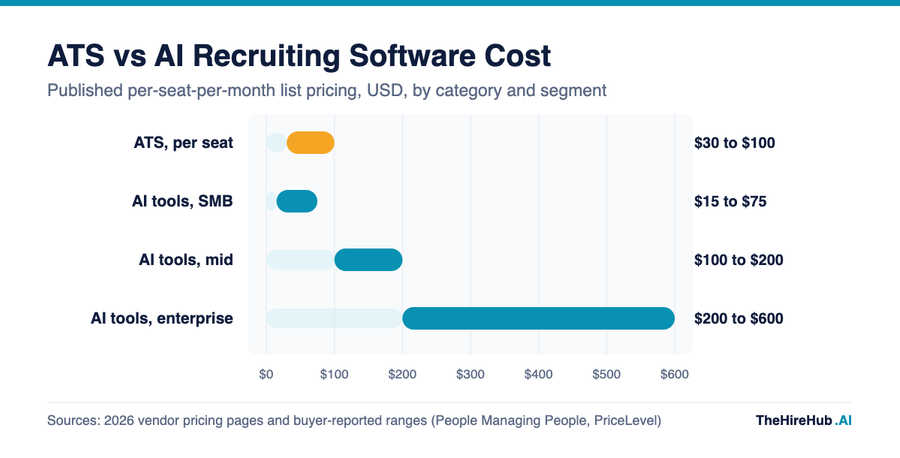
How to read this:
- The seat rate is the least informative number in the deal. The billing unit (seat, job, candidate, interview) decides what you actually pay in a spike month.
- ATS ranges are narrow because the category is mature and the buyers compare. AI ranges are wide because the category is not, and pricing power still sits with the seller.
- A cheap per interview rate on a screening tool can exceed your entire ATS bill at high volume. Model your worst month, not your average one. Our note on AI recruiting software cost works through the arithmetic.
How it actually works, and where it breaks
Mechanically, an ATS is a workflow state machine wrapped around a search index. A candidate exists in a stage, moves between stages under rules you configure, and everything that happened is written down. AI recruiting software runs a model over that same data and returns a score, a ranking, a transcript, or a draft.
The first failure mode is the honest one. When the record breaks, it breaks loudly: a stuck stage, a lost application, a job board feed that stopped syncing. Someone notices inside a day and it gets fixed on Monday.
The second failure mode is the dangerous one. When the judgement breaks, nothing surfaces. A screening model quietly filters out a cohort you never see, your funnel metrics look healthier because volume dropped, and the problem reads as efficiency. This is the core risk covered in our piece on AI screening false negatives, and it is the failure mode no dashboard is built to catch.
The third failure mode sits between the two systems. Scores computed in one tool and decisions taken in another have to write back to the record, or your audit trail has a hole in exactly the place a regulator or a rejected candidate will look. Getting that plumbing right is unglamorous and it is most of the work, which is why ATS integration deserves more evaluation time than the model demo.
"An ATS fails loudly and gets fixed on Monday, while a scoring model fails quietly and gets reported upwards as efficiency."
What this means for your team
Treat these as two purchases on two clocks. The record is a decade decision. The decision layer is a quarter decision. A sensible sequence for adding AI on top of an ATS you already run looks like this.
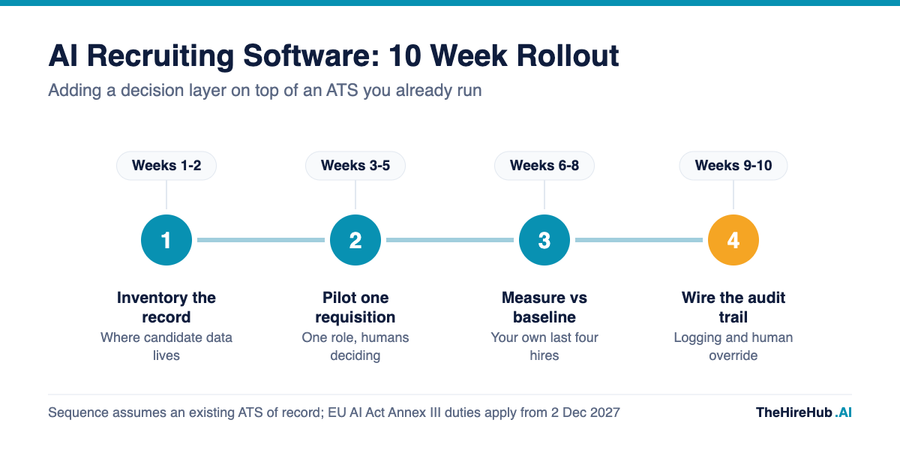
- Weeks 1 and 2 are inventory, not procurement. List every place candidate data already lives, then write down which specific calls you would hand to a machine. Most teams discover the list is shorter and more boring than the vendor deck implied.
- Pilot on one requisition, not one team. A single role with a real funnel gives you a comparison you can defend. A team wide rollout gives you an anecdote.
- Measure against your own last four hires, not the vendor's benchmark. Your baseline is the only baseline that survives a board question.
- Wire the audit trail before you scale, not after. Logging, human override and a written record of who overrode what are the parts you cannot retrofit cheaply.
That last point is not just hygiene. Under the EU AI Act, recruitment and candidate selection are Annex III high risk uses carrying risk management, bias testing, logging and human oversight duties. Those obligations were originally due on 2 August 2026 and were deferred to 2 December 2027 by the Digital Omnibus, which entered into force on 27 July 2026. The transparency duty in Article 50 and the AI literacy duty in Article 4 were not deferred, so the deadline that moved is not the one covering "tell people a machine is involved".
ATS vs AI recruiting software: what actually replaces what
Almost nothing. This is the part the category naming gets wrong. AI recruiting software does not replace an ATS, because a model is not a record and no serious buyer wants their compliance history living inside a product that might be acquired in eighteen months.
What AI tooling replaces is recruiter hours inside stages the ATS already tracked but never did any thinking about: sifting, first round screening, scheduling, follow up. Some ATS vendors now ship those capabilities natively, which is a real option and usually the cheaper one if the quality is adequate. The trade is that a bundled model is harder to rip out when it underperforms, and you lose the ability to benchmark it against anything.
The reverse claim also fails. An ATS with an AI module bolted on does not become a decision system with proper oversight just because the feature exists. Oversight is a process you run, not a checkbox, which is the argument in our piece on human in the loop hiring.
How to actually do this (and the four traps)
- Buying a decision layer to fix a record problem. If your data is a mess, a model trained on that mess will produce confident nonsense. Fix the record first. This is the single most common misdiagnosis in the category.
- Signing the same contract length for both. A three year ATS deal is defensible. A three year commitment on a screening model you have run for six weeks is not. Negotiate the exit on the AI contract harder than the price.
- Letting the AI vendor quietly become the system of record. Once interview transcripts, scores and rejection reasons only exist in the AI tool, you have swapped systems of record without deciding to. Insist that every decision writes back.
- Counting savings you cannot attribute. Recruiter hours saved is the easiest number to claim and the hardest to prove. Tie the case to a metric that existed before the tool did, using something like our AI recruitment ROI framing, or expect finance to discount it entirely.
"Buy the system of record for the decade and the decision layer for the quarter, because only one of them should be hard to leave."
The one thing every hiring leader should take from this
Ask one question at both demos: if we leave you in two years, what do we take with us? The ATS answer should be everything, in a format you can import elsewhere. The AI vendor's answer should be that nothing important lived there in the first place, because every score and decision wrote back to your record as it happened. A vendor who cannot answer that cleanly is asking to be your system of record without telling you, and that is a much larger decision than the one on the order form. At TheHireHub we run this evaluation often enough to have opinions.
Hiring shouldn't have to feel harder just because the talent market is more competitive.
At TheHireHub.ai, we help hiring teams simplify the process from finding the right candidates to assessing and ranking them, so your team can spend less time managing the hiring process and more time making the right decisions.
If you're looking to make hiring easier, faster, and better, we'd be happy to help.
Frequently Asked Questions
No. An applicant tracking system is a system of record: it stores applications, moves candidates through stages, and keeps the audit trail. AI recruiting software is a decision layer that ranks, screens, schedules or predicts on top of that record. The categories overlap in marketing and almost never in function.
Almost every team above roughly 20 hires a year needs the record. The decision layer is optional and depends on volume. If a recruiter reads every application within a day, AI screening is solving a problem you do not have yet.
Established ATS vendors typically price between $30 and $100 per user per month. Annual contracts are more revealing: Greenhouse Core starts near $5,100 a year for small teams and passes $70,000 for enterprise Pro, with PriceLevel's 2025 buyer data showing a $12,250 median contract. Lever runs roughly $8,000 to $15,000 a year for small companies.
Seat pricing spans about $15 to $75 per user per month for small business tiers, $100 to $200 for mid market, and $200 to $600 at enterprise. Usage pricing is increasingly common and runs roughly $2 to $18 per completed interview, with a median near $5 for voice, $3 for chat, $4 for async video and $8 for a skills assessment.
In practice, no. A model is not a record, and compliance history, stage audit trails and reporting need to live somewhere you control and can export. Some AI-first vendors add enough pipeline management to look like an ATS, but you are then trusting a young product with your system of record.
Yes. Recruitment and candidate selection are listed in Annex III as high risk uses, which triggers risk management, bias testing, logging and human oversight duties. Those obligations were originally due 2 August 2026 and were deferred to 2 December 2027 by the Digital Omnibus that entered into force on 27 July 2026. The Article 50 transparency duty and Article 4 AI literacy duty were not deferred.
Bundled AI from your ATS vendor is usually cheaper and easier to wire up, and it is the right default if quality is adequate. A separate tool is worth it when you need to benchmark the model or expect to replace it, because a bundled model is much harder to remove when it underperforms.
Jobscan's 2025 usage study detected an ATS at 489 of the Fortune 500, or 97.8 percent. The remainder likely run systems built in house, so effective adoption at that size is close to universal.
Budget about ten weeks for a defensible rollout: two weeks mapping where candidate data already lives and which decisions you would delegate, three weeks piloting one requisition, three weeks measuring against your own recent hires, and two weeks wiring logging and human override before you scale.
Signing the same contract length for both. A multi-year ATS commitment is defensible because migration is genuinely expensive. The same commitment on a screening model you have run for six weeks removes your only real leverage, which is the ability to leave.


