
AI Screening False Negatives: The Qualified Candidates Your Filters Reject (2026)
How automated hiring filters silently reject people who could do the job, and the five-stage audit that finds them.
AI screening false negatives are the qualified candidates your filters reject before a human looks. 88% of employers admit it happens. Here is how to measure yours.

TL;DR
AI screening false negatives are the qualified people your automation rejects before a human ever opens the file, and they are not a rare edge case. In the largest study of the problem, Harvard Business School and Accenture found that 88% of employers agreed qualified high-skills candidates get vetted out because they do not match the exact criteria written into the job description, rising to 94% for middle-skills roles. The failure is silent by design: a rejected candidate leaves no trace in your funnel metrics, so time to hire looks healthy while the best applicant sits in the discard pile. If you are still deciding how much of the funnel to automate at all, start with our guide to resume screening with AI.
What is actually happening
Every screening system makes two kinds of mistake. A false positive advances someone who cannot do the job, and you find out in the interview loop. A false negative rejects someone who could, and you never find out at all.
Recruiting teams are structured to catch the first kind and blind to the second. Interview panels, scorecards and reference checks all exist to filter out people who should not advance. Nothing in a standard hiring process is designed to look back at the rejections.
That asymmetry matters more in 2026 than it did in 2021, because the volume going through the filter has changed shape. Candidates now use generative tools to produce and submit applications at a scale that was physically impossible three years ago, and employers have responded by automating more of the first pass. Both sides of the funnel got faster. Only one side got audited.
The Harvard and Accenture research, which surveyed more than 8,000 workers and 2,250 executives across the United States, the United Kingdom and Germany, put a number on the scale of the loss. More than 90% of surveyed employers said they use their recruiting system to initially filter or rank applicants: 94% for middle-skills roles and 92% for high-skills roles. Filtering is the default, not the exception.
The same research estimated that more than 27 million people in the United States alone are "hidden workers", meaning people who want work and can do the work but are screened out by the processes companies use to find talent. That population is disproportionately caregivers, veterans, immigrants, people with disabilities, and anyone whose résumé has a shape the filter was not written to recognise.
In India the pressure is arriving through volume rather than through regulation. Naukri's JobSpeak index recorded AI and machine learning roles growing more than 30% year on year through 2026 while overall IT hiring moved in low single digits, which means a small number of in-demand requisitions are absorbing very large applicant pools. The narrower the funnel gets at the top, the more expensive each silent rejection becomes.
The numbers
Hold two things separately here: what employers say their systems do, and what the systems actually do when researchers test them.
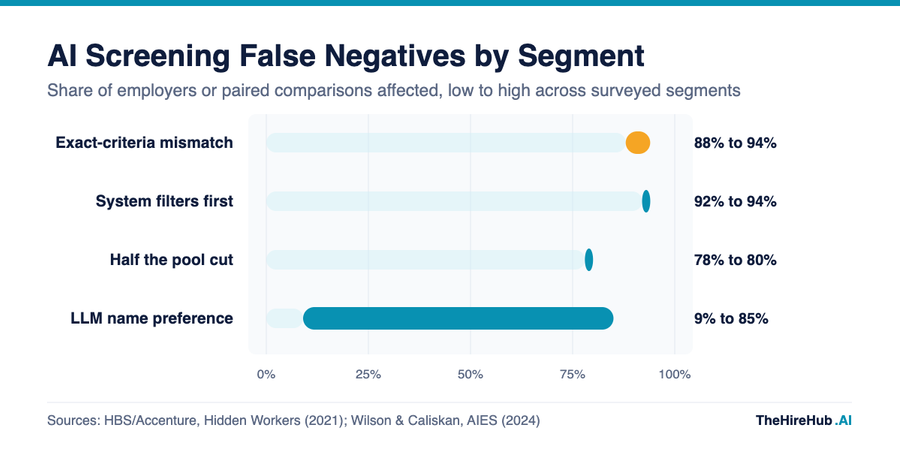
On the employer-reported side, the pattern is consistent. 78% of the business leaders interviewed by Harvard and Accenture estimated that half or more of their middle-skills candidates were eliminated by filtering, and 80% said the same about candidates for high-skilled positions. Nearly half of employers, 48%, filtered middle-skills candidates purely on the basis of an employment gap longer than six months, with no regard for anything else on the résumé.
The audit side is less flattering. In a 2024 study published at the AAAI/ACM Conference on AI, Ethics and Society, University of Washington researchers Kyra Wilson and Aylin Caliskan tested three production language models against 554 real résumés across more than 500 real job listings, generating over three million comparisons. The models favoured white-associated names 85% of the time and female-associated names 11% of the time. Black male candidates were passed over almost universally.
One quieter finding sits underneath all of this. Only 21% of employers said that all of their high-skills hires over the previous three years had met every requirement listed in the job posting. The requirements were never the real bar. They were just the thing the filter was pointed at.
How to read this chart:
- The bars show a range, not a single figure. The low end is the number reported for high-skills roles, the high end is the number for middle-skills roles, so the width of each bar is the extra exposure a more junior requisition carries.
- The employer bands are self-reported. Employers are describing behaviour they already know about, which makes these figures a floor rather than a ceiling.
- The model-audit band measures something different: how a language-model ranker distributes preference between two name groups across three million paired comparisons. It is not an employer estimate.
How it actually works, and where it breaks
Mechanically, most screening stacks do the same four things in sequence. They parse the document into structured fields, they apply hard knockout rules, they score what survives against the requisition, and they rank the survivors for a recruiter to read. False negatives can enter at any of the four, and they enter for different reasons.
The first failure mode is parsing loss. If the résumé is a two-column PDF, a design template, or a scan, fields land in the wrong place or vanish entirely. The candidate is then scored against an incomplete record. Our breakdown of AI resume parsing accuracy covers what specifically tends to break here.
The second failure mode is knockout rules doing the work of judgement. A knockout is binary: gap longer than six months, no degree, wrong city, fewer than five years in title. It fires before any scoring happens, so a strong candidate who trips one rule never reaches the part of the system that could have noticed they were strong. The six-month employment gap filter is the clearest example, because the rule encodes a proxy for recency of skills and then applies it to people whose gap had nothing to do with skills.
The third failure mode is proxy drift in the scoring model. Where knockouts are explicit and auditable, learned scoring is neither. If the model has picked up correlations between name, school, employer prestige and past hiring decisions, it will reproduce them, and the output will look like a confidence score rather than a preference. This is what the Washington audit was measuring.
The fourth is subtler and only appeared recently. A 2025 follow-up from the same Washington team, presented in October at the AI, Ethics and Society conference, put 528 people through a simulated screening task across 16 different jobs. Without an AI recommendation, participants showed little bias. When the simulated AI was severely biased, participants followed its picks around 90% of the time.
Human review, in other words, does not automatically function as a check. It functions as a check only when the reviewer is looking for the thing the model got wrong.
"Your screening stack is very good at explaining who it advanced, and completely silent about who it should have."
What this means for your team
The practical problem with false negatives is that you cannot manage what you never measure, and no standard recruiting dashboard measures rejection quality. Fixing that is a sequence, not a setting.
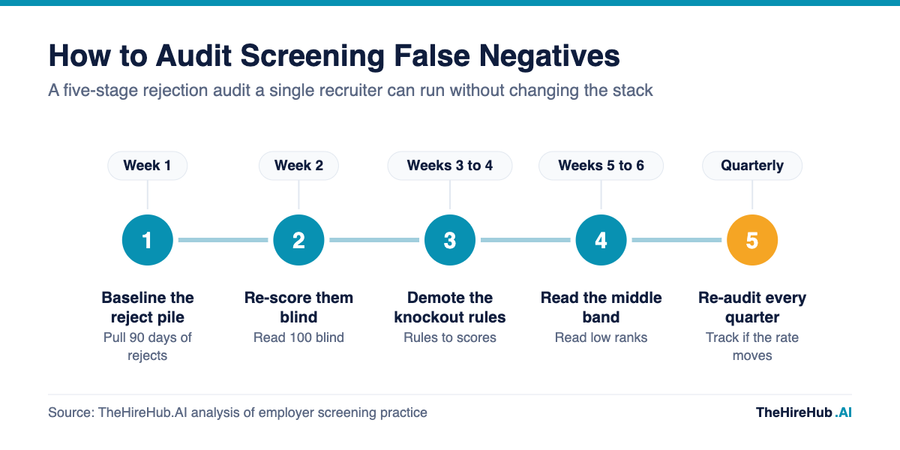
The sequence below is deliberately cheap. None of it requires replacing your stack, and one person can do the first two stages in a fortnight with a spreadsheet.
- Baseline the reject pile. Pull every application auto-rejected in the last 90 days for two or three representative requisitions. Record how many were rejected by a hard rule versus by a low score, and which rule fired.
- Re-score a blind sample. Take 100 rejected applications, strip names and schools, and have a recruiter or hiring manager read them cold against the actual job. The share they would have advanced is your false negative rate. Most teams running this for the first time find it uncomfortable.
- Convert knockouts into signals. Any rule that fires on more than a few percent of the pool should stop being a rule and start being a score input. Employment gaps and degree requirements are the usual first two to demote.
- Add a human review band. Instead of reading only the top-ranked candidates, read a fixed slice of the middle of the distribution as well. This is the cheapest structural catch there is, and it is the only one that finds mistakes the model does not know it made.
- Re-audit on a schedule. Requisition templates accumulate requirements the way tree trunks accumulate rings. Re-run the blind sample every quarter, on new requisitions, and watch whether the rate moves.
If you run high-volume roles, the arithmetic gets sharper rather than softer, because a one-point shift in the false negative rate is a large absolute number of people. Our note on high volume hiring works through the mechanics at that scale.
False negatives vs bias: not the same problem
These two get collapsed together, and the conflation makes both harder to fix. Bias is a distributional problem: the system treats comparable candidates differently depending on a protected or proxied attribute. A false negative is an accuracy problem: the system rejects someone who could do the job, regardless of who they are.
The overlap is real but partial. A biased model produces false negatives, which is why the Washington audits matter. But a perfectly unbiased model with a six-month gap knockout still produces a large volume of false negatives, and no fairness audit will catch them, because the rule applies uniformly to everyone.
Compliance work under NYC Local Law 144 and the EU AI Act tests for disparate impact, not for missed talent. If that is your immediate concern, our guide to AI hiring compliance covers what the statutes actually require, and our note on bias free hiring covers the distributional side.
Treat them as two separate audits with two separate owners. The fairness audit answers whether you are treating people equally. The false negative audit answers whether you are finding the best ones.
How to actually do this (and the four traps)
Trap one: measuring accuracy on the people you hired. Every "our AI is 95% accurate" claim you will be shown is computed on candidates who advanced. It is a statement about false positives, so ask the vendor for the false negative rate and how it was derived. If the answer involves candidates who were never interviewed, no one knows.
Trap two: treating the rejected pool as gone. Most of these people are already sitting in your system, correctly parsed and freshly rejected. Re-screening past applicants when a similar role opens is the highest-yield sourcing you can do, and it is what talent rediscovery is for.
Trap three: assuming human review is the safety net. The 2025 Washington result is the direct rebuttal. A reviewer who sees a ranked list and reads from the top has not audited the model, they have ratified it. Review only catches false negatives when the reviewer looks at candidates the model ranked low.
Trap four: tuning the model instead of the requisition. Most false negatives originate in the job description, not the algorithm. If the posting lists twelve requirements and only 21% of your actual hires met all of them, the filter is faithfully enforcing a standard your own organisation does not apply. Cut the requisition first, then look at the model.
"Nobody ever got promoted for the hire they nearly missed, which is exactly why no one is counting them."
The one thing every hiring leader should take from this
Run the blind sample. Not the vendor audit, not the fairness report, not the dashboard review: take 100 applications your system rejected last quarter, strip the identifying details, and read them against the job as it actually exists. You will get a number within a week, it will cost you nothing, and it is the only number in hiring that tells you what your process is quietly throwing away, because every other metric on your dashboard describes only the people who made it through. At TheHireHub we think that single exercise changes more hiring decisions than any tooling change, and we are happy to talk it through if you want a second pair of eyes.
Hiring shouldn't have to feel harder just because the talent market is more competitive.
At TheHireHub.ai, we help hiring teams simplify the process from finding the right candidates to assessing and ranking them, so your team can spend less time managing the hiring process and more time making the right decisions.
If you're looking to make hiring easier, faster, and better, we'd be happy to help.
Frequently Asked Questions
A false negative is a candidate who could have performed the job but was rejected by an automated screening step before a human reviewed the application. It is the opposite of a false positive, which advances someone who cannot do the job. False negatives are harder to detect because a rejected candidate generates no downstream signal in your hiring data.
Harvard Business School and Accenture found that 88% of employers agreed qualified high-skills candidates are vetted out because they do not exactly match job description criteria, rising to 94% for middle-skills roles. 78% of business leaders in the same research estimated that half or more of their middle-skills applicants were eliminated by filtering.
Take a sample of roughly 100 applications your system rejected, remove names, schools and employers, and have a recruiter or hiring manager assess them cold against the real job requirements. The proportion they would have advanced is your working false negative rate. Repeat quarterly on fresh requisitions to see whether it moves.
Four things, in roughly this order of frequency: parsing errors that lose or misplace résumé fields, hard knockout rules such as employment gap or degree filters, learned scoring models that have absorbed proxies for prestige or demographics, and job descriptions that list requirements the organisation does not genuinely apply to its own hires.
Yes, and they are among the largest single contributors. In the Harvard and Accenture research, 48% of employers filtered middle-skills candidates on the basis of an employment gap longer than six months alone. The rule is a proxy for skill recency and it fires on caregivers, people recovering from illness, and military spouses regardless of capability.
No. Bias means comparable candidates are treated differently based on an attribute or a proxy for one. A false negative means a capable candidate was rejected, whoever they are. Biased systems produce false negatives, but an unbiased system with aggressive knockout rules produces plenty of them too, and a fairness audit will not detect those.
Not reliably. In a 2025 University of Washington study of 528 participants across 16 job types, reviewers working with a severely biased AI recommendation followed its picks around 90% of the time. Review catches false negatives only when the reviewer deliberately examines candidates the system ranked low, rather than reading down from the top.
Not directly. Both regimes focus on disparate impact and on transparency toward candidates rather than on whether qualified people are being missed. A system can pass a bias audit under either framework while still rejecting a large share of capable applicants, so the false negative audit needs to be run separately.
Demote your knockout rules to scoring inputs and add a human review band over the middle of the ranked distribution. Both are configuration changes rather than procurement decisions, and together they address the two largest mechanical causes without touching the underlying model.
It raises the cost of each one. Higher application volume pushes teams to tighten filters, and tighter filters reject more capable people while the extra volume makes the funnel look healthier on every standard metric. Volume growth without a rejection audit tends to increase the false negative rate and hide it at the same time.


