
How Many Interview Rounds Should You Run in 2026? The Data Says Four
The average hire now passes through five stages and up to 17.6 separate conversations, and almost none of the growth bought better hires.
The median 2026 hire passes through five interview stages. Four is the ceiling that candidates tolerate and the point where extra rounds stop adding signal.

TL;DR
The average corporate hire in 2026 moves through five distinct interview stages and between 11.7 and 17.6 separate conversations, depending on whether the role is a business or a technical one. If you are asking how many interview rounds to run, the defensible answer is four, with a fifth only when the role genuinely spans two different skill families. Google's People Analytics team found four interviews predicted the hiring decision with 86% confidence, and Greenhouse's candidate research puts the tolerance ceiling at two to four. Everything past that buys certainty for the panel and pays for it with the candidates you most wanted, which is why the calendar deserves as much attention as the scorecard in our time to hire benchmarks.
What is actually happening
Hiring loops did not get longer because anyone decided they should. They got longer because three separate pressures each added a gate, and nobody went back to remove the gate that the new one replaced. Inside most 2026 five stage loops, the 2019 version (recruiter screen, then onsite) is still sitting there intact. The new rounds layered on top.
The first pressure is volume. BambooHR's State of Hiring 2026 put applicants per posting at roughly 95 in 2025 against about 46 in 2021, and completed hires fell 22% over the same window. More applicants meant more screening gates before the interviews that actually decide anything.
The second is fear. SHRM's 2025 benchmarking put cost per hire at $5,475 for non-executive roles and $35,879 for executive ones, the latter up 113% since 2017. Every extra round gets justified by the cost of getting it wrong, and the cost of getting it wrong keeps rising partly because the loops keep growing. A 2022 Harvard Business Review piece by Atta Tarki, Tyler Cowen and Alexandra Ham named this plainly: companies afraid of bad hires have built bloated processes, and the treatment has become worse than the disease.
The third is candidate optionality. Gartner's 2023 survey of roughly 3,500 candidates found half accepted an offer and then backed out before starting, with more than a third holding four or more offers at once. Employers responded by adding late commitment rounds, which lengthened loops, which gave candidates more time to accumulate competing offers.
Three things are worth separating before you look at any benchmark:
- Stages are the named gates in your pipeline: phone screen, onsite, final round. The candidate experiences these as rounds.
- Events are the individual scheduled conversations inside those gates. Five stages with three interviewers each is fifteen events.
- Interviewer hours are what the business actually pays. Ashby's 2026 data puts a technical hire at 23.3 hours of interviewer time.
The numbers
There are two numbers in this argument and they do not agree. Greenhouse's 2024 candidate research put the ceiling candidates are willing to complete at two to four interviews. The median employer loop in 2026 runs five distinct stages, with more than a third of roles configured at seven or more. India sits marginally tighter, at three to five rounds depending on seniority.
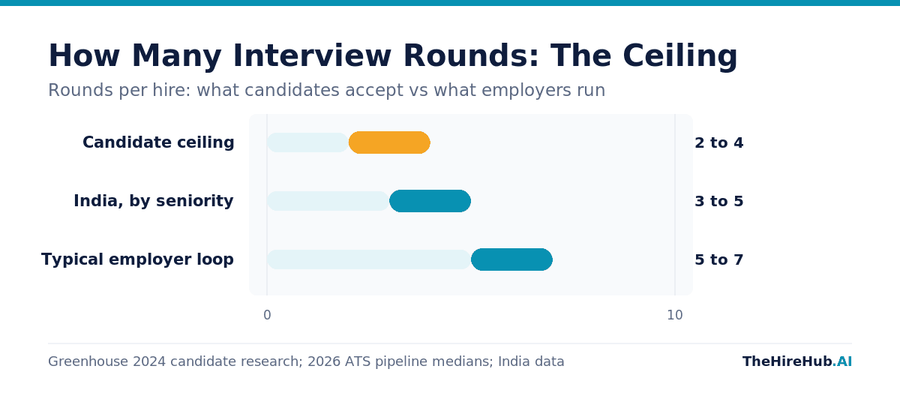
How to read this:
- The gap between the top bar and the bottom bar is your drop-off risk. Every round above the candidate ceiling is a round where your strongest candidate, the one with other offers, quietly decides you are not worth the calendar.
- The employer range is wider than it looks. Five stages with three interviewers in each is fifteen separate conversations, which is how technical roles reach 17.6 interview events per hire on Ashby's 2026 data against 11.7 for business roles.
- India is not exempt, it is just earlier in the same curve. Three to five rounds is the current norm, but sector offer dropout already runs 25% to 32%, so the tolerance ceiling binds sooner than the round count suggests.
How it actually works, and where it breaks
The mechanism is simple enough. Each round is supposed to test a distinct attribute, and the panel combines independent reads into a decision. When that works, adding a round adds information. The trouble is that rounds stop being independent long before teams stop adding them.
The first failure mode is redundancy. Roughly half of hiring pipelines run the recruiter screen and the hiring manager conversation as separate gates, and the two ask most of the same qualification questions. A second read of the same attribute is not a second data point, it is the same data point costing another week.
The second is drop-off. Greenhouse's 2024 Candidate Experience Report found candidates view two to four interviews as the maximum they are willing to complete, that 52% had been ghosted after at least one interview, and that 20% rejected an offer specifically because of the interview experience. In India the squeeze is sharper still, with sector offer dropout running 25% to 32% and average notice periods for senior tech roles at 62 days. Every round past four raises the odds that your strongest candidate is gone before the offer, and losing them restarts the whole sequence.
The third is the calendar. Greenhouse's benchmarks across 247,000 jobs show time to fill rising from 43.64 days in 2022 to 59.67 days in 2025, a 37% climb. Each additional stage adds a scheduling round trip, and reference checks moving from post-offer admin to pre-offer gate added five to seven days on their own. Slow loops lose candidates to faster ones, which is the quiet mechanism behind a falling offer acceptance rate.
"The fifth round almost never changes the decision. It changes who is still available to accept it."
What this means for your team
Four rounds is not fewer rounds. It is the same evaluation, with the sequential dependencies removed and each gate assigned exactly one attribute it owns. Here is the shape that holds up.
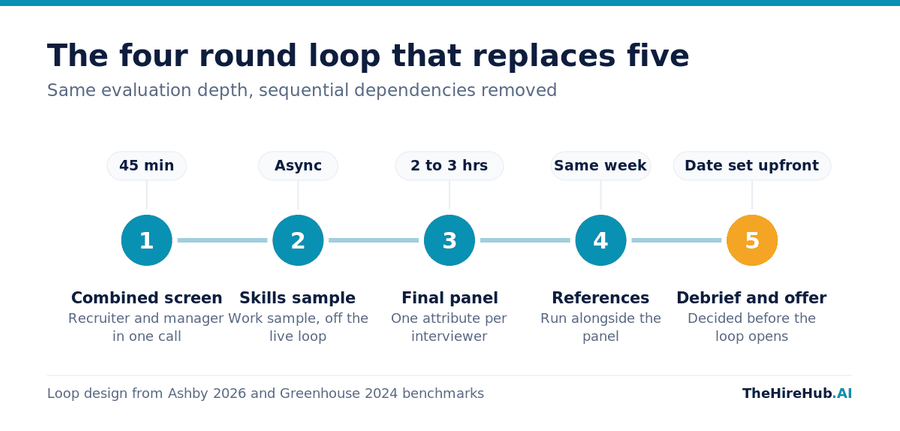
Stage by stage, the design rules matter more than the count:
- Combine the recruiter screen and the hiring manager conversation. One 45 minute call with both people present covers the qualification and the depth, and saves a full week of coordination.
- Make the skills assessment asynchronous. A work sample produces stronger signal than a live hour of the same exercise, and it comes out of the live loop entirely.
- Give each panel interviewer one attribute and one scorecard. Overlapping briefs are what turn a panel into three versions of the same interview.
- Run references in parallel with the final round, not after it. The diligence is identical and you get the five to seven days back.
- Decide on a fixed debrief date set before the loop starts. Most lost time is not interview time, it is the gap between the last interview and someone making a call.
Four rounds versus the five stage default
The nearest alternative to a designed four round loop is the one most teams already run: five or more stages that accumulated organically. It is worth being precise about why that default loses. It is not slower because it has one more gate. It is slower because the gates are sequential, overlapping and unscheduled, so each one adds a scheduling round trip on top of its own duration.
The other alternative is the opposite error, compressing to two rounds and pushing the screening burden onto automated filtering. That trades one failure for another, because aggressive automated screening rejects qualified people silently and you never see what you lost. The workable middle is fewer human gates fed by better matched candidates, which is what AI candidate screening tools are actually for. Screening quality at the top of the funnel is what makes a shorter loop safe, and it also reduces the load behind a stretched recruiter to hire ratio.
How to actually do this (and the four traps)
- Do not cut rounds without reassigning what they measured. Deleting the fifth interview is only safe if the attribute it tested moves somewhere explicit. Cutting blind is how teams end up adding a sixth round eight months later.
- Do not let seniority silently add gates. Senior roles justify more stakeholders, not more sequential rounds. Add people to an existing panel rather than adding another week to the calendar.
- Do not measure the loop by interviews per hire alone. That number falls if you simply reject earlier, which looks like efficiency and is not. Track it against offer acceptance and 90 day retention, the pairing we lay out in our AI hiring metrics guide.
- Do not treat the no-show as a candidate problem. When people stop turning up mid-loop, the loop is usually the cause, and the pattern behind interview no-show rates is nearly always length and silence rather than bad intent.
One more thing worth saying about cost. At SHRM's $5,475 average cost per hire, interviewer time for a single extra round across a typical pipeline is a meaningful fraction of the total, and the vacancy days it adds usually cost more than the interviews themselves. Our cost per hire benchmarks put the India figure at ₹30,000 to ₹70,000 for most roles, which makes the calendar cost, not the interviewer cost, the line that moves.
"A hiring process that cannot explain what each round measures is not being rigorous, it is being indecisive in public."
The one thing every hiring leader should take from this
Count your stages, then ask what attribute each one owns and where that attribute would go if the stage disappeared. Most teams find at least one round that cannot answer the question, and that round is costing them candidates, calendar and interviewer hours in exchange for a feeling of thoroughness. Four rounds, each measuring something distinct, beats six that overlap, and the evidence for that has been sitting in the benchmarks for years. If you want a second pair of eyes on your loop, we look at this stuff all day.
Frequently Asked Questions
The median corporate hire passes through five distinct interview stages. Technical roles average 17.6 separate interview events per hire and business roles 11.7, according to Ashby's 2026 Talent Trends Report. In India, three to five rounds is the common range, rising with seniority.
Four. Google's People Analytics research found four interviews predicted the hiring outcome with 86% confidence, and Greenhouse's candidate research found two to four is the maximum most candidates will complete. A fifth round is defensible only when a role spans two genuinely different skill families.
Past four, drop-off risk starts rising faster than signal quality. Greenhouse found 20% of candidates rejected an offer because of the interview experience, and INSEAD noted candidates reporting nine to twelve rounds for a single position at the extreme end.
Three pressures compounded. Applicants per posting roughly doubled between 2021 and 2025, fear of a bad hire rose as executive cost per hire climbed 113% since 2017, and candidate optionality pushed employers to add late commitment rounds. New gates layered on top of old ones instead of replacing them.
Greenhouse's benchmarks put average time to fill at 59.67 days in 2025, up 37% from 2022. India runs roughly 35 to 45 days from approved requisition to accepted offer for most white collar roles, stretching past 60 days for senior and niche hires.
Most of the cost is calendar, not salary. An extra round adds interviewer hours across everyone still in the pipeline, plus roughly a week of additional vacancy, plus the expected loss when a late stage candidate drops out and the sequence restarts.
No published benchmark links the growth in rounds to better retention, ramp or performance. Interview events per hire rose 42% between 2021 and 2024 on Gem's data without a matching quality improvement, which is the core argument for designing loops rather than letting them accumulate.
Roughly 16 candidates receive some form of interview per hire, and about three reach the final loop, derived from Gem's published passthrough rates. Engineering roles run closer to 30 candidates interviewed per hire because so few applicants clear technical screening.
No. References have drifted from post-offer administration to a pre-offer gate in most pipelines, adding five to seven days of calendar time. Running them in parallel with the final round preserves the diligence and returns the week.
It can, but only by improving who enters the loop rather than by replacing human judgement inside it. Better matched candidates at the top of the funnel mean fewer late rounds added to compensate for weak early signal. Aggressive automated filtering without oversight creates the opposite problem, silently rejecting qualified people.

