
Recruiter to Hire Ratio: How Many Open Reqs One Recruiter Can Actually Carry in 2026
The average recruiter now carries 14 open requisitions against 2,500 applications, and the number that matters is not the count but the weight behind it.
The average recruiter now carries 14 open requisitions and 2,500 applications. What a defensible recruiter to hire ratio actually looks like, and the four traps.

TL;DR
The honest recruiter to hire ratio is 15 to 20 open requisitions for a corporate recruiter working mixed roles, and the average recruiter today carries 14 while processing more than 2,500 applications a year. That sounds comfortable until you look at what changed underneath it: the same 14 reqs in 2021 came with roughly a third of the application volume and a team that was 23% larger. Req count is a unit of measurement, not a unit of work, so a flat number almost certainly overloads whoever holds your hardest searches. The fix is to weight reqs before you count them, then automate the volume rather than raising the ceiling. For the wider dashboard this metric sits inside, start with our guide to AI hiring metrics.
What is actually happening
Three things moved against recruiters at the same time, and only one of them shows up on a capacity spreadsheet. Gem's 2025 Recruiting Benchmarks, drawn from more than 140 million applications and 1.3 million hires between January 2021 and December 2024, put the average recruiter at 14 open requisitions, up 56% in three years. Over the same period the average talent acquisition team shrank from 31 people to 24. So the load per person rose while the bench behind each person got thinner.
The third change is the one nobody budgets for. Applications per recruiter climbed to more than 2,500, roughly 2.7 times the volume of three years earlier. A req is not a fixed quantity of work. It is a container, and the amount of work inside it has nearly tripled while the label on the outside stayed the same.
The downstream effects are already visible in the funnel. Hiring teams now run about 20 interviews per hire, against 14 in 2021, and average time to hire stretched from 33 days to 41. Both of those usually get blamed on indecisive hiring managers, and some of it genuinely is. A good deal of it is a recruiter with 14 containers who cannot get to the bottom of any of them.
SHRM's own guidance has held roughly steady through all of this, which is itself informative. Its HR Knowledge Center puts the national cross-industry average at 30 to 40 open reqs per recruiter at any one time, with the median closer to 15 to 20. Individual loads observed in practice run from single digits to well over 100. That is not a benchmark so much as a warning that the spread is the story.
What makes the spread meaningful is role complexity. Tim Sackett, writing for SHRM, put the practical difference plainly: a recruiter working high-volume roles might comfortably hold 20 openings at once, while a recruiter working scarce-skill searches might manage four or five. Assign both of them 20 and you have not standardised anything. You have quietly created one bored recruiter and one who is about to resign.
The numbers
Here is the same question answered five different ways, which is exactly why teams argue about it. Each band below measures something real. They disagree because they are not measuring the same thing.
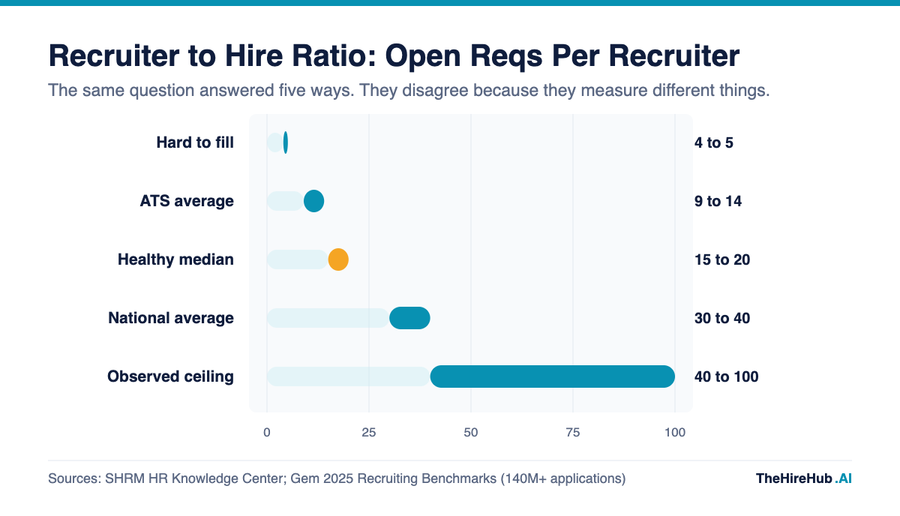
Read against each other, these bands say something more useful than any single figure. The 4 to 5 band is what a genuinely hard search costs when someone does it properly: real sourcing, real market mapping, real closing. The 30 to 40 national average is not a target anyone chose. It is what happens when hiring plans expand faster than recruiter headcount gets approved, and it is the band where quality quietly stops being measurable.
The gap between 14 and 20 is where most teams actually live, and it is narrower than it looks. A recruiter at 14 weighted reqs is at capacity. A recruiter at 14 reqs where nine of them are repeat high-volume roles has room. The count alone cannot tell you which one you have.
- The measurement window matters more than the number. A point-in-time count of actively worked reqs runs far lower than an annual assigned load. Compare like with like or the benchmark is noise.
- Weight before you count. Score each req by search difficulty, then cap the weighted total. A scarce-skill search should count as three or four ordinary ones.
- Applications per req is half the load. Two recruiters at 14 reqs are not carrying the same job if one of them is fielding three times the applicant flow. Track the product, not the count.
How it actually works, and where it breaks
The mechanism is straightforward. A requisition consumes recruiter hours in four buckets: intake and calibration, sourcing and outreach, screening and scheduling, and closing. Only the first and last genuinely require the recruiter, while the middle two scale with volume, and volume is precisely what exploded. That is why req load became a live problem in a period when hiring itself was flat.
The first failure mode is silent triage. Above roughly 20 to 30 reqs, recruiters stop doing the work in order and start doing it by whoever shouted most recently. Intake meetings get skipped because the hiring manager seems clear enough. Active sourcing stops in favour of reviewing whatever arrived inbound, which is the 49% of applications that produce under 25% of hires.
The second failure mode is shallow screening, and it is expensive in a way that never appears in a capacity report. A stretched recruiter screens for obvious disqualifiers rather than genuine fit, which systematically rejects strong non-obvious candidates. This is the same category of error automation makes at scale, and it is worth understanding both versions: see our breakdown of AI screening false negatives.
The third failure mode is that none of this is visible for about two months. Req count is a leading indicator that reads as fine right up until time to fill and quality of hire both slip, at which point the cause is eight weeks in the past and gets attributed to the market. If you are not already tracking it, quality of hire measurement is the metric that catches this drift earliest.
"A req count tells you how many searches a recruiter has been given, and almost nothing about whether any of them are being run well."
What this means for your team
Setting a defensible ratio takes about three weeks and no new software. The sequence matters more than the precision, because the point is to get a weighted ceiling you can defend to a hiring manager who wants one more search added this week.
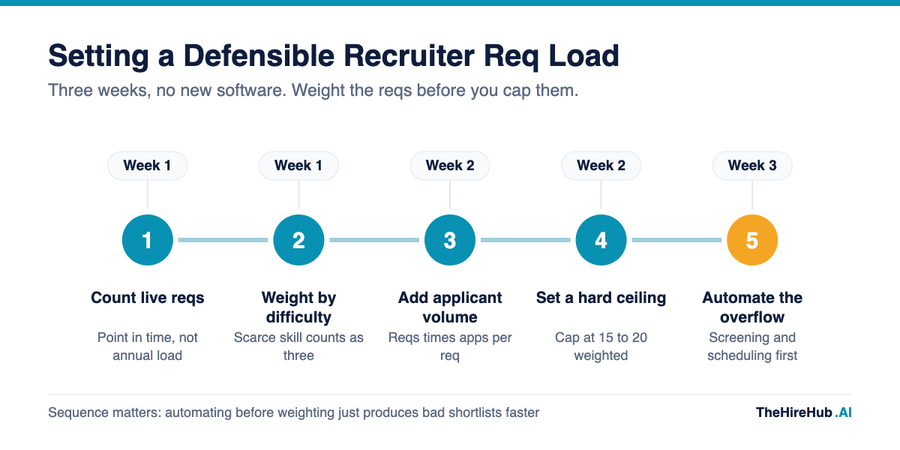
Two details in that sequence do most of the work. Weighting is where the honesty lives: if every req scores the same, you have rebuilt the flat average you were trying to escape. And the ceiling has to be a real cap, not a guideline, or it becomes the number people breach politely every quarter until it means nothing.
The automation step comes last on purpose. Automating a broken intake process just produces bad shortlists faster. Once the weighting is real and the ceiling holds, the highest-return targets are the two middle buckets: sourcing outreach and screening plus scheduling. Those are volume problems, and volume problems are what software is actually good at.
- Weight scarce-skill searches at 3x an ordinary professional req, and high-volume repeat roles at 0.5x.
- Cap the weighted total at 15 to 20, then hold the line when the next req arrives.
- Review monthly, not annually. Load drifts upward between reviews, never downward.
Adding a recruiter versus automating the load
When the ceiling binds, there are two moves, and most teams pick the wrong one by default. The first is to hire another recruiter. In India that is a real and recurring cost: Glassdoor reports the average talent acquisition specialist salary at ₹6,00,000 a year, with base pay typically running ₹4,00,000 to ₹8,00,000. Add tooling, ramp time and management overhead and a marginal recruiter is a commitment of roughly ₹8,00,000 to ₹12,00,000 a year before they fill anything.
The second move is to take work out of the req rather than adding people to absorb it. That is the case for recruitment automation, and its economics are different in kind: it lifts capacity per recruiter instead of adding a fixed annual cost, and it compounds across every req rather than being assigned to a subset of them. It is also easier to reverse if it does not work.
Neither move is automatically right. Adding a recruiter wins when the bottleneck is judgement work, meaning closing, calibration and hard searches, because those do not automate well. Automation wins when the bottleneck is volume, which for most teams sitting above 14 reqs it is. If you want to run that comparison properly rather than by instinct, work through our AI recruitment ROI framework before you approve either.
How to actually do this (and the four traps)
- Do not benchmark against a number whose methodology you cannot state. An ATS-measured average and a self-reported sustainable load differ by design, and comparing them produces a target nobody can hit. Write down which one you are using before you set a ceiling.
- Do not distribute reqs evenly. Even distribution is the single most common capacity error and it disguises itself as fairness. It reliably overloads your strongest searcher, because hard reqs get assigned to whoever handles them best, and then that person carries the same count as everyone else.
- Do not treat the ceiling as advisory. A cap that gets exceeded whenever a hiring manager escalates is not a cap. Decide in advance what gives when req 21 arrives: it waits, it gets reassigned, or something already open gets paused. Pick one now, in writing.
- Do not automate before you weight. Automation multiplies whatever process it is pointed at, including a bad one. Get the intake and the weighting right first, then apply AI candidate sourcing to the volume layer where it actually pays back.
"Capacity planning that assumes every requisition weighs the same is not planning, it is arithmetic performed on the wrong number."
The one thing every hiring leader should take from this
The recruiter to hire ratio is not a number you can copy from a benchmark table, and the teams that try end up defending a figure they cannot explain. It is the product of three things: how many searches are open, how hard each one is, and how much applicant volume each one drags behind it. Get those three right and the ceiling sets itself; get them wrong and you will keep hiring recruiters to solve a problem that is not a headcount problem. If you want a second opinion on where your own load actually sits, we look at this stuff all day.
Frequently Asked Questions
For a corporate recruiter working mixed professional roles, 15 to 20 open requisitions is the widely cited sustainable median, per SHRM's HR Knowledge Center. The ATS-measured average across Gem's 2025 benchmark data is 14. Treat either as a starting point and adjust for role complexity and applicant volume before you set a ceiling.
It depends almost entirely on search difficulty. SHRM cites practitioner guidance that a high-volume recruiter may hold around 20 openings at once while a recruiter on scarce-skill searches manages four or five. Observed loads in practice range from single digits to well over 100.
Count the requisitions actively being worked at a single point in time, not everything assigned over a year, then divide by the number of recruiters carrying them. The two measurement windows produce very different numbers, so state which one you used whenever you quote the result.
Reqs per recruiter is a snapshot of workload: how many searches are open right now. Hires per recruiter is throughput: how many closed over a period. A team can look healthy on one and be failing on the other, so capacity planning needs both.
Quality typically degrades in the 20 to 30 band, above the sustainable median but below the cross-industry average. The tell is behavioural rather than numerical: intake meetings get skipped, proactive sourcing stops, and screening gets shallower. None of that shows up in a req count.
It changes the volume layer, not the judgement layer. Sourcing outreach, screening and scheduling scale well with automation, which is where most of the added load sits. Intake, calibration and closing do not, so automation raises the ceiling without removing the need for experienced recruiters.
Larger organisations generally carry higher loads per recruiter, because hiring plans expand faster than recruiter headcount gets approved. Gem's data showed average team size falling from 31 to 24 between 2022 and 2024, precisely at companies large enough to have teams that size.
When the weighted load has held above your ceiling for two consecutive months and the excess is judgement work rather than volume work. If the excess is volume, screening and scheduling in particular, automation is usually the cheaper and more reversible move.
Glassdoor puts the average talent acquisition specialist salary in India at ₹6,00,000 a year, with base pay typically between ₹4,00,000 and ₹8,00,000. Fully loaded with tooling, ramp and management time, budget meaningfully above the headline salary figure.
Because application volume rose independently of open roles. Gem recorded more than 2,500 applications per recruiter, roughly 2.7 times the level of three years earlier, against a req count that rose 56%. The work inside each requisition grew faster than the number of requisitions.


