
Interview Scorecard Template: How to Build One That Predicts Performance (2026)
A one-page scorecard, scored blind, is the cheapest upgrade most hiring loops never make.
An interview scorecard template turns gut feel into evidence. Build one in three days, see why structured interviews predict better, and avoid the four traps.

TL;DR
An interview scorecard template is a one-page form that lists four to six job-relevant criteria, defines what a 1, 3 and 5 look like for each, and makes every interviewer commit a score before the debrief starts. It matters because structure is the biggest single lever in interviewing: the 2022 Sackett meta-analysis put structured interviews at a validity of 0.42 and unstructured ones at 0.19, so the same conversation predicts more than twice as well once it is scored against fixed criteria. The template takes about three days to build and one calibration session to bed in. If your loop already feels slow and political, start with our piece on interview chaos and then come back here.
What is actually happening
Most companies say they run structured interviews. Very few do. What they run is a calendar of conversations where each interviewer improvises questions, forms a gut view, and then argues for it in a debrief where the loudest or most senior voice wins.
A scorecard changes the order of operations. The criteria are agreed before the first candidate is seen, each interviewer is assigned two or three of them, and scores are written down independently before anyone speaks. That sequence matters more than the form itself, because it removes anchoring on the first opinion in the room.
The research case is old but has been revised downward in an honest way. Schmidt and Hunter's 1998 review gave structured interviews a validity near 0.51 and unstructured ones near 0.38. The 2022 update by Sackett and colleagues argued the older corrections were too aggressive and lowered those figures to 0.42 and 0.19. The gap between structured and unstructured actually widened, which is the part most people miss.
There is a fairness argument too. In the same 2022 work, the Black-White score difference was reported at 0.23 for structured interviews against 0.79 for cognitive ability tests. A scorecard is not a bias cure, but it narrows the room in which bias operates, which is why it sits underneath any serious approach to bias-free hiring.
Finally, scorecards are what make everything downstream measurable. You cannot compute quality of hire if the inputs were vibes. A scored record at the interview stage is the only thing you can later compare against actual performance.
The numbers
The honest headline is that no selection method is as predictive as the old literature suggested, and structure is what separates a useful interview from a coin flip. The chart below shows the range between the 2022 revised estimate and the 1998 estimate for four common predictors, expressed as validity coefficients multiplied by 100.
A second point is easy to miss. Cognitive ability tests, long treated as the gold standard, fell from 51 to 31 in the revision, while structured interviews fell far less. That is a quiet argument for investing in interview design before buying more assessment software.
Read the amber bar as the argument of this post. Even at the pessimistic end, a structured interview sits at 42, close to where work samples and job knowledge tests land after revision, while an unstructured interview sits at 19 in the revised data.
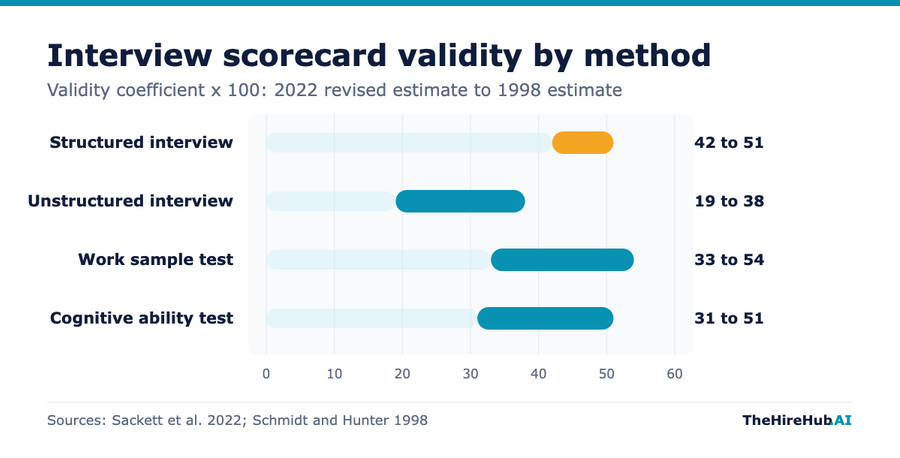
- How to read this: each bar runs from the 2022 estimate (left edge) to the 1998 estimate (right edge). A long bar means the field has argued about the true value, not that the method is erratic.
- What to take from it: structured interviews and work samples are in the same league. Unstructured interviews are the weak link, and they are the default at most companies.
- What not to take from it: these are averages across studies and jobs. Your own scorecard can underperform them if the criteria are vague or the raters are untrained.
How it actually works, and where it breaks
The mechanism is simple. A scorecard forces three things that an unstructured interview lets you skip: the same competencies assessed for every candidate, written evidence attached to every score, and independence between raters. Validity comes from consistency, not from cleverness.
There is also a practical benefit that has nothing to do with prediction. When every candidate is scored on the same criteria, you can compare people interviewed three weeks apart by different panels. Without that, a strong candidate seen on a Monday is quietly measured against a weak one seen on Friday, and recency does the deciding.
It breaks in three predictable places. The first is criteria that are really traits, such as "culture fit" or "strong communicator", which every rater reads differently and which quietly reintroduce affinity bias. The second is scales without anchors: a 1 to 5 rating with no description of what a 4 looks like produces five different private scales and a spurious average.
The third failure is the debrief. If raters see each other's scores before submitting their own, the first number out loud pulls the rest toward it. It is worth checking whether your applicant tracking system can hide scores until every rater has submitted, because that one setting protects the whole exercise. A related trap shows up when the hiring manager becomes the single point of approval, which is the pattern behind the hiring manager bottleneck.
"A scorecard does not make interviewers smarter, it simply stops them from deciding first and justifying afterwards."
What this means for your team
Build the scorecard in this order, because each stage constrains the next. Begin with the outcomes the role must deliver in its first year, then derive the criteria from those outcomes rather than from the job description. Four to six criteria is the working range; beyond that raters lose focus and the form stops being filled in honestly.
Next, write behavioural anchors. For each criterion, describe in one line what a 1, a 3 and a 5 sounds like in an answer. Then run a calibration session where your interviewers score the same recorded or written sample answer and compare. The disagreements you find in that hour are the whole point.
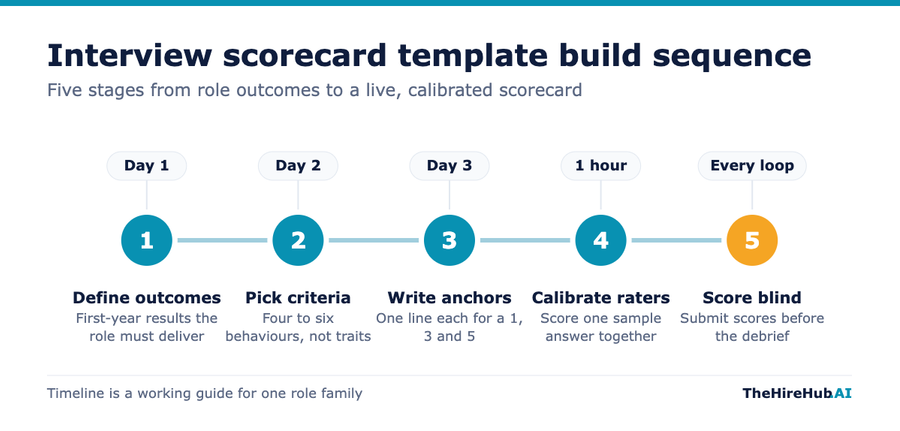
Once live, the loop is mechanical. Each interviewer owns specific criteria, asks the same core questions of every candidate, and submits scores and evidence before the debrief. The debrief then discusses only the gaps between raters, which shortens it considerably.
A realistic timeline is one day to agree outcomes, one to choose criteria, one to write anchors, and a one hour calibration before the first live interview. Teams that skip calibration usually discover the problem in the first debrief, when two raters give the same candidate a 2 and a 5 and cannot explain why.
Review the scorecard after the first three hires. Compare interview scores against the early performance signals you trust, and retire any criterion that never separates anyone.
Interview scorecard vs the alternative
The nearest neighbour is the free-form feedback note, where each interviewer writes a paragraph and a recommendation. It feels richer, but it is nearly impossible to compare across candidates and it rewards fluent writers over careful observers.
AI interview tooling sits on the other side. Automated scoring can apply a rubric consistently across hundreds of candidates, but it only inherits whatever rubric you give it, which is why the quality of your criteria matters more than the model. Our breakdown of AI interview scoring covers what such systems measure and where they fail, and the broader logic of keeping a person accountable is in human in the loop hiring.
Neither extreme is the right answer for a growing team. The scorecard is the stable layer that both people and software should plug into, and it stays valuable whether your process is run in a spreadsheet or inside an automation platform.
The practical rule: write the scorecard by hand first. If you cannot define a 1, a 3 and a 5 for a criterion, no tool can score it for you.
How to actually do this (and the four traps)
Start with one role family, not the whole company, and ship a version that fits on a single page. Then watch for these four traps.
- Scoring traits instead of behaviours. "Ownership" is a trait; "describes a time they fixed a problem outside their remit and what it cost them" is a behaviour. Write criteria so a rater can point to evidence in the answer.
- Letting the scale drift. Without anchors and a calibration session, one rater's 4 is another's 2. Recalibrate every quarter, and whenever a new interviewer joins.
- Averaging away the red flag. A 5 on communication does not cancel a 1 on integrity. Mark certain criteria as must-pass, and treat a low score there as a stop regardless of the mean.
- Skipping the feedback loop. A scorecard nobody checks against outcomes decays into paperwork. Tie it to your cost per hire benchmarks and early performance data so you can see whether it is earning its keep.
"If you cannot say what a five looks like in an answer, you are not measuring anything, you are collecting opinions."
The one thing every hiring leader should take from this
Interviews are not unreliable because people are careless. They are unreliable because we ask a conversation to do the work of a measurement and then act surprised when it behaves like a conversation. The fix is not a smarter interviewer, it is a smaller, sharper question: what exactly are we scoring, and who is scoring it? Answer that before the first candidate walks in, and the rest of the process gets easier to run, easier to defend and easier to improve. At TheHireHub we see the same pattern in nearly every loop that has gone wrong, and we look at this stuff all day.
Frequently Asked Questions
It is a one-page form listing four to six job-relevant criteria, with a short description of what a 1, 3 and 5 look like for each. Every interviewer scores the same criteria and records evidence before the debrief, so candidates are compared on the same basis.
Four to six is the working range. Fewer than four leaves gaps in what you assess, and more than six makes raters rush, which pushes scores toward the middle and weakens the evidence behind each one.
The research says yes. The 2022 Sackett meta-analysis put structured interview validity at 0.42 and unstructured at 0.19. The older 1998 Schmidt and Hunter estimates were higher for both (0.51 and 0.38), but structure won in both studies.
No. Seeing an early score anchors everyone else. Have each rater submit scores and written evidence independently, then discuss only the criteria where raters disagree.
It is a one-line description of what a given score sounds like in an answer. For example, a 5 on problem solving might be a candidate who names a specific problem, their own action, and a measurable result. Anchors keep every rater's scale aligned.
About three working days for one role family: one day to agree outcomes, one to choose criteria, one to write anchors. Add an hour of rater calibration before the first live interview.
It can apply a rubric consistently at volume, but it inherits whatever rubric you give it. Write and test the scorecard by hand first, and keep a person accountable for the final decision.
Review it after the first three hires, then roughly every quarter, and whenever a new interviewer joins. Retire criteria that never separate candidates and recalibrate raters on the same sample answers.
It narrows the room for bias but does not remove it. In the 2022 Sackett work, group score differences were reported at 0.23 for structured interviews against 0.79 for cognitive ability tests, so structure helps, but vague criteria can still let affinity bias back in.

