
The Hiring Manager Bottleneck in 2026: Where Your Time to Hire Actually Goes
Interviews take 12 hours. The process takes 41 days. The gap is where your best candidates leave.
Interviews account for 12.3 hours per hire, yet time to hire averages 41 days. Here is where the other days go, and the six week fix that cuts them.

TL;DR
The hiring manager bottleneck is the largest controllable delay in most pipelines, and almost none of it happens during interviews: Greenhouse's March 2026 benchmark puts actual interview time at 12.3 hours per hire, while SHRM has average time to hire at 41 days, up 24 percent since 2021. The rest is handover time, waiting on availability, on feedback, and on a debrief slot that two calendars will not agree on. That wait has a price, because roughly 40 percent of top executive candidates withdraw from processes running past four weeks, according to JRG Partners research published in July 2026. The fix is not interviewing faster or lowering the bar, it is measuring the gaps between stages, and our time to hire benchmarks are the right place to check your own baseline first.
What is actually happening
Every TA leader has seen the same requisition report. The dashboard says 41 days, the hiring manager says the process felt fast, and nobody can point to where the time went. It did not go into evaluation. At 12.3 hours of real interview time per hire, the interviews are a rounding error against a six week calendar.
The days go into the space between stages, and that space is owned by people who do not work in recruiting. A panelist submits feedback on Thursday afternoon, two more trickle in by Tuesday, the debrief slips to Friday because of calendar conflicts, and the offer goes out the following Wednesday. That is thirteen days in which nobody evaluated anybody. No stage in your ATS is tagged with it, so no report shows it.
The structural pressure has made this worse, not better. Greenhouse's March 2026 benchmark data shows applications per recruiter up 411.8 percent since 2022 while recruiter headcount per organisation fell 55.6 percent. Gartner puts 78 percent of recruiting leaders on flat or shrinking budgets. Hiring more coordinators to chase feedback is not on the table for most teams.
Meanwhile the load on hiring managers themselves has climbed. JRG Partners' 2026 analysis found that a typical executive hiring manager spends 8 to 12 hours a week on recruitment tasks while carrying three to seven open roles at once. Fifty five percent report that recruitment work is actively degrading their ability to hit their own objectives, and 62 percent report meaningful fatigue from interview coordination.
This is the part worth sitting with. The hiring manager is not slow because they do not care, they are slow because hiring is the fourth priority on a desk that already has three.
Nothing in the standard setup makes the cost of a two day delay visible to the person creating it. A recruiter feels every idle day because the requisition is their scorecard. A hiring manager feels a Slack nudge.
The numbers
Put the benchmarks next to each other and the gap is uncomfortable. SHRM research indicates top talent is typically off the market inside 10 days. The 2026 target most advisory firms now recommend is 21 to 35 days from first interview to offer. Actual US professional roles run 30 to 45 days, and in India the median lands at 35 to 45 days, stretching to 50 to 70 for senior engineering, AI, cloud and security roles.
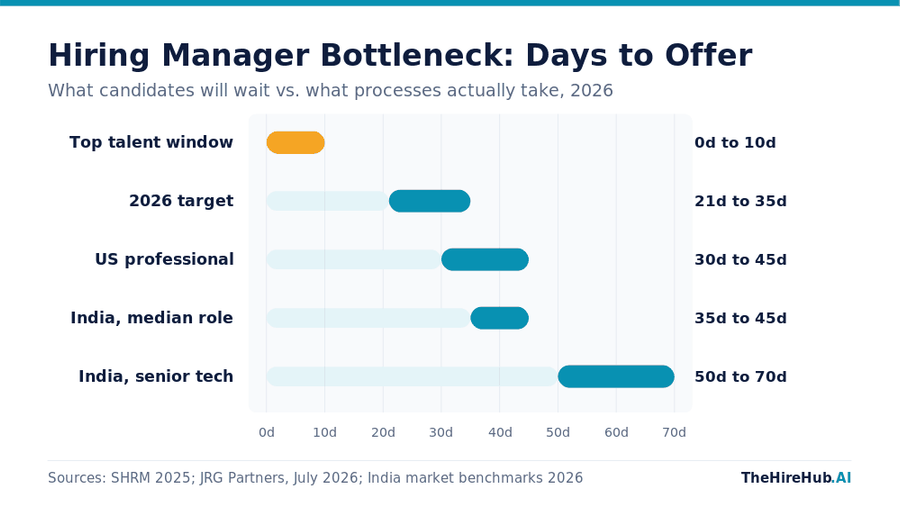
- The amber band is the constraint, not a target. It is roughly how long the strongest candidates stay available, and every other band on this chart is longer than it.
- The gap between the amber band and your own band is your real competitive exposure. If you run at 40 days, you are not competing for the top of the market. You are competing for whoever is still available on day 40.
- These are days to offer, not days of work. Compressing them does not mean interviewing less, because the interviews were never the expensive part.
How it actually works, and where it breaks
The mechanism is simple once you look at it as a queue. Every stage handover is a request sitting in somebody's inbox waiting for a human with other priorities to action it. Queue time scales with the number of people you need and the looseness of the deadline you give them. Add interviewers, remove deadlines, and the queue grows.
The first failure mode is scheduling by availability request. Platform data from candidate.fyi, drawn from 257,946 scheduling events, shows availability-based coordination consumes about 243 minutes of back and forth versus 27 minutes when a candidate self-schedules. The elapsed difference is 5.9 days against 3.9 days per round, so across four rounds you have found most of a week. Our AI interview scheduling guide covers the mechanics of closing that specific gap.
The second failure mode is feedback with no deadline attached. Most organisations have no service level agreement on post-interview feedback, so evaluations arrive whenever. The same dataset shows manual reschedule resolution taking 68 hours and coordinator response times running 7 to 18 hours, with a structural 14 percent reschedule rate meaning a long loop generates several of these events per role.
The third failure mode is panel inflation. JRG Partners found executive hires now average around 5.5 distinct interviews, with 5 to 8 rounds and 8 to 15 stakeholders on strategic roles. Each added interviewer is another calendar, another feedback form and another opinion to reconcile, and the marginal signal after the fourth interviewer is usually close to zero.
"Your process is not slow because people are thinking hard; it is slow because nobody owns the silence between stages."
What this means for your team
The sequence below is deliberately boring, and it works because it fixes the queue before it touches the tooling. Teams that automate coordination before they have measured it tend to automate their existing mess faster.
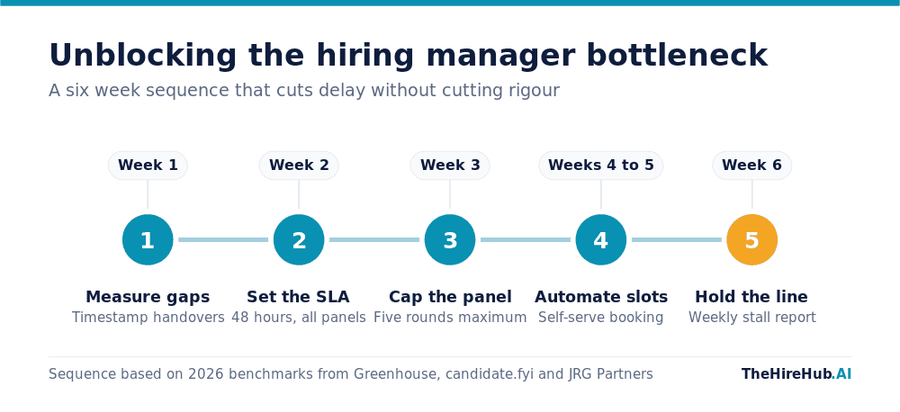
Week one is measurement only. Timestamp every handover: interview complete to feedback submitted, last feedback to debrief held, debrief to offer approved. You will almost certainly find that one or two transitions hold most of the delay, and it is rarely the one people complain about.
Week two sets a feedback service level agreement, and 48 hours is the number that works. The critical detail is visibility: the SLA has to be published where the whole panel can see who is outstanding, because most hiring managers hit a deadline that somebody is actually tracking. Week three caps the panel at five rounds and names a single decider per role.
Weeks four and five are where automation earns its place, and only here. Self-serve booking and autonomous reschedule handling remove the two largest queue contributors without touching evaluation rigour. Week six is the discipline that makes it stick: a weekly stall report listing every candidate waiting more than 48 hours, named by owner, sent to the people whose names are on it.
None of this is theoretical. Published customer results from coordination platforms include Relativity Space cutting scheduling turnaround from 2.8 days to 16.2 hours inside six weeks, and Intercom reaching a first interview in under 24 hours. The candidate side of this matters too, and our guide to candidate experience in AI hiring covers what that wait actually costs you in acceptance rates.
The hiring manager bottleneck vs the recruiter capacity problem
These two get conflated constantly, and the fix for one does nothing for the other. The recruiter capacity problem is a volume problem: too many applications, too few recruiters, not enough hours to screen. It is real, and it is what most recruitment automation buying decisions are aimed at.
The hiring manager bottleneck is a latency problem. It is not that the work is too large, it is that the work sits untouched. Adding screening capacity to a pipeline that stalls for six days at the feedback stage simply produces stalled candidates faster. You can tell which one you have by looking at your stage transition times rather than your funnel volumes, and the seven numbers in our AI hiring metrics guide will separate them cleanly.
Most teams have both. The point is that they need different interventions, and buying a screening tool to fix a latency problem is the most common expensive mistake in this category.
How to actually do this (and the four traps)
- Do not start with the tool. The instinct is to buy scheduling software in week one. Measure first, because if your real delay is offer approval sitting with finance, a scheduling tool will not touch it and you will have spent budget proving that.
- Do not let the SLA be a suggestion. A 48 hour feedback target with no visible tracking is a wish. The mechanism that works is publication, not escalation: a list showing who is outstanding, visible to peers, updated automatically. Escalating to somebody's manager burns credibility you will need later.
- Do not confuse speed with lowered standards. This is the objection every hiring manager raises and it deserves a straight answer. Structured processes are what make speed safe, and JRG Partners found structured interviewing alone can cut time to hire by up to 25 percent. Keep the scorecards, keep the debrief, and read our quality of hire measurement guide before you change anything about how decisions get made.
- Do not automate a process you have not capped. Automating scheduling for an eight round loop makes the loop faster, not shorter. Cap the rounds first, then automate what survives, or you will lock a bad process into software and make it harder to change.
"A hiring process that cannot say who is waiting on whom today is not a process, it is a habit."
The one thing every hiring leader should take from this
If you measure one thing after reading this, measure the time between your last interview and your offer decision, per role, for the last ten hires. That single number is where the hiring manager bottleneck lives, it is almost never on a dashboard, and it is the one most likely to be costing you candidates you already paid to find and assess.
You do not need new tooling to start, and you do not need permission. You need ten timestamps and the willingness to show them to the people who own them. TheHireHub builds for exactly this gap, and if you want a second pair of eyes on what your numbers mean, we look at this stuff all day.
Frequently Asked Questions
It is the delay that accumulates while a requisition waits on a hiring manager rather than on a recruiter: availability for a panel, post-interview feedback, a debrief slot, and the final decision. It is distinct from a sourcing or screening problem because the work is not too large, it is simply sitting untouched. Most ATS reports do not surface it because the time falls between stages rather than inside one.
Forty eight hours from interview end to submitted feedback is the working standard most teams can hit without complaint. The number matters less than the visibility: publish who is outstanding where the whole panel can see it, because feedback deadlines are met when somebody is tracking them and missed when nobody is. Teams that set a target without publishing compliance typically see no change at all.
Five is a reasonable cap for most roles, and JRG Partners' 2026 benchmark recommends no more than five to six rounds even for executive hires. Beyond the fourth interviewer the marginal signal is usually close to zero while the coordination cost keeps rising linearly. If you need a sixth round to decide, the problem is usually undefined success criteria rather than an unclear candidate.
Not when you cut queue time rather than evaluation time. Structured interviewing, scorecards and a real debrief are what make speed safe, and JRG Partners found structured processes alone can reduce time to hire by up to 25 percent. What gets removed is scheduling back and forth and feedback chasing, none of which was contributing signal about the candidate.
The median lands at roughly 35 to 45 days from approved requisition to acceptance, with senior AI, cloud and security roles commonly running 50 to 70 days. High volume and entry level roles close considerably faster, often inside two weeks. Benchmark against your own trend and your own segment rather than a national average, which blends situations that have nothing in common.
In India, external senior hires typically carry recruitment fees in the ₹2 lakh to ₹12 lakh range before you count the vacancy itself. Globally, JRG Partners estimates that restarting a mid to senior search after a candidate withdraws costs roughly $10,000 to $15,000 in US market terms, excluding the opportunity cost of the empty seat. The larger cost is usually the candidate you lose rather than the fee you pay.
Not into interviews: Greenhouse's March 2026 data puts actual interview time at 12.3 hours per hire against an average 41 day time to hire. The days go into scheduling coordination, reschedules, waiting on feedback, and waiting for a debrief slot. Timestamp each handover for ten recent hires and the two transitions holding most of the delay will become obvious quickly.
It can remove the mechanical parts, which is most of the delay: self-serve scheduling, autonomous reschedule handling, and automated feedback prompting. Industry projections put the time to hire reduction from AI screening and scheduling at roughly 15 to 20 percent. It cannot make a hiring manager decide, so pairing automation with a published feedback service level agreement matters more than the tooling choice itself.
Make the delay visible rather than escalating it. A weekly stall report listing every candidate waiting more than 48 hours, named by owner and sent to those owners, changes behaviour more reliably than chasing individually or escalating to their manager. Pair it with a shorter feedback form, because a long scorecard is itself a reason the task keeps getting deferred.
Time to fill runs from requisition approval to offer acceptance and includes sourcing. Time to hire starts only when the eventual hire enters your pipeline, so it isolates how fast you evaluate. A long fill with a short hire points to a sourcing problem, while a long hire points at the process itself, which is where the hiring manager bottleneck shows up.

