
Moonlighting Detection in India 2026: The UAN Check That Actually Works
Why one EPFO record settles the detection question, and why policy is the part most companies have not written.
EPFO data showed over one lakh people contributing to provident fund under two employers in the same month. Here is how the UAN check works and where it fails.

TL;DR
Moonlighting detection in India comes down to one number that most hiring teams already have the right to ask for: the Universal Account Number. If two employers are crediting provident fund against the same UAN in the same month, that is concurrent employment, and EPFO data from 2023 showed more than one lakh people in exactly that position. Everything else, the monitoring software, the productivity dashboards, the laptop telemetry, is a worse version of a check that takes a day and costs almost nothing. The harder question is not how to detect it but what you intend to do when you find it, and most companies have not decided. If you are building out verification generally, start with automated reference checks.
What is actually happening
The scale is larger than most leaders assume, and it varies wildly depending on how you ask. A Cutshort survey of 3,000 Indian tech professionals found roughly 23 percent had moonlighted at some point, with 7 percent actively doing so. AuthBridge, screening white collar hires, found around 5 percent actively moonlighting, concentrated in remote and flexible roles.
Perception runs far ahead of measurement. A Kotak Institutional Equities survey of 400 IT and ITES employees found 65 percent were aware of people taking part-time work while working from home. An Indeed report found that over 43 percent of Indian IT employees consider dual employment favourable in principle.
The trend line is the part that matters for hiring. Randstad India reported a 25 to 30 percent increase in moonlighting activity across the IT sector over a three year period. This is not a pandemic artefact that has since reversed.
The extreme cases are genuinely extreme. A 2024 Times of India investigation reported that AuthBridge had uncovered an IT employee working simultaneously for 78 companies, with all of them crediting provident fund contributions into the same account. That is not a moonlighter, that is a business model, and it ran undetected because nobody checked the one record that would have shown it instantly.
The structural driver is worth naming, because it explains why this did not fade. Remote and hybrid work removed the two things that used to make a second job impractical: physical presence and a fixed nine-to-six. AuthBridge's own finding that moonlighting concentrates in remote and flexible roles is the same point from the data side. Companies that have since mandated office attendance have reduced their exposure somewhat, but the majority of Indian tech roles retain enough flexibility for the question to stay live.
What has also changed is the policy landscape. Swiggy, Tech Mahindra, Cred, DBS Bank Tech, Thoughtworks and Razorpay permit external work subject to disclosure or approval. Infosys, TCS, Wipro, Cognizant and Accenture India do not. Two candidates with identical behaviour can be entirely compliant at one employer and terminable at the next.
The numbers
Verification data tells you where misrepresentation concentrates, and it is not evenly spread. AuthBridge's Workforce Fraud Files for the first half of FY26 put the overall white collar discrepancy rate at 4.33 percent, with the on-demand workforce higher at 5.61 percent. Within specific checks the spread is far wider: CV and employment validation showed discrepancies of 2.91 percent in BFSI against 12.80 percent in IT.
Education checks tell a different story again, running at 7.80 percent in telecom and 9.16 percent in retail. The check you run determines the risk you see.
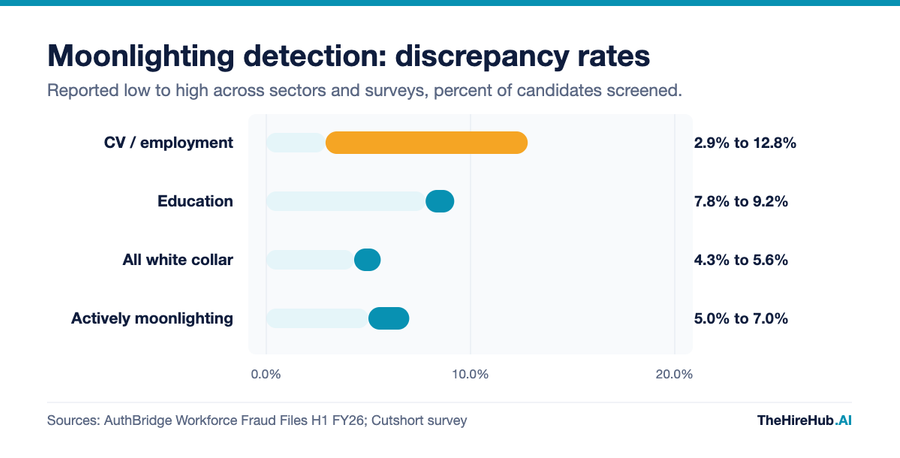
How to read this:
- These are discrepancy rates, not moonlighting rates. A discrepancy means the record did not match the claim, which includes honest error as well as deliberate fraud.
- IT sits at the top of CV and employment validation because salaries are highest there, so the incentive to inflate is strongest.
- A low sector number is not reassurance. BFSI's 2.91 percent reflects heavier pre-existing regulatory screening, not more honest candidates.
How it actually works, and where it breaks
The mechanism is simple and it is the reason UAN checks are decisive. Every formal-sector employee in India has one Universal Account Number, and every employer contributing provident fund does so against that number. Two employers contributing in the same month against one UAN is direct evidence of concurrent employment, not an inference from behaviour.
The first failure mode is the gap in coverage. UAN only captures formal employment with PF contributions. A candidate consulting through their own company, invoicing a foreign client, or being paid in cash leaves no trace in EPFO at all, which means a clean UAN history proves considerably less than it appears to.
The second is the false positive, and it is common enough to matter. Overlapping contributions arise routinely from notice-period overlap, a delayed exit filing by a previous employer, or a payroll team crediting a month late. Treating every overlap as fraud will cost you good candidates, and treating it as proof in a termination conversation will cost you a tribunal.
The third is consent. Candidate data pulled for verification sits squarely inside India's data protection obligations, so the UAN and the authority to check it need to be collected properly rather than assumed. The same discipline applies here as to any other candidate data you hold, which is worth reading alongside recruitment data privacy.
"A clean UAN history is not a clean candidate, it only means the second job was paid in a way the state never saw."
What this means for your team
Detection is the easy half. The sequence below is the operational version, and the thing to notice is that step four exists at all: you ask before you conclude, because the innocent explanations are numerous and the cost of getting it wrong is high.
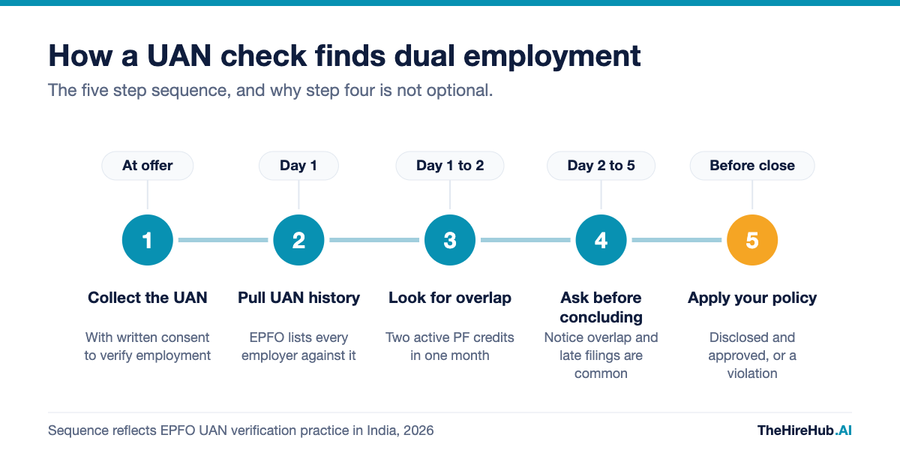
The rules that make this work in practice:
- Collect the UAN in the offer pack, with explicit consent for employment verification, not as an afterthought during onboarding.
- Define what counts as a violation in your own policy before you start checking. Undisclosed concurrent full-time employment is a different matter from a weekend consulting engagement.
- Set a disclosure route that people will actually use. Policies that make disclosure feel career-limiting produce concealment, not compliance.
- Treat a single month of overlap as a question, not a finding. Two or more consecutive months is a different conversation.
- Apply the policy consistently across levels. Selective enforcement against junior staff while senior people advise startups on the side will not survive scrutiny.
Moonlighting detection vs continuous employee monitoring
There is a well-funded market selling the other approach: keystroke logging, screen capture, idle-time tracking, and network analysis to infer whether someone is working elsewhere. It is worth being clear about why that trade is usually bad.
Monitoring is probabilistic where a UAN check is documentary. It infers a second job from productivity patterns that have a dozen other explanations, from caring responsibilities to burnout to a badly scoped role. It also applies to every employee continuously in order to catch a small minority, which is a poor ratio, and the cultural cost lands on exactly the senior people you can least afford to lose. A point-in-time verification at hire, applied to everyone equally and openly, achieves more with less collateral damage.
There is a second-order cost too. Monitoring reframes the employment relationship as adversarial, and people respond to being measured by optimising for the measure rather than the work. Teams that install activity tracking tend to discover their productivity data gets better while their delivery does not, which is a familiar problem with any metric chosen for how easily it can be collected rather than how well it reflects the job. It is the same failure that makes most hiring dashboards useless, and the reason it pays to pick metrics deliberately, as in our AI hiring metrics breakdown.
How to actually do this (and the four traps)
- Do not run a check you have no policy for. Discovering concurrent employment with no written position on it puts you in a worse spot than not knowing. Write the policy first, publish it, then verify against it.
- Do not treat overlap as proof. Notice-period overlap and late payroll filings generate innocent overlaps constantly, which is one of the quieter costs of India's long notice culture, as covered in our notice period buyout guide. Ask, document the answer, then decide.
- Do not skip consent. Pulling employment records without properly collected authority converts a legitimate check into a liability. Put it in the offer pack in plain language.
- Do not assume a clean UAN means a clean candidate. Consulting income, foreign clients and cash work are invisible to EPFO. If the role genuinely requires exclusivity, say so in the contract rather than relying on a check that cannot see most of the alternatives.
"Better detection without a written policy produces more awkward conversations and less consistent outcomes than having no check at all."
The one thing every hiring leader should take from this
Moonlighting is a policy problem that companies keep trying to solve with surveillance. The detection question was settled the moment UAN-based verification became routine, and it costs a day. What is not settled, in most organisations, is what they actually believe about people doing paid work elsewhere, and until that is written down and applied evenly, better detection just produces more awkward conversations and more inconsistent outcomes. Decide the policy, publish it, then verify. If you want to talk through where this sits in your own hiring process, we look at this stuff all day.
Frequently Asked Questions
Moonlighting means taking paid work outside your primary employment, usually without disclosing it. In India the term is applied most often to IT employees holding a second full-time or part-time role while employed elsewhere.
The most reliable method is checking the Universal Account Number against EPFO records. Because every employer contributing provident fund does so against the employee's single UAN, two employers contributing in the same month is direct evidence of concurrent employment.
It is a check of a candidate's Universal Account Number against EPFO provident fund records, which lists every employer that has contributed against it. It reveals employment history and any overlapping periods of concurrent employment.
There is no blanket ban. It depends on the employment contract and on company policy. Many Indian contracts contain exclusivity or conflict of interest clauses, and breaching those is a contractual matter rather than a criminal one.
Estimates vary by method. A Cutshort survey of 3,000 tech professionals found about 23 percent had moonlighted at some point and 7 percent were actively doing so, while AuthBridge screening data found around 5 percent of white collar hires actively moonlighting.
As of 2026, Swiggy, Tech Mahindra, Cred, DBS Bank Tech, Thoughtworks and Razorpay permit external work with disclosure or approval. Infosys, TCS, Wipro, Cognizant and Accenture India do not permit it.
Yes, and often are. Notice period overlap, a delayed exit filing by a former employer, or payroll crediting a month late all create overlapping contributions. A single month of overlap should be treated as a question rather than a finding.
No. It only captures formal employment with provident fund contributions. Freelance consulting billed through a personal company, work for a foreign client, and cash payments leave no EPFO record at all.
Yes. Employment verification involves processing personal data, so the UAN and explicit authority to verify should be collected in writing, normally in the offer pack, rather than assumed.
It is generally a worse trade. Monitoring infers a second job from productivity patterns that have many other explanations, applies to all employees continuously to catch a small minority, and carries a cultural cost that a one-time documentary check does not.

