
Automated Reference Checks in 2026: What They Catch, What They Miss, and What They Cost
Automation turns a nine day phone chase into a 48 hour questionnaire, but it does not make a weak predictor a strong one.
Automated reference checks cut turnaround from seven to ten days down to two to three, at roughly $5 to $50 a check. Here is what that buys you, and what it does not.

TL;DR
Automated reference checks turn a three to seven day phone chase into a structured questionnaire that comes back in 24 to 48 hours, at roughly $5 to $50 per completed check on global pricing. That is the honest gain: speed and consistency, not truth. Reference checking has never been a strong predictor of performance, and automating a weak signal does not make it a strong one. What it does do is make the signal comparable across candidates, which is the only condition under which it becomes usable at all. If you are already mapping where machines stop and people start, read this alongside our human in the loop hiring guide.
What is actually happening
The reference check is the last manual step in most hiring processes. Sourcing got automated, screening got automated, scheduling got automated. Then a recruiter spends a week playing phone tag with two people who will say something pleasant and non-committal.
The economics of that final step stopped making sense some time ago. Published operator data puts manual reference checking at around 76 minutes of recruiter or hiring manager time per candidate, for an average yield of 2.4 references. That is more than an hour of senior time to collect two opinions that nobody will write down in a comparable format.
Meanwhile the thing being checked got easier to fake. GCheck's 2026 Trust in Hiring Report found that 41 percent of job seekers send fake references, inside a broader finding that 93 percent admitted to some form of embellishment. The report attributes this to competitive market pressure (72 percent) and, more damningly, to an expectation that verification will be weak (53 percent).
Employers are finding it. HireRight's 2025 Global Benchmark Report found that more than three quarters of employers uncovered at least one candidate discrepancy in the past year, and 41 percent of organisations said they had already hired a fraudulent candidate. An older Workforce survey put the share of employers who had caught an outright fake job reference at 29 percent.
India has its own version of this number. AuthBridge's Workforce Fraud Files recorded a 4.33 percent background verification discrepancy rate for white collar roles in H1 FY26 and 5.61 percent for the on demand workforce, against 6 percent and 4 percent respectively in the 2025 edition. Its 2024 annual report was harsher still: a 44 percent spike in employment verification discrepancies, with telecom at 18.2 percent and a 12 percent discrepancy rate across more than 150,000 moonlighting checks.
So the reference check is simultaneously the least automated step, the most gamed, and the one nobody has time to do properly. That is exactly the shape of problem automation is good at, and exactly the shape of problem where automation gets oversold.
The numbers
The case for automating reference checks is a throughput case, and it holds up. The case that automation makes references more predictive does not hold up, and no vendor data I could find this year establishes it.
Start with the time. Manual phone referencing runs three to seven days for a single reference and seven to ten business days to close a full set of three, because you are coordinating two calendars across time zones for every call. Platforms that send a structured questionnaire and chase it automatically report 24 to 48 hours for a single response, with completed multi reference reports typically landing in two to three days.
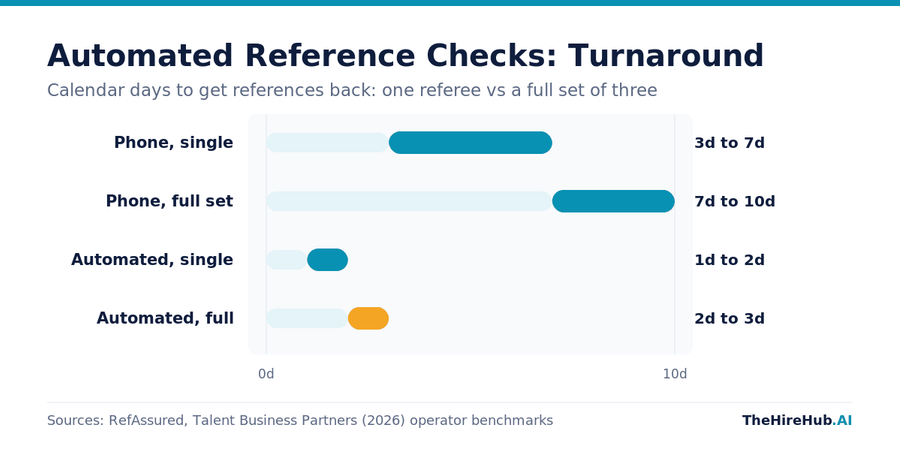
Three things to read out of that chart, and one thing not to:
- The saving is concentrated in the chase, not the answer. You are removing calendar coordination, not reading time.
- A full reference set is the number that matters for your offer stage, not a single response. Compare 7 to 10 days against 2 to 3 days, and ignore the single reference row when you model your timeline.
- Response rates are better than recruiters assume. A study of 150,000 candidates and 769,822 reference providers found an 85.3 percent compliance rate among people asked to give a reference, so the bottleneck was never willingness.
Now the validity, which is the number vendors skip. The Schmidt and Hunter meta-analysis put the criterion validity of reference checks at .26 against job performance. When Sackett and colleagues re-analysed the selection literature in 2022 and revised most of those estimates downward, reference checks could not be updated at all, because the underlying studies did not report enough information to redo the maths. A predictor whose best available estimate is nearly thirty years old and uncorrectable is not one to build a hiring decision on.
Pricing is the last number. Pay per use platforms sit at roughly $15 to $50 per completed check on published global rates, flat per candidate tools go as low as about $5, and the enterprise names (Xref, Checkster, Crosschq, iCIMS SkillSurvey since the 2022 acquisition) quote against volume rather than publishing a rate. Subscription tools price separately again: HiPeople publishes a Grow plan from $60 a month and Scale from $84.
How it actually works, and where it breaks
The mechanism is unglamorous. The candidate supplies referee contact details, the platform emails each referee a structured questionnaire tied to the specific role, reminders fire on a schedule, and responses are normalised into a comparable report. Some tools add a rating scale and a benchmark against other referees for the same role.
The first failure mode is that the candidate still controls the input. Every referee in the file is one the candidate chose and briefed. Automation makes it faster to collect a curated sample, and a faster curated sample is still a curated sample.
The second is verification of the referee, not the reference. If a platform accepts a personal email address and an unverified phone number, it has automated the exact thing GCheck found 41 percent of candidates gaming. Domain verification, corporate email requirement, and identity checks on the referee are the features that matter here, and they are the features most often absent from the cheaper tiers. This is the same structural problem as AI interview cheating detection: the tool validates the artefact, not the person behind it.
The third is scoring. The moment a reference platform produces a numeric rating that feeds a go or no-go decision, it has become a candidate evaluation system, with everything that implies legally. Under Annex III of the EU AI Act, systems used to evaluate candidates are high risk, and the core obligations for those systems apply from 2 August 2026, with deployer penalties reaching EUR 15 million or 3 percent of global turnover. A reference tool that merely collects text is a workflow tool. One that scores is a regulated one.
"A reference platform that scores candidates has stopped being a workflow tool and become a regulated one, whether or not its vendor says so."
What this means for your team
Treat the reference check as an offer stage confirmation step, not a screening step. Running it earlier burns referee goodwill on candidates you will not hire, and referees are a finite resource in any given industry.
Here is the sequence that works, with the human review deliberately placed after the automation rather than replaced by it.
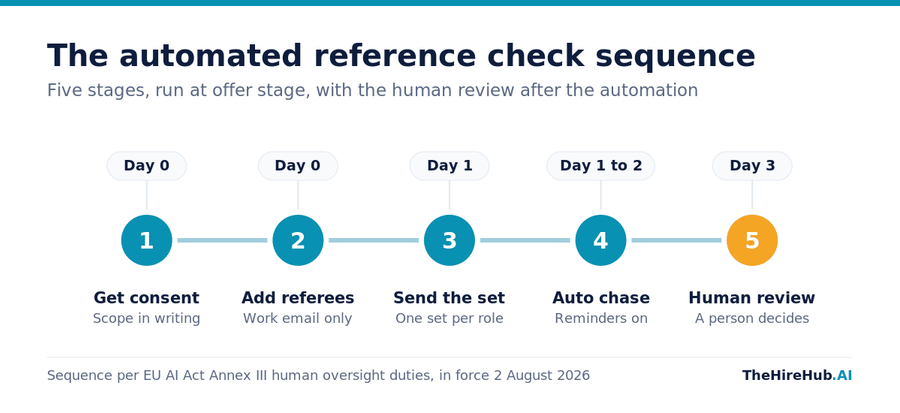
The stage that people skip is the fourth one. A reference report with a low score is a prompt to have a conversation, not a rejection trigger. Automated rejection on reference data is where a throughput tool quietly turns into a discrimination exposure, and it is the same error pattern we covered in AI screening false negatives.
Consent belongs at the front, in writing, and it should name what will be asked and who will read it. This is not just compliance hygiene. Candidates who understand what is being collected chase their own referees, which is the cheapest response rate improvement available to you.
Automated reference checks vs background verification
These get conflated constantly and they answer different questions. Background verification is a factual check: did this person hold this title at this company for these dates, do the credentials exist, is there a criminal record where the law permits asking. It is documentary, it is largely objective, and in India it is the AuthBridge and First Advantage layer of the process.
A reference check is an opinion check. It asks what this person was like to work with, and it produces judgement rather than fact. Automating it speeds up opinion collection. It does nothing whatsoever to verify employment dates, which is the discrepancy category India's own data keeps flagging.
The practical consequence is that these are additive, not alternative. If you are choosing one, choose verification, because a fabricated employment record is a larger risk than a flattering referee. If you are running both, sequence verification first and use the reference questionnaire to probe whatever verification surfaced. For how the tooling layers fit together more broadly, our ATS vs AI recruiting software comparison is the better starting point.
How to actually do this (and the four traps)
- Do not let speed become the only metric. Cutting reference turnaround from nine days to two is worth real money at offer stage, but it is a cycle time win, not a quality win. Track it next to your actual outcome measures rather than instead of them, and read our quality of hire measurement guide before you claim the improvement.
- Do not accept unverified referee contact details. Require a corporate email domain wherever one plausibly exists, and treat a personal address as a flag to verify by a second channel rather than a reason to reject. This single control removes most of the fake reference surface.
- Do not let the questionnaire drift by role. The entire value of automation here is comparability, and comparability dies the moment each hiring manager writes their own questions. Fix a core question set at the job family level, allow two role specific additions, and nothing more.
- Do not automate the decision. Collect automatically, read manually. Keep a named human accountable for the call and keep a written record of why, which is what both the EU regime and any future discrimination claim will ask you to produce.
A fifth habit is worth adding: tell candidates their references came back well when they did. It costs nothing, and it is one of the few moments in a hiring process where the automation can produce goodwill rather than spend it. Our candidate experience AI hiring post covers why those moments are worth more than they look.
"The candidate picks the referees, so the fastest reference process in the world still only tells you who they trusted to praise them."
The one thing every hiring leader should take from this
Automate the reference check because it is the last manual bottleneck before an offer, and because a structured questionnaire returned in 48 hours is strictly better than an unstructured phone call returned in nine days. Do not automate it because you believe it will tell you who performs. The best available estimate of that predictive power is .26, it is nearly three decades old, and nobody has been able to improve on it. Buy the throughput, keep the scepticism, and keep a person on the decision.
At TheHireHub.AI we see the same pattern across every automation layer in hiring: the tool is worth having, and it is never worth trusting on its own. If you want to see where that line falls in your own process, book a demo and bring a role you are actually trying to fill. It is a screen share on your real numbers rather than a pitch deck, and you will leave with a written estimate of the time-to-hire you would save.
Frequently Asked Questions
It is a structured questionnaire sent to a candidate's referees by software rather than asked over the phone by a recruiter. The platform emails each referee the same role specific questions, chases non responders automatically, and returns the answers in a comparable format. The gain is speed and consistency, not accuracy.
A single automated reference typically comes back in 24 to 48 hours, and a full set of three in two to three days. Manual phone referencing runs three to seven days for one reference and seven to ten business days for a full set, mostly because of calendar coordination.
On published global pricing, pay per use platforms charge roughly $15 to $50 per completed check, flat per candidate tools go as low as about $5, and subscription products such as HiPeople publish plans from $60 a month. Enterprise names including Xref, Checkster, Crosschq and iCIMS SkillSurvey quote against hiring volume rather than publishing rates.
Not especially. The Schmidt and Hunter meta-analysis put the criterion validity of reference checks at .26 against job performance. When Sackett and colleagues re-analysed the selection literature in 2022, reference checks could not be updated because the underlying studies did not report enough information, so that nearly thirty year old estimate remains the best available.
Yes, and many try. GCheck's 2026 Trust in Hiring Report found that 41 percent of job seekers send fake references, and an older Workforce survey found 29 percent of employers had caught an outright fake. Requiring a corporate email domain for referees and verifying identity by a second channel removes most of that surface.
It depends on whether the tool scores candidates. Under Annex III, systems used to evaluate candidates are classed as high risk, and the core obligations apply from 2 August 2026, with deployer penalties reaching EUR 15 million or 3 percent of global turnover. A tool that only collects and formats text is a workflow tool; one that produces a rating feeding a decision is regulated.
At offer stage, as a confirmation step. Running them during screening burns referee goodwill on candidates you will not hire, and referees are a finite resource within any industry. Collect written consent first, naming what will be asked and who will read the answers.
A background check verifies facts: employment dates, titles, credentials and, where lawful, criminal records. A reference check collects opinions about how someone works. They are additive rather than alternative, and if you can only run one, verification addresses the larger risk, since fabricated employment records are what India's own data keeps flagging.
Three is the working standard, and it is what most automated platforms are priced around. Manual referencing yields about 2.4 references per candidate on published operator data, so automation mainly closes the gap between what you intended to collect and what you actually got.
More often than recruiters assume. A study covering 150,000 candidates and 769,822 reference providers found an 85.3 percent compliance rate among people asked to give a reference. Willingness was never the bottleneck; scheduling was.

