AI Recruiting Pilot: The 45 Day Plan That Proves Value in 2026
How to run an AI recruiting pilot with a baseline, three fixed metrics and a written verdict, so you scale what works and kill what does not.
Most AI recruiting pilots fail because success was never defined. Here is a 45 day plan with a baseline, three fixed metrics and a written scale, extend or kill verdict.

TL;DR
An AI recruiting pilot should run about 45 days, track three metrics you fix before day one, and end with a written verdict: scale, extend or kill. That is the whole answer. Most pilots fail because nobody defined success in advance, not because the software is bad, and Gartner expects more than 40% of agentic AI projects to be cancelled by the end of 2027 for reasons that include unclear business value and weak risk controls. If you are still choosing what to test, start with our guide on how to evaluate AI recruiting tools.
What is actually happening
Almost every talent team is being asked to "try AI" right now, and almost none of them are being asked to define what trying it means. The result is a familiar pattern: a vendor demo in week one, a login handed to two enthusiastic recruiters, and a review in week eight where everyone agrees it "feels faster." Nobody can say faster than what.
The wider enterprise data is sobering. Fortune's summary of the MIT NANDA report put it bluntly: roughly 95% of enterprise generative AI pilots stall with no measurable P&L impact. The same summary says tools bought from specialist vendors succeeded about 67% of the time, while internal builds succeeded at roughly a third of that rate. Note that this covers enterprise generative AI broadly, not recruiting specifically, so treat it as a warning about pilot discipline rather than a recruiting benchmark.
Vendor noise makes it worse. Gartner has estimated that only about 130 of the thousands of vendors selling "agentic AI" are real, and it describes the rest as rebadged chatbots, assistants and RPA. In recruiting that shows up as products whose "AI screening" is a keyword filter with a new label. A pilot is how you find out which one you are holding.
The cost of guessing is not small. SHRM benchmarking data reported in 2022 put the average US cost per hire at nearly $4,700 (US dollars, US employers). Every requisition you route through a tool that does not work is a requisition where you paid that cost and learned nothing.
What separates the pilots that convince a CFO from the ones that quietly die is boring. They have a baseline taken before the tool was switched on. They compare like with like. And someone with authority agreed in advance what result would end the experiment.
The numbers
There is no universal pilot length, because the real constraint is how many decisions your team makes. A pilot needs enough screened candidates and closed requisitions to show a difference. As a rule of thumb, aim for at least 100 screened candidates in each arm before you trust a comparison.
The ranges below are our recommended design by hiring volume. They are a planning heuristic, not survey data, so adjust them to your own funnel. Low-volume teams need longer because each closed requisition is a rare data point, while high-volume teams get statistical signal quickly and should keep the pilot short.
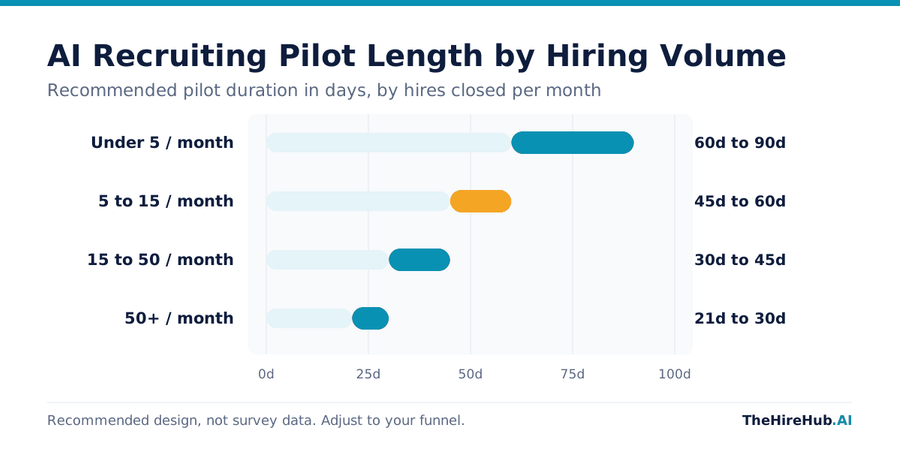
How to read this:
- Hiring volume sets the length, not the vendor's onboarding calendar. If a salesperson proposes 14 days for a team that closes three roles a month, you will learn nothing.
- Short pilots on high-volume teams still need the full four step structure. Compress the weeks, never the baseline or the review.
- Anything beyond 90 days is no longer a pilot, it is a slow rollout with a pilot's budget approval. Decide earlier.
How it actually works, and where it breaks
The mechanism is simple. You split comparable work into two arms, one run the way you run it today and one run with the tool, and you measure both against the same three metrics. For the first stretch the tool runs in shadow mode, which means it scores or screens but humans still decide, so you can compare its calls with theirs at no risk to candidates.
Three failure modes account for most wasted pilots. The first is cherry-picked requisitions. Teams test on their easiest, highest-volume role, the tool shines, and the result collapses on the first awkward senior hire.
The second is a metric nobody can measure in time. Quality of hire takes months to show up, so pilots quietly swap in "recruiter satisfaction," which tells you about the interface and nothing about the outcome. Pick fast proxies you can actually read in 45 days, such as recruiter hours per hire, time from application to first interview, and the share of AI shortlists a hiring manager accepts. Our piece on AI hiring metrics covers how to define each one.
The third is the silent reject. If no one reviews the candidates the tool turned away, you will never see the qualified people it lost, and the pilot will look like a clean win. Sample the rejected pile every week and read our breakdown of AI screening false negatives before you start.
"A pilot without a baseline is just a demo that happens to take six weeks."
What this means for your team
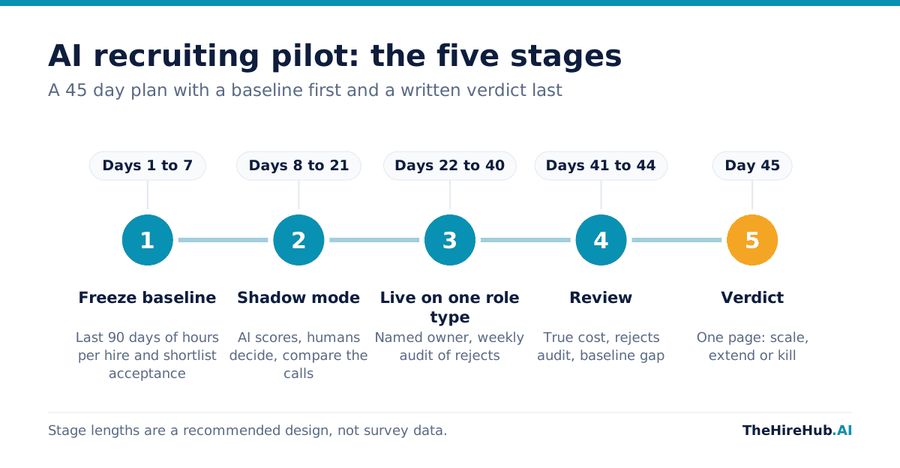
Think of the pilot as five stages, each with one job. Do not let stages bleed into each other, because the whole value of the exercise is that the decision at the end is made on evidence gathered under fixed rules.
In stage one you freeze the baseline from your last 90 days: recruiter hours per hire, application to first interview, and shortlist acceptance. In stage two the tool runs in shadow mode and you compare its recommendations to real human decisions. In stage three it goes live on one requisition type, with a named owner and a weekly check on rejected candidates.
Stage four is the review, where you audit the rejects, add up the true cost including recruiter time spent babysitting the tool, and compare against the baseline. Stage five is the verdict, written on one page. If you need a template for the financial side, our recruitment automation ROI guide shows how to put numbers on payback.
AI recruiting pilot vs the alternative
The nearest neighbour is the full rollout dressed up as a pilot, where the contract is already signed and the "pilot" exists to build internal buy-in. The difference is the exit. A real pilot can end in a kill decision at no penalty, and a rollout in disguise cannot.
The other neighbour is the demo-led purchase, where a polished sales environment replaces your own messy data. If you are still weighing whether to buy or build, read our take on AI recruiting build vs buy first, because the MIT summary above suggests the choice matters more than most teams assume.
How to actually run an AI recruiting pilot (and the four traps)
Run it with one owner, one requisition type, one page of rules and a hard end date. Then watch for these four traps.
- Skipping the written kill criteria. Before day one, write the exact result that ends the pilot, for example "shortlist acceptance below 60% or any unexplained pattern in rejected candidates." Without this, every ambiguous result becomes a reason to continue.
- Letting the vendor define success. Vendor dashboards report what the vendor is proud of, usually volume of candidates processed. Measure with your own export from your own system, and keep the baseline in a sheet the vendor never touches.
- Removing the human too early. Keep a reviewer on every automated decision until the audit shows the tool agrees with your best recruiters. Our guide to human in the loop hiring explains where the human should stay and why regulators increasingly expect it.
- Running it in your busiest month. A pilot during a hiring surge measures a team in survival mode. Pick a normal stretch so that the comparison with your baseline is fair.
"If nobody is allowed to say the pilot failed, you are running a rollout and calling it a test."
The one thing every hiring leader should take from this
The goal of an AI recruiting pilot is not to prove the tool works. It is to find out, cheaply and honestly, whether it works for your roles, your data and your team, and to be willing to hear no. Teams that write the kill criteria first almost always make better decisions, including the decision to buy.
Pick one requisition type this week, freeze your baseline, and put the end date on the calendar. If you want a second pair of eyes on the design, the team at TheHireHub is happy to help, because we look at this stuff all day.
Frequently Asked Questions
Plan on about 45 days for a team closing 5 to 15 hires a month. Low-volume teams need 60 to 90 days because each closed requisition is a rare data point, and high-volume teams can reach a reliable signal in 21 to 30 days.
Track three metrics you can read inside the pilot window: recruiter hours per hire, time from application to first interview, and the share of AI shortlists a hiring manager accepts. Fix the definitions and take a baseline before the tool is switched on.
Shadow mode means the tool scores or screens candidates while humans still make every decision. You then compare its recommendations with real recruiter calls, which shows how well it agrees with your best people at no risk to candidates.
As a rule of thumb, aim for at least 100 screened candidates in each arm before trusting a comparison. This is a planning heuristic rather than a statistical guarantee, so widen the sample if your results look close.
Kill criteria are the written results that end the pilot, agreed before day one. An example is shortlist acceptance below 60% or any unexplained pattern in rejected candidates. Without them, every ambiguous result becomes a reason to carry on.
Usually because success was never defined in advance. Fortune's summary of the MIT NANDA report says roughly 95% of enterprise generative AI pilots show no measurable P&L impact, though that covers enterprise AI broadly and not recruiting specifically.
One named owner with the authority to approve the verdict. Shared ownership between a vendor contact, a recruiter and IT tends to produce a pilot that nobody is allowed to call a failure.
Sample the rejected pile every week and have a senior recruiter review it blind. If qualified people appear in the rejects, the tool has a false negative problem that a clean-looking shortlist will hide.
One page with three possible outcomes: scale, extend with specific conditions, or kill. It should state the measured result against the baseline, the true cost including recruiter time spent supervising the tool, and the single reason for the decision.
Not on its own. Vendor dashboards report what the vendor is proud of, usually candidate volume. Measure with your own export from your own system and keep the baseline in a sheet the vendor never touches.

