AI Recruiting Build vs Buy in 2026: What It Actually Costs to Build Your Own
The cost, failure-rate and compliance maths behind building AI screening in-house instead of buying it.
71% of in-house builds get abandoned and upkeep alone runs $20,000 to $100,000 a year. The real AI recruiting build vs buy maths, with the four traps.

TL;DR
The honest answer on AI recruiting build vs buy: 71 percent of in-house IT builds are eventually abandoned, and the upkeep alone on a homegrown internal tool runs $20,000 to $100,000 a year (USD, from a global survey of 2,000 IT and security decision-makers) before you count the engineers who wrote it. That upkeep band sits directly on top of what a 200 to 1,000 person company would pay to simply buy a mid-market AI recruiting stack outright. Build only when the workflow is genuinely proprietary and you already run a platform team that will still exist in three years. Buy when what you actually want is screening, scheduling, sourcing or matching, because those have become commodities. If you are still at the "what does this cost" stage, start with our AI recruiting software cost breakdown and come back here.
What is actually happening
Something changed in 2025 and 2026 that made this question live again. Large language models got cheap enough that a competent backend engineer can wire up a resume screener in a fortnight. Model API prices fell roughly 80 percent across the industry between 2025 and 2026, with mid-tier models now landing at a couple of dollars per million input tokens. So the demo is easy, and the demo is what gets funded.
The demo is not the product. A screening tool that a founder can prototype over a weekend still needs an ATS integration, a candidate-facing notice, an audit log, a way to re-run last quarter's decisions when someone asks why a candidate was rejected, and an owner. None of that is hard. All of it is permanent.
This is why the build-versus-buy conversation in talent acquisition looks different from the same conversation in, say, internal analytics. Hiring is a regulated decision surface. The tool touches personal data, it produces an outcome a candidate can contest, and in a growing number of jurisdictions it triggers named obligations rather than general good practice.
The Exclaimer research that produced the 71 percent abandonment figure found the rate climbs to 83 percent in heavily regulated industries such as manufacturing and finance. That is the pattern worth noticing. The more compliance weight a homegrown system carries, the less likely it is to survive.
Meanwhile the buy side has stopped being a single decision. There is the ATS, there is the AI layer, and there is increasingly a question of whether those are the same product at all. That boundary matters here because "build" almost always means building the AI layer on top of an ATS you already bought, which is a smaller project than people describe and a longer commitment than they expect.
The numbers
Here is the part most build-versus-buy decks skip. The comparison is almost never "engineering time versus subscription fee". It is "one-off engineering time plus permanent upkeep versus subscription fee", and the upkeep line is the one that decides it.
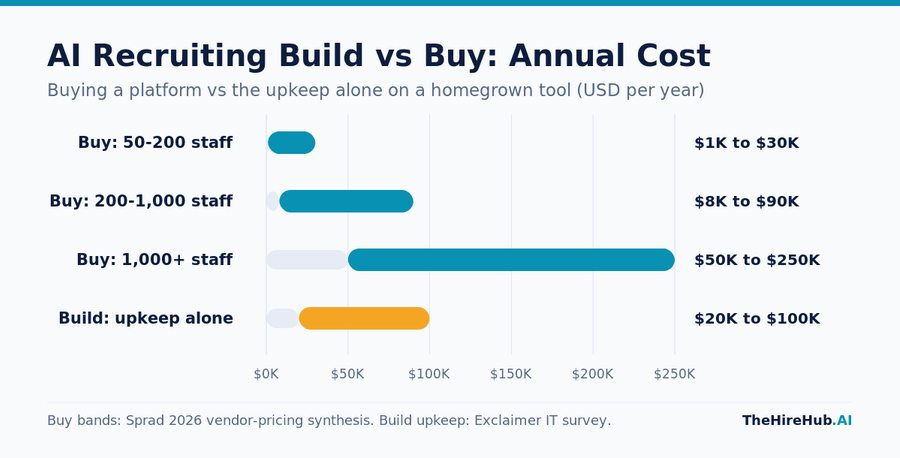
Three things to read off that chart.
- The buy bands are annual subscription orientation, synthesised from public vendor anchors: JazzHR publishes tiers at $1,000, $3,480 and $5,508 a year, SmartRecruiters publishes a $14,995 entry floor, and Greenhouse and HireVue route buyers into a sales conversation instead of a price page.
- The build bar is upkeep only. It is what 66 percent of surveyed teams said they need every year just to keep an existing internal tool running, and it excludes the original build entirely.
- Add the build cost on top and the picture gets worse, not better. A senior machine learning engineer in India with six to ten years of experience has a median CTC of ₹37 lakh, with a range of roughly ₹25.9 lakh to ₹59.2 lakh. One of those, for one year, is your v1.
The delivery record is the other number that should move you. Of in-house IT projects, only 8 percent are delivered on time and just 11 percent stay on budget. More than half take 1.6 to 2 times longer than planned, and 46 percent end up costing close to twice the original budget.
Set that against what a bought platform is displacing. Contingency agency fees typically run 15 to 25 percent of first-year salary, and SHRM's 2025 benchmarks put cost per hire at $5,475 for nonexecutive roles and $35,879 for executive roles. If you are trying to build the business case rather than the tool, our AI recruitment ROI walkthrough is the better starting point.
How it actually works, and where it breaks
The mechanism is straightforward and that is precisely the trap. You take a job description and a resume, you prompt a model to score fit against named criteria, you store the score and the reasoning, and you surface a ranked list. Getting to 80 percent of a commercial screener costs a fortnight. Getting to the last 20 percent is where the years go.
Three failure modes account for almost everything that goes wrong.
- The maintenance tax nobody budgeted. 63 percent of teams report spending 10 to 50 hours a month maintaining internal tools. That is a recurring quarter to half of an engineer, forever, on something that is not your product.
- The compliance surface you inherit. Build it and you are the provider, not just the deployer. Under NYC Local Law 144 an automated employment decision tool needs an independent annual bias audit, a public summary of the results, and 10 business days of notice to candidates, with penalties running $500 to $1,500 a day per violation. Under the EU AI Act, recruitment and selection systems fall in the high-risk category, and the Digital Omnibus agreement moved the application date for those Annex III obligations from 2 August 2026 to 2 December 2027. Later, not lighter.
- The silent accuracy failure. A screener that rejects good people does not throw an error. It just returns a shorter list, and everyone congratulates it on the efficiency gain. This is the same problem we unpack in AI screening false negatives, and an in-house tool with no benchmark set has no way to catch it.
There is a fourth, quieter one. 64 percent of organisations reported security-related downtime tied to internal tooling, and 31 percent named compliance and data protection as a key barrier. Candidate data is the most sensitive data a hiring team holds.
"The build never dies in the sprint that creates it; it dies in the quarter when the person who wrote it changes teams."
What this means for your team
Do not run this as an architecture debate. Run it as a twelve-week decision with a real baseline at the front and a kill switch at the end.
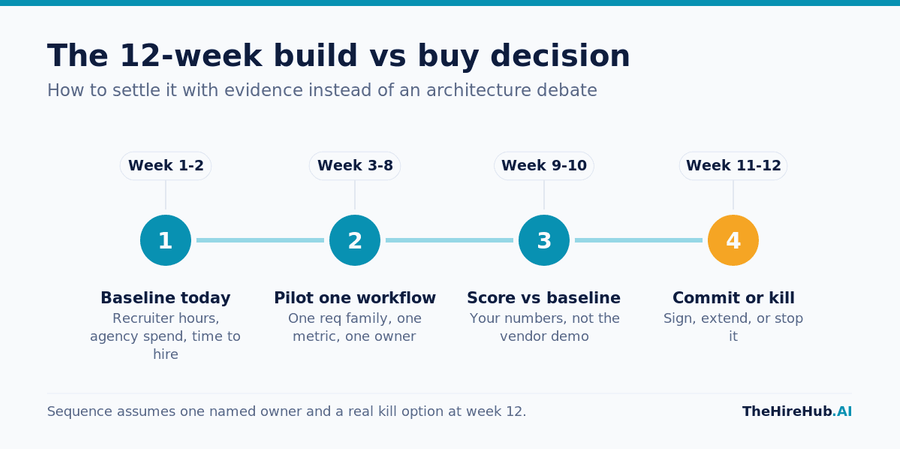
Stage by stage, the parts people get wrong:
- Baseline first, always. If you cannot state today's recruiter hours per hire, agency spend and time to hire, you cannot evaluate anything, because every option will look like an improvement against a number you invented afterwards.
- Write the decision test before you look at tools. Three questions settle it: is this workflow genuinely different from how other companies hire, will we still have an owner for it in three years, and would we notice within a week if it broke.
- Pilot one workflow, not the platform. One requisition family, one metric, one named owner. A pilot that touches five workflows tells you nothing about any of them.
- Score against the baseline, not the demo. The demo was built to win. Your baseline was built by your team and is the only honest comparator.
- Keep the kill option real. A pilot you were never going to stop is not a pilot, it is a rollout with extra meetings.
Whatever you land on, keep a person in the loop on rejection decisions. That is now both an operational safeguard and, increasingly, a regulatory expectation, which is why we wrote up human in the loop hiring as its own topic.
Build vs buy vs doing nothing
Most build-versus-buy comparisons quietly assume the third option does not exist. It does, and it is frequently the right one for the first year. Doing nothing means keeping the manual process and fixing the structural problems in it: the job descriptions, the scorecards, the interview loop, the time between stages. Automation applied to a process nobody has cleaned up just produces bad decisions faster.
Between the two active options, the split is less about size than about ownership. Buying is right when the workflow is standard, when you want the vendor carrying the model updates and the audit trail, and when the alternative use of your engineers is the product customers pay for. Building is right when the hiring workflow itself is a differentiator (high-volume operations, assessment-heavy roles, an unusual internal mobility model), when you already run a platform team with capacity, and when you have accepted the annual upkeep as a permanent line item rather than a project. If you are leaning towards buying, run a structured comparison first: our guide to evaluate AI recruiting tools covers the scoring frame.
How to actually do this (and the four traps)
- The prototype trap. A working prototype is evidence that the problem is tractable, not evidence that you should own the solution. Score the prototype on the last 20 percent (integrations, audit logs, error handling, candidate notices), not the first 80. Almost every abandoned build was a great prototype.
- The sunk-owner trap. Builds do not usually fail because the code is bad. They fail because the one engineer who understood the pipeline moved to another team, and nobody wanted to inherit a screening tool. Before you approve the build, name the owner and name the successor, in writing.
- The compliance-later trap. Bias audits, candidate notice, log retention and human oversight are not a phase two. They are the reason the abandonment rate hits 83 percent in regulated industries. Cost them into v1 or you are building something you will have to switch off. Our recruitment data privacy piece covers the data handling side of the same question.
- The false-precision trap. In-house tools get graded on whether they run, not on whether they are right. SHRM found only 20 percent of organisations track quality of hire at all, so most teams have no instrument capable of detecting that their screener has quietly got worse. Define the accuracy check before you ship, or you will never run one.
"Nobody gets promoted for buying the boring thing, which is exactly why so many teams end up maintaining a screening tool they never wanted."
The one thing every hiring leader should take from this
The build-versus-buy question is not really about cost, because on cost the answer is usually close enough to argue either way. It is about who owns the thing in year three, when the model provider deprecates an endpoint, a regulator asks for a bias audit, and the engineer who wrote it has left. If you can answer that question with a name and a budget line, build. If you cannot, buying is not the lazy choice, it is the accurate one. That is the whole decision, and it is worth an hour of your time before it is worth an engineer's quarter. If you want a second opinion on where your own line sits, TheHireHub is easy to reach, and we look at this stuff all day.
Frequently Asked Questions
Rarely, once you count the full life. The upkeep alone on an internal tool runs $20,000 to $100,000 a year according to a survey of over 2,000 IT decision-makers, which overlaps the entire annual subscription band a 200 to 1,000 person company would pay to buy a mid-market AI recruiting stack. The build cost sits on top of that, not instead of it.
A working prototype takes a competent engineer one to two weeks. A production system with ATS integration, audit logging, candidate notices and an accuracy benchmark takes months, and only 8 percent of in-house IT projects land on their original timeline at all.
71 percent of in-house IT builds are eventually abandoned, rising to 83 percent in heavily regulated industries such as manufacturing and finance, based on Exclaimer's 2025 survey of more than 2,000 IT and security decision-makers.
No, it increases your exposure. If you build the tool you are the provider as well as the deployer, so the bias audits, technical documentation, human oversight procedures and record keeping fall to you rather than to a vendor.
Recruitment and selection systems are classified high-risk under Annex III. The Digital Omnibus agreement moved the application date for those obligations from 2 August 2026 to 2 December 2027 for stand-alone high-risk systems, with August 2028 for high-risk AI embedded in products.
An independent bias audit of the tool every year, a public summary of the audit results posted on your website, and at least 10 business days of notice to candidates before the tool is used to evaluate them. Penalties run from $500 to $1,500 per day per violation.
Roughly $1,000 to $30,000 a year for a 50 to 200 person company, $8,000 to $90,000 for 200 to 1,000, and $50,000 to $250,000 or more for 1,000-plus enterprises, before implementation. Enterprise first-year implementation commonly adds 20 to 100 percent on top of the subscription.
When the hiring workflow itself is a competitive differentiator rather than a standard screening or scheduling flow, when you already run a platform team that will still exist in three years, and when you have budgeted the annual upkeep as a permanent line rather than a one-off project.
One requisition family, one metric, one named owner, measured against a baseline you captured before the pilot started. Piloting several workflows at once produces a result you cannot attribute to anything.
Yes, and that is usually the cheaper sequence. Buying first gives you a production baseline, real usage data and a working definition of the workflow, all of which make a later build far more likely to survive than one designed from a whiteboard.


