
Time to Hire Benchmarks 2026: What Good Actually Looks Like, by Role and Sector
The published numbers, what they actually measure, and the four places your calendar quietly loses a week.
The published time to hire benchmarks for 2026, what each one actually measures, and the four stages where hiring calendars quietly lose a week or more.

TL;DR
Most Indian hires close in 35 to 45 days from approved requisition to accepted offer, and the time to hire benchmarks underneath that average run from 14 days for retail and e-commerce roles to 70 days for senior AI, cloud and cybersecurity hires. Globally, SHRM's 2026 benchmarking data from more than 4,600 organisations puts the median time to fill at 39 calendar days for nonexecutive roles, down from the year before. The number worth caring about is not the average, it is the spread, because benchmarking a senior platform engineer against a national mean tells you nothing you can act on. If you want the wider dashboard this metric belongs in, start with our guide to AI hiring metrics.
What is actually happening
Two things happened to hiring speed at the same time, and they pull in opposite directions. At the aggregate level, hiring got slightly faster in 2026. SHRM's latest benchmarking round, drawn from more than 4,600 organisations, records a median time to fill of 39 calendar days for nonexecutive roles, down from the prior year, while executive roles held flat.
Underneath that, hiring got harder. More than two in three organisations told SHRM they struggled to fill open positions in 2026. In India the same tension shows up sharply: white-collar hiring grew 8 percent across FY26 on Naukri's JobSpeak index, the strongest in three years, and yet 82 percent of Indian employers report they cannot find the skills they need.
So the average improved while the difficulty increased. That is not a contradiction, it is a composition effect. When high-volume, standardised roles make up more of your requisition mix, your mean drops even as your hardest roles get slower.
The other thing that changed is recruiter load. SHRM found that extra-large organisations saw a 67 percent increase in median requisitions per recruiter in 2026. A team carrying a third more open roles per head will show you a flat time to hire number right up until the moment it does not, because queueing effects are non-linear.
One caution before any of these numbers go into a board deck. India has no independent national benchmark that breaks time to hire down cleanly by sector and level, so the India figures below are aggregations from recruiter and platform data rather than a census. Treat them as a gut-check on your own pipeline, not as a standard you are failing.
The numbers
Here is what published data says a hire should take in India, by segment, measured from approved requisition to accepted offer. Retail and e-commerce sit at the fast end because the roles are standardised and the applicant pool is deep. Senior AI, cloud and security roles sit at the slow end for exactly the inverse reasons.
The global picture rhymes. Ashby's 2026 recruiting operations analysis, built on 54 million applications and 93,000 jobs from January 2021 through March 2026, found technical roles take a median 75 days to first fill against 60 days for business roles, and senior roles take 37 percent longer than junior ones (52 days junior, 63 mid, 71 senior). The older AMS and Josh Bersin cross-industry research, published in 2023 across eight industries and more than 25 countries, put the global average at 44 days with energy and defence above 67 days.
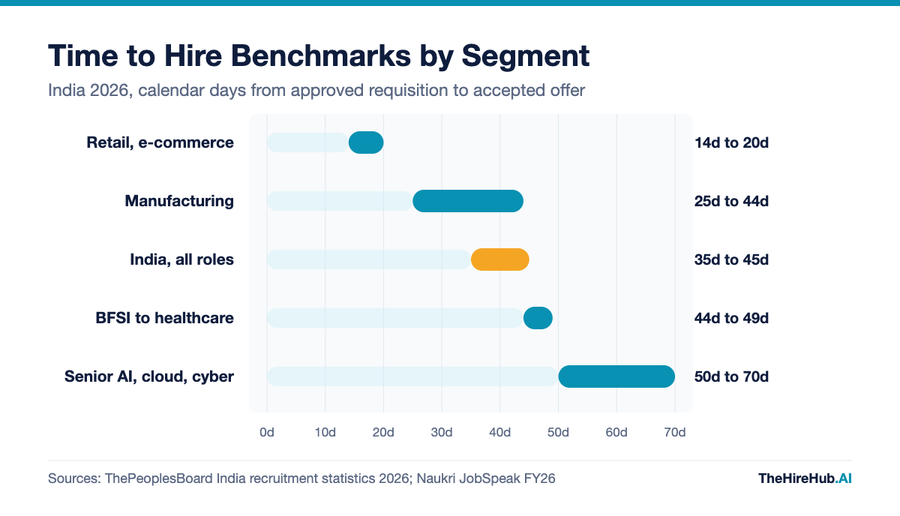
- Read the band, not the midpoint. A 25 to 44 day manufacturing band means your shop-floor req and your design engineer req are different animals sharing a label.
- Executive hiring is off this scale entirely. Indian leadership searches routinely run past 120 days, which is why folding them into a company-wide average destroys the average's usefulness.
- Check which clock you are running. Time to fill starts when the requisition is approved. Time to hire starts when the person you eventually hired entered the pipeline. The gap between them is your intake and approval overhead, and it is usually the part nobody owns.
How it actually works, and where it breaks
Time to hire is not one duration. It is the sum of a dozen small waits, which is why teams that go hunting for the bottleneck usually cannot find it. Ashby's analysis is blunt on this point: comparing the fastest and slowest quartiles of companies, the difference is spread across application review, scheduling, feedback and offer approval rather than concentrated in any one of them.
The first break is scheduling, and specifically the wrong half of it. Teams obsess over how fast they send a scheduling request, when the real delay is lead time, meaning how far out the interview actually lands once calendars are consulted. Automated scheduling confirms interviews in a median 3.7 hours against 5 hours for manual coordination, roughly 26 percent faster, and that saving compounds across every stage of a five-interview loop.
The second break is the gap between the final interview and the decision. This is the single largest source of delay in most processes, and it is rarely a missing-feedback problem. Ashby found 38 percent of scorecard pairs from the same interview disagree by at least one point, and nearly half of those disagreements straddle the yes-or-no line. Disagreement that crosses that threshold triggers another meeting, and another meeting costs days.
The third break is offer turnaround, the stretch between deciding and actually producing the offer. Slower-quartile companies lose an extra 3.3 days here on business roles and 4.7 days on technical ones, purely to approval chains and manual document assembly. In India that delay lands on top of a 30 to 90 day notice period, and roughly one in three IT roles carries the full 90 days.
"Nobody owns the wait between the last interview and the decision, which is exactly why it is the longest one."
What this means for your team
Stop reporting one number. Split your reporting by function and seniority at minimum, because a single company-wide target makes technical hiring look broken when it is operating exactly within its expected range. Then instrument each stage separately, so you can see which wait is growing rather than watching a total that averages your problems away.
Here is where the days actually go, and what each stage looks like when it is healthy.
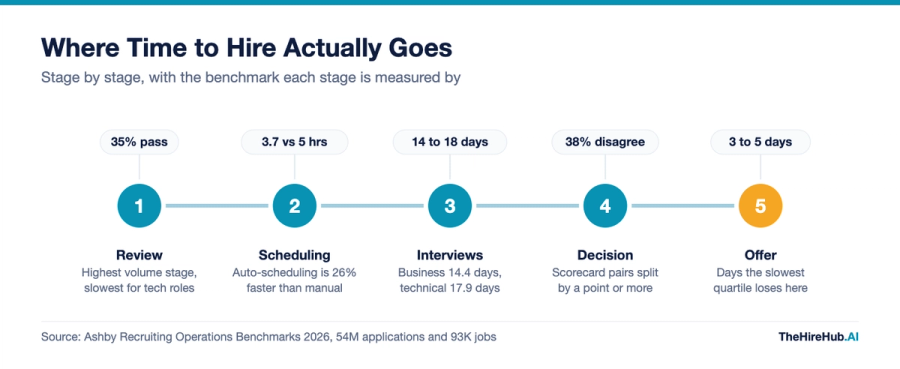
Two stages deserve attention that they almost never get. The first is the recruiter screen, where only about 35 percent of candidates pass, making it your highest-leverage filter and your largest volume queue at the same time. The second is archiving, which sounds like housekeeping and is not: candidates archived within a day return a median NPS of 9, those left 10 to 24 days return 7, and those left 50 days or more return 3. Silence is a speed problem that shows up on your employer brand rather than your dashboard.
The other lever is where candidates come from. Referred candidates clear the initial screen at 52 percent against 35 percent overall, and accept offers at 89 percent for business roles and 84 percent for technical ones. In India the channel gap is starker still: roughly 20 to 30 percent of referred candidates get hired, AI-driven platforms with intent scoring convert 8 to 15 percent, and job boards land between 1 and 3 percent. Faster hiring is often a sourcing decision wearing a process costume.
Time to hire benchmarks vs cost per hire
These two metrics get quoted together and optimised against each other, which is a mistake in both directions. Cost per hire is a spend question and time to hire is a flow question, and the cheapest channel is frequently the slowest one. Indian teams that calculate cost per hire from job-board spend alone can leave ₹2 lakh to ₹4 lakh per mid-senior hire uncounted once agency fees enter the picture, which makes the cheap-looking channel look even cheaper than it is.
The honest way to hold both is to treat speed as the constraint and cost as the variable, then check quality separately so you are not just hiring faster and worse. That third leg is why quality of hire measurement belongs on the same page as your speed numbers, and why the build-versus-buy question in AI recruiting vs agency turns on which of the three you are actually short of.
How to actually do this (and the four traps)
- Do not benchmark against a national average. The single most common error is comparing a specialist engineering req against an all-roles mean and concluding the process is broken. Segment by function and seniority first, then compare. Ashby's own guidance is that one blended target will consistently make technical hiring look slower than it is.
- Do not confuse time to fill with time to hire. Teams quote whichever number flatters them and then compare it to a benchmark measuring the other thing. Pick one definition, write it down, and keep it stable, because a definition change mid-year invalidates every trend line you have.
- Do not optimise the stage you can see. Scheduling speed is visible and satisfying to fix; interviewer availability is invisible and is usually the actual constraint. Widening and training your interviewer pool moves lead time more than any scheduling tool will on its own, and the tooling only pays off once the pool exists. Our recruitment automation guide covers which parts of this genuinely automate.
- Do not treat the offer-to-start gap as someone else's problem. In India a candidate can accept in week one and still be 90 days from a desk, which means your time to hire can improve while time to productivity does not move at all. Track the gap as its own number and staff around it.
"A hiring process does not get slow all at once, it gets slow in the places nobody thought to measure."
The one thing every hiring leader should take from this
The benchmark is not the point. Most teams that pull their time to hire numbers for the first time find days, sometimes whole weeks, sitting inside stages they assumed were fine, and the value is in the finding rather than in the comparison. Run the segmented numbers once, find the two stages where your calendar leaks, and fix those; the industry median will take care of itself. If you want a second pair of eyes on where your days are going, we look at this stuff all day.
Frequently Asked Questions
SHRM's 2026 benchmarking data, drawn from more than 4,600 organisations, puts the median time to fill at 39 calendar days for nonexecutive roles, down from the prior year, with executive roles flat. In India the working range is 35 to 45 days from approved requisition to accepted offer. Compare yourself against your own role type and seniority rather than a single national figure.
Roughly 35 to 45 days from the day a role is approved to the day someone accepts. The spread by sector is much larger than the average suggests: retail and e-commerce fill in 14 to 20 days, manufacturing in 25 to 44 days, BFSI around 44 days, healthcare and pharma around 49 days, and senior AI, cloud or cybersecurity roles in 50 to 70 days.
Time to fill starts when the requisition is approved and ends when the offer is accepted, so it includes budget sign-off and posting delays. Time to hire starts when the person you eventually hired entered your pipeline. Time to hire is always the smaller number, and the gap between the two is your intake and approval overhead.
Longer than almost anything else you hire. Ashby's 2026 analysis of 54 million applications found technical roles take a median 75 days to first fill against 60 days for business roles, and hired technical candidates spend about 17.9 days moving from first interview to last, versus 14.4 days for business candidates. In India, senior AI, cloud and security roles commonly run 50 to 70 days.
Usually recruiter load rather than recruiter performance. SHRM found extra-large organisations carried 67 percent more median requisitions per recruiter in 2026, and queueing delays grow non-linearly with load. Check requisitions per recruiter before you check anyone's process.
In specific stages, yes, and the gains are smaller than most vendor claims. Automated scheduling confirms interviews in a median 3.7 hours against 5 hours manually, about 26 percent faster, and AI-assisted application review cuts triage time on high-volume roles. Neither touches interviewer availability or offer approval chains, which is where most of the delay actually sits.
SHRM records executive time to fill as flat year on year and materially longer than nonexecutive roles. In India, executive and leadership searches routinely exceed 120 days. Folding these into a company-wide average is the fastest way to make that average meaningless.
Neither alone. Speed with no quality check produces fast bad hires, and quality with no speed check loses candidates to competitors mid-process. Track both on the same page, and add offer acceptance rate, which in India runs about 55 to 65 percent for senior roles hired through traditional channels.
There usually is not one. Ashby's comparison of fastest and slowest quartile companies found the difference spread across application review, scheduling, feedback and offer approvals rather than concentrated anywhere. The single largest individual gap is the stretch between the final interview and the hiring decision.
Pick one definition, write it down, and never change it mid-year. Segment by function and seniority, because a blended target makes technical hiring look broken when it is operating normally. Then track the offer-to-start gap separately: Indian notice periods run 30 to 90 days, and about one in three IT roles carries the full 90.


