
Quality of Hire Measurement: What Actually Predicts a Good Hire in 2026
The metric 89% of talent teams say matters more every year, and only 25% are confident they can actually measure.
Only 25% of talent leaders are confident they can measure quality of hire. The three signals to track, when to read each, and the four traps that break the loop.

TL;DR
Quality of hire measurement breaks at most companies for one unglamorous reason: nobody writes down what a good hire looks like before the hiring starts. In LinkedIn's Future of Recruiting 2025 survey of 1,271 senior recruiting professionals, 89% said measuring quality of hire is becoming more important, yet only 25% felt very confident they could actually do it. The fix is not another dashboard. Pick three signals, read them at day 90 and again at month 12, and shift your process toward the selection methods that genuinely predict performance, because structured interviews sit at .42 operational validity while the informal chat sits far below that. For the wider metric set this plugs into, start with the recruitment metrics every startup should track.
What is actually happening
Quality of hire has become the metric everyone claims and almost nobody defines. Aptitude Research, in a survey of 256 HR and talent acquisition leaders conducted with Crosschq, found that 75% named improving quality of hire their top priority for 2025. That is a remarkable level of agreement on a target. It is much less remarkable once you notice how few organisations can say what they are aiming at.
The same research found only 38% of companies believe they consistently achieve high-quality hires. Among that already self-selected effective group, just 23% measure quality of hire comprehensively using both quantitative and qualitative data. So the honest picture is a large majority chasing a number they have not operationalised.
Steve Hunt, chief scientist in residence at Crosschq, put the problem plainly in that report: "People are more focused on what influences QoH and aren't confident in their ability to quantify it or measure it." That is the whole gap in one sentence. Teams debate sourcing channels and interview panels endlessly, then never close the loop on whether any of it produced better employees.
Meanwhile the ground is moving. Gartner's talent acquisition outlook for 2026 names "AI reshapes how organizations assess talent" as one of four defining trends, and flags that candidate quality is under pressure from candidate fraud and from candidates' own use of generative AI during hiring. Gartner also predicts that by 2027, 75% of hiring processes will include certifications or tests for workplace AI proficiency.
Put those together and the stakes rise. If candidates can increasingly produce polished answers on demand, then the signals you were quietly relying on (a fluent screening call, a tidy take-home) decay in value. Measurement stops being a reporting nicety and becomes the only way to tell which parts of your process still work.
There is some optimism about the tooling. In the same LinkedIn research, 61% of talent professionals said they believe AI can improve how they measure quality of hire, and Aptitude found 56% of the effective organisations planned to increase investment in technology aimed at it. That optimism is reasonable, with one caveat worth stating early. Automation is good at collecting and joining the data, and useless at deciding what "good" means for your business, which is roughly the dividing line we drew in will AI replace recruiters.
The numbers
The most useful quantitative anchor in this whole field is not a vendor benchmark. It is the 2022 re-analysis of personnel selection research by Sackett, Zhang, Berry and Lievens, published in the Journal of Applied Psychology. They showed that decades of validity estimates had been systematically overcorrected for range restriction, which means the industry had been overstating how well its favourite tools predict job performance.
The corrected numbers reorder the field. Structured interviews come out highest at .42. General cognitive ability tests, long treated as the gold standard, fall from .52 under the older matrix to .31 under the corrected one. Biodata lands at .38, integrity tests at .31, situational judgement tests at .26, and conscientiousness measures at .19.
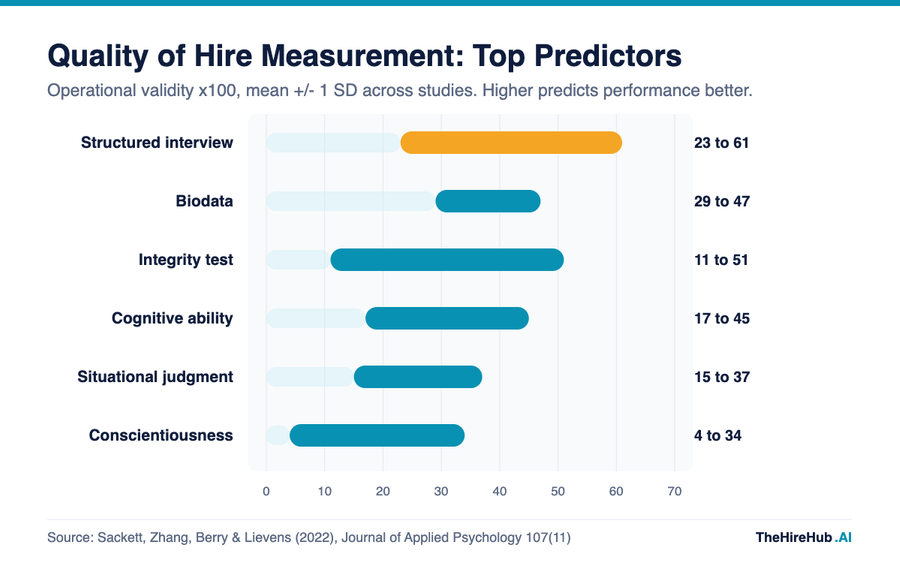
How to read this chart:
- The bar is the honest range, not the headline. Each band is the mean operational validity plus or minus one standard deviation across studies, because the same method built well or built badly gives very different results.
- Structured interviews win on both count and ceiling. In the authors' own words the 80% credibility interval for structured interviews runs from .24 to .66, so a well-designed one is the single strongest tool most teams already own.
- Nothing here reaches 1.0, and nothing will. Even the best predictor explains a minority of the variance in performance, which is why combining two methods beats optimising one.
That last point has a number attached. In the updated matrix, structured interviews combined with integrity tests reach a multiple correlation of .53, better than any single method on its own. Structured interviews alone carry roughly 35% of the predictable variance across the six methods studied. Cognitive ability contributes about 16%.
How it actually works, and where it breaks
The mechanism is simple to state. You define what "good" means for a role before you open it, you collect evidence against that definition in a consistent way for every candidate, and you check months later whether the people who scored well actually performed well. Then you adjust the weights. That loop, run twice, is worth more than any tool purchase.
Three things break it in practice.
The first is definitional drift. A hiring manager's idea of a great hire in January is not the one they will describe in September, especially if the team's priorities moved. Without a written scorecard fixed at intake, every retrospective becomes a memory test, and memory flatters whoever is telling the story.
The second is the survivorship problem. You only ever observe performance for the people you hired, never for the strong candidates you rejected. That means your model can look excellent while quietly screening out people who would have thrived, which is exactly the failure mode worth reading about in our breakdown of AI interview scoring and what it does and does not capture.
The third is measuring the wrong window. First-year retention is the most commonly used proxy, and it is genuinely useful, but a hire who leaves at month eight might have been a great hire mismanaged. Retention measures the whole employment experience, not the selection decision.
"A hiring process that cannot say what good looks like will reliably produce hires nobody can agree were good."
What this means for your team
You do not need a year of setup before you learn anything. You need a written definition, a baseline against hires you already made, and the discipline to look twice.
Three signals are enough for a first cycle, and three is deliberately fewer than most teams want:
- Ramp. Time from start date to first independent piece of work, defined per role. It is the earliest hard signal you get and it is much harder to argue with than an impression.
- Manager confirmation at day 90. One fixed question, asked the same way every time, on whether they would make the same hire again for the same role.
- Retention at month 12, split by voluntary and involuntary, because the two point at completely different problems in your process.
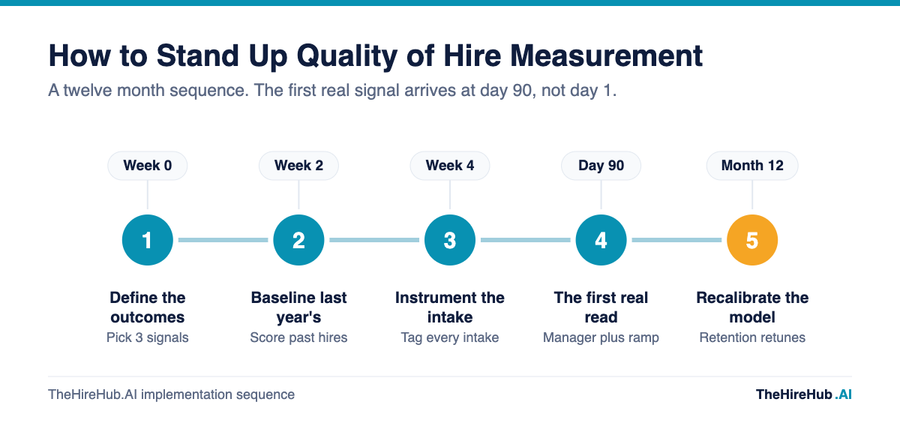
The sequence is deliberately front-loaded on definition and back-loaded on judgement. Week 0 is where you pick your three signals and get the hiring manager to sign the scorecard. Week 2 is where you score last year's cohort retrospectively, which costs an afternoon and immediately tells you whether your current process discriminates at all.
Week 4 is instrumentation. Tag every intake with source, selection method used, and scorecard result, because without that tagging your day 90 data cannot be sliced by anything actionable.
Day 90 gives you the first real read: hiring manager rating plus a ramp measure such as time to first independent delivery. Month 12 is where retention data lets you retune the weights on the signals you chose. Most teams find their initial weights were wrong, which is the point of measuring rather than assuming.
Quality of hire measurement vs the metrics you already report
Time to fill and cost per hire are process metrics. They tell you how efficiently the machine ran, not whether it produced anything good. A team can cut time to fill by 40% and quietly halve the quality of its output, and no dashboard built on speed will notice.
Quality of hire is an outcome metric, which makes it slower, noisier, and far more useful. It is also the metric that connects recruiting to the business case, which is why it belongs next to the numbers in our AI recruitment ROI guide rather than in a separate report. If you are weighing internal capability against outside help, the same measurement discipline is what makes an honest comparison possible in AI recruiting vs agency.
How to actually do this (and the four traps)
- Do not build a composite score first. The instinct is to average performance, retention and manager satisfaction into one index. Resist it for two cycles. Composites hide which input is moving, and a number nobody can decompose is a number nobody will act on.
- Do not let the hiring manager grade their own homework unblinded. Manager satisfaction is a legitimate input and also the softest one. Ask a specific question ("would you hire this person again for this role") at a fixed interval, rather than an open-ended impression collected whenever someone remembers.
- Do not confuse a hiring problem with an onboarding problem. If early attrition clusters in one team rather than one source or one method, the selection process is probably fine and the manager is the variable. This is the most common misdiagnosis, and it wastes entire recruiting redesigns.
- Do not over-index on a single strong predictor. Even structured interviews carry a wide credibility range, and the research is explicit that validity is not a mandate to prefer one tool regardless of cost, volume, candidate reaction or subgroup differences. Pair two methods and you beat any one of them, as the false economy of a single filter shows in the real cost of a bad hire.
"Measure the hire at ninety days and you learn about onboarding; measure at twelve months and you finally learn about hiring."
The one thing every hiring leader should take from this
The reason quality of hire stays unmeasured is not that the statistics are hard. It is that measuring it means committing, in writing and in advance, to a definition you can later be shown to have got wrong. That is uncomfortable, and it is also the entire value. Write down three signals this week and score last year's hires against them. If you would rather not do it alone, book a demo and we will walk through your last twelve months of hires and pick the three signals with you.
Hiring shouldn't have to feel harder just because the talent market is more competitive.
At TheHireHub.ai, we help hiring teams simplify the process from finding the right candidates to assessing and ranking them, so your team can spend less time managing the hiring process and more time making the right decisions.
If you're looking to make hiring easier, faster, and better, we'd be happy to help.
Frequently Asked Questions
Quality of hire measurement is the practice of scoring how well the people you hired actually performed, against a definition of success written before the role opened. It normally combines a ramp or productivity signal, a hiring manager rating at a fixed interval, and retention over the first year. The defining feature is that the definition is fixed in advance, which is what separates it from a retrospective opinion.
There is no cross-industry benchmark worth trusting, because every organisation defines the inputs differently and most weight them differently again. The useful comparison is against your own baseline: score the cohort you hired last year, then check whether this year's cohort scores higher on the same three signals. A score that moves in the right direction on a stable definition is more meaningful than any external number.
The common approach is a weighted average of a performance or ramp score, a hiring manager satisfaction score, and a retention score, each normalised to the same scale. Keep the three components visible separately for at least two hiring cycles before you combine them, because a single composite hides which input is actually moving. Only average them once you know what each one does on its own.
Take the first real read at day 90, using a hiring manager confirmation and a ramp measure, then take a second read at month 12 once retention data exists. Day 30 is too early to tell hiring from onboarding, and waiting a full year for any signal at all means you cannot correct a broken process in time to matter.
Time to hire is a process metric that describes how quickly your pipeline moved, while quality of hire is an outcome metric that describes whether the pipeline produced good employees. They frequently move in opposite directions, so reporting speed without quality can make a deteriorating process look like an improving one.
In the 2022 re-analysis by Sackett, Zhang, Berry and Lievens in the Journal of Applied Psychology, structured interviews had the highest mean operational validity at .42, ahead of biodata at .38 and cognitive ability tests and integrity tests at .31 each. The same research showed that combining two methods outperforms optimising any single one, with structured interviews plus integrity tests reaching a multiple correlation of .53.
It is a useful input and a poor standalone measure. Retention reflects onboarding, management, compensation and team dynamics as much as it reflects the selection decision, so a good hire who is badly managed will look identical to a bad hire in the data. Split voluntary from involuntary exits and pair retention with a day 90 signal to separate hiring problems from management problems.
AI is genuinely useful for the data plumbing: joining applicant tracking records to performance and retention systems, tagging hires by source and selection method, and surfacing patterns across cohorts too large to eyeball. It cannot decide what a good hire means for your business, and a model trained only on people you hired will never see the strong candidates you rejected. Treat the definition and the weighting as human decisions.
Three is the right number for a first cycle. Fewer than three and you cannot tell a hiring problem from an onboarding problem, more than three and the review meeting turns into a debate about the dashboard rather than the hires. Add signals only after you have run two full cycles on the original three.
Recruiting owns the measurement system and the consistency of the process, and the hiring manager owns the definition of success for their role and the rating at each checkpoint. Shared ownership is what makes the metric credible, because a number recruiting produces alone will always be suspected of grading its own homework.


