
Before You Buy an AI Recruiting Service in 2027: The Hidden Cost Vendors Leave Out of the Demo
Why checking the AI can cancel the time it saves, with a worked cost model, the research and a 30-day audit.
AI recruiting demos show time saved and skip the checking. A worked model, the research on accuracy and bias, and a 30-day audit show what AI screening really costs in 2027.

TL;DR
If you are evaluating an AI recruiting service for 2027, the demo will show you the time saved and leave out the time spent on AI recruiting verification: the checking that follows every ranking. In practice, AI sourcing and screening often move work from reading resumes to checking the AI. In the worked model below, a recruiter who feels the need to re-check about 63% of the resumes the AI rejected saves no time at all.
Independent research explains why the checking cannot simply be skipped. A 2025 study found GPT-4 and human raters showed near-zero agreement on resume fit, and a 2025 University of Washington experiment found people followed a biased AI's picks about 90% of the time. The fix is not to avoid AI: ask vendors the right questions before you sign, and measure net time saved in a pilot. Start with our ai recruiting vendor checklist.
What is actually happening
The loudest version of this complaint comes from practitioners. In an r/recruiting thread titled "AI recruiting is going nowhere", users describe AI sourcing and screening agents that often return results still needing heavy human filtering. Their point is that double-checking rankings and fixing mistakes shifts the workload rather than shrinking it.
This matches a wider pattern in AI-assisted work. A September 2025 survey of 1,150 US desk workers by the Stanford Social Media Lab and BetterUp found about 40% had received low-quality AI-generated work from a colleague in the past month. Each incident took about two hours to resolve. That study is not about recruiting, but it names the mechanism: output that looks finished and is not.
The evidence on how people judge their own AI productivity is also poor. In METR's July 2025 randomised trial, 16 experienced developers took 19% longer on real tasks when AI was allowed, yet afterwards believed it had made them about 20% faster. METR notes its results predate newer tools, so treat it as a warning about self-reported savings, not a verdict on any product.
Almost none of the vendor-side statistics measure the checking. An aggregator of 2026 AI-recruiting figures that we read on 16 November 2026 lists claims such as 31% faster hiring and 75% faster time-to-shortlist, and contains no statistic on recruiter verification workload. The number that decides whether AI pays for itself is the one nobody publishes.
The numbers
The core arithmetic is simple, and almost no pilot does it. Net time saved is the manual baseline minus everything the AI-assisted process costs, including checking and rework. The model below is illustrative: every input is an assumption you should replace with your own timings.
What does AI recruiting verification cost per role?
Take one role with 400 applicants. The manual baseline is a 90-second skim per resume, which is 10 hours. In the AI-assisted version, the recruiter reviews the AI's top 40 in full at 5 minutes each (3.3 hours), spends 1 hour on prompts, fixes and exceptions, and re-checks some share of the 360 rejected resumes at 90 seconds each.
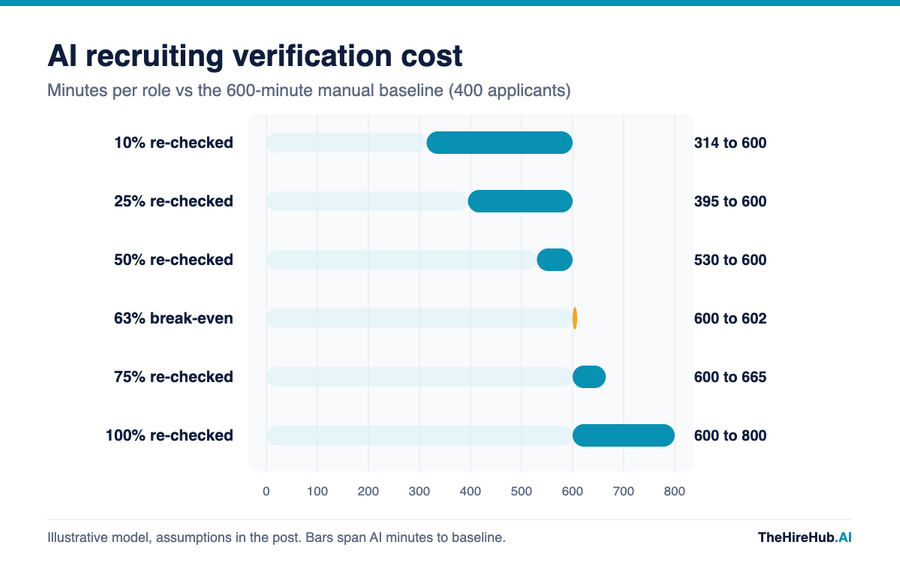
The only variable is how much of the reject pile the recruiter feels they must re-check. The chart shows the minutes each scenario takes against the 600-minute manual baseline.
How to read this chart:
- Each bar spans the AI-assisted minutes and the 600-minute manual baseline. Re-checking 10% of rejects takes about 314 minutes, a saving of 48%. At 25% it takes 395 minutes, and at 50% it takes 530 minutes, a saving of 12%.
- The amber bar is break-even. At about 63% of rejects re-checked, AI-assisted screening takes 602 minutes and saves nothing. At 75% it takes 665 minutes, 11% more than manual, and at 100% it takes 800 minutes, 33% more.
- In money, at an assumed loaded recruiter cost of ₹800 an hour, the 100% case costs about ₹2,700 more per role than manual screening. Across 150 roles a year that is roughly ₹4 lakh, before any licence fee.
Sources and method
The model is illustrative and built on stated assumptions, not measured data, and the ₹800 hourly cost is an assumption, not a benchmark. The research cited in this post comes from the studies named in each section: a 2025 NAACL findings paper, two University of Washington studies, METR, the Stanford and BetterUp survey, Gartner and a court order in Mobley v. Workday. None of it measures a specific vendor's product, so it shows what can happen, not what any given tool does.
How it actually works, and where it breaks
The verification burden is not a sign that the tools are broken. It follows from how the work is structured, and the research shows where it comes from.
Do AI screeners agree with human recruiters?
Not reliably. A NAACL 2025 findings paper compared zero-shot GPT-4 with four human raters on 736 real resumes across 20 openings. Human raters agreed with each other substantially (Fleiss' kappa about 0.79), while human-versus-GPT-4 kappa was near zero on every dimension.
Correlations were 0.57 for work experience and between 0.34 and 0.41 for skills, education and certifications. Prompt engineering helped, but the best exact-match rate on the hard cases was 61.6%.
The error types matter more than the headline. The authors catalogued about 415 cases of different scoring standards, 109 where a relevant certification was judged irrelevant, 35 hallucinations, and 31 where the model credited skills the resume never stated. These are plausible-looking mistakes, so a recruiter cannot confirm them without re-reading the resume. The authors recommend that humans and the model score independently, with extra review where they disagree.
Is bias a verification problem as well as a legal one?
Yes. In the University of Washington's 2024 study (presented at AAAI/ACM AIES, funded by NIST), three LLM-based retrieval systems ranked more than 550 real resumes against over 500 job listings across nine occupations, with 120 names swapped in. That produced over three million comparisons.
White-associated names were preferred 85% of the time against 9% for Black-associated names, and male-associated names 52% against 11% for female-associated names. The systems never preferred Black male-associated names over white male-associated names. This used research models, not any vendor's product, so it shows what can happen without controls.
The legal environment is moving the same way. In Mobley v. Workday (N.D. Cal.), a June 22, 2026 order let California FEHA claims proceed and held that the vendor can be directly liable for its own regulated conduct performed on an employer's behalf. This is a summary of one court ruling, not legal advice, but the practical reading for buyers is that "the vendor's tool did it" is not a position to plan around.
Is a human in the loop actually a safeguard?
Only if the human is not simply agreeing. UW researchers tested 528 US adults screening candidates for 16 job types under four conditions: no AI, neutral AI, moderately biased AI and severely biased AI. With no AI or a neutral AI, participants picked white and non-white candidates at equal rates.
With moderately biased AI they mirrored its preferences, and with severely biased AI about 90% of their choices followed the AI's picks. The AI was simulated and participants were recruited online, so this shows a tendency, not a measure of professional recruiters. It still undercuts the assumption that review by a person catches the model's errors.
Why does the checking happen? Five mechanisms
- Plausible errors cost as much to catch as to make. When a model credits a skill the resume never states, nothing on the surface flags it. Catching it means re-reading the source, which is the work the tool was meant to remove.
- There is no ground truth, so there is no cheap check. Resume fit is a judgement. Even trained humans needed averaging across four raters to reach substantial agreement in the NAACL study.
- The errors that matter are invisible. A false positive appears in the shortlist, where you reject it in seconds. A false negative sits in the reject pile where nobody looks, which is why our piece on ai screening false negatives matters for any buyer.
- Automation bias erodes the safeguard. If people follow a biased AI about 90% of the time, review is not independent.
- The input side is getting noisier. Gartner reported in July 2025 that 39% of candidates used AI in their applications (n=3,290, Q4 2024) and that 6% admitted to interview fraud (about 3,000 surveyed, Q2 2025). It also predicts that by 2028 one in four candidate profiles worldwide will be fake, though it publishes no method for that forecast, so treat it as a signal, not a statistic.
Claims check
Vendor time-saving figures are real data points, but they answer a different question from the one a buyer has. This is a note on what each figure measures, not a judgement on any company.
- Speed claims that stop at the shortlist. Figures such as 75% faster time-to-shortlist, attributed to Eightfold in 2025, or up to 70% faster hiring with full workflow redesign, attributed to Pin's April 2026 analysis, are relayed on a third-party aggregator we read on 16 November 2026. They measure elapsed time to an output, and nothing on that page measures the recruiter hours spent checking it.
- Accuracy claims about parsing. The same aggregator cites 89 to 94% parsing and skill-identification accuracy, sourced to Pin's 2026 data. Extracting a skill from text is a different task from judging fit for a role, which is where the NAACL study found near-zero agreement with human raters.
- Self-reported workload savings. User surveys of recruiters reporting around 20% less workload are worth discounting, because METR's developers believed they were 20% faster while measuring 19% slower.
- Headline speed on a vendor homepage. Recruit CRM's homepage, read on 16 November 2026, lists a 40% faster placements claim and an 800 million profile search index. The extract we read shows no baseline or method beside either figure.
Put these questions to any vendor before you sign: faster than what baseline, measured by whom, over which roles, and including which human time? What is the override rate in customer deployments? Will you support a paid pilot with a reject-pile audit written into the success criteria? A vendor confident in its numbers will agree to all three.
"A demo measures how fast the AI answers; a pilot should measure how long your team spends deciding whether to believe it."
What this means for your team
The practical answer is a 30-day audit that turns the model above into your own numbers. It needs a spreadsheet, a gold set and discipline about logging time, and it works for any vendor. Our ai recruiting pilot plan covers the wider scorecard; this audit adds the verification line most pilots skip.
Which metrics matter?
Five metrics cover it:
- Net time saved: manual baseline minutes minus AI-assisted minutes, where AI-assisted includes prompts, checking, rework and exception handling.
- Verification ratio: minutes spent checking per minute the AI claims to save. Above 1.0 the tool is losing.
- Override rate: the share of AI decisions a recruiter reverses.
- Reject-pile miss rate: the share of a random sample of AI-rejected candidates that a human would have advanced.
- Agreement: recruiter-versus-AI agreement on a gold set, ideally reported as kappa so chance agreement is removed.
What does the 30-day audit look like?
The chart shows the five stages. Run the reject sampling every week while the AI is live, because it is the only way to see the silent errors.
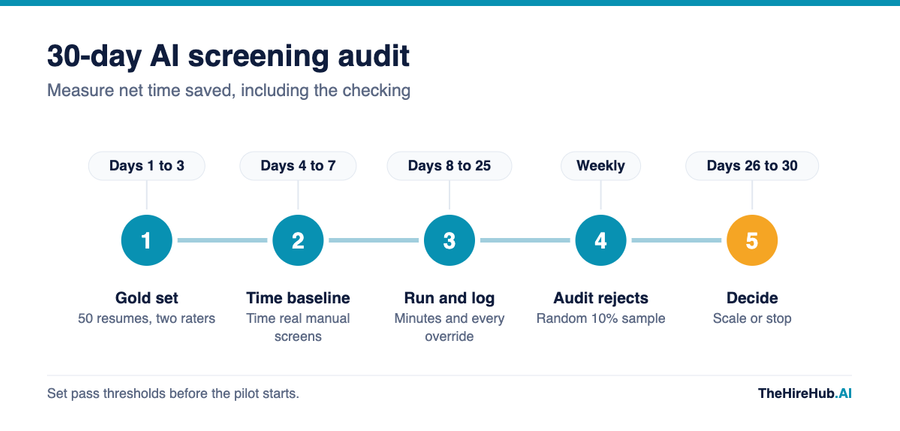
- Days 1 to 3: build a gold set. Pick 50 resumes for two roles and have two recruiters score them independently, then resolve disagreements. The human-human agreement figure tells you how noisy the task is.
- Days 4 to 7: time the manual baseline. Time real screening on a comparable batch, so the comparison is not a guess.
- Days 8 to 25: run the AI live with logging. Log minutes per role, every override and its reason, and any error that reached a hiring manager.
- Weekly: sample the rejects. Pull a random 10% of AI-rejected candidates each week, blind to the AI's score where the tool allows, and have a recruiter judge them.
- Days 26 to 30: compute and decide. Calculate net time saved, verification ratio and reject-pile miss rate by role family, then decide per role whether to scale, narrow or stop.
Set the pass thresholds before you start and agree who owns them, because a metric chosen after seeing the result will always favour the purchase.
AI screening vs structured human screening
The nearest alternative is not "no AI" but structured human screening: explicit criteria, scored the same way for every candidate. It is slower per resume but cheap to verify, because the reasoning is written down. AI tends to do best when it is given that same structure, such as checkable knock-out criteria, instead of an open request to rank everyone.
For sourcing rather than screening, the trade-offs differ, and our comparison of linkedin recruiter vs ai sourcing covers them. For the licence side of the business case, the ai recruiting software cost guide sets out what these tools cost, which is the number your verification hours should be added to.
How to actually do this (and the four traps)
Once you can measure the tax, you can lower it. Five design rules follow from the mechanisms above:
- Make every AI judgement carry its evidence. Require the tool to quote the resume line behind each criterion it scores, so verification is a glance at one sentence instead of a full re-read.
- Narrow the AI's job. Use it for explicit, checkable criteria (certification held, years in a named skill, location) before holistic ranking.
- Sample the rejects on a schedule. A fixed weekly random sample is cheaper than a vague worry about the whole pile, and it gives you a miss rate you can defend.
- Keep a blind first pass on a sample. Have the recruiter score a slice before seeing the AI's view, and review only the disagreements.
- Treat overrides as data. Log why recruiters reverse the AI, review the log monthly, and take it to the vendor.
The four traps
- Counting only the AI's minutes. Vendor dashboards report time to output. Your cost is output plus checking plus rework, and the checking is off the dashboard.
- Auditing the top and trusting the bottom. The shortlist is where errors are visible. The reject pile is where good candidates disappear.
- Treating "human in the loop" as a control. A reviewer who sees the AI's answer first tends to adopt it. Without independent scoring on a sample, the loop is a ritual.
- Averaging across role types. Volume roles with clear criteria and niche senior roles behave very differently. If you run an ATS, the recruitment funnel conversion rates benchmarks show which stage to measure by role family.
"Silent errors are the expensive ones: nobody audits the candidates the AI quietly turned away."
The one thing every hiring leader should take from this
If you are about to sign an AI recruiting contract for 2027 on the promise of screening hours saved, add one line to the business case: verification time, measured, by role, and write it into the pilot's success criteria. The honest answer to the practitioner complaint is that it is partly right. Checking the AI is real work, it grows when trust is low, and nobody's dashboard shows it.
But it is also measurable and designable. Teams that log it, sample their rejects and demand evidence-linked outputs have a far better chance of keeping the saving. If you want a second pair of eyes on how to run that audit, TheHireHub can help: we look at this stuff all day.
Frequently Asked Questions
It can, but the saving depends on how much you feel you must re-check. In our illustrative model the saving falls from 48% to zero as re-checking rises from 10% to about 63% of rejected resumes. Measure net time, including checking, before you scale.
Because the errors look plausible and there is no cheap ground truth. A 2025 study found GPT-4 hallucinated requirements and credited unstated skills, and its agreement with human raters was near zero on resume fit, so only a re-read confirms a ranking.
It varies by task. Parsing and skill extraction are reported at high accuracy by vendors, but independent work on judging fit shows weak agreement with humans. Test accuracy on your own gold set of roughly 50 resumes rather than relying on a headline figure.
It is the recruiter time spent checking, correcting and re-ranking AI output, plus the cost of any missed candidates. It does not appear on vendor dashboards, so it has to be logged separately and subtracted from claimed savings.
Not by itself. In a 2025 University of Washington experiment with 528 participants, people followed a severely biased AI's picks about 90% of the time. Independent first-pass scoring on a sample is a stronger control than simply reviewing the AI's answer.
Pull a random 10% of rejects each week, judge them blind to the AI's score where possible, and track the share you would have advanced. That reject-pile miss rate is the only way to see silent errors.
Potentially. A June 22, 2026 order in Mobley v. Workday let California claims proceed and held a vendor can be directly liable for its own regulated conduct on an employer's behalf. This is not legal advice, so ask counsel about your own tools and jurisdictions.
More of the same tools, with growing scrutiny. Candidate-side AI use is rising (Gartner reported 39% of candidates using AI in applications in late 2024), litigation is maturing, and buyers are starting to ask for measured net savings. Plan for a verification line in the budget.
No verified 2027 price list exists for the category as of November 2026. Use current published prices plus a renewal scenario, and add your measured verification hours at your loaded hourly rate to get the true cost.
Often, but test it. High-volume roles with explicit criteria are cheaper to verify, while niche senior roles depend on judgement that is harder to check. Report net time saved by role family, never as one blended number.

