
AI Recruiting Vendor Checklist for 2027: 18 Questions That Test Every Claim
Six criteria, a 100-point scorecard and a claims check for buying AI recruiting software next year.
A six-criteria, 18-question scorecard for evaluating AI recruiting vendors in 2027, with a claims check against SHRM and LinkedIn benchmarks and the three 2027 legal dates.

TL;DR
An AI recruiting vendor checklist only works if it tests evidence, not features. As of November 2026, vendor homepages still carry headline figures such as 75% faster hiring and 24x faster sourcing with no baseline, sample or date beside them, while the best independent survey data puts the time saved by recruiters who use generative AI at about 20% of the work week. For 2027 planning, score every vendor on six criteria and 18 questions, weight evidence highest, and get each claim in writing against your own baseline before you sign. If you have not priced the category yet, start with what AI recruiting software cost looks like by tier.
What is actually happening
Buying AI recruiting software got harder in 2026, not easier. Every sourcing tool, applicant tracking system and interview product now describes itself as agentic, and the feature lists have converged. The demos look alike because they are built on similar models. What separates vendors is the quality of the proof behind their numbers.
That proof is thin. We read three vendor homepages on 15 November 2026 and found more than thirty quantified claims between them, covering speed, database size, candidate quality and cost. Almost none printed a baseline, a sample size or a measurement period on the page. A handful linked to a single customer story.
The published guidance does not help much either. Most vendor evaluation checklists that rank today are either gated behind a form or written by a vendor about the criteria it happens to pass. Very few include a scoring model, and almost none cover India.
Meanwhile the legal ground is moving, and three dates land in 2027. Colorado's replacement AI law, SB 26-189, takes effect on 1 January 2027 and requires notice, an explanation of adverse decisions and a route to human review. India's Digital Personal Data Protection Act brings its consent, security and breach duties into force in mid-May 2027, 18 months after the rules were notified on 13 November 2025. The EU's high-risk obligations for recruitment systems were deferred to 2 December 2027, not repealed.
Each of those regimes puts duties on the company that deploys the tool, which is you. A contract signed in the first quarter of 2027 will be live when all three apply. That makes the checklist a contract instrument, and it belongs next to your recruitment budget planning rather than in a folder of demo notes.
The numbers
Start with the benchmarks a claim has to beat. SHRM's 2025 Recruiting Benchmarking survey of 2,371 members (fielded January to March 2025, US dollars) puts median cost-per-hire at $1,200 for nonexecutive roles and $10,625 for executive roles, with a median executive time-to-fill of 45 days. LinkedIn's Future of Recruiting 2025 survey of 1,271 recruiting leaders found that those already using generative AI save about 20% of their work week. The same report found only 37% were integrating or experimenting with it, and 11% actively integrating.
So the independent picture is a real but modest gain, concentrated in recruiter hours, in a market where most reference customers are still mid-pilot. Hold that against a homepage promising a multiple.
What should an AI recruiting vendor checklist include?
An AI recruiting vendor checklist should cover six criteria: evidence behind performance claims, data and privacy, bias and compliance, human control, integration fit and commercial terms. Score each on a 100-point scorecard, give evidence the largest share, and require written answers. Verbal answers given in a demo do not count.
- Evidence and proof (25 to 30 points). What is the baseline, sample size and time period behind each headline number? Can we speak to two customers of our size and hiring mix? Will you write the claimed result into the order form as a target?
- Data and privacy (15 to 20 points). Do you train models on our candidate data? Who are your sub-processors and where is data processed? How quickly do you notify us of a breach, and how long are logs retained?
- Bias and compliance (15 to 20 points). Who ran your most recent bias audit, on what data, and can we read it? Which candidate notices do you generate for us? What changes in your product for the 2027 deadlines?
- Human control (10 to 15 points). At which steps can a recruiter override the system? What evidence sits behind each score or ranking? Is every automated action logged with a reason?
- Integration fit (10 to 15 points). Which of our systems do you write back to, and how often? Who builds and maintains the integration? What happens to our workflows if the connection fails?
- Commercial terms (10 to 15 points). What is the total first-year cost including implementation and usage? What are the renewal uplift cap and exit terms? In what format do we get our data back?
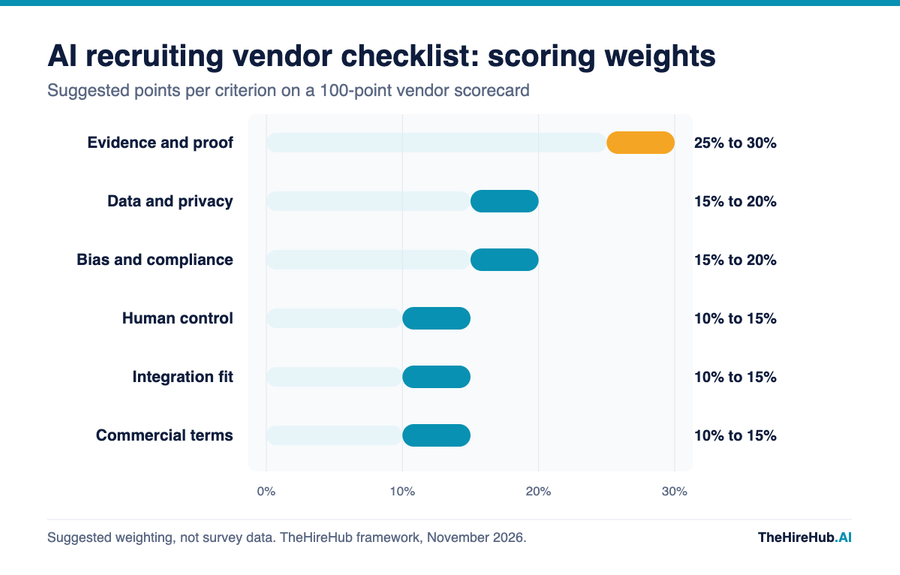
How to read this:
- The ranges are a suggested weighting, not survey data. Pick one number inside each range so the six add up to 100 before any vendor is scored.
- Evidence carries the most weight because every other answer depends on it. A vendor that cannot document its headline number is unlikely to document its audit.
- Raise the data and privacy weight if you hire in India or the EU, where the 2027 duties fall on the deploying employer.
Sources and method
Benchmarks come from SHRM's 2025 Recruiting Benchmarking data brief (survey fielded 9 January to 3 March 2025) and LinkedIn's Future of Recruiting 2025 report (survey fielded September 2024). Legal dates were checked in November 2026 against law firm summaries published between November 2025 and July 2026. Vendor claims were read on each vendor's live homepage on 15 November 2026. The figures describe US and global survey respondents, not Indian employers specifically, and none of them is a forecast for 2027.
How it actually works, and where it breaks
A performance claim has four parts: a metric, a baseline, a sample and a period. Take one of them away and the number cannot be checked. The checklist works by asking for all four, in writing, for every figure a vendor uses in its pitch.
Run the arithmetic on a typical promise. Against SHRM's 45-day median for executive roles, hiring 75% faster would mean filling the role in about 11 days. Interview loops and offer negotiation alone make that unrealistic for most senior hires, so the claim must describe one stage of the process and not the whole of it.
Why do AI recruiting vendor claims fall apart in practice?
AI recruiting vendor claims usually fail for one of three reasons: the number describes a single stage and not the whole funnel, it comes from the vendor's best customer and not a typical one, or it measures an input such as database size when buyers assume an outcome such as hires. None of these makes the claim false, only incomplete.
The stage problem is the most common. If sourcing takes a tenth of the elapsed time on a requisition, making it 24 times faster shortens time-to-fill by less than a tenth. The interview loop and the offer stage are untouched.
Claims check
- Database size. hireEZ's homepage cites "1B+ profiles across 45+ platforms" (hireez.com, checked 15 November 2026). No source or deduplication method is published on the page. Independent benchmarks do not measure database size at all, because reach is not the same as reachable, interested candidates in your market.
- Speed multiples. Findem's homepage shows a 24x figure for faster sourcing (findem.ai, checked 15 November 2026), with no baseline printed beside it. LinkedIn's survey data points to roughly one working day a week saved across all recruiter tasks.
- Cost and spend reductions. Humanly's homepage headlines a 92% cut in job board spend for one named customer, with the case study linked (humanly.io, checked 15 November 2026). A single customer result is useful evidence, but it is not a typical outcome. Ask for the median across customers of your size.
- Quality multiples. Claims of several times more qualified candidates appear without a definition of qualified. LinkedIn's own platform data found recruiters using AI-assisted messaging were 9% more likely to make a quality hire, and LinkedIn presents that as an association, not a cause.
"A vendor number without a baseline is an advertisement, and you should budget for it the way you budget for an advertisement."
What this means for your team
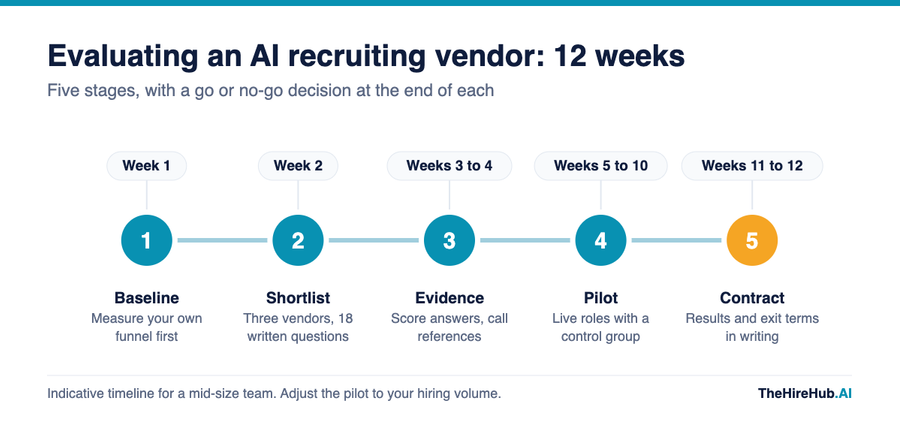
Treat the evaluation as a twelve-week sequence with a decision at the end of each stage. Skipping the first stage is the reason most evaluations end in a draw.
- Baseline (week 1). Pull your own time-to-fill, cost-per-hire and stage conversion for the last twelve months. Your cost per hire benchmarks are the only numbers a vendor claim can be honestly compared with.
- Shortlist (week 2). Pick three vendors at most and send all 18 questions in writing. Set a deadline, and treat a missing answer as a zero.
- Evidence (weeks 3 and 4). Score the written answers, read the audit and security documents, and call two reference customers you chose yourself.
- Pilot (weeks 5 to 10). Run the top scorer on live roles with success metrics agreed in advance. A structured AI recruiting pilot needs a control group, or the result means nothing.
- Contract (weeks 11 and 12). Write the pilot result, the data terms and the exit terms into the agreement. Tie renewal pricing to the outcome the vendor claimed.
AI recruiting vendor checklist vs an RFP
A checklist and a request for proposal look similar and do different jobs. An RFP asks vendors to describe themselves, which produces long, well-written and largely identical documents. A checklist asks for evidence you can verify, and scores what comes back.
The RFP still has a place for large, regulated buyers who need a formal procurement trail. Even then, the checklist should sit inside it as the scored section, with the narrative questions cut back. For smaller teams the checklist replaces the RFP entirely.
The other neighbour is the internal build. If no vendor scores above 60 on your scorecard, the honest conclusion may be that the category is not ready for your use case, and the build vs buy question deserves a second look before you compromise on evidence.
How to actually do this (and the four traps)
- Scoring the demo and not the documents. A good demo proves the vendor has a good sales engineer. Score only what arrives in writing, and have a second person score independently before you compare.
- Accepting the vendor's references. Supplied references are the vendor's happiest customers. Ask for the full customer list in your segment and choose two yourself, including one that joined in the last six months.
- Leaving compliance to the vendor. The 2027 rules in Colorado, India and the EU place duties on the employer that deploys the tool. Your AI hiring liability does not transfer because a vendor holds a certificate.
- Signing before the exit is written. Data export format, deletion timelines and renewal caps are easy to negotiate before signature. They are close to impossible afterwards.
"The cheapest moment to find out a tool does not work is before the contract, and the checklist exists to move that moment forward."
The one thing every hiring leader should take from this
If you are finalising a 2027 plan this month, the decision in front of you is which vendor can prove its claim on your data. The impressive demo matters far less. Set your baseline first, send the 18 questions in writing, weight evidence at a quarter of the score or more, and put the pilot result into the contract.
Vendors with real results welcome that process, and the ones who resist it have told you what you needed to know. If you want a second opinion on a scorecard or a vendor's answers, we look at this stuff all day.
Frequently Asked Questions
An AI recruiting vendor checklist is a scored list of questions a buyer sends to vendors before purchase. A useful one covers six areas: evidence behind performance claims, data and privacy, bias and compliance, human control, integration fit and commercial terms. Answers are collected in writing and scored on a 100-point scale so vendors can be compared on proof and not on presentation.
Measure your own time-to-fill, cost-per-hire and stage conversion first. Shortlist three vendors at most, send the same written questions to each, score the answers independently, check two references you chose yourself, then run a pilot with a control group. Write the pilot result and the exit terms into the contract.
Ask for the baseline, sample size and time period behind every headline number. Ask whether your candidate data trains their models, who the sub-processors are, who ran the latest bias audit, where a recruiter can override the system, who maintains integrations, and what the total first-year cost and exit terms are.
Three legal dates fall in 2027. Colorado's replacement AI law, SB 26-189, takes effect on 1 January 2027. India's Digital Personal Data Protection Act brings its main duties into force in mid-May 2027. The EU's high-risk obligations for recruitment systems apply from 2 December 2027. All three place duties on the employer that deploys the tool.
A 2027 contract should name the performance target the vendor claimed, the data processing and breach notification terms, the audit documents the vendor will supply each year, a cap on renewal price increases, and the format and timeline for returning or deleting your data at exit. Negotiate these before signature.
Independent data points to a modest gain. LinkedIn's Future of Recruiting 2025 survey found recruiters already using generative AI saved about 20% of their work week, roughly one working day. Vendor claims of 70% or more usually describe one stage, such as sourcing or screening, and not the whole time-to-fill.
Database size is an input and not an outcome. A large profile count says nothing about how many of those people are current, deduplicated, contactable and relevant to your roles and locations. Ask the vendor how many profiles match three of your real open roles, and what share responded for customers like you.
Yes, where the tool processes personal data of candidates in India. The employer is typically the data fiduciary and remains responsible for notice, consent, security safeguards and breach reporting, even when a vendor processes the data. The main obligations take effect in mid-May 2027, so vendor contracts signed now should already reflect them.
About twelve weeks for a mid-size team: one week to set a baseline, one to shortlist, two to review evidence and references, six for a pilot on live roles, and two for contracting. High-volume hiring teams can shorten the pilot because they reach a meaningful sample sooner.
Yes, in a lighter form. A team making a handful of hires a year can drop the formal scoring and still ask the six most important questions in writing: the baseline behind the headline claim, data training, the bias audit, override points, total first-year cost and exit terms.

