
Recruitment Budget Planning for 2027: Line by Line, With Real INR Costs
How to build a 2027 hiring budget from attrition, recruiter capacity and channel prices, with a worked 84-hire example in rupees.
Recruitment budget planning for 2027, line by line: what agencies, Naukri, LinkedIn, tools and recruiters really cost in India, with a worked 84-hire example.

TL;DR
Recruitment budget planning for 2027 comes down to one honest equation: hires you need, times what each channel really costs, plus a reserve for the year not going to plan. In our worked example below, an Indian company of 300 people that needs 84 hires lands at roughly ₹88 lakh to ₹1.3 crore, or about ₹1 lakh to ₹1.5 lakh per hire, and the agency line alone can swallow a quarter of it. Build the line items from your attrition rate and recruiter capacity, not from last year's number plus ten percent. If you want the per-hire baselines first, start with our cost per hire benchmarks.
What is actually happening
Most hiring budgets in India are still built backwards. Finance hands TA a number, usually last year's spend adjusted for inflation, and the team spends the year rationing it. That worked when hiring volumes were predictable. It works badly when attrition moves two points in a year and the board wants a growth plan at the same time.
Attrition is moving. Aon's annual India salary increase survey, published on 14 October 2026 and covering more than 1,200 organisations, puts attrition at 18% in 2026, up from 16.2% in 2025. For a 300-person company that is 54 people walking out in a year, and every one of them is a requisition before a single growth role is added.
Hiring intent is also high. ManpowerGroup's Employment Outlook Survey for October to December 2026, which polled 3,055 Indian employers in July 2026, reported a net employment outlook of 54%, up six points on the previous quarter and eleven points on the year before. When most of your competitors plan to hire at the same time, channel prices hold firm and good candidates get more than one offer.
Pay is the third pressure. The same Aon survey projects average Indian salary increases of 9.1% in 2027, after 9% actual in 2026. That figure hits your recruitment budget twice: once in the salaries of your own recruiters, and again in agency fees, because agencies bill as a percentage of the CTC you offer.
Then there is the work itself. Gem's 2026 Recruiting Benchmarks, built on more than 165 million applications between mid-2021 and mid-2025, found that each recruiter now carries about 13.4 open roles at a time, application load per recruiter is 93% higher than in 2021, and interviews per hire are up 33%. More volume per recruiter means the "people" line in your budget is doing more, and costs more, than it used to.
The numbers
Here is the worked example we will use throughout. A 300-person Indian technology-enabled company with 18% attrition (54 backfills) and a 10% growth plan (30 new roles) needs 84 hires in 2027. Average offered CTC is ₹12 lakh, with ten hard-to-fill roles averaging ₹25 lakh.
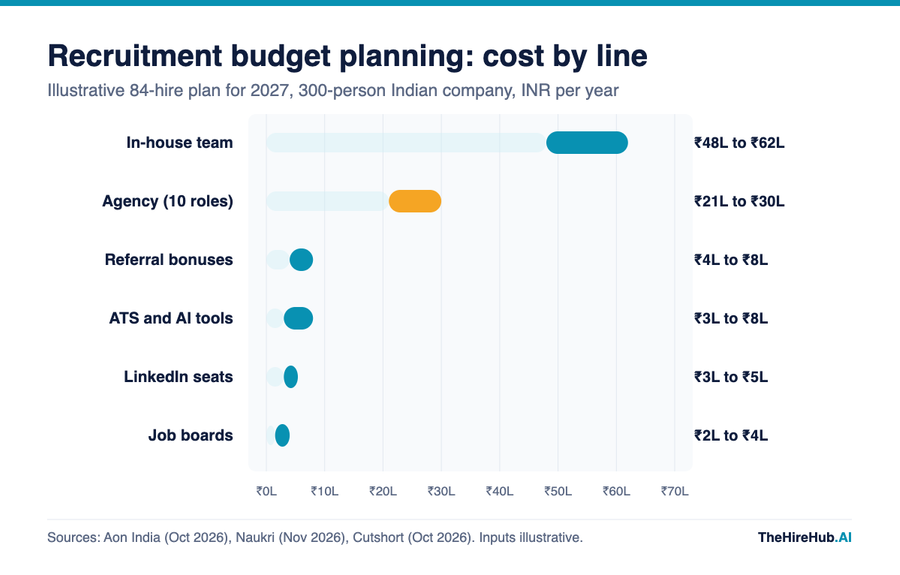
How to read this:
- The in-house team is the biggest line and the most predictable one. Three recruiters and a coordinator, at an illustrative ₹14 lakh to ₹18 lakh loaded cost per recruiter, cost ₹48 lakh to ₹62 lakh a year before tools.
- Agency is the line that breaks budgets. Ten hard roles at ₹25 lakh CTC, billed at 8.33% to 12%, comes to ₹21 lakh to ₹30 lakh. That is about 12% of hires taking roughly a quarter of the spend.
- Tools and job boards are small but sticky. LinkedIn seats, Naukri credits and your ATS together run ₹7 lakh to ₹17 lakh, and they renew whether you hire or not.
Add a 10% reserve and the total is ₹88 lakh to ₹1.29 crore, or about ₹1.05 lakh to ₹1.54 lakh per hire. For context, SHRM's 2025 benchmarking put the average non-executive cost per hire in the US at $5,475 and the executive average at $35,879 (USD, US data), and found that the median organisation spends 20% of its total HR budget on recruiting.
Sources and method
Attrition and 2027 salary projections come from Aon's India survey (released 14 October 2026). Hiring intent comes from ManpowerGroup India's Q4 2026 survey, workload data from Gem's 2026 benchmarks, and US cost per hire from SHRM's 2025 benchmarking release. Naukri prices were checked on Naukri's own small business packages page on 13 November 2026; LinkedIn Recruiter Lite and agency fee ranges are indicative figures from Cutshort's India pricing guide (updated October 2026). Recruiter salaries, referral bonuses and tool spend in the example are illustrative inputs, so replace them with your own payroll and contract figures.
How it actually works, and where it breaks
A driver-based recruitment budget has three inputs. The first is the hire count: growth roles from the business plan plus backfills from your attrition rate. The second is capacity: how many requisitions one recruiter can carry, which tells you how many recruiters you need. The third is channel mix: for each role, whether it will most likely be filled by inbound applicants, direct sourcing, referral, internal move or an agency.
Multiply each channel's share of hires by its unit cost and you have the variable part of the budget. Add salaries, seats and subscriptions and you have the fixed part. The split matters because the fixed part does not shrink when hiring slows, and the variable part explodes when it speeds up.
What should a recruitment budget include?
A complete recruitment budget has six kinds of line: the TA team's loaded salaries, agency fees, job board and database access, sourcing seats such as LinkedIn Recruiter, your ATS and other software, and candidate-facing costs like referral bonuses, assessments and background checks. Add a reserve on top. Interviewer time belongs in the model too, even though it sits in other teams' payroll.
Why do recruitment budgets overrun?
Most overruns come from the agency line, not from tools. A role that was meant to be sourced in-house sits open for sixty days, a hiring manager escalates, and it goes to an agency at 8.33% to 12% of CTC. Ten of those in a year at ₹25 lakh each costs more than a full-time recruiter.
The second failure is pricing last year's CTC. If agency fees are a percentage of offered pay and offered pay rises 9.1%, the agency line rises with it even if you place the same number of roles. Budgets built on 2026 salaries come up short by the second quarter.
The third failure is ignoring capacity. Gem's data shows recruiters carrying about 13 open roles each and facing far more applications than a few years ago. If your plan quietly assumes each recruiter can carry 25 roles, the shortfall shows up as slow hiring, then as emergency agency spend. Our guide to the recruiter to hire ratio shows how to size the team properly.
"A recruitment budget that ignores recruiter capacity does not save money; it just moves the spend into emergency agency fees."
What this means for your team
The sequence below takes about three weeks if finance and TA work on it together, and it should finish before annual contracts come up for renewal.
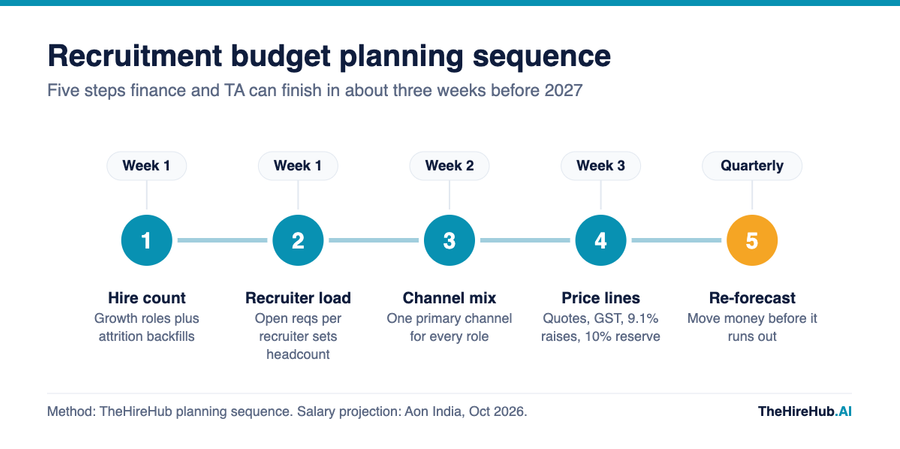
- Count the hires. Take next year's headcount plan, apply your trailing attrition rate to existing headcount, and add the two. Split the total by quarter, because Q1 joiners and Q4 joiners carry very different salary costs.
- Size the team. Divide expected open requisitions by realistic recruiter load. If the answer says four recruiters and you have three, either fund the fourth or budget the agency spend that will fill the gap.
- Assign a channel to every role. Most volume roles should come from job boards and sourcing; senior and niche roles may justify an agency. Gem's data shows referrals convert at roughly eleven times the rate of inbound applicants, which is why a funded employee referral program earns its own line.
- Price every line. Get renewal quotes for LinkedIn and your ATS, check Naukri package prices (GST is extra), and apply the 2027 salary increase to every percentage-of-CTC fee. For software, our breakdown of ai recruiting software cost gives current ranges. Then hold about 10% back as a reserve for a key exit, a surprise leadership search or a channel that underdelivers.
- Re-forecast every quarter. Compare actual hires and actual channel mix against plan, and move money between lines before it runs out.
Driver-based budgeting vs last year plus ten percent
The alternative most companies use is incremental budgeting: take last year's recruitment spend, add an inflation factor and defend it. It is fast and finance understands it. The problem is that it carries forward every inefficiency from the year before, including roles that went to agencies only because nobody planned for them.
Driver-based budgeting takes longer the first time, but every rupee traces back to a hire count, a channel and a unit price, so the conversation with your CFO becomes about assumptions rather than totals. It also makes the trade-offs visible. You can show, line by line, what a fourth recruiter costs against what the same roles would cost through an agency, which is the analysis behind our comparison of ai recruiting vs agency hiring. Startups with very small hiring plans can start lighter; our budget ai recruitment tools guide covers the under ₹50,000 a month version.
When does incremental budgeting still make sense?
If you hire fewer than ten people a year, have stable attrition and use one or two channels, last year plus an adjustment is usually good enough. The driver-based model pays off once hiring volume, channel mix or attrition start to move, which for most Indian companies planning growth in 2027 is already the case.
How to actually do this (and the four traps)
Build the budget in a spreadsheet with one row per line item and three columns per row: the driver (hires, seats, months), the unit price with its source and date, and the formula. When a number changes, you change the input, not the total.
- Treating attrition as a rounding error. At 18% attrition, backfills can outnumber growth hires. Budget them explicitly by team, because attrition in sales and support usually runs well above the company average.
- Pricing fees on today's salaries. Every fee that is a percentage of CTC should use projected 2027 offers, not 2026 offers. Apply the salary increase before you multiply.
- Forgetting the hidden people cost. Interviews per hire are up a third since 2021 according to Gem, and every interview hour is a hiring manager not doing their job. Track it, even if it never appears in the TA budget, and fix your recruitment funnel conversion rates before adding interview rounds.
- Locking every dollar on day one. Annual tool contracts signed in January cannot be moved in July. Keep the reserve unallocated and avoid committing to seat counts for recruiters you have not yet hired.
"Count your backfills before you count your growth hires, because attrition decides more of your 2027 budget than ambition does."
The one thing every hiring leader should take from this
If you are finalising your 2027 plan this month, do one thing before anything else: count your backfills honestly and price your agency line on next year's salaries. Those two numbers decide whether the budget survives the first quarter. Everything else, from tool renewals to job board credits, is small enough to adjust as you go. TheHireHub builds these models with Indian hiring teams every planning season, and if you want a second pair of eyes on yours, we look at this stuff all day.
Frequently Asked Questions
No survey has published a 2027 India cost per hire yet, so build it from your own lines. In our worked example, a 300-person company making 84 mostly mid-level hires spends about ₹1.05 lakh to ₹1.54 lakh per hire all-in, with agency-filled senior roles costing far more than the average.
Pay and churn. Aon's October 2026 survey projects average Indian salary increases of 9.1% in 2027 after 9% in 2026, and attrition reached 18% in 2026. Higher pay lifts every percentage-of-CTC agency fee, and higher attrition adds backfill requisitions before any growth hiring.
SHRM's 2025 benchmarking found that recruiting takes a median 20% of the total HR budget, with an average of 26%. The middle half of organisations sat between 10% and 39%, so the right share depends heavily on hiring volume and growth plans.
Estimate total hires (growth roles plus attrition backfills), assign each role a likely channel, and multiply each channel's hires by its unit cost. Add fixed costs such as recruiter salaries, sourcing seats and software, then add a reserve of around 10% for unplanned roles.
Contingency agencies in India most commonly charge 8.33% of annual CTC, roughly one month's salary, according to Cutshort's pricing guide updated October 2026. Niche or senior searches often run 10% to 12% or move to a retainer, and fees rise automatically as offered salaries rise.
As checked on 13 November 2026, Naukri's small business packages range from ₹3,500 for two job postings and 60 CV views over 30 days to ₹6,000 for five postings and 150 CV views, plus GST. Resdex database access is priced per plan through an account manager.
Divide the open requisitions you expect to carry at any time by a realistic load per recruiter. Gem's 2026 Recruiting Benchmarks found recruiters handle about 13.4 open roles at a time, with application volume per recruiter 93% higher than in 2021.
Around 10% of the total is a sensible default for most growing companies. It covers a key resignation, an unplanned leadership search or a channel that underdelivers. Keep it unallocated until a real need appears, rather than spreading it across lines in January.
Yes. Keep AI sourcing, screening and scheduling tools on their own line, separate from the ATS, so you can judge each against the recruiter hours or agency fees it replaces. Prefer contracts that let you change seat counts mid-year.
Start in the fourth quarter of 2026, before annual LinkedIn, ATS and job board contracts renew. With finance and TA working together, a driver-based budget takes about three weeks: count hires, size the team, set the channel mix, price each line and agree the reserve.


