
ATS Pricing in India for 2027: What You Will Actually Pay, in INR
Per-recruiter plans, Vendr contract medians, GST and the hidden line items, converted to rupees for your 2027 plan.
ATS pricing in India runs from free to about ₹71 lakh a year. Here is what each buyer type pays, in INR, with GST, add-ons and a 2027 buying sequence.

TL;DR
ATS pricing in India runs from free to roughly ₹71 lakh a year, and where you land depends far more on how the vendor counts you than on features. Per-recruiter tools like Zoho Recruit start at ₹1,250 per recruiter per month on annual billing, so a five-person startup team can run a full ATS for under ₹1 lakh a year. Quote-only platforms bought through procurement sit in a different universe: Vendr's purchase data puts the median Greenhouse contract at $27,000 a year (about ₹25 lakh). If you are setting a 2027 recruiting tech line, price the licence, then add 18% GST, add-ons and currency risk, and read our recruitment budget planning breakdown for where the ATS sits in the total.
What is actually happening
The Indian ATS market has split into two pricing worlds that rarely appear on the same shortlist. The first is transparent and seat-based: Zoho Recruit, Manatal and Recruit CRM publish per-user prices you can multiply out in a spreadsheet. The second is quote-only and headcount-based: Greenhouse, Lever, Darwinbox, Keka Hire and Naukri RMS either ask you to talk to sales or publish only a starting tier.
Keka's pricing page, checked on 17 November 2026, lists two hiring tiers (PRO and ADVANCED) with no rupee figure and notes that a "nominal setup fee" applies. Capterra lists Naukri RMS as "contact vendor" with no free trial. That is normal for India-built suites, which tend to bundle hiring with payroll and HRMS and price the bundle by employee count.
The global mid-market tools have moved the other way. Workable now publishes prices by company size, starting at $299 a month for 1 to 20 employees on annual billing. Ashby publishes a $400 a month starting price for its Foundations plan (up to 100 employees) and lists add-ons such as SSO at $100 a month separately.
There is also a forced-migration wave heading into 2027. Freshworks told Freshteam customers it would stop annual, half-yearly and quarterly renewals from 7 March 2026, with renewals signed before that date running to April 2027 at the latest, according to People Matters. Many Indian SMBs ran on Freshteam, which means a cluster of ATS purchases landing in the first half of 2027.
Finally, currency. Most global ATS contracts are billed in dollars, and the rupee closed at 94.86 against the dollar on 2 November 2026, per HDFC Sky. A dollar contract that renews in 2027 carries exchange-rate exposure your finance team should model, not ignore.
The numbers
Here is what each buyer type actually pays for the licence alone, using published prices where they exist and Vendr purchase data where they do not. All USD figures are converted at ₹94 and exclude GST.
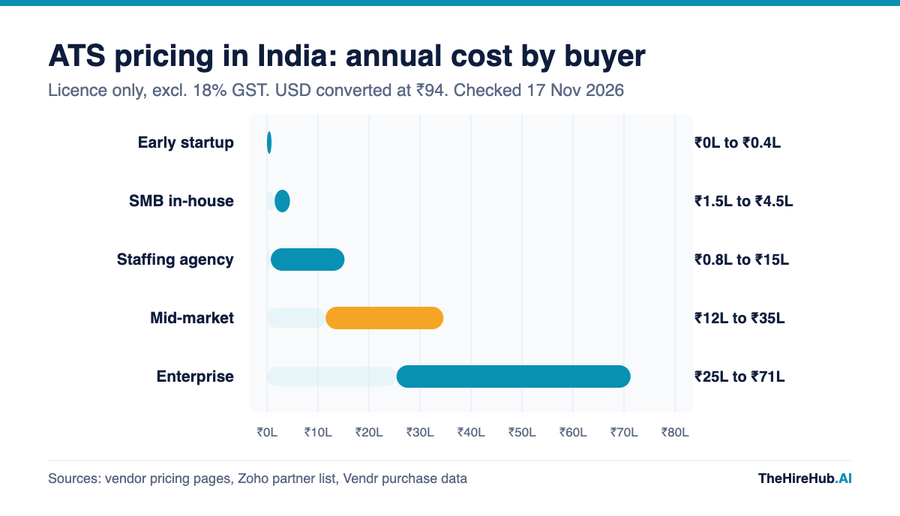
The underlying price points behind those bands, all checked on 17 November 2026:
- Zoho Recruit (Corporate HR): Forever Free with 1 active job per licence; Standard at ₹1,250 per recruiter per month annually (₹1,500 monthly); Enterprise at ₹2,500 annually (₹3,000 monthly), per an authorised Zoho partner's India price list. The Staffing Agency edition runs ₹1,250 to ₹3,750 per user per month.
- Manatal: $15, $35 and $55 per user per month on annual billing, rising to $19, $39 and $59 on monthly billing (Manatal pricing).
- Recruit CRM: $95, $135 and $215 per user per month for Pro, Business and Enterprise, with annual billing saving "up to 17%" (Recruit CRM pricing).
- Workable and Ashby: Workable Standard at $3,588 a year for up to 20 employees (Workable pricing); Ashby Foundations from $400 a month for up to 100 employees (Ashby pricing).
- Lever (Vendr median final prices): $12,240 at 200 employees, $36,778 at 500 and $63,172 at 1,000 (Vendr).
- Greenhouse (Vendr): median annual contract $27,000 across 712 purchases, with a range of $10,627 to $75,854 (Vendr).
How to read this:
- The early startup band assumes one or two recruiters on Zoho Recruit Standard or Manatal Professional; it tops out under ₹40,000 a year.
- The mid-market and enterprise bands are negotiated contract values, not list prices, so they already reflect discounting.
- None of these figures include job board slots, assessments, background verification or implementation, which can match the licence in year one.
Sources and method
Prices come from each vendor's public pricing page, an authorised Zoho partner's India price list (Zoho's own page did not render rupee figures when checked) and Vendr's marketplace purchase data, all checked on 17 November 2026. Dollar figures use ₹94 to the dollar, close to the early November 2026 rate. These are licence costs only; they exclude GST, add-ons and services, and vendors can change list prices at any time.
How ATS pricing actually works, and where it breaks
Why do ATS vendors charge per recruiter, per employee or per contract?
ATS vendors use three meters. Per-recruiter pricing (Zoho, Manatal, Recruit CRM) charges for every person who logs in to work candidates, so it scales with your TA team. Per-employee pricing (Workable, Ashby, Lever) scales with company headcount, whether you hire 10 people or 200. Quote-only contracts bundle both with services, and the final number depends on negotiation.
The meter you pick decides who wins as you grow. A 400-person company with two recruiters pays very little on a per-recruiter plan and a lot on a per-employee plan. An agency with 15 recruiters and a small internal headcount sees the reverse.
Where it breaks
The first failure is the hiring-manager seat. Per-recruiter plans look cheap until you discover that hiring managers who leave scorecards need a licence too, or a cheaper "reviewer" seat that only some plans include. Ask exactly which roles consume a paid seat before you multiply anything.
The second is the active-job cap. Zoho Recruit's licences carry active job limits (1 on Free, 10 on Standard, 20 on Enterprise per licence), and Manatal's Professional plan is capped at 15 jobs per account according to its homepage. A campus season or a GCC ramp can blow straight through those caps mid-year.
The third is tax and currency. Domestic vendors add 18% GST to the invoice. For a foreign SaaS vendor billing a GST-registered Indian company, the buyer self-assesses IGST under reverse charge, which is usually creditable, as India Briefing explains. Either way, your cash outlay is the licence plus 18%, and the dollar portion moves with the rupee.
Claims check
ATS marketing pages are full of numbers. Here is how three common claim types compare with what you will actually be billed for.
- Distribution reach. Manatal's homepage says "Post your jobs on 2,500+ Organic & Premium Channels" (manatal.com). Premium channels are paid at each job board's own rates, so the ATS licence covers the connector, not the postings. Ask which channels are free in India and what a Naukri or LinkedIn slot costs on top.
- Setup speed. The same page promises "2 minutes to get started", which describes account creation. No figure is published for migrating candidate data, configuring pipelines or integrating your HRMS. Ask for the median time to first live requisition for a customer your size.
- Engagement outcomes. Workable's homepage cites "98% response rates and 60x faster replies than email alone" (workable.com). No source, channel or baseline is published on the page. Messaging volume is often a priced line item: Ashby lists extra candidate texts at $90 per 1,000.
"An ATS price is a meter, not a number: pick the meter that grows the way your hiring grows."
What this means for your team
If you are buying or renewing an ATS for 2027, the sequence matters more than the shortlist. Most teams pick a tool in a demo and discover the real cost at the invoice, which is backwards.
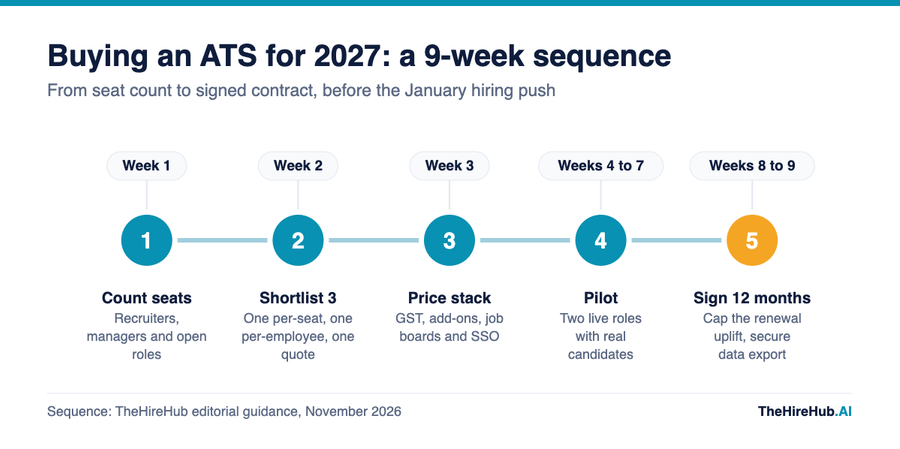
Stage one is a seat count: every recruiter, coordinator and hiring manager who will touch the system, plus the number of roles you expect to have open at peak. Stage two is a deliberately mixed shortlist of three: one per-seat tool, one per-employee tool and one quote-only platform, so you can see which meter suits your shape. Stage three prices the full stack, including GST, SSO, texting, assessments and job board slots.
Stage four is a pilot on two live roles with real candidates, not a sandbox. Stage five is the contract: sign 12 months, cap the renewal uplift in writing and confirm you can export all candidate data in a usable format if you leave.
A worked example: 300 employees, 4 recruiters, 120 hires in 2027
Take a Bengaluru SaaS company with 300 employees, four recruiters and a plan to make 120 hires in 2027. On Zoho Recruit Enterprise, the licence is 4 × ₹2,500 × 12, or ₹1.2 lakh a year, about ₹1.42 lakh with GST. That works out to roughly ₹1,180 per hire on the tool.
The same company buying Lever would land somewhere between Vendr's 200-employee median of $12,240 and its 500-employee median of $36,778. Even the low end is about ₹11.5 lakh before tax, or close to ₹9,600 per hire.
Neither number is wrong. The second buys structured interviewing, analytics and integrations the first may not match, and that trade-off is the real decision. Put the per-hire figure next to your cost per hire benchmarks before deciding which one your 2027 plan can carry.
ATS pricing vs AI recruiting software pricing
An ATS is a system of record: it stores candidates, moves them through stages and keeps the audit trail. AI recruiting software does work on top of that record, such as sourcing, screening or outreach, and it is usually priced by usage, credits or roles rather than seats. The two are often bought separately and then integrated.
That is why the totals in this guide look modest next to the figures in our AI recruiting software cost analysis. If you are deciding whether you need one, the other or both, our comparison of ATS vs AI recruiting software walks through which jobs each layer actually does.
How to actually do this (and the four traps)
Start from your hiring plan, not the vendor's pricing page. Count seats, count peak open roles and decide which pricing meter fits your shape before you sit through a single demo. If you need a starting shortlist, our guide to the best applicant tracking system in India groups the options by company size.
- Pricing the licence, not the stack. The licence is the visible line. GST, job board slots, SSO, texting, assessments and background verification can double year-one spend, so price them together.
- Choosing monthly billing for a 12-month need. Annual billing saves about 17% on Zoho Recruit and around 21% on Manatal's entry plan. If you know you will use the tool all year, monthly billing is a premium for flexibility you will not use.
- Ignoring the active-job cap. Seat-based plans often limit open requisitions per licence. Check the cap against your peak month, not your average, or you will be forced into an upgrade mid-year.
- Signing a dollar contract with no exit. A multi-year dollar commitment exposes you to the exchange rate and locks your data in. Keep the first term to 12 months and get the data export terms in writing.
"If you have only priced the licence, you have not priced the ATS; you have priced the demo."
The one thing every hiring leader should take from this
The cheapest ATS is the one whose pricing meter matches the shape of your hiring, not the one with the lowest number on the pricing page. Before you finalise your 2027 plan, write down your seat count, your peak open roles and your hire target, then cost every shortlisted tool against those three numbers, with GST and add-ons included. Pair that with a clear view of the recruitment CRM vs ATS question so you do not buy the same capability twice. If you want a second pair of eyes on the numbers, we look at this stuff all day.
Frequently Asked Questions
Licence costs run from free to about ₹71 lakh a year. Per-recruiter tools such as Zoho Recruit start at ₹1,250 per recruiter per month on annual billing, while quote-only platforms bought by larger companies land at a Vendr median of $27,000 a year for Greenhouse. Add 18% GST to any figure.
None of the pricing pages checked for this guide show 2027 list prices yet, so plan from current prices checked in November 2026 and add a buffer for renewal uplifts. If your contract is billed in dollars, also model the exchange rate: the rupee closed at 94.86 to the dollar on 2 November 2026.
Yes. Zoho Recruit's Forever Free plan costs nothing but allows only one active job per recruiter licence. It suits a founder hiring one role at a time; anyone running several open roles will hit the cap quickly and need a paid plan.
Usually not. Indian vendors add 18% GST to the invoice. When a GST-registered Indian company buys from a foreign SaaS vendor, it pays IGST itself under reverse charge, which is generally claimable as input tax credit. Budget the licence plus 18% either way.
Both price by company headcount, contract length and modules, then negotiate. Vendr's purchase data is the best public guide: a Greenhouse median of $27,000 a year, and Lever medians of $12,240 at 200 employees and $63,172 at 1,000 employees.
Annual billing is cheaper. Zoho Recruit Standard is ₹1,250 per recruiter per month annually against ₹1,500 monthly, about 17% less, and Manatal's entry plan is $15 annually against $19 monthly. Choose monthly only if you might cancel within the year.
Freshteam customers must move: Freshworks stopped renewals from 7 March 2026, with earlier renewals running to April 2027 at the latest. AI features are already sold as extras on some plans (Ashby lists its AI Notetaker as a paid add-on), so check your renewal terms for uplift caps before January.
Agency plans are priced per recruiter. Zoho Recruit's Staffing Agency edition runs ₹1,250 to ₹3,750 per user per month, and Recruit CRM lists $95 to $215 per user per month. A 10-recruiter agency should budget roughly ₹1.5 lakh to ₹15 lakh a year before GST.
The big ones are GST, job board slots, SSO, candidate texting, assessments, background verification and implementation. Ashby, for example, lists SSO at $100 a month and extra texts at $90 per 1,000. In year one these can match the licence itself.
It depends on your ratio of recruiters to employees. A large company with a small TA team usually pays less per recruiter; an agency or a team with many recruiters relative to headcount usually pays less per employee. Model both against your 2027 plan.

