
Recruitment CRM vs ATS: What Each Does, What It Costs, and When You Need Both (2026)
One system manages applicants, the other manages relationships. Here is how to tell whether you need the second one.
An ATS manages applicants; a recruitment CRM manages people who have not applied yet. Real contract costs, conversion data and a test for whether you need both.

TL;DR
An ATS manages people who have already applied. A recruitment CRM manages people who have not applied yet, and that one line settles most of the recruitment CRM vs ATS question. It matters now because, across 38 million applications in Ashby's data, inbound applicants reached interview at 3% while sourced candidates reached it at 25% and referrals at 40%. Most teams under a few hundred people need a strong ATS first and a CRM only when they hire the same profiles repeatedly. If you are still choosing your core system, start with our breakdown of ATS vs AI recruiting software.
What is actually happening
For a decade the two categories were cleanly split. The ATS (Greenhouse, Lever, Workable, iCIMS) was the system of record: requisitions, applications, interview stages, scorecards, offers and compliance reports. The recruitment CRM (Beamery, Gem, Avature) was the marketing layer: talent pools, email nurture, event lists and career site leads.
That line has blurred. Most mid-market ATS products now ship CRM-lite features such as tags, talent pools and bulk email, and CRM vendors increasingly sell their own ATS alongside. So a hiring leader searching this question is rarely asking for a definition. They are asking whether to pay for a second system.
The pressure behind the question is inbound volume. Ashby's analysis of 38 million applications between 2021 and 2024 found inbound made up about 94% of all applications, while the offer rate for inbound applicants fell from 7 in 1,000 to 2 in 1,000. More applications, fewer of them usable.
Teams respond by going outbound, and outbound at any scale needs somewhere to keep relationships that are not attached to an open job. An ATS is built to close a requisition. It is not built to remember a strong engineer you met at a meetup eight months ago.
The supply of movable talent is real. Robert Half's November 2025 survey of more than 2,000 US workers found 38% planned to look for a new job in the first half of 2026, up from 27% that July. Those people are not applying to your roles today, and a CRM is how you are already in their inbox when they start looking.
The numbers
Two numbers decide this: what each system costs, and what the pipeline it holds actually converts at.
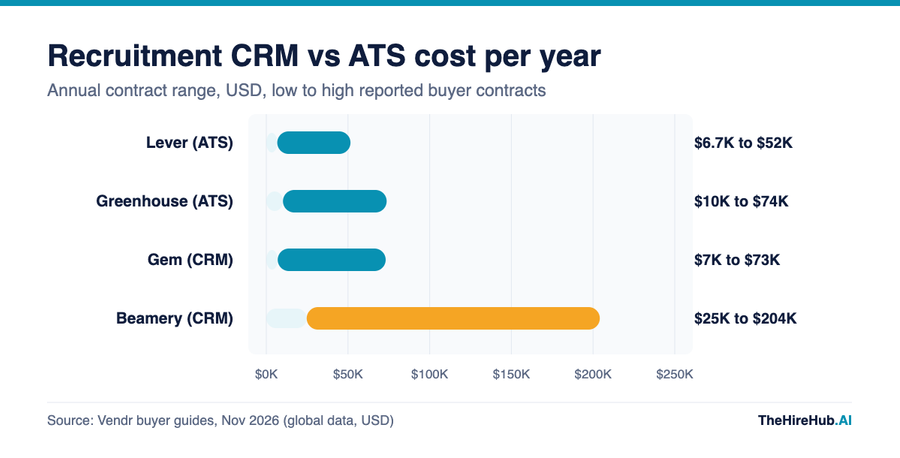
On cost, published buyer data shows CRMs sit at or above ATS prices, not below them. Vendr reports a median Greenhouse contract of $26,553 a year (range $10,222 to $73,684 across 888 purchases) and a median Lever contract of $15,536 (range $6,720 to $51,540). On the CRM side, Gem's median is $25,699 (range $7,000 to $73,076), while Beamery's median is $76,797, with contracts reported as high as $204,153.
On conversion, the case for a CRM is strong but narrow. In Ashby's data, sourced candidates moved from application to interview at 25%, against 3% for inbound applicants. Yet sourced candidates were only 4.8% of applications, and Ashby's separate analysis of nearly 250,000 hires puts sourced hires at about 16% of the total.
How to read this:
- A CRM is not a cheaper ATS. Median CRM contracts match or exceed median ATS contracts, so a CRM is an addition to the budget, not a swap.
- Ranges matter more than medians. Beamery's spread from $24,717 to $204,153 tells you enterprise CRM pricing is negotiated on headcount and modules, so define scope before you take a demo.
- Conversion justifies the spend only at volume. If you make only a handful of repeat hires per profile each year, a 25% interview rate on a tiny pool will not pay back a five-figure contract.
How it actually works, and where it breaks
An ATS is organised around the requisition. A candidate enters because a job exists, moves through stages, and exits as hired or rejected. Every report you run (time to hire, pass-through rates, source of hire) hangs off that job.
A recruitment CRM is organised around the person. A candidate enters because you found them, met them at an event, or they nearly got an offer last quarter. They sit in pools tagged by skill, seniority and location, and receive sequenced outreach until a role opens or they opt out. The metric that matters is conversion into the ATS, not time to hire.
What a good CRM and ATS integration looks like
The integration is where most of the value is won or lost. At minimum, a candidate record should exist once, with activity from both systems on a single timeline. When a pool member applies or is moved onto a requisition, their history (every email, event and note) should travel with them, and the hiring manager should see it without logging into a second tool. Rejected finalists should flow back into the right pool automatically, tagged with the stage they reached and why they were not hired.
Ask vendors to demonstrate this live with your own data, not a sandbox. A two-way sync that only runs nightly, or that copies records rather than linking them, is where duplicates begin.
Where it breaks
It breaks in three predictable places. The first is duplicate records: if the CRM and ATS do not sync both ways, the same engineer exists twice with two histories, and a recruiter cold-emails someone who interviewed last week. The second is stale pools: a pool of 5,000 people nobody has touched in a year is a liability, because titles, emails and interest have all decayed.
The third is consent. Holding candidate data with no open role attached is exactly what privacy law scrutinises. India's DPDP Rules, notified in November 2025, bring consent notices, purpose limitation and retention and erasure obligations into force 18 months after notification, and our note on recruitment data privacy covers what to put in place before then.
"An ATS remembers the jobs you filled; a CRM remembers the people you almost hired, and most teams throw that second memory away."
What this means for your team
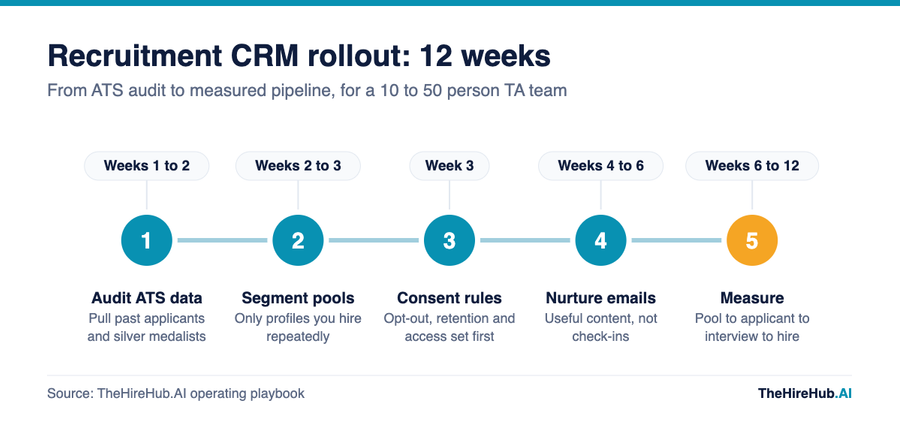
If you decide you need CRM capability, the rollout is less about software and more about data hygiene. This sequence works for a TA team of 10 to 50 people:
- Audit what your ATS already holds. Most teams have thousands of past applicants and silver medalists sitting in closed requisitions, and our guide to talent rediscovery covers how to resurface them.
- Segment by repeat demand. Build pools only for profiles you hire several times a year. One-off senior roles belong in a search, not a pool.
- Set consent and retention rules before the first email. Decide how long a candidate stays without engagement, how they opt out, and who can see their record.
- Write nurture emails that carry information. Team news, salary bands, a hiring manager's note on what the team is building. Not "just checking in".
- Measure conversion into the ATS. The only numbers that matter are how many pool members become applicants, interviews and hires.
Recruitment CRM vs the alternative
The nearest alternative to a dedicated recruitment CRM is not another CRM. It is a good ATS used well, plus disciplined outbound. For a team making fewer than roughly 50 hires a year, the CRM-lite inside a modern ATS (tags, saved searches, talent pools and bulk email) paired with a consistent approach to passive candidate outreach covers most of what a standalone CRM does, without a second contract or a sync to maintain.
The calculus flips when you hire the same profiles in volume, run campus or event programmes, or recruit across several brands or geographies. Then segmentation, campaign analytics and career site lead capture justify a dedicated system. AI sourcing and engagement tools now sit in between, finding and messaging candidates without a pool-first workflow, and if you are pricing that route, compare it against our breakdown of AI recruiting software cost.
A quick decision test
You probably need a dedicated recruitment CRM if most of these are true:
- You hire the same role family at least ten times a year, for example sales development, customer support or backend engineering.
- At least one recruiter or sourcer spends most of their week on outbound rather than processing applicants.
- You run events, campus drives or referral campaigns that generate leads with no open role attached.
- Your ATS search cannot reliably find past finalists by skill, location and the stage they reached.
If only one or two apply, invest in ATS hygiene and outbound discipline first, and revisit the question in two quarters.
How to actually do this (and the four traps)
- Buying a CRM to fix a broken ATS. If your stages, scorecards and source tracking are messy, a CRM adds a second mess on top. Fix the system of record first.
- Measuring opens instead of hires. Email open rates flatter every nurture campaign. Track pool-to-applicant and pool-to-hire against your baseline recruitment funnel conversion rates.
- Hoarding candidates without consent. Keeping people in a pool indefinitely, with no clear notice or opt-out, is a growing legal and reputational risk. Set a retention window and honour it.
- Building pools nobody owns. A pool without a named recruiter and a cadence decays within months. Assign every pool to a person and review it every quarter.
"Software cannot keep a candidate relationship warm on its own, it can only remind a recruiter that the relationship exists."
The one thing every hiring leader should take from this
Treat the ATS as non-negotiable and the CRM as earned. Every team needs a clean system of record for applicants, but only teams with repeat demand, outbound capacity and the discipline to keep pools fresh will see a return from a second system. Before you sign anything, pull two numbers from your own data: how many hires last year came from people you already knew, and how many past finalists you never contacted again. If those answers surprise you, that is your case for CRM capability, and at TheHireHub we look at this stuff all day.
Frequently Asked Questions
An ATS manages candidates who have applied to an open job, moving them through stages to hire or rejection. A recruitment CRM manages relationships with people who have not applied yet, such as passive candidates, past finalists and event leads, using talent pools and nurture outreach.
Every hiring team needs an ATS as its system of record. A separate CRM is worth adding only when you hire the same profiles repeatedly, have dedicated outbound sourcing capacity, and can keep talent pools fresh. Smaller teams usually get enough from the pool and tagging features inside a modern ATS.
Partly. Many ATS products now include tags, talent pools, saved searches and bulk email, which cover basic nurturing. They usually lack campaign analytics, advanced segmentation and career site lead capture, which is where a dedicated CRM earns its cost.
Published Vendr buyer data shows a median Gem contract of about $25,699 a year, with a range of $7,000 to $73,076, and a median Beamery contract of about $76,797, with contracts reported up to $204,153. These are global USD figures and pricing depends on headcount, modules and contract length.
Usually not as a first purchase. Startups making fewer than roughly 50 hires a year get more return from a clean ATS and disciplined outbound. A CRM starts paying back when you have repeat demand for the same role families and someone whose job is to work the pipeline.
At minimum your ATS, with a two-way sync that keeps one candidate record and one activity timeline. It should also connect to your email and calendar, your careers site for lead capture, and your sourcing tools so that new prospects land in the right pool automatically.
Track how many pool members become applicants, interviews and hires, and compare the cost and time to hire of those hires with your inbound baseline. Email open and click rates are useful diagnostics but are not evidence of return on their own.
Holding candidate data is permitted, but India's Digital Personal Data Protection framework requires clear consent notices, purpose limitation and retention and erasure practices. The DPDP Rules notified in November 2025 bring these core obligations into force 18 months after notification, so set opt-out and retention rules now. This is not legal advice.
A silver medalist is a candidate who reached the final stages of a hiring process but did not receive the offer. They are often the highest-value members of a talent pool because they have already been assessed and found strong, which is why rediscovering them is usually the first CRM use case.

