
Background Verification in India: Timelines, Red Flags and the DPDP Shift (2026)
Why the employment check is now the one that fails, and how to redesign BGV before DPDP obligations bite in 2027.
Background verification in India now fails on the employment check. Timelines by check type, discrepancy data, and a four-stage process built for the DPDP era.

TL;DR
Background verification in India now fails on the check most teams treat as a formality. AuthBridge's Workforce Fraud Files for H1 FY26 found discrepancies in 11.15% of white-collar employment verifications, more than twenty times the 0.50% rate on criminal record checks. Meanwhile the slowest checks (education and employment) take 3 to 15 business days, and the DPDP Rules turn consent, retention and vendor oversight into board-level liability by May 2027. The answer is not more checks: it is the right checks per role, started earlier, with a human reviewing every red flag before an offer is pulled. If you already run automated reference checks, treat BGV as the layer that verifies facts, not opinions.
What is actually happening
Background verification (BGV) in India used to be a post-offer ritual: send the candidate a portal link, wait a fortnight, file the report. Three things have changed that, and each lands on the hiring leader rather than the vendor.
First, the fraud has moved to the paperwork nobody questions. AuthBridge's H1 FY26 report, released in February 2026, put employment verification discrepancies at 11.15% for white-collar hires, address at 7.68%, education at 4.49% and references at 4.17%. Criminal records, the check most founders worry about, came in at 0.50%. The risk is not that you hire a criminal; it is that you hire someone whose last two years did not happen the way the CV says.
Second, the discrepancy rate varies sharply by sector. The same report shows employment discrepancies at 16.37% in retail, 14.32% in telecom and 13.00% in BFSI, while IT recorded a 12.80% CV validation discrepancy rate. If you hire across functions, a single BGV package for everyone is either overkill for some roles or dangerously thin for others.
Third, identity itself is now in play. Gartner's July 2025 survey of 3,000 job candidates found 6% admitted to interview fraud, either impersonating someone or having someone pose as them, and Gartner projects that by 2028 one in four candidate profiles worldwide could be fake. We covered the remote interview side of this in our guide to deepfake candidates; BGV is where that fraud should be caught if the interview misses it.
Layered over all of this is the Digital Personal Data Protection regime. The DPDP Rules were finalised in November 2025, with core data fiduciary obligations becoming enforceable on 13 May 2027 and penalties of up to ₹250 crore for failing to maintain reasonable security safeguards. Your BGV vendor processes candidate data on your behalf, and the Act holds you, the data fiduciary, responsible for it.
The numbers
Turnaround is where most hiring leaders feel BGV, because it decides whether a candidate joins on the promised date or sits in limbo. Published ranges from Indian verification providers show a clear split: digital checks close in hours or a couple of days, while anything that depends on a past employer or a university registrar can stretch past two weeks.
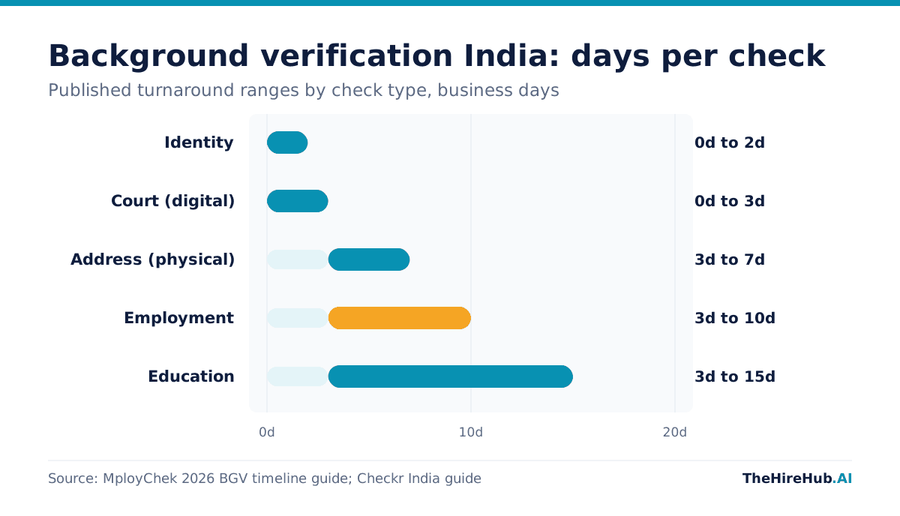
Checkr's India guide reports averages in the same band: 6 to 7 business days for employment and education, and 7 to 8 business days for a traditional criminal search. Checkr also closes education, employment and watchlist checks as "unable to verify" after 15 business days of unsuccessful attempts, which tells you where the real ceiling sits.
How to read this:
- The long bars are the high-risk bars. Employment verification is both the slowest common check and the one with the highest discrepancy rate, so it deserves to start first, not last.
- Digital speed hides coverage gaps. A real-time e-court search is fast because it queries indexed records; it is not the same as a police verification, and it should not be described to your board as one.
- The ceiling is a policy decision. If you let every check run to its 15-day limit before acting, your time to offer quietly grows by two weeks. Decide in advance what happens when a check is still open on joining day.
How it actually works, and where it breaks
A typical BGV flow starts when the candidate accepts the offer. The candidate uploads documents and signs an authorisation, the vendor runs identity and court checks digitally, then contacts past employers and institutions, and finally issues a colour-coded report (green, amber, red) per check. HR reads the report, and if it is red, someone decides whether to withdraw the offer.
It breaks in three places. The first is timing. Many Indian professionals serve notice periods of a month or more, so a red flag found in week three often arrives after the candidate has resigned from their current job. Withdrawing an offer at that point is legally and reputationally expensive, which is why so many amber flags get waved through.
The second is interpretation. An "employment discrepancy" can mean a fabricated company, an inflated title, a two-month gap smoothed over, or a past employer whose HR team simply never replied. Vendors flag all of these in the same colour. Without a human who understands the role reading the detail, you either reject good candidates for paperwork noise or accept bad ones because "everyone has a few ambers".
The third is consent drift. Many companies still bury BGV authorisation in the offer letter, collect far more data than the role justifies, and never delete records of candidates who were not hired. Under DPDP, that is precisely the pattern that creates exposure, and it is the employer, not the vendor, who answers for it.
"A background check that only starts after your candidate resigns is not a safeguard, it is a sunk cost waiting to happen."
What this means for your team
The fix is to move BGV from a post-offer afterthought into the hiring process itself, with checks scoped by role and started before the candidate resigns. That does not mean verifying every applicant. It means verifying the finalist, with consent, at the point where you are about to commit.
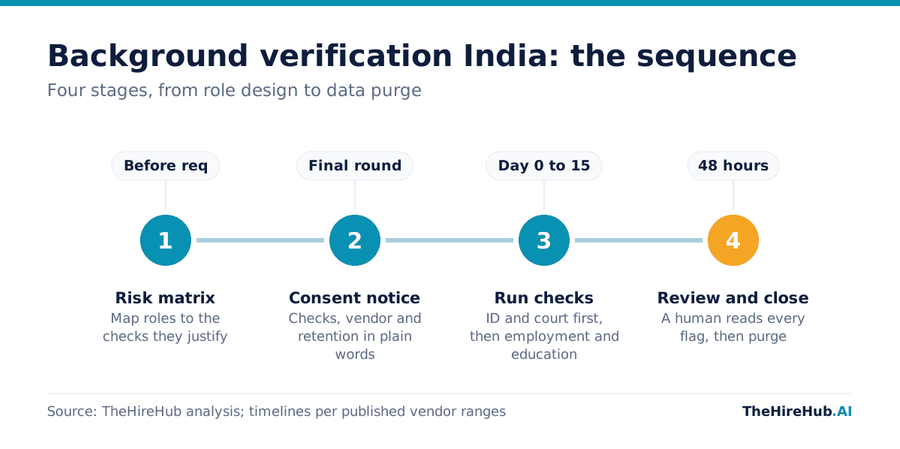
Stage one happens before the requisition opens. Build a role risk matrix that maps job families to the checks they justify: a finance controller needs employment, education, court and credit checks; a junior designer may need identity, employment and education only. This is your data minimisation defence and your cost control in one document. Review it once a year, and whenever a role moves into a regulated function or starts handling customer money.
Stage two is a standalone consent notice at the final round, not a clause in the offer letter. It should list which checks will run, which vendor will run them, and how long the data will be kept. Written in plain language, it also signals to a strong candidate that you run a serious process, which matters more than most teams assume.
Stage three runs the checks in the right order. Identity and court checks go first because they close in 0 to 3 days and catch the identity fraud that Gartner's numbers warn about. Employment and education verification starts before the offer is released, or at the latest the day it is accepted, because those are the checks that run to 15 days.
Stage four is a 48-hour review and a clean close. The hiring manager and HR look at every amber flag together, talk to the candidate, and decide; then you retain what you need for the hired employee and purge the rest on a documented schedule. If your offer acceptance rate is already under pressure, starting earlier also means fewer late surprises that make a candidate walk.
Background verification vs reference checks
The two get confused because they both happen late and both involve calling past employers. They answer different questions. Background verification confirms facts: did this person work at this company, with this title, between these dates, with this degree, and without a court record. Reference checks gather judgement: how good were they, and would you hire them again.
You need both, but they fail differently. A reference can be glowing and still come from a friend posing as a manager; a BGV report can be fully green for someone who was a poor performer. Use BGV to remove false facts, and use structured automated reference checks to test performance claims. And if you worry about dual employment after joining, that is a separate control entirely, covered in our guide to moonlighting detection.
How to actually do this (and the four traps)
Most teams can redesign their BGV process in a quarter without changing vendors. The work is mostly policy, sequencing and who reads the report. Watch for these four traps.
- Running one package for every role. A flat bundle over-collects for low-risk roles and under-checks for finance, leadership and regulated positions. Map checks to role risk and write the rationale down.
- Starting after resignation. If verification only begins once the candidate has served notice, you have no good options when a red flag appears. Start the slow checks before the offer is final, with explicit consent.
- Letting colours make decisions. A vendor's red or amber is a prompt for a conversation, not a verdict. Give every flagged candidate a chance to explain, record the decision, and keep a human accountable for it, which is also your best defence on AI hiring liability if automated tools sit anywhere in the chain.
- Forgetting the data after the decision. Unhired candidates' documents sitting in a vendor portal for years are a liability with no upside. Set retention periods per data type, check that your vendor honours them, and review this alongside your wider recruitment data privacy policy.
"Verification is part of the hiring decision, so the person who owns the hire should own every red flag too."
The one thing every hiring leader should take from this
Background verification in India is no longer a compliance checkbox that HR runs after the real decision is made. With more than one in ten white-collar employment histories coming back with a discrepancy, and DPDP putting the employer on the hook for how that data is handled, BGV is part of the hiring decision itself. Scope it by role, start it before the candidate resigns, put a person on every flag, and delete what you no longer need. The teams that get it right treat verification as a design choice, not an afterthought, and if you want a second opinion on yours, TheHireHub is where we look at this stuff all day.
Frequently Asked Questions
It depends on the check. Published ranges from Indian verification providers put identity checks at same day to 2 days, digital court record searches at 0 to 3 days, physical address checks at 3 to 7 days, employment checks at 3 to 10 business days and education checks at 3 to 15 business days. A full package therefore usually closes within two to three weeks, with education and employment as the slowest items.
Employment verification. AuthBridge's Workforce Fraud Files for H1 FY26 found discrepancies in 11.15% of white-collar employment checks, compared with 7.68% for address, 4.49% for education, 4.17% for references and 0.50% for criminal records.
The DPDP framework relies on consent and a limited set of legitimate uses, including certain employment purposes. Most employers still collect a standalone, plain-language consent for background checks because it is the clearest basis and lists the checks, the vendor and the retention period. Take advice from counsel on your specific process, as this is not legal advice.
The DPDP Rules were finalised in November 2025. Core data fiduciary obligations such as notice, consent handling, breach notification and individual rights become enforceable on 13 May 2027, so BGV processes should be redesigned before then.
Start the slow checks, employment and education, at the final round or the day the offer is accepted, with consent, rather than after the candidate has resigned. Identity and court checks can run immediately because they close within a few days.
Offers are commonly made conditional on satisfactory verification, which gives the employer room to withdraw. Treat every discrepancy as a prompt to talk to the candidate first, record the decision, and check the position with your legal team, because withdrawing after a candidate has resigned carries real risk.
Use a role risk matrix. Finance, leadership and regulated roles typically justify employment, education, court and credit checks, while many junior or low-risk roles need only identity, employment and education. Mapping checks to role risk also supports data minimisation.
Background verification confirms facts such as employers, titles, dates, degrees and court records. A reference check gathers opinions about performance. You need both, because a strong reference cannot confirm a degree and a clean BGV report cannot tell you whether someone was good at the job.
No. A digital e-court search queries indexed court records and can return results in hours, but it is not the same as a police verification, and some roles or regulators may still require the latter.
Keep it only as long as the purpose and any legal requirement demand. Set retention periods per data type, make sure your vendor follows them, and delete records of candidates who were not hired on a documented schedule.

