
Best Job Posting Sites in Dubai and the UAE for Employers (2027): Real Prices, Reach and Rules
Where to advertise a job in Dubai, what each platform actually charges, and the UAE rules your advert has to follow.
Where Dubai employers should post jobs in 2027: real prices for Bayt, LinkedIn, Naukrigulf, GulfTalent and Dubizzle, free options, and the UAE advert rules.

TL;DR
The best job posting sites in the UAE for employers are LinkedIn for white-collar and senior roles, Bayt and Naukrigulf for high-volume GCC-wide reach, GulfTalent for experienced professionals, Dubizzle Jobs for local Dubai roles, Indeed for broad free reach, and Nafis whenever you are hiring Emiratis. Most of them let you post free, and a paid single post costs between about $42 (Naukrigulf, bought as a 5-pack) and $250 (Bayt Premium) on prices we checked in November 2026. The real cost of hiring in Dubai is not the advert. It is screening the flood that comes back and getting the work permit right, which is why the same role can cost $42 on a job board or 15% to 25% of first-year salary through an agency (see our breakdown of AI recruiting vs agency).
What is actually happening
Dubai is hiring into a bigger and more crowded market than ever. The Dubai Data and Statistics Establishment put the emirate's population at 4.58 million at the end of 2025, up 7.5% in a year. Across the UAE, the 2024 Labour Force Survey from the Federal Competitiveness and Statistics Centre counted 9.4 million people in the labour force, 85% of the employed in the private sector, and unemployment at 1.9%.
That growth means more applicants per advert, from more countries, in more formats. A single Dubai real estate or retail role routinely draws applications from the UAE, the wider GCC, India, Pakistan, the Philippines and Europe. The posting channel decides who sees the role; it does nothing to sort them.
2026 was not a straight line. GulfTalent data reported by Onrec in May 2026 showed the number of companies posting jobs in the Gulf fell 24% in March during the regional conflict, recovering to 79% of February levels by the end of April. The National reported in July 2026 that Naukrigulf saw hiring intent down 23% year on year in April and May, while Hays expected hiring to pick up after the summer.
The rulebook is also tightening. Mainland private companies with 50 or more employees must grow Emirati headcount in skilled roles by 2% a year, reaching the 10% target by the end of 2026, with the second 1% due by 31 December. Gulf News reported in June 2026 that each unfilled Emirati position now costs AED 10,000 a month, or AED 120,000 a year, and MoHRE has been urging companies to advertise vacancies on Nafis.
So the 2027 question for a Dubai founder or HR head is not "which job board?". It is which mix of channels reaches the right candidates for each role, and what happens to the applications after they arrive.
The numbers
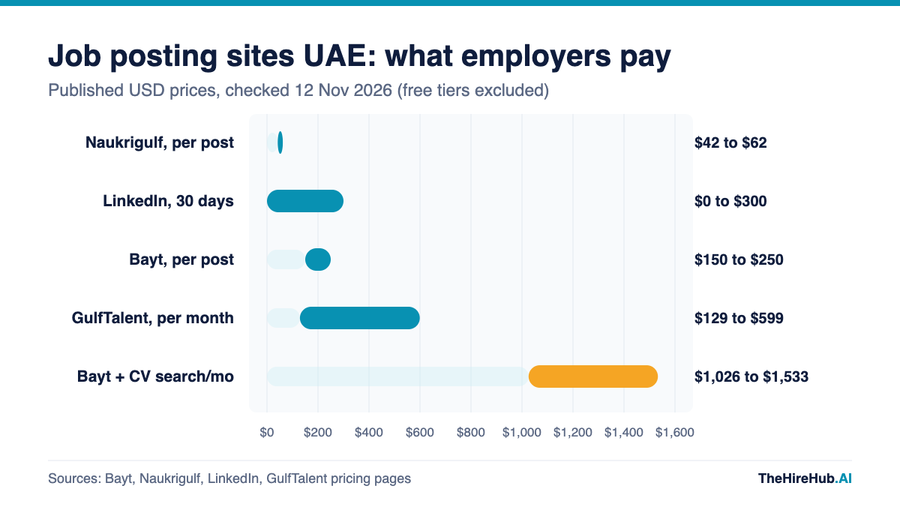
Here is what the main job posting sites in Dubai and the UAE charge employers, from each platform's own pricing page, checked on 12 November 2026.
- Bayt.com: free tier of up to 3 job posts. Paid single posts are $150 (Classic, 60 days) and $250 (Premium, 60 days, featured), VAT excluded. Combined job post and CV search plans run from $1,026 to $1,533 a month.
- Naukrigulf: first 5 posts free for new employers. The PRO pack is $210 for 5 posts (about $42 each) and Premium is $308 for 5 posts with branding.
- LinkedIn: one free job post open at a time. Promoted posts run on a daily or total budget you set; LinkedIn's own example is a $10 daily budget costing "$300 or less" over 30 days.
- GulfTalent: no free posting advertised. Plans run from $129 a month (Lite, billed annually, 1 post a month) to $599 a month (Team, billed monthly, 5 posts a month).
- Dubizzle Jobs: ad packages from AED 269 excluding VAT for a 30-day ad. CV search packages run from AED 449 to AED 2,099.
- Indeed UAE: free job post to start; sponsored posts run on a daily or monthly budget, with no UAE rates published.
On reach, every platform publishes its own figures, and they are worth reading as claims rather than audited numbers. Bayt says "60 Million+ Professionals" across MENA, Naukrigulf says 16M+ jobseekers, GulfTalent says over 10 million professionals, and Dubizzle says more than 300k candidates search its jobs daily. For LinkedIn, DataReportal's Digital 2026 UAE report counts 10.0 million members from LinkedIn's advertising tools, which is total registered members, not active users.
How to read this:
- Posting is cheap; screening is not. Even the top published single-post price ($250) is a small fraction of one agency fee, so the cost decision is really about who reads the applications.
- Per post and per month are different products. Bayt and Naukrigulf sell posts; GulfTalent sells monthly plans; LinkedIn and Indeed sell budgeted visibility. Compare cost per hire, not cost per listing.
- CV search is the hidden upsell. The jump from Bayt's $150 post to its $1,026 monthly plan is mostly database access, which only pays off if someone actually searches it every week.
Sources and method
Prices come from each platform's public employer pricing page, checked on 12 November 2026, in the currency the platform publishes (USD for Bayt, Naukrigulf, GulfTalent and LinkedIn; AED for Dubizzle). Reach figures are the platforms' own published claims. Market data is from the Dubai Data and Statistics Establishment, the Federal Competitiveness and Statistics Centre via Gulf News, and MoHRE statements reported by Gulf News; Emiratisation and labour-law rules are from u.ae, MoHRE and the text of Federal Decree-Law No. 33 of 2021.
How it actually works, and where it breaks
Every UAE job board works the same way at its core. You post a role, the platform pushes it to its candidate base and search results, and applications land in a dashboard or your inbox. Paid tiers buy you longer visibility, higher ranking, featured badges and access to the CV database so you can search for people who have not applied.
Why does one Dubai job post get hundreds of applications?
Because Dubai is a destination market. Candidates in India, Pakistan, the Philippines, Egypt and Europe apply to UAE roles from abroad, often to dozens at once, and job boards make that a one-click action. The result is volume without fit: many applicants are not in the UAE, not on a transferable visa, or not close to the role.
It breaks in three predictable places. The first is screening collapse: a recruiter with five open roles cannot read every CV, so they skim the first fifty and miss the strong candidate who applied on day four. The second is channel blindness: LinkedIn applicants sit in LinkedIn, Bayt applicants in Bayt, referrals in email, and nobody sees one ranked list.
The third is compliance by accident. Federal Decree-Law No. 33 of 2021 bans discrimination on race, colour, sex, religion, nationality, social origin or disability, yet adverts asking for a specific nationality or gender still appear, as The National noted in November 2025. Article 4(2) does allow measures that increase Emirati participation, so an Emiratisation role advertised for UAE nationals is lawful; "Indian candidates preferred" is not.
Claims check
- Database size: Bayt's homepage says "60 Million+ Professionals" while its pricing pages say "over 59.3M job seekers" (bayt.com/en/employers). Neither figure tells you how many are active in the UAE this month.
- Candidate pool: Naukrigulf's posting page says "reach 16M+ qualified candidates" while another of its pages cites 12 million+ job seekers (naukrigulf.com/employer-job-posting). Ask any platform for UAE-located, active-in-90-days numbers for your role.
- CV volume: GulfTalent says "Reach over 10 million professionals" and "Access to 12 million CVs" on the same site (gulftalent.com/recruitment-solutions). Registered CVs and reachable professionals are not the same number.
"In Dubai, posting a job is the cheap part; reading every application that floods back is where the real hiring cost sits."
What this means for your team
For a Dubai company hiring 5 to 20 roles a quarter, especially in real estate and retail, a workable sequence looks like this:
- Pick channels by role, not habit. LinkedIn for managers and specialists, Bayt or Naukrigulf for volume roles, Dubizzle for local frontline hiring, GulfTalent for experienced professionals, and Nafis for every role counting toward Emiratisation.
- Write one compliant advert. State the salary band if you can, the visa or location requirement, and the skills. Leave out nationality, gender and religion unless the role is an Emiratisation role.
- Pull every applicant into one ranked list. Score every CV against the same criteria, whichever board it came from, so the day-four applicant gets the same look as the day-one applicant.
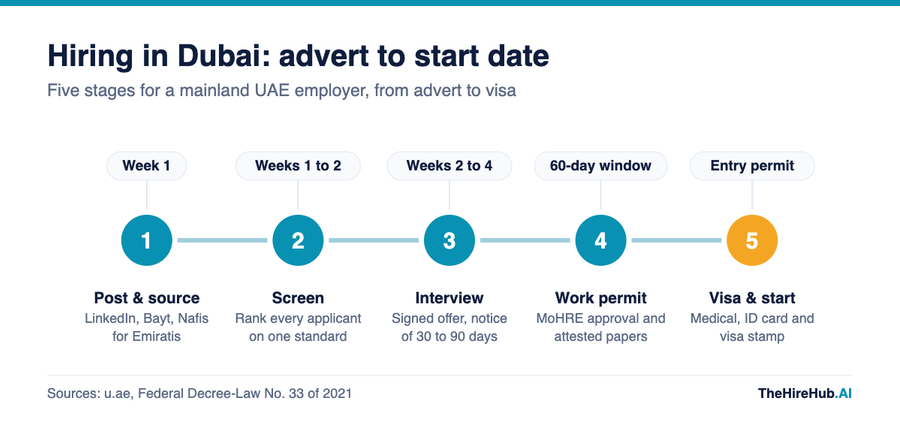
- Interview and offer fast. Strong candidates in Dubai usually hold other processes, and employed candidates owe their current employer 30 to 90 days of notice under Article 43 of the labour law.
- Run the permit and visa steps in parallel with notice. The MoHRE work permit needs a signed offer and attested documents and is valid for 60 days; the residence visa follows with an entry permit, medical test and Emirates ID.
When is the hiring season in Dubai?
Recruiters commonly report January and September as the busiest months, with summer and Ramadan quieter, though no official dataset confirms a fixed season. For 2027 planning, the Emirates Astronomical Society expects Ramadan to begin around 8 February 2027, subject to moon sighting, so roles you want filled before it should open in early January.
Job boards vs agencies vs AI recruiting in Dubai
A job board sells reach. An agency sells a shortlist, and in the UAE that typically costs 15% to 25% of first-year salary according to TASC Outsourcing and Adecco UAE, which Adecco puts at roughly AED 15,000 to 40,000 for an entry-to-mid-level hire. For most Dubai SMEs the gap between a $150 post and a five-figure dirham fee is exactly where hiring budgets leak, and our cost per hire benchmarks show the same pattern across markets.
AI recruiting software sits between the two: you keep the cheap channels, and software does the reading, ranking and scheduling an agency charges for. If you are comparing that route, start with what applicant screening tools can and cannot judge, and what AI recruiting software cost looks like in practice. TheHireHub is one such end-to-end platform, covering job description, sourcing, screening, AI interviews and scheduling across every channel you post to.
How to actually do this (and the four traps)
- Paying for featured posts on every board. Featured badges help on one or two boards where your candidates live. Spread across six, they mostly buy you more of the same unread CVs.
- Buying CV search nobody runs. Database plans pay off only with a weekly search routine. If nobody owns that, a free post plus disciplined high volume hiring software workflow will beat it.
- Treating Nafis as an afterthought. If your company is covered by Emiratisation targets, every month without a qualifying hire costs AED 10,000 per unfilled position in 2026. Post Emiratisation roles on Nafis first and track them separately.
- Ignoring notice periods in the offer timeline. A 90-day notice period plus a work permit means a March hire may not start until June. Build that into the headcount plan instead of discovering it at offer stage.
"The best job board in the UAE is the one your next hire already opens every morning, not the one with the biggest claimed database."
The one thing every hiring leader in Dubai should take from this
Advertising a job in the UAE is easy and mostly cheap; the competitive advantage in 2027 is what happens in the 48 hours after applications arrive. Choose two or three channels that match each role, keep every advert inside Article 4, post Emiratisation roles on Nafis, and make sure every applicant from every board is ranked against the same standard. Get that right and a $150 post can do the work of a 20% agency fee, and if you want to see how that runs end to end for a Dubai team, we look at this stuff all day.
Frequently Asked Questions
For most Dubai employers the strongest mix is LinkedIn for white-collar and senior roles, Bayt and Naukrigulf for high-volume GCC-wide reach, GulfTalent for experienced professionals, Dubizzle Jobs for local Dubai roles and Indeed for broad free reach. If the role counts toward Emiratisation, also advertise it on Nafis, the federal platform for Emirati jobseekers.
As of November 2026, Bayt allows up to 3 free job posts, Naukrigulf gives new employers 5 free posts that stay live for 2 months, LinkedIn allows one free job post open at a time, and Indeed UAE lets you start with a free post. GulfTalent and Dubizzle Jobs do not advertise free job posting for employers.
You can post jobs in Dubai on LinkedIn, Bayt, Naukrigulf, GulfTalent, Dubizzle Jobs, Indeed UAE and foundit Gulf, and on Nafis for roles aimed at UAE nationals. Government portals such as Dubai Careers list government jobs only, so private companies should use the commercial job boards and Nafis.
LinkedIn lets you keep one free job post open at a time. Promoted posts run on a daily or total budget you choose, and the cost per click or view depends on the role, location and competition; LinkedIn's own example is a $10 daily budget costing $300 or less over 30 days. It does not publish UAE-specific or AED prices.
Bayt is one of the longest-running job sites in the Middle East and publishes its employer pricing openly. Employers can start with up to 3 free job posts with no credit card. Paid single posts cost $150 (Classic) or $250 (Premium) for 60 days, excluding VAT, as of November 2026.
Advertise the role on the channels your candidates use, screen and interview, then issue a signed offer. For a mainland company, the offer supports a MoHRE work permit application, followed by the residence visa process: entry permit, medical fitness test, Emirates ID and visa stamping. The employer pays recruitment and visa costs; charging them to the worker is prohibited under UAE labour law.
Recruiters commonly report January and September as the busiest hiring months in Dubai, with summer and Ramadan quieter, although no official dataset confirms a fixed season. Ramadan 2027 is expected to begin around 8 February 2027, subject to moon sighting, so roles you want filled before it are best opened in early January.
Generally no. Article 4 of Federal Decree-Law No. 33 of 2021 prohibits discrimination on race, colour, sex, religion, nationality, social origin or disability in access to work. The law treats measures that increase Emirati participation as non-discriminatory, so Emiratisation roles may be advertised for UAE nationals.
There is no published legal requirement to post every vacancy on Nafis, but MoHRE urges companies covered by Emiratisation targets to advertise there. Mainland companies with 50 or more employees must reach a 10% Emirati share of skilled roles by the end of 2026, and Gulf News reports a contribution of AED 10,000 a month for each unfilled position.
UAE agencies commonly charge 15% to 25% of the hire's first-year salary, according to TASC Outsourcing and Adecco UAE. Adecco puts that at roughly AED 15,000 to 40,000 for an entry-to-mid-level hire and AED 40,000 to 100,000 or more for managerial and specialist roles.

