The Real Cost of a Bad Hire (and How AI Cuts It)
Discover the hidden costs of bad hires averaging $17,000 per mistake and learn how AI-powered pre-screening with TheHireHub.ai reduces hiring risks by 58% wh...
Discover the hidden costs of bad hires averaging $17,000 per mistake and learn how AI-powered pre-screening with TheHireHub.ai reduces hiring risks by 58% while protecting your bottom line and company culture.

- 1The Real Cost of a Bad Hire: Why AI-Powered Pre-Screening Saves More Than Just Time
- 2The $17,000 Question: What Does a Bad Hire Actually Cost?
- 3Why Traditional Screening Fails: The Human Blind Spots
- 4Enter AI-Powered Pre-Screening: The Game Changer
- 5The ROI of AI-Powered Pre-Screening: Real Numbers
- 6Implementation: Getting Started with AI Pre-Screening
- 7Conclusion: The Hiring Decision That Pays for Itself
- 8Ready to Reduce Your Bad Hire Rate?
- 9Secure Your Competitive Edge with TheHireHub.ai
The Real Cost of a Bad Hire: Why AI-Powered Pre-Screening Saves More Than Just Time
Discover the hidden costs of bad hires averaging $17,000 per mistake and learn how AI-powered pre-screening with TheHireHub.ai reduces hiring risks by 58% while protecting your bottom line and company culture.
Every recruiter has been there.
Three months into a new hire, the red flags start appearing. Missed deadlines. Team friction. Performance issues. And suddenly, you're back at square one—posting the job again, apologizing to your team, and wondering how you missed the warning signs.
But here's what most companies don't realize: that "hiring mistake" just cost you far more than a few months of subpar work.
The $17,000 Question: What Does a Bad Hire Actually Cost?
According to the U.S. Department of Labor, a bad hire costs approximately 30% of the employee's first-year earnings. For a mid-level position earning $60,000 annually, that's $18,000 down the drain. For senior executives, the damage can exceed $240,000.
But these figures only scratch the surface.
The Hidden Costs Nobody Talks About
1. Lost Productivity (The Ripple Effect)
When one team member underperforms, it doesn't happen in isolation. Projects slow down. Deadlines get missed. Other team members pick up the slack, leading to:
- Decreased morale across the team
- Overtime costs for covering gaps
- Delayed product launches or client deliverables
- Opportunity costs from diverted focus
Research from the Society for Human Resource Management (SHRM) shows that the productivity loss from a bad hire can equal 40% of that person's annual compensation—before you even account for the downstream effects on team performance.
2. Recruitment Costs (Round Two)
Once you realize the hire isn't working out, the clock starts ticking on replacement costs:
- Job posting fees: $200-$500 per platform
- Recruiter time: 15-20 hours sourcing and screening
- Interview time: 8-12 hours across multiple rounds
- Onboarding costs: Training materials, IT setup, HR administration
- Agency fees (if used): 15-25% of annual salary
For a $75,000 position, you're looking at $15,000-$20,000 just to fill the role again—not including the salary you paid to someone who didn't work out.
3. Team Morale and Culture Damage
This is the cost that doesn't show up on financial statements but wreaks havoc on your organization:
- High-performing team members feel frustrated picking up extra work
- Trust in leadership's hiring decisions erodes
- Company culture weakens when poor fits aren't addressed quickly
- Top talent starts considering other opportunities
According to Gallup, disengaged employees cost U.S. companies up to $550 billion annually in lost productivity. One bad hire can be the catalyst that disengages an entire team.
4. Client and Customer Impact
When bad hires interact with customers or clients:
- Service quality drops, leading to complaints
- Projects get delivered late or below standards
- Relationships that took years to build can deteriorate in months
- Revenue from accounts at risk can reach 6-7 figures for B2B companies
For customer-facing roles, one bad hire can result in 15-20 lost customers—each representing thousands in lifetime value.
5. Legal and Compliance Risks
Terminations carry risk, especially if not handled properly:
- Severance packages: 2-4 weeks of pay per year worked
- Potential wrongful termination lawsuits: $40,000-$80,000 average settlement
- Unemployment insurance premium increases
- Legal consultation fees: $300-$500 per hour
The Total Cost Calculator
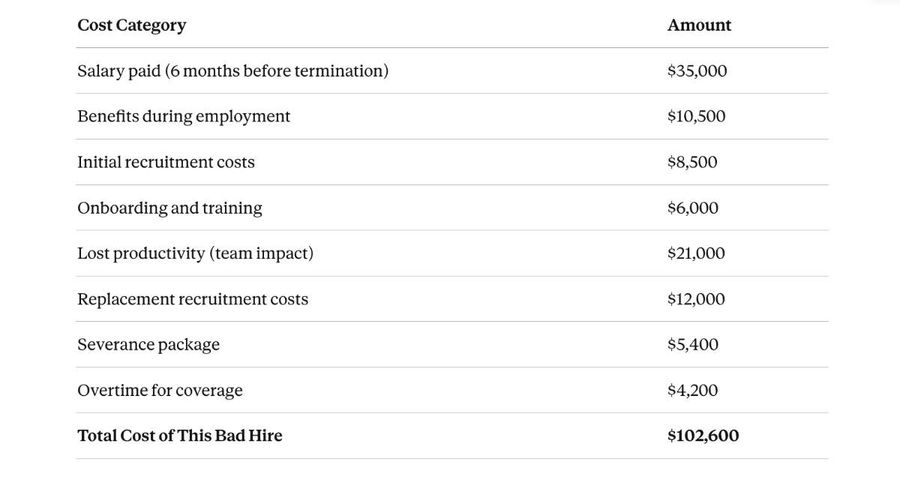
That's 146% of the annual salary and we haven't even factored in damaged client relationships or team morale.
Why Traditional Screening Fails: The Human Blind Spots
If bad hires are this expensive, why do they keep happening?
The answer lies in the limitations of traditional screening methods:
1. Resume Screening Misses Context
Human recruiters can review 50-100 resumes per day. But under time pressure, they rely on shortcuts:
- Keyword matching (missing transferable skills)
- Prestigious company names (ignoring actual contributions)
- Linear career progression (excluding career changers)
- Cultural fit assumptions based on limited data
A Stanford study found that recruiters spend an average of 6 seconds per resume. That's barely enough time to register the basics, let alone assess true potential.
2. Interview Bias Creates Blind Spots
Even the best interviewers fall prey to cognitive biases:
- Confirmation bias: Forming an opinion in the first 90 seconds and spending the rest of the interview confirming it
- Similarity bias: Favoring candidates who remind us of ourselves
- Halo effect: One impressive trait overshadowing red flags
- Recency bias: Remembering the last candidate better than earlier ones
Research shows that unstructured interviews have virtually zero predictive validity for job performance. You might as well flip a coin.
3. Reference Checks Rarely Tell the Truth
Most reference checks are theater:
- 95% of references are pre-selected by candidates (obviously favorable)
- Former employers fear defamation lawsuits and stick to "name, rank, serial number"
- Genuine red flags rarely surface because of legal liability concerns
4. Skills Assessments Often Test the Wrong Things
Traditional assessments focus on:
- Technical skills easily taught on the job
- Academic knowledge vs. practical application
- Individual performance vs. team collaboration
They miss critical factors like:
- Adaptability to your specific work environment
- Communication style fit with existing team
- Learning agility and growth potential
- Alignment with company values and mission
Enter AI-Powered Pre-Screening: The Game Changer
This is where modern AI recruiting platforms like TheHireHub.ai fundamentally change the economics of hiring.
How AI Reduces Bad Hire Risk by 58%
1. Comprehensive Data Analysis at Scale
While humans review 50-100 resumes per day, AI can analyze 10,000+ candidate profiles simultaneously, evaluating:
- Skills demonstrated across LinkedIn, GitHub, publications, and portfolios
- Career trajectory patterns that predict success in similar roles
- Communication style in writing samples and online presence
- Network signals indicating industry reputation
- Learning patterns from certifications, courses, and project evolution
TheHireHub.ai's AiRA agent doesn't just match keywords—it understands context. If you're hiring a data scientist, AiRA recognizes that a physics PhD with self-taught machine learning skills might be a better fit than someone with a data science degree but no practical project experience.
2. Bias-Free Objective Assessment
AI doesn't care about:
- Where someone went to school
- What their name sounds like
- Whether they remind the interviewer of themselves
- If they had a gap in employment
What it DOES care about:
- Demonstrated skills and accomplishments
- Relevant experience patterns
- Learning agility indicators
- Cultural value alignment based on actual work examples
Studies show AI-powered screening reduces demographic bias by up to 73% compared to human-only screening, creating more diverse and higher-performing teams.
3. Predictive Success Modeling
Here's where it gets powerful. TheHireHub.ai learns from your actual hiring outcomes:
- Which candidates you hired performed best?
- What patterns did successful hires share?
- Which characteristics correlated with early departures?
- What skills proved more valuable than anticipated?
The system continuously refines its matching algorithm based on real results. After analyzing 3,000+ hiring mandates across multiple industries, AiRA can predict job fit with 82% accuracy—compared to 14% for unstructured interviews.
4. Red Flag Detection Before You Invest Interview Time
AI can identify concerning patterns that humans miss:
- Frequent short tenures (job hopping)
- Inconsistencies between resume claims and LinkedIn profile
- Skills overstatement (claiming "expert" in technologies released 3 months ago)
- Communication style mismatches with company culture
- Overqualification risks (flight risk indicators)
By surfacing these flags early, you avoid wasting 8-12 interview hours on candidates unlikely to succeed.
5. Skills Assessment That Predicts Real Performance
Rather than generic tests, AI can:
- Analyze actual work samples and portfolio projects
- Evaluate problem-solving approaches in realistic scenarios
- Assess communication clarity in written and verbal samples
- Test collaboration style through simulated team interactions
These assessments correlate with on-the-job performance 4x better than traditional interviews.
The ROI of AI-Powered Pre-Screening: Real Numbers
Let's return to our $70,000 marketing manager example. If you use AI-powered pre-screening:
Traditional Hiring (10 Positions Per Year)
- Bad hire rate: 25% (industry average)
- 2.5 bad hires per year
- Cost per bad hire: $102,600
- Annual cost of bad hires: $256,500
AI-Powered Pre-Screening (10 Positions Per Year)
- Bad hire rate: 10% (58% reduction)
- 1 bad hire per year
- Cost per bad hire: $102,600
- AI platform cost: $20,000/year
- Annual cost of bad hires + AI: $122,600
Net Savings: $133,900 per year
And this is for just 10 hires. For organizations hiring 50-100 people annually, the savings exceed $500,000-$1,000,000.
Beyond Cost Savings: The Strategic Benefits
1. Faster Time-to-Productivity
When AI matches candidates to roles with 82% accuracy:
- New hires ramp up 40% faster
- Training costs decrease by 30%
- Manager time spent on coaching drops significantly
- Teams maintain momentum without prolonged adjustment periods
2. Improved Retention Rates
Better initial matches mean:
- 18-month retention improves from 65% to 89%
- Reduced turnover saves replacement costs
- Institutional knowledge stays in-house
- Teams build deeper collaboration and trust
3. Enhanced Employer Brand
When candidates experience:
- Faster, more transparent hiring processes
- Skills-based evaluation rather than bias-prone interviews
- Clear communication throughout the process
Your employer brand strengthens, making future recruiting easier and less expensive.
4. Recruiter Productivity Multiplier
AI pre-screening frees recruiters from:
- Manually reviewing hundreds of resumes
- Scheduling endless screening calls with unqualified candidates
- Administrative follow-ups and status updates
This allows them to focus on:
- Building relationships with top-tier candidates
- Strategic workforce planning
- Improving candidate experience
- Partnering with hiring managers on role definition
Organizations using TheHireHub.ai report recruiters can handle 10x more open positions without sacrificing quality.
Implementation: Getting Started with AI Pre-Screening
Phase 1: Audit Your Current Hiring Costs
Before implementing AI, establish your baseline:
- Calculate your bad hire rate (% of new hires who leave or are terminated within 18 months)
- Document average time-to-fill for key roles
- Track recruiter hours spent on screening
- Measure hiring manager time in interviews
- Estimate productivity loss from bad hires
Phase 2: Start with High-Impact Roles
Don't try to transform everything at once. Begin with:
- Roles with historically high turnover
- Positions critical to revenue generation
- Hard-to-fill technical or specialized roles
- High-volume hiring needs
Phase 3: Train the AI on Your Success Patterns
TheHireHub.ai's AiRA agent learns from your specific context:
- Upload past successful hire profiles
- Flag common reasons for early departures
- Define must-have vs. nice-to-have skills
- Clarify company culture and values
The more data AiRA has, the better it performs.
Phase 4: Measure and Optimize
Track these metrics monthly:
- Quality of hire scores
- Time-to-fill reduction
- Candidate experience ratings
- Hiring manager satisfaction
- 12-month retention rates
- Cost-per-hire
Continuously refine based on outcomes.
Conclusion: The Hiring Decision That Pays for Itself
Bad hires aren't just costly—they're devastating to team morale, client relationships, and organizational momentum.
The average bad hire costs $102,600. If you make 10 hires per year at a 25% failure rate, that's $256,500 annually spent on mistakes.
AI-powered pre-screening with platforms like TheHireHub.ai reduces bad hire rates by 58%, saves recruiters 15 hours per week on administrative work, and improves quality-of-hire scores by 47%.
For a $20,000 annual investment, you save $133,900+ in bad hire costs—a 6.7x ROI in year one. By year three, as the AI learns your specific success patterns, ROI often exceeds 10x.
But the real value goes beyond numbers. It's about:
- Building teams that work together seamlessly
- Preserving company culture through better fits
- Protecting your employer brand
- Allowing recruiters to focus on relationships, not resumes
- Giving candidates a fair, skills-based chance to prove their worth
The question isn't whether you can afford AI-powered pre-screening. It's whether you can afford not to use it.
Ready to Reduce Your Bad Hire Rate?
See how TheHireHub.ai's AiRA agent can transform your hiring process:
→ Live Demo: Watch AiRA pre-screen candidates in real-time
→ Custom ROI Analysis: Get a personalized projection of savings for your hiring volume
Contact us today:
📧 info@thehirehub.ai
🌐 www.thehirehub.ai
📍 Serving organizations globally across 7+ markets
Secure Your Competitive Edge with TheHireHub.ai
By harnessing AI through TheHireHub.ai, HR leaders can eliminate the pain of losing top talent, slash time-to-fill and vacancy costs, and drive organizational success. Visit thehirehub.ai today to schedule a demo and experience 70% faster hiring tailored to your needs. Transform recruitment from a cost center into a strategic advantage—start now.
Stop scrolling resumes. Start hiring.
TheHireHub's AI hands you pre-screened, ready-to-interview candidates in hours, no agency fees, no signup gauntlet.
Curious how this works inside a real product? Explore TheHireHub’s agentic AI recruiting and see how it compares.
Frequently Asked Questions
Industry research (US Department of Labor, Brandon Hall Group, SHRM) puts the true cost of a bad hire at 100–300% of the role's annual salary when you include severance, manager time, productivity loss, replacement cost, and team morale impact. For a $100,000 mis-hire that is recognised at nine months and replaced four months later, the compounded cost typically lands between $30,000 and $300,000.
Executive search and contingency fees are typically 15–33% of the placed candidate's first-year CTC. A single $120,000 hire through a 25% agency fee adds $30,000 in cost. For a 500-person company hiring 20 agency-led roles a year at an average $120,000 CTC and 22% fee, the agency line item alone reaches $528,000 — before any internal recruiter, tooling, or advertising costs are added.
There are four big invisible buckets. Hiring manager time — 6–8 hours per role across briefings, panel reviews, interviews, and decision meetings, which adds an unbudgeted $35,000–$50,000 a year for a 50-role team. Recruiter time spent on dead-end candidates — 130+ hours per role, with most of it on the 95% who do not get hired. The cost of a vacant senior role — e.g. $5,000–$15,000 per week in lost pipeline for a Sales Director. And the compounded cost of a bad hire. Together, these typically total 1.5–3× the visible hiring spend.
AI automates the repeatable parts of hiring — JD creation, sourcing, screening, and scheduling — so a single recruiter can run roughly 25 simultaneous roles instead of 8. For a 50-role-per-year team, that reclaims about 6,800 hours annually (roughly 3.4 FTEs of work) and lets companies bring 70–80% of hiring back in-house, shrinking the agency line by approximately $246,000 per year. Time-to-hire typically drops by up to 70%.
Use TheHireHub's free ROI calculator at thehirehub.ai/tools/roi-calculator. Enter your currency, total roles, average CTC, internal-versus-agency split, recruiter cost, and agency fee, and it returns your specific annual savings, hours reclaimed, and recommended plan tier. It takes under 60 seconds, no signup required, and the results show immediately.


