Will AI Replace Recruiters? What the 2026 Data Actually Says
The honest answer to the question every talent team is quietly asking, with the numbers on what is being automated, what is not, and which recruiters are at risk.
AI is not replacing recruiters, it is dissolving the administrative half of the job. The 2026 task-by-task numbers on what automates, what does not, and who is at risk.

TL;DR
No, but the question is hiding a more uncomfortable one. Will AI replace recruiters is the wrong framing: AI is not replacing the role, it is dissolving the parts of the role that were always administrative. Roughly 84 percent of talent leaders plan to use AI in recruiting in 2026 and 52 percent plan to add autonomous agents to their teams, while only 24 percent expect headcount increases. That gap is the whole story. The recruiters at risk are the ones whose week is mostly scheduling, keyword searching, and status emails. The ones who are safe are the ones doing calibration, judgement, and closing, which is exactly the work that got squeezed out when admin ate the calendar. If you want the mechanics of how the automation layer actually works, start with our recruitment automation guide.
What is actually happening
Two things are happening at once, and conflating them is why the conversation gets so heated.
The first is a genuine capability shift. Screening, scheduling, first-touch outreach, and status communication are now good enough to run with light supervision. Josh Bersin's April 2026 analysis projects that 30 to 40 percent of existing HR roles can be automated with relatively low effort, rising sharply when teams re-engineer their processes around agents rather than bolting agents onto old workflows.
The second is a hiring market contraction that has nothing to do with AI. Entry-level job postings fell 15 percent in 2025 while applications per vacancy rose 30 percent. Talent teams got smaller because budgets got smaller. AI is arriving at the same moment, so it gets the blame for cuts it did not cause.
The result is that recruiters are being asked to handle more applications with fewer people, and AI is the only lever available. That is a very different situation from AI making recruiters unnecessary. It is AI becoming load-bearing.
There is a third dynamic that gets less airtime. When one team automates screening and another does not, the automated team responds to candidates in hours rather than days. Speed compounds into offer acceptance. So adoption spreads for competitive reasons even where the efficiency case is marginal.
The numbers
Not all recruiting work automates equally. The spread below is the single most useful thing to internalise, because it tells you where the role is genuinely being hollowed out and where it is not.
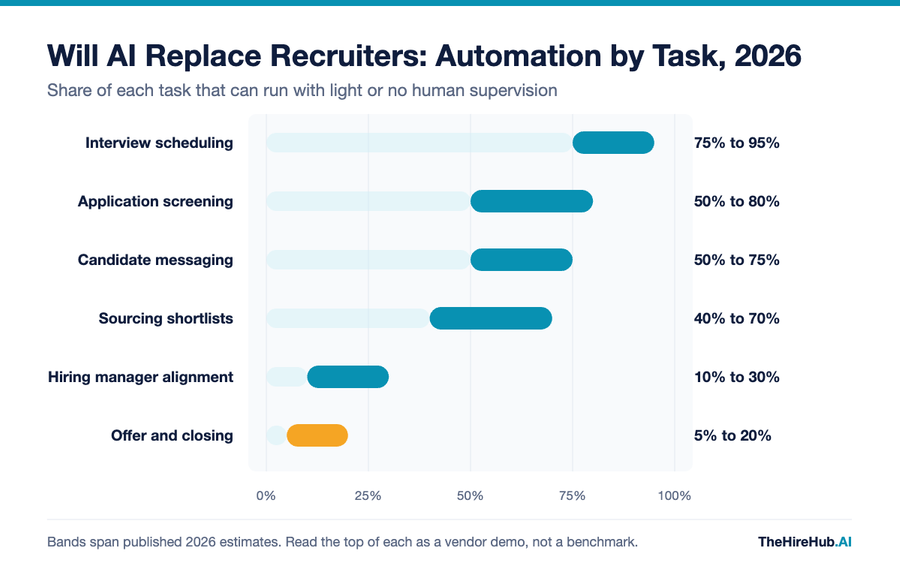
How to read this:
- The top of each band is what vendors demonstrate under good conditions, not what your team will get in month one.
- Tasks with narrow, well-defined outputs automate first. Tasks that require holding context across people automate last, or never.
- Nothing on this chart is a prediction about jobs. It is a statement about tasks, and roles are bundles of tasks that get rebundled.
How it actually works, and where it breaks
The mechanism is straightforward. A model parses applications, scores them against a role definition, ranks them, and routes low-confidence cases to a human. Scheduling agents negotiate calendars. Messaging agents keep candidates warm. None of this is exotic in 2026.
The breakage is more interesting, and it comes in three forms.
It breaks on silent rejection. A 2026 SHRM survey of 1,908 HR professionals found that 19 percent of organisations using hiring automation report their tools have screened out qualified applicants. You do not see a false negative. Nobody complains about an interview they never knew they missed.
It breaks on agreement with humans. Independent assessments put screening agreement with human reviewers at roughly 60 to 70 percent, and rigorous quality-of-hire validation remains rare. A tool can be fast, consistent, and confidently wrong at the same time. Our piece on AI resume parsing accuracy goes deeper on where the extraction layer itself fails before scoring even begins.
It breaks on unsupervised authority. Reporting in 2026 suggests around 75 percent of companies allow AI to reject candidates without human review. That is a governance decision, not a technical one, and it is the one regulators are now moving on.
"A screening tool can be fast, consistent, and confidently wrong at the same time, and a false negative never files a complaint."
What this means for your team
The teams getting real leverage are not the ones that bought the most tools. They are the ones that sequenced adoption by risk rather than by excitement, in roughly the order below.
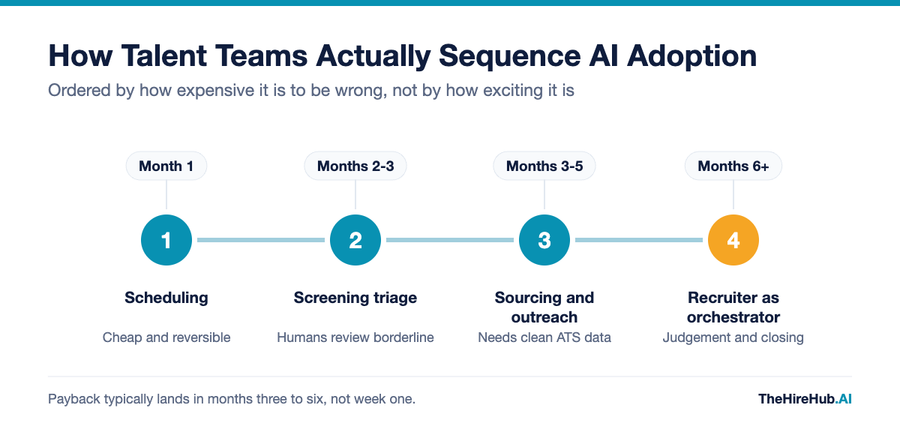
The pattern is consistent: automate the work where being wrong is cheap and reversible, then earn the right to automate the work where being wrong is expensive. Teams that invert this order spend their first two quarters rebuilding trust with hiring managers instead of filling roles. If you are running high application volume, our guide to high volume hiring with AI covers the screening layer in more detail.
Recruiters vs AI agents: what each is actually for
The useful distinction is not human versus machine, it is bounded versus unbounded work. An agent is excellent at bounded tasks: a defined input, a defined output, a defined success condition. Rank these 400 applications. Find fifteen calendar slots. Send this follow-up. Give an agent a task with clean edges and it will outperform a tired human at 6pm every time, which is the honest case for agentic AI in hiring.
Recruiters are for unbounded work. Persuading a candidate who has three offers and a spouse with an opinion. Telling a hiring manager their scorecard is describing two different jobs. Reading a room. Deciding that a candidate who looks wrong on paper is right for a team going through a rough patch. None of that has a defined success condition, which is precisely why it does not automate. Negotiation, senior sourcing, and hiring-manager calibration remain the slowest functions to automate for exactly this reason. The recruiters being displaced are the ones whose jobs had already been reduced to bounded tasks by bad process, long before any AI showed up.
How to actually do this (and the four traps)
- Automating a broken process instead of fixing it. If your scorecard is vague, an agent will apply that vagueness at scale and with perfect consistency. Automation is an amplifier, so fix the role definition before you point a model at it.
- No baseline before you start. If you cannot state your current time to hire, screening pass-through rate, and offer acceptance on the day you switch on, you will spend the next two quarters arguing about whether the tool works. Capture the baseline first, in writing.
- Treating human review as optional overhead. Given that roughly three quarters of companies now let AI reject without review, and that regulators in the EU and New York have moved on exactly this, unsupervised rejection is becoming a compliance exposure rather than an efficiency gain. Our AI hiring compliance guide covers the obligations in force now.
- Cutting the recruiters before the leverage arrives. The efficiency shows up in months three to six, not week one. Teams that cut headcount at signature discover they have automated 40 percent of the work and removed 100 percent of the people who knew how to supervise it.
"Automating a broken hiring process does not fix it. It just makes the same bad decision four hundred times before lunch."
The one thing every hiring leader should take from this
Stop asking whether AI will replace recruiters and start asking which parts of your recruiters' weeks you would be embarrassed to still be paying humans for in two years. That list is your automation roadmap, and it is usually shorter and more specific than the vendor pitch suggests. The remainder, the judgement and the closing and the difficult conversation with the hiring manager, is not a rump left over after automation. It is the actual job, finally given room. If you are trying to work out which parts of your process are ready for this and which are not, we look at this stuff all day.
Frequently Asked Questions
No. The 2026 consensus across analyst and practitioner research is role transformation rather than replacement, with AI absorbing transactional work while recruiters move toward judgement, relationships, and closing. What is genuinely at risk is the administrative portion of the role, not the role itself.
Interview scheduling, application screening, and templated candidate communication. These have clean inputs, clean outputs, and cheap failure modes, which is why they automate before sourcing strategy or offer negotiation.
Negotiation, senior and executive sourcing, and hiring-manager calibration. These require holding context across multiple people and making judgement calls without a defined success condition, so they are the slowest to automate.
Published estimates range from about 30 to 52 percent depending on how the survey defines admin, with scheduling alone accounting for a large share. The variance across sources is wide enough that you should measure your own team rather than trusting a benchmark.
The picture is mixed. Only 24 percent of talent leaders expect headcount increases in 2026, but hiring volumes also fell independently of AI, with entry-level postings down 15 percent in 2025. Attributing every talent team cut to automation overstates the case.
Sometimes. A 2026 SHRM survey of 1,908 HR professionals found 19 percent of organisations using hiring automation report their tools have screened out qualified applicants. False negatives are invisible by nature, which is why human review of borderline cases matters.
Independent assessments put agreement with human reviewers at roughly 60 to 70 percent. That is useful for triage and insufficient for unsupervised rejection, which is the practical argument for human-in-the-loop review.
Role calibration, structured interviewing, closing, and supervising AI output. The scarce skill is increasingly judging whether a shortlist is good, not producing the shortlist.
Adoption is high and rising, with AI implementation in Indian IT and ITES projected around 84 percent by the end of 2026. Application volumes per role are also higher, which makes the screening layer more load-bearing than in smaller markets.
Most teams see meaningful returns in months three to six rather than immediately, because the first two months go into calibration, integration, and rebuilding trust with hiring managers. Budgeting for instant payback is the most common planning error.


