Candidate Experience in AI Hiring 2026: Why 38% Walk Away, and How to Stop It
Candidates are not rejecting automation, they are rejecting being assessed by something nobody disclosed and nobody will answer for.
Greenhouse found 38% of job seekers have walked away from a hiring process because it used an AI interview, and 70% were never told AI would be evaluating them.

TL;DR
Candidate experience in AI hiring is now a measurable leak, not a soft concern. Greenhouse's 2026 Candidate AI Interview Report, which surveyed 2,950 active job seekers, found 38% have walked away from a hiring process because it included an AI interview, and another 12% say they would. The cause is not the technology: only 19% want less AI in hiring. It is that 70% were never clearly told AI would be evaluating them, and 51% of those who completed an AI interview never heard back at all. If your worry is the opposite direction, candidates using AI against you, start with our guide to AI interview cheating detection.
What is actually happening
AI interviewing crossed into the mainstream faster than the norms around it did. Greenhouse found 63% of job seekers have now been interviewed by an AI, up 13 percentage points in just six months. That is a rate of adoption that outpaced almost every hiring team's ability to write a policy for it. The result is a large population of candidates encountering something they were not warned about.
The disclosure gap is the heart of the problem. Seven in ten candidates were never clearly told upfront that AI would be evaluating them, and for one in five, the discovery happened once the interview had already started. Just 18% say employers have clear AI policies. Meanwhile 57% think disclosure should be a legal requirement, which tells you where public expectation is heading even where the law has not arrived.
It is worth being precise about what candidates object to, because the vendor framing usually gets this backwards. They are not anti-automation. Only 19% want less AI in the process, and the majority want the same amount or more, provided there are guardrails. What they object to is being assessed by something unaccountable and undisclosed.
The specific triggers are documented. The biggest reason candidates abandon a process is a pre-recorded video interview scored by AI with no human present, cited by 33%. Failure to disclose how AI would be used follows at 27%, and AI monitoring during the process at 26%. Notice that two of those three are transparency failures rather than technology failures, and cost nothing to fix.
There is also a bias problem that automation has not solved. Candidates reported nearly identical rates of perceived bias from AI and from human interviewers: 36% felt age bias from both, and 27% flagged race or ethnicity bias from both. Only 21% believe most employers are using AI responsibly. Whatever else AI screening is doing, candidates are not experiencing it as the neutral arbiter it was sold as.
The numbers
The useful way to read this data is as a funnel of trust rather than a list of grievances. Each figure below is a point where a candidate decides whether to keep going or quietly stop. The gap between how many people meet AI in a process and how many believe it is being used fairly is the whole story.
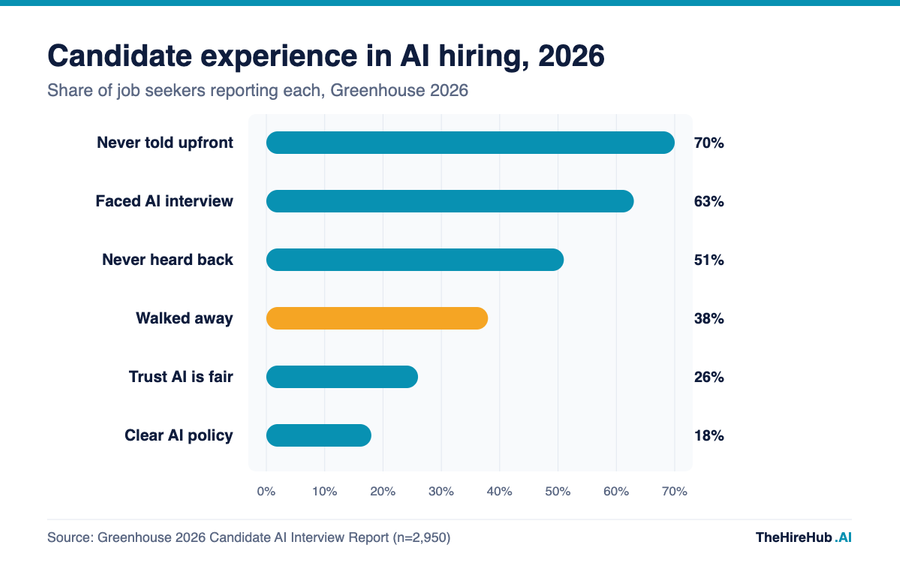
How to read this:
- The 38% walk-away figure is self-reported abandonment, not inferred from drop-off logs. These are candidates who knew why they left, which makes it a floor rather than a ceiling on the real number.
- The 51% who never heard back is the most damaging line on the chart and the cheapest to fix. Among candidates who completed an AI interview, only 28% moved to the next round and 13% got a formal rejection.
- Read "trust AI is fair" at 26% against "faced AI interview" at 63%. Most of your candidate pool is now being assessed by a method they do not believe in, which is a retention problem for your pipeline long before it is an ethics problem.
How it actually works, and where it breaks
The mechanism is straightforward. A candidate applies, gets routed to an asynchronous or voice-based AI interview, records answers against timed prompts, and a model scores those answers on rubrics the candidate cannot see. Throughput goes up because no recruiter time is consumed at the top of the funnel. That is a real gain, and it is why adoption moved so fast.
The first breakage is that removing the human also removes the reciprocity. A live screen, however brief, creates an obligation to respond. An automated stage creates none, which is how you end up with 51% of completed AI interviews receiving no reply. The system that made it cheap to assess also made it free to ignore people.
The second breakage is that the candidate cannot calibrate. In a human screen, a candidate reads the room and adjusts. Facing a model with undisclosed criteria, they are guessing at what is being measured, which is exactly why 39% say they want an explanation of what the AI is assessing. Uncertainty of this kind reads as unfairness whether or not the scoring is actually sound, a dynamic our guide to AI interview scoring goes into.
The third breakage is reputational and compounding. When AI interviews are handled well, 38% of candidates come away with a more positive view of the employer. When handled badly, 34% come away with a more negative one. The same tool moves brand perception in both directions by a similar magnitude, so the variable is execution, not adoption.
"Candidates are not rejecting the machine, they are rejecting being processed by one that nobody will admit is in the room."
What this means for your team
The fixes candidates actually asked for are cheap, and they are not evenly valuable. Greenhouse asked what guardrails people want: the option to request a human interview instead (46%), upfront disclosure (44%), a clear explanation of what the AI is measuring (39%), confirmation that a human reviews the AI evaluation before any decision (38%), and evidence the tool has been audited for bias (29%). Run them in the order below, because the early steps cost nothing and remove most of the damage.
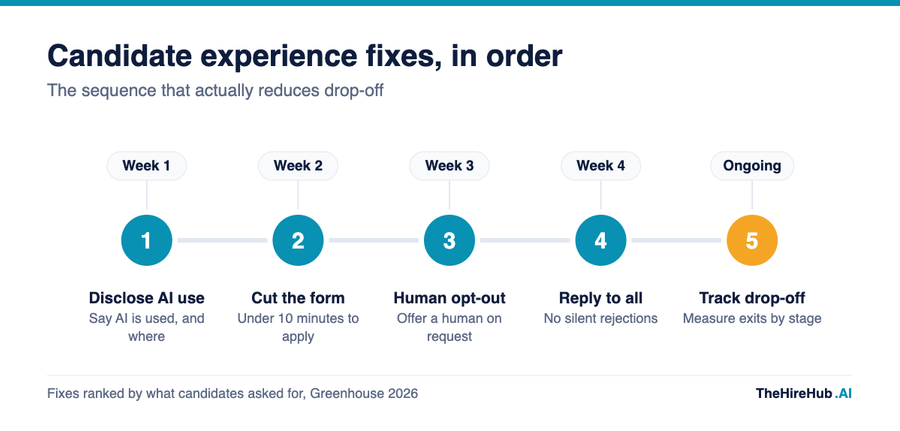
Notes on running this in practice:
- Step 1 is a sentence in your job posting and interview invitation. Say that AI is used, at which stage, and what it evaluates. This single change addresses the 27% who leave specifically because use was not disclosed.
- Step 3 is the highest-rated guardrail at 46%, and it is cheaper than it sounds. Very few candidates actually exercise a human-interview option, but its existence changes how the process is perceived by everyone who sees it offered.
- Step 4 is non-negotiable and mostly a configuration problem. If your ATS can send a templated rejection, there is no defensible reason for half your AI interviewees to hear nothing.
Candidate experience versus throughput: which one you are optimising
The nearest neighbour to a candidate experience programme is a throughput programme, and most teams have quietly been running the second while claiming the first. Throughput optimises for applications processed per recruiter hour. Candidate experience optimises for qualified people who are still in the process at offer stage. Those two goals only diverge when automation is opaque, and that is precisely where most implementations sit.
The tell is which number gets reported upward. If your weekly hiring review shows time-to-screen and cost-per-application but not stage-level drop-off or response rate, you have built a throughput system and are measuring it honestly. That is a legitimate choice for very high volume roles. It is a poor choice for roles where the candidate has options, which is most roles worth automating for.
The reconciliation is not to abandon automation but to make it accountable, and that increasingly overlaps with regulation. Disclosure duties, human review of automated decisions, and bias auditing are becoming legal obligations rather than courtesies in several jurisdictions, which our AI hiring compliance guide covers. The same three measures are what candidates independently asked for, so the compliance floor and the experience fix are largely the same work.
How to actually do this (and the four traps)
- Do not treat disclosure as a legal checkbox. A buried line in a privacy policy satisfies nobody and prevents nothing. Candidates want to know AI is in the room and what it measures, stated where they will actually read it, which is the invitation itself. Doing this badly leaves the 27% disclosure-driven walk-away rate fully intact.
- Do not automate the rejection out of existence. Silence is not neutral, it is the single worst outcome in the dataset, and it is what half of completed AI interviews currently receive. A templated rejection sent promptly is vastly better than nothing, and costs one configuration change.
- Do not run AI as the only voice in an early stage. The top walk-away trigger at 33% is a pre-recorded video interview scored by AI with no human present. Keeping a human somewhere visible in the first two stages removes the specific thing most candidates cite when they leave, and it is the same reasoning behind how teams are rethinking voice AI phone screens.
- Do not measure adoption instead of outcome. Interviews completed per week tells you the tool is running, not that it is working. Track stage-level drop-off, response rate, and whether the people you hired through the automated path perform, which is the discipline in our quality of hire measurement guide.
"Silence is the cheapest thing you can send a candidate and the most expensive thing they will remember about you."
The one thing every hiring leader should take from this
Candidates have already told you the fix and it is embarrassingly cheap. Tell them AI is involved, tell them what it is looking for, keep a human reachable, and reply to everyone. None of that requires changing your stack or slowing your funnel, and it addresses the majority of the reasons people currently leave. The teams that lose candidates to automation in 2026 are not losing them to the technology, they are losing them to the silence around it. At TheHireHub we think that gap is the most fixable problem in hiring right now.
Sources
- Greenhouse, 2026 Candidate AI Interview Report (survey of 2,950 active job seekers)
- Greenhouse, The 2026 AI in Hiring Report
Hiring shouldn't have to feel harder just because the talent market is more competitive.
At TheHireHub.ai, we help hiring teams simplify the process from finding the right candidates to assessing and ranking them, so your team can spend less time managing the hiring process and more time making the right decisions.
If you're looking to make hiring easier, faster, and better, we'd be happy to help.
Frequently Asked Questions
It is how job seekers actually experience a hiring process that uses AI to screen, interview, or score them, measured by whether they complete it, how they are treated at each stage, and whether they hear back. In 2026 it is best treated as a funnel metric rather than a sentiment one, because candidates who dislike the process leave it.
Greenhouse's 2026 Candidate AI Interview Report, based on 2,950 active job seekers, found 38% have walked away from a hiring process because it included an AI interview, and a further 12% say they would. That is self-reported abandonment, so it is a floor rather than a ceiling on the true rate.
Mostly no. Only 19% want less AI in hiring and the majority want the same amount or more, provided there are guardrails. What they object to is undisclosed and unaccountable use, not automation itself.
The biggest single trigger is a pre-recorded video interview scored by AI with no human present, cited by 33%. Failure to disclose how AI would be used follows at 27%, and AI monitoring during the process at 26%. Two of those three are transparency failures that cost nothing to fix.
Largely not. 70% of candidates were never clearly told upfront that AI would be evaluating them, and 21% only found out once the interview had started. Just 18% say employers have clear AI policies.
Among those who completed one, 28% moved forward to the next round, 13% were formally rejected, and 51% never heard back at all. That silence is the most damaging and the cheapest outcome to fix in the entire dataset.
Candidates do not experience it that way. They reported nearly identical rates of perceived bias from AI and from human interviewers, with 36% feeling age bias from both and 27% flagging race or ethnicity bias from both. Only 21% believe most employers are using AI responsibly.
In order of demand: the option to request a human interview instead (46%), upfront disclosure (44%), a clear explanation of what the AI measures (39%), confirmation that a human reviews the AI evaluation before a decision (38%), and evidence the tool has been audited for bias (29%).
Yes, and it is cheaper than it sounds. It is the highest-rated guardrail at 46%, but very few candidates actually exercise it. Its main value is changing how the process is perceived by everyone who sees it offered.
Stage-level drop-off and response rate, not interviews completed. Adoption metrics tell you the tool is running, not that it is working. Pair those with six-month performance of hires made through the automated path so you can see whether the funnel is filtering for quality or just for tolerance.


