
Employee Referral Program: What Actually Works in 2026
Bonuses, response times and the four traps that quietly kill most programs.
Most companies run an employee referral program and few hit their goals. Here is what bonuses to set, how fast to respond, and the four traps to avoid in 2026.

TL;DR
An employee referral program is the cheapest source of hire most companies already own and badly run. In the HireClix data reported by HR Dive in 2025, 71% of companies run a formal referral program, yet only 2% say it meets their referral hiring goals. Indian policy templates put the bonus at roughly ₹10,000 to ₹60,000 depending on seniority, paid after probation. The answer is not a bigger bonus: it is fast acknowledgement, a short feedback loop, and a payout rule that rewards retention. If you are weighing this against paid channels, start with our AI recruiting vs agency comparison.
What is actually happening
Most referral programs fail quietly. A policy gets written, an email goes out, three referrals arrive in the first month, and then nothing. The program is still "live", but nobody checks it and nobody owns it.
The first reason is ownership. Referrals sit between HR, the hiring manager and the recruiter, and each assumes another is responding. A referred resume lands in a shared inbox, waits a week, and gets treated like any other application.
The second reason is feedback. The employee who made the referral hears nothing for weeks, so they stop referring. Referral volume is a function of how respected the referrer feels, not of the size of the cheque.
The third reason is incentive design. A randomised grocery-chain experiment published as NBER Working Paper 25920 found that larger bonuses increase referral volume but decrease quality. The same experiment reported that introducing the program reduced overall attrition by 15%.
The fourth reason is fairness. PayScale data cited by LinkedIn's talent blog found women of color are 35% less likely than white men to receive an employee referral. A program that only mirrors your current workforce will reproduce it.
There is also a capacity problem that rarely shows up in the policy. When referrals arrive, the recruiter who owns the role is usually already carrying a full requisition load. A referred candidate then competes for attention with fifty inbound applications, and the referrer's patience runs out first.
The numbers
Referral economics are easy to state and hard to measure, because most companies do not track source of hire to retention. Still, a few benchmarks are worth anchoring on. SHRM's 2025 benchmarking put the average cost per hire for a non-executive role at $5,475 (USD, global survey), and its 2026 benchmarking put median time to fill at 39 days. Our cost per hire benchmarks post breaks down how that moves by channel.
On funnel quality, Ashby has reported that 40% of referred applicants reach an interview and 16% of those interviewed receive an offer. That is the real value of a referral: not volume, but a shorter, higher-conversion funnel.
On payouts, a published policy template from an HR software vendor (Keka) sets example bonuses by level of the referred hire. The chart below shows the low and high of those example figures across its categories.
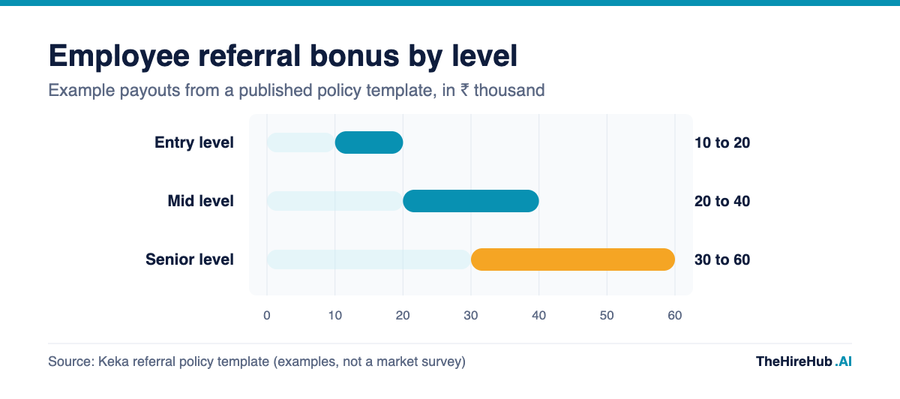
How to read this:
- The figures are template examples to adapt, not a market survey. Treat them as a starting structure, then test against your own offer-to-join cost.
- Bonus scales with seniority, but not proportionally. A senior referral pays roughly three times an entry referral, while the cost of an agency fee scales far faster. That gap is the economic case for referrals.
- Payout timing matters more than the amount. In the same template, the bonus is paid only after the referred employee completes probation successfully.
How it actually works, and where it breaks
A referral program is a three-step loop. An employee submits a name, the talent team screens and responds, and the referrer is paid when the hire sticks. Each step has a service level, and the program is only as fast as its slowest one.
The mechanism that makes it work is trust transfer. The referrer has already vouched for the person, so the screen is shorter and the candidate arrives with context. That is why referred candidates tend to convert better and accept offers more readily, which you can track against your own offer acceptance rate.
It breaks in three places.
Notice what this means for the metrics. Referral volume alone tells you almost nothing, because a program can post a record month of submissions and still deliver no hires. The numbers that matter are submissions per hundred employees, acknowledgement time, referral-to-interview rate, and the share of referred hires still in seat after probation. The first is silence: a referral that waits more than two working days for acknowledgement is treated by the employee as ignored. The second is quality dilution, where a rich bonus encourages employees to refer anyone, which is exactly the NBER finding above.
The third is closed-network bias. If referrals become the dominant source, your hiring pool narrows to the social circles of the people you already employ. Intel reported that doubling referral bonuses for underrepresented candidates lifted their share of new hires from 32% to 41%, which shows the lever works when designed on purpose.
"A referral program does not fail because the bonus is too small. It fails because the referrer never hears back."
What this means for your team
Run the program as a pipeline with owners and clocks, not as a policy document. Each stage needs one named owner and one deadline. The chart below uses the turnaround times from the same published template as a sensible starting point.
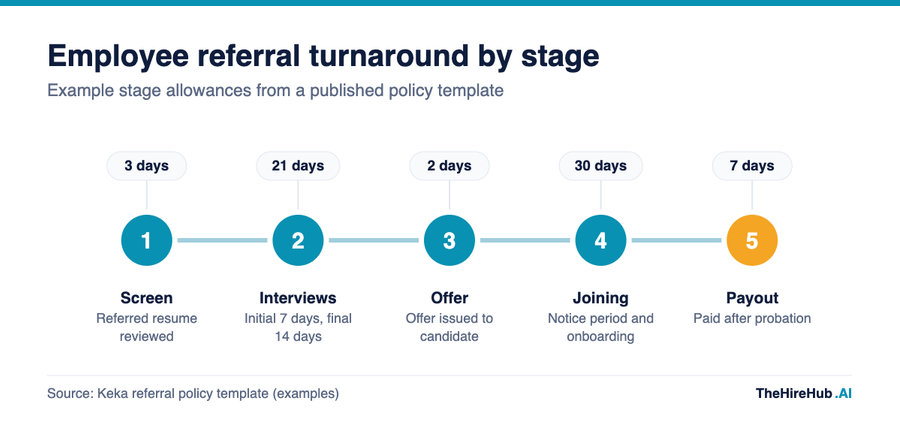
In practice, this sequence looks like the following:
- Acknowledge within 48 hours. Send the referrer a human or automated confirmation that their person is in the process.
- Screen in days, not weeks. Referred resumes go to the front of the queue, with the same bar as everyone else.
- Report status to the referrer. A two-line update at each stage costs nothing and keeps volume alive.
- Pay in two parts if you can. Half at joining and half after probation aligns the reward with retention, which is the outcome you actually want.
Automation helps most at steps one and three.
A useful test is to ask what happens to a referral submitted at 6 pm on a Friday. If the answer is that it waits until someone opens a shared inbox on Tuesday, the program has a design problem, not a motivation problem. Fix the intake first, because every downstream metric inherits that delay. An applicant system that tags source of hire and pings the referrer on stage change removes the manual follow-up that kills most programs.
Employee referrals vs the alternative
The nearest neighbour is the paid agency. An agency gives you reach into networks you do not have, while a referral program gives you reach into the networks you already do. The two are complements for most companies, not substitutes.
The cost curve is different. Agency fees scale with the salary of the hire, while a referral bonus is a fixed, small number. For leadership roles where your own employees do not know the candidate pool, an agency still earns its fee, and our AI recruiting vs agency piece covers where that line sits.
The other neighbour is rediscovery of past applicants. Referrals reach new people, while talent rediscovery from silver medalists reaches people who already know you. Run both before you pay for a new channel.
A third option is the broader sourcing stack. If your open roles are in a market where your employees simply do not know the talent, referrals will plateau quickly. In that case, direct sourcing is the right lever, and referrals become the trust layer on top of it rather than the whole strategy.
How to actually do this (and the four traps)
Start small: one team, one quarter, one clear owner. Measure source of hire against retention at 90 days and one year, not just volume. Our quality of hire measurement guide shows how to define that metric properly.
- Paying for volume instead of fit. A high flat bonus invites low-quality referrals. Tie the payout to passing probation, and keep the amount modest.
- Ignoring the referrer after submission. Silence is the most common reason a program dies. Update the referrer at every stage, including rejections.
- Letting the program become your only source. Heavy reliance narrows diversity. Track the demographic mix of referred versus non-referred hires, and consider targeted incentives.
- Never measuring it. If you cannot say what share of hires came from referrals and how long they stayed, you are running a hope, not a program. Add source of hire to every offer record.
Beyond the four traps, one operating habit separates healthy programs from stale ones: a monthly ten-minute review. Look at submissions, response times, interview conversion and the oldest referral still waiting. If the oldest referral has been waiting more than a week, that single number tells you where the program is leaking.
"The referral you ignore for a week is the referral you will not receive again, from that employee or any of their friends."
The one thing every hiring leader should take from this
A referral program is a service you provide to your own employees, and the bonus is the least important part of it. Respond fast, report back, pay on retention, and measure the source of every hire. Get those four things right and the program becomes your cheapest and most reliable channel, and if you want a second pair of eyes on yours, we look at this stuff all day.
Frequently Asked Questions
An employee referral program is a structured way for current employees to recommend people for open roles, usually with a recognition or cash reward paid when the referred person is hired and stays. The best programs also give the referrer regular status updates.
There is no single right amount. A published Indian policy template uses example bonuses of roughly ₹10,000 to ₹20,000 for entry roles, ₹20,000 to ₹40,000 for mid roles and ₹30,000 to ₹60,000 for senior roles. Research from the NBER suggests larger bonuses raise volume but can lower quality, so keep it modest and test it.
Pay after the referred employee has settled in, ideally split between joining and the end of probation. Paying on retention aligns the reward with the outcome you want, which is a hire who stays.
Referred candidates tend to convert better through the funnel. Ashby has reported that 40% of referred applicants reach an interview and 16% of those interviewed receive an offer. Track your own source of hire against retention rather than relying on external averages.
They usually fail on follow-through rather than incentive. Referrals sit unanswered, the referrer hears nothing, and participation fades. HireClix data reported by HR Dive found 71% of companies run formal programs but only 2% say they meet their referral hiring goals.
Acknowledge within two working days at the latest, and move referred resumes to the front of the screening queue. A quick response protects the relationship with the referrer, which is what drives future referrals.
Yes, if they become the dominant source. Referrals tend to mirror existing networks, and PayScale data cited by LinkedIn found women of color are 35% less likely than white men to receive a referral. Intel reported that doubling bonuses for underrepresented candidates lifted their share of new hires from 32% to 41%.
Track submissions per hundred employees, acknowledgement time, referral-to-interview rate, offer acceptance, and the share of referred hires still in seat after probation and after one year. Add source of hire to every offer record so the data exists.
For most companies they complement each other. Referrals are cheap and fast where your employees know the talent pool, while agencies add reach into networks you do not have, especially for senior or niche roles.
They help most with intake and follow-up: tagging referral source, acknowledging submissions automatically, and notifying the referrer when the candidate moves stage. The judgement about fit and fairness should stay with people.

