
Notice Period Buyout in India 2026: Rules, Cost and When to Fund It
What a buyout actually costs, who should pay it, and how to decide before you extend the offer.
A 90 day notice on ₹15 lakh costs about ₹3.75 lakh to buy out. Here is the formula, the notice bands by seniority, and when funding it is cheaper than waiting.

TL;DR
A notice period buyout is the cash you or your candidate pays to cut short a contractual notice, and in Indian senior hiring it has quietly become a standard line item rather than an exception. The formula almost every Indian employer uses is monthly CTC divided by 26, multiplied by the days left unserved, so a candidate on ₹15 lakh a year with 90 days outstanding is looking at roughly ₹3.75 lakh. That number decides whether your best candidate starts in three weeks or three months, and sometimes whether they start at all. If you are still treating notice length as the candidate's problem, you are absorbing the cost somewhere else, usually in a role that sits open for a quarter. Before you argue about it, it helps to know your own offer acceptance rate.
What is actually happening
India runs one of the longest notice cultures in the world, and the IT services sector is the clearest case. NASSCOM data from 2024 found that 67 percent of Indian IT companies mandate a 90 day notice for experienced hires. That is not a negotiating position, it is the default in the employment contract.
The effect on hiring is not subtle. The India Tech Hiring Playbook 2026 puts the average notice period for senior tech hires at 62 days, with engineering leadership roles frequently stretching to a full 90. For a founder trying to close a critical hire, that is a quarter of runway spent waiting.
What has changed recently is who pays. Buyouts used to be something a candidate quietly arranged with their outgoing employer. Increasingly, the incoming employer funds it, reimbursing the notice recovery in order to pull the start date forward.
The reason is arithmetic rather than generosity. A long notice does not just delay a start date, it raises the chance the hire never happens. LinkedIn India data from 2024 showed that offer dropout rates for candidates on a 90 day notice ran 35 percent higher than for candidates on a 30 day notice.
There is also a negotiation reality worth knowing. Survey data from the employment platform Hush suggests roughly 90 percent of Indian employees on a three month notice successfully shorten it to between 30 and 45 days. The 90 day figure in the contract is frequently not the 90 days actually served.
It is worth understanding why the long notice exists at all, because it explains why it is so hard to shift. In the IT services model, engineers are staffed against client contracts, and an unplanned exit leaves a billable seat empty that the vendor is still contractually obliged to fill. A 90 day window is the buffer that lets the vendor backfill without breaching a client SLA. None of that logic applies to a 40 person product company, yet the 90 day clause gets copied into its contracts anyway, which is how a startup ends up enforcing a policy built for a completely different business.
The numbers
Notice length tracks seniority with reasonable predictability, and knowing the bands tells you what to expect before you make an offer. Entry level roles typically run 15 to 30 days. Mid level individual contributors with three to seven years of experience sit at 30 to 60 days. Senior and IT services roles land at 60 to 90 days, and CXO or leadership contracts can carry anything from 90 to 180 days.
The buyout cost follows directly from that. Most Indian contracts compute it as monthly CTC divided by 26, the average number of working days in a month, multiplied by the days left unserved. Some contracts specify 30 instead of 26, using calendar days, which makes the same notice meaningfully cheaper. The calculation is usually run on gross salary, so basic pay plus HRA plus fixed allowances, not on take home.
Here is the shape of it across levels.
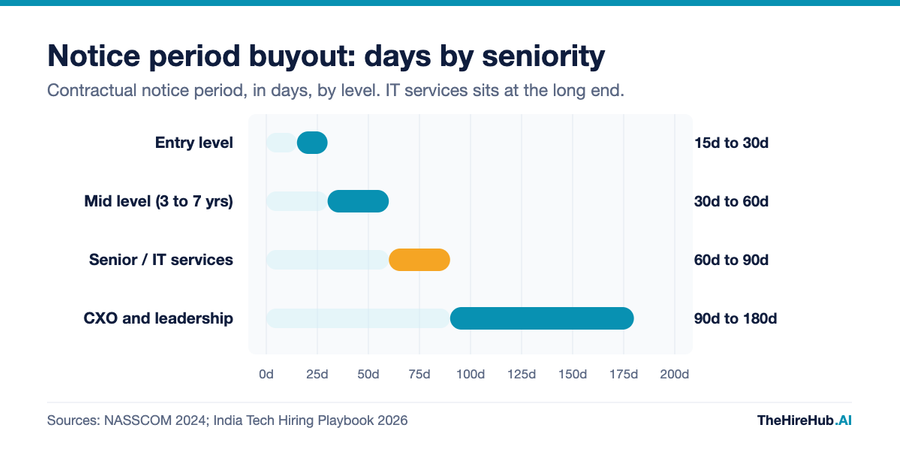
How to read this:
- The bar shows contractual notice, not what gets served. Assume a negotiated reduction of 30 to 50 percent is achievable in most private sector cases.
- Buyout cost scales with salary, not just days, so the same 90 days costs very different amounts at mid level and at CXO level.
- The employer on the other side is not obliged to accept a buyout. Many Indian IT firms explicitly reserve the right to refuse.
How it actually works, and where it breaks
Mechanically, a buyout is a recovery. The outgoing employer deducts the unserved amount from the candidate's full and final settlement, and if you have agreed to fund it, you reimburse the candidate once they produce proof of the deduction. That sequencing matters, because the candidate is out of pocket first.
The first failure mode is the refusal. A buyout clause in a contract gives the employee the option to request, not the right to demand. Several large Indian IT services firms treat acceptance as discretionary, and a candidate who has promised you a four week start on the assumption of a buyout can find themselves serving the full term.
The second is the tax surprise. A funded buyout is generally treated as taxable income in the candidate's hands, so reimbursing exactly the deducted amount can leave them short. Teams that discover this at the eleventh hour end up renegotiating the offer after it has been accepted, which is the worst possible moment.
The third is the one nobody budgets for. Funding a buyout is a real cash cost that belongs in your cost per hire, and if you are not tracking it there, your hiring economics are wrong. It is worth checking it against your cost per hire benchmarks rather than treating it as a one-off exception every time.
"A buyout clause is an option to ask, not a right to leave, and candidates discover the difference at the worst possible moment."
What this means for your team
The practical answer is to stop treating notice period as something you discover at the offer stage. It is a screening variable, and the teams that handle it well ask about it in the first conversation and price it in immediately.
The sequence below is where the decision actually sits. The important property is that every one of these five points is cheaper than the sixth option, which is losing the candidate and reopening the role.
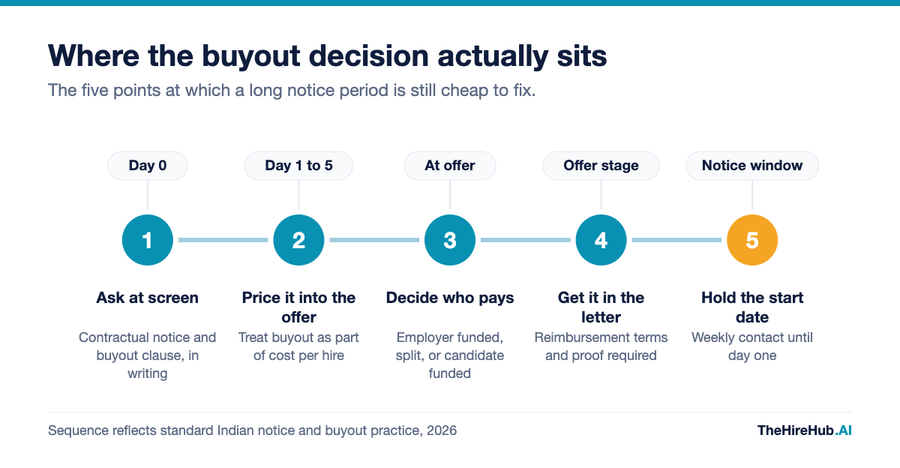
A few operating rules that hold up in practice:
- Ask for the contractual notice and the buyout clause in writing at the screen, not the candidate's recollection of it.
- Decide your funding position before you extend, so you are not inventing policy under time pressure.
- Put the reimbursement terms in the offer letter, including what proof you need and when you pay.
- Keep contact through the notice window. Candidates who hear from their future manager in the first week after accepting are meaningfully more likely to actually join.
- Resist adding interview rounds. Dropout climbs sharply once a process runs past three rounds, and a long notice compounds that.
Notice period buyout vs simply waiting it out
Waiting is a legitimate choice, and sometimes the right one. If the role is not blocking revenue, if you have interim cover, and if the candidate is genuinely committed, paying several lakh rupees to compress a start date is hard to justify.
The calculation flips when the role is a bottleneck. A vacant engineering lead position does not cost you the salary you are not paying, it costs you the output of everyone waiting on that person's decisions. Weighed against that, a one-time buyout often looks cheap, which is the same logic that makes time to hire benchmarks worth tracking in the first place. The honest comparison is buyout cost against the fully loaded cost of the role staying open, and most teams have never calculated the second number.
Run it once and the decision stops being contentious. Take a team of six engineers whose roadmap is gated on a lead who has not started: if that team costs you ₹40 lakh a quarter in salary and is running at perhaps 70 percent of its useful output without direction, the drag is somewhere near ₹12 lakh over a quarter. Against that, a ₹3.75 lakh buyout that recovers eight weeks is not an indulgence, it is a discount. The same sum looks completely different for a role with no dependencies behind it, which is why this has to be calculated per role rather than set as a blanket policy. Teams carrying more open roles than recruiters feel this most acutely, and the recruiter to hire ratio is usually the tell.
How to actually do this (and the four traps)
- Treat it as a screening question, not an offer-stage discovery. Ask for notice length and the buyout clause in the first call. A candidate on 90 days with a non-negotiable contract is a different hiring plan from one on 30 days, and you want to know at week zero.
- Do not promise a start date you do not control. The outgoing employer decides whether to accept a buyout. Commit to a start date only once the candidate has confirmation in writing, or commit to a range and communicate the uncertainty to the hiring manager.
- Gross up, or say clearly that you will not. A funded buyout is generally taxable to the candidate, so a rupee-for-rupee reimbursement leaves them out of pocket. Decide your position and write it into the offer, because renegotiating after acceptance damages trust at exactly the wrong time.
- Book it in cost per hire. A buyout is not a rounding error. Left out of your numbers, it makes expensive channels look cheap and quietly distorts every hiring decision that follows, which is the kind of thing structured hiring in India exists to prevent.
"Every week you spend arguing about a buyout is a week the role stays open, and that meter never stops running."
The one thing every hiring leader should take from this
The buyout is not really a payment, it is a price on your own urgency. Teams that know what an open role costs them per week make this decision in an afternoon, and teams that do not will argue about three lakh rupees while losing far more to a seat that stays empty for a quarter. Work out the weekly cost of the vacancy first, then the buyout question answers itself. If you want a second opinion on where your own process is leaking time, we look at this stuff all day.
Frequently Asked Questions
A notice period buyout is a payment that lets an employee leave before serving their full contractual notice. The unserved portion is calculated as a cash amount and usually recovered from the employee's full and final settlement, or reimbursed by the incoming employer.
Most Indian contracts use monthly CTC divided by 26, multiplied by the number of days left unserved. Some contracts use 30 as the divisor instead, treating it as calendar days, which lowers the amount. The figure is normally based on gross salary rather than take home pay.
Yes. A buyout clause gives the employee the right to request a buyout, not to demand one. Many large Indian IT services companies explicitly reserve discretion over whether to accept, so a shortened start date should never be treated as certain until it is confirmed in writing.
A buyout funded or reimbursed by a new employer is generally treated as taxable income in the employee's hands. That means a rupee-for-rupee reimbursement can leave the candidate short, so employers should decide in advance whether they will gross it up.
Traditionally the employee paid, through a deduction from their final settlement. In senior and in-demand roles it is now common for the incoming employer to fund or share the cost in order to bring the start date forward.
Entry level roles typically run 15 to 30 days, mid level roles 30 to 60 days, senior and IT services roles 60 to 90 days, and CXO or leadership contracts 90 to 180 days. NASSCOM data from 2024 found 67 percent of Indian IT companies mandate 90 days for experienced hires.
Often yes. Survey data from the platform Hush suggests around 90 percent of Indian employees on a three month notice manage to shorten it to between 30 and 45 days through negotiation, unused leave adjustment, or manager discretion.
Yes. LinkedIn India data from 2024 found that offer dropout rates for candidates on a 90 day notice were 35 percent higher than for candidates on a 30 day notice, because a longer gap gives competing offers more time to land.
It should. A funded buyout is a real cash outlay tied to a specific hire, and leaving it out of cost per hire makes some channels and roles look cheaper than they actually are.
No. In a buyout the employee leaves early and the unserved notice is paid for. On garden leave the employee stays on the payroll for the notice period but is asked not to attend work, which delays the start date rather than bringing it forward.

