Top AI Candidate Screening Tools in 2026 (Compared & Ranked)
AI candidate screening tools evaluate resumes 100x faster than manual review with 85-95% accuracy. We compared the top 10 platforms across AI depth, pricing, and integration — here are the results.
Compare the top 10 AI candidate screening tools for 2026. From resume parsing to predictive analytics — find the right platform to automate high-volume hiring and improve quality-of-hire.

10 Best AI Candidate Screening Tools & Software in 2026 (Tested & Ranked)
We tested 10 AI screening platforms across accuracy, pricing, and integration depth. Here's how they rank and how to choose the right one for your team.
AI candidate screening tools use machine learning and natural language processing to evaluate job applications automatically — scoring candidates against role requirements, ranking them by predicted fit, and producing shortlists in minutes instead of days.
The shift is massive: manual resume screening takes 23 hours per hire on average. AI screening reduces this to under 1 hour with higher accuracy. In 2026, 78% of large organizations use some form of AI screening, up from 45% in 2023.
This guide compares the top AI candidate screening tools, explains how they work, and helps you choose the right one for your team.
Best AI Candidate Screening Tools for India (2026)
Indian talent teams screen at a different scale and price point than US buyers, high application volumes from Naukri and campus drives, INR budgets, and a need for multi-language résumé handling (English + regional). Here's how the shortlist changes for India:
- TheHireHub.AI — Built for Indian mid-market teams (50–500 employees). Screening is part of an end-to-end agentic workflow (source → screen → schedule), with pricing from roughly ₹12,000/month. Strongest fit for volume hiring off Naukri/LinkedIn with explainable, bias-audited scoring.
- Zoho Recruit — India-headquartered, the most budget-friendly option (from ~₹2,000/user/month), solid résumé parsing and matching for smaller teams.
- Global enterprise tools (HireVue, Eightfold), powerful but priced and configured for large US enterprises; usually overkill for Indian SMB/mid-market budgets.
What to check for India specifically: INR (not USD) billing, résumé parsing accuracy on multi-column and mixed-language CVs, integration with Indian job boards, and NYC Law 144 / EU AI Act–grade bias auditing if you hire globally.
How AI Candidate Screening Actually Works
AI screening operates in three stages that together produce a ranked, explainable shortlist:
Stage 1: Parsing & Understanding. The AI extracts structured data from unstructured resumes — skills, experience, education, certifications, projects, and employment history. Unlike keyword-based ATS parsing, modern AI understands context: it knows "built a microservices architecture serving 10M users" signals senior-level distributed systems experience, even if the resume never uses the phrase "senior engineer."
Stage 2: Scoring & Ranking. Machine learning models score each candidate across multiple dimensions: skills match (hard and soft), experience depth and relevance, career trajectory alignment, education relevance, and predicted culture fit. Each dimension is weighted based on what has historically predicted success in similar roles. The output is a composite "fit score" — not a binary yes/no.
Stage 3: Explainable Recommendations. The best AI screening tools show recruiters why a candidate scored high or low. This transparency is critical for trust, compliance, and decision quality. You see the reasoning, not just a number.
AI Screening vs Manual Screening vs Keyword ATS
Comparison of Manual Screening and Keyword ATS and AI Screening:
- Speed: Manual Screening 6-8 min per resume; Keyword ATS 1-2 sec (binary filter); AI Screening 1-2 sec (scored ranking)
- Accuracy: Manual Screening 60-70% (fatigue, bias); Keyword ATS 40-50% (misses synonyms); AI Screening 85-95% (contextual understanding)
- Consistency: Manual Screening Varies by reviewer and time of day; Keyword ATS Consistent but crude; AI Screening Consistent and nuanced
- Bias Risk: Manual Screening High (unconscious bias); Keyword ATS Medium (keyword bias); AI Screening Low (auditable, correctable)
- Candidate Volume: Manual Screening 50-100/day per recruiter; Keyword ATS Unlimited (but crude); AI Screening Unlimited (with quality)
- Synonym Handling: Manual Screening Human judgment (inconsistent); Keyword ATS Misses different terminology; AI Screening Understands skill equivalence
- Explainability: Manual Screening "I liked this candidate"; Keyword ATS Pass/fail on keywords; AI Screening Scored dimensions with reasoning
- Learning: Manual Screening Experience-based (slow); Keyword ATS Static rules; AI Screening Improves with every hiring outcome
- Cost per Screen: Manual Screening $3-5 per resume; Keyword ATS $0.10-0.50 per resume; AI Screening $0.50-2.00 per resume
Top 10 AI Candidate Screening Tools (2026)
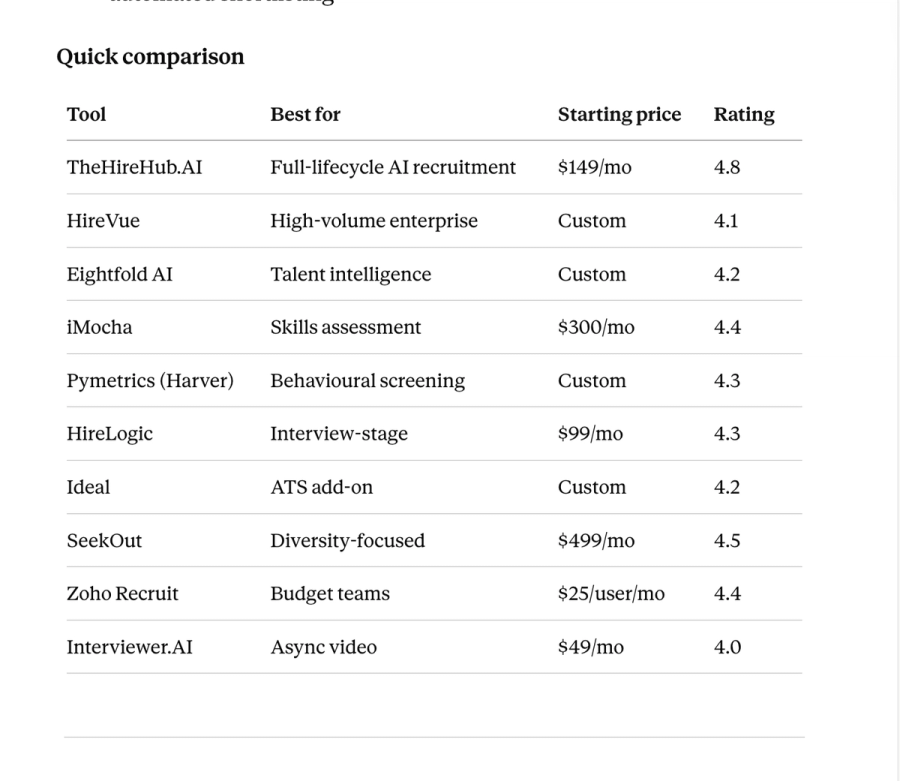
Here are the leading platforms, evaluated across AI screening depth, integration ecosystem, pricing, and user ratings:
1. TheHireHub.AI
- Best for: Full-lifecycle AI recruitment (screening + sourcing + scheduling)
- AI screening: Predictive scoring against historical success profiles, explainable rankings, skills adjacency detection, bias auditing
- Pricing: From $149/month
-.
- Standout: Screening is part of end-to-end agentic AI — not a standalone feature
2. HireVue
- Best for: High-volume enterprise screening
- AI screening: Video interview analysis, game-based assessments, structured evaluation
- Pricing: Custom (enterprise)
-.
- Standout: Game-based assessments for early-career roles
3. Eightfold AI
- Best for: Enterprise talent intelligence
- AI screening: Skills inference, potential scoring, internal mobility matching
- Pricing: Custom
-.
- Standout: Skills-first approach that looks beyond resume keywords
4. iMocha
- Best for: Skills assessment + screening
- AI screening: 3,000+ skill assessments, AI-proctored testing, role-fit scoring
- Pricing: From $300/month
-.
- Standout: Strongest assessment library for technical roles
5. Pymetrics (Harver)
- Best for: Behavioral and cognitive screening
- AI screening: Neuroscience-based games, soft-skill assessment, bias-audited algorithms
- Pricing: Custom
-.
- Standout: Measures cognitive and emotional traits, not just hard skills
6. HireLogic
- Best for: Interview-stage screening
- AI screening: Real-time interview analysis, skill assessment from conversations, post-interview scoring
- Pricing: From $99/month
-.
- Standout: Screens during interviews, not just at application stage
7. Ideal (by Ceridian)
- Best for: ATS-integrated AI screening
- AI screening: Resume screening, candidate matching, automated shortlisting within existing ATS
- Pricing: Custom
-.
- Standout: Works as an add-on to your existing ATS
8. SeekOut
- Best for: Diversity-focused screening
- AI screening: AI matching with diversity analytics, technical talent scoring, GitHub/patent data
- Pricing: From $499/month
-.
- Standout: Diversity filters with compliance-safe analytics
9. Zoho Recruit
- Best for: Budget-conscious teams
- AI screening: Resume parsing, candidate matching, workflow-based screening automation
- Pricing: From $25/user/month
-.
- Standout: Most affordable AI screening with reasonable depth
10. Interviewer.AI
- Best for: Async video screening
- AI screening: Pre-recorded video interview evaluation, sentiment analysis, automated shortlisting
- Pricing: From $49/month
-.
- Standout: Screen candidates through video without live interviews
How to Choose an AI Screening Tool
The right choice depends on three factors:
Your screening bottleneck. If you get 500+ applications per role, you need enterprise-grade screening (HireVue, Eightfold). If you get 50-200, a mid-market tool like TheHireHub.AI or iMocha delivers more value per dollar.
Standalone vs integrated. Do you want screening as a feature within a full recruitment platform, or as a bolt-on to your existing ATS? Full platforms (TheHireHub.AI, Eightfold) offer more value. Bolt-ons (Ideal, HireLogic) offer faster implementation.
What you are screening for. Hard skills and experience? Choose resume-focused tools. Soft skills and cognitive ability? Look at Pymetrics/Harver. Technical competency? iMocha. Full-spectrum screening? TheHireHub.AI or Eightfold.
The ROI of AI Candidate Screening
For a company processing 5,000 applications per year:
- Manual screening cost: 5,000 x 7 min x $30/hr = $17,500/year in recruiter time
- AI screening cost: $2,000-6,000/year (platform subscription)
- Time saved: 580+ hours/year
- Quality improvement: 25-40% better shortlist accuracy
- Net ROI: $11,500-15,500/year in direct savings, plus faster hires and better quality
The real ROI multiplier: AI screening does not get tired at 4pm, does not have unconscious bias about names, and applies the same standard to application #1 and application #5,000.
Stop scrolling resumes. Start hiring.
TheHireHub's AI hands you pre-screened, ready-to-interview candidates in hours, no agency fees, no signup gauntlet.
TheHireHub automates much of this end to end. See the AI recruitment platform and review plans and pricing.
Secure Your Competitive Edge with TheHireHub.ai
By harnessing AI through TheHireHub.ai, HR leaders can eliminate the pain of losing top talent, slash time-to-fill and vacancy costs, and drive organizational success. Visit thehirehub.ai today to schedule a demo and experience 70% faster hiring tailored to your needs. Transform recruitment from a cost center into a strategic advantage—start now.
Stop scrolling resumes. Start hiring.
TheHireHub's AI hands you pre-screened, ready-to-interview candidates in hours, no agency fees, no signup gauntlet.
Curious how this works inside a real product? Explore TheHireHub’s agentic AI recruiting and see how it compares.
Ready to automate your hiring?
TheHireHub's AiRA agent handles sourcing, screening, and scheduling autonomously. See it in action.
Frequently Asked Questions
AI candidate screening tools are software platforms that use machine learning and NLP to automatically evaluate job applications — parsing resumes, scoring candidates against role requirements, ranking them by predicted fit, and producing explainable shortlists. They replace or augment manual resume review with data-driven, consistent, scalable screening.
Modern AI screening tools achieve 85-95% accuracy in identifying qualified candidates, compared to 60-70% for manual screening and 40-50% for keyword-based ATS filtering. Accuracy improves over time as the system learns from your specific hiring outcomes.
AI screening significantly reduces bias when properly implemented — it evaluates substance over formatting, applies consistent criteria, and can be audited for fairness. However, it can inherit biases from historical data. Choose platforms with built-in bias detection, demographic parity monitoring, and regular algorithmic audits.
Yes. Most AI screening platforms integrate with major ATS systems (Greenhouse, Lever, Workday, iCIMS, SmartRecruiters) via native integrations or APIs. Some operate as add-ons within your existing ATS, while others are standalone platforms that sync screening results back to your system.
Pricing ranges from $25/user/month (Zoho Recruit) to custom enterprise pricing ($50,000+/year for Eightfold or HireVue). Mid-market solutions like TheHireHub.AI start at $149/month. The ROI typically exceeds cost within the first month for teams screening 100+ applications per month.
AI screening evaluates candidates who have already applied or been identified — scoring and ranking them against role requirements. AI sourcing proactively finds candidates across job boards, LinkedIn, and databases before they apply. Many platforms (TheHireHub.AI, hireEZ, SeekOut) offer both capabilities.
AI screening is legal in most jurisdictions, but regulations are evolving. The EU AI Act classifies hiring AI as "high-risk" requiring transparency and auditing. New York City Local Law 144 requires annual bias audits for automated hiring tools. Illinois AIPA requires consent for AI-analyzed video interviews. Choose platforms with built-in compliance features and stay current with local regulations.
Cloud-based AI screening tools can be operational in 1-2 weeks. Enterprise implementations with custom integrations and model training take 1-3 months. Most platforms offer free trials or pilot programs so you can test screening quality before committing.
It depends on scale:
Enterprise high-volume → HireVue or Eightfold;
Mid-market full-lifecycle → TheHireHub.AI;
Budget teams → Zoho Recruit.
Match the tool to your application volume and whether you want a standalone platform or an ATS add-on.


