
15 Best Recruiting Platforms for Sourcing and Screening in 2026: Prices, Fit and What to Avoid
Fifteen sourcing, screening and scheduling tools grouped by the job they do, with published or observed prices and the claims we could not verify.
Fifteen recruiting platforms for sourcing and screening, grouped by job, with real prices from $99 a month to $15,000 a seat and the vendor claims we could not verify.

- 1TL;DR
- 2What is actually happening
- 3The numbers
- 4How it actually works, and where it breaks
- 5The 15 best recruiting platforms for sourcing and screening
- 6What this means for your team
- 7Unified platform vs point tools
- 8How to actually do this (and the four traps)
- 9The one thing every hiring leader should take from this
TL;DR
The best recruiting platforms for sourcing and screening in 2026 split into four jobs: full-lifecycle suites, sourcing specialists, screening and assessment tools, and scheduling tools. Published per-seat prices run from $99 a month for self-serve sourcing tools to $3,000 to $15,000 a year for enterprise sourcing seats, and most suites do not publish prices at all. The vendor lists you will find elsewhere rank the author first and cite nothing. This one ranks by what each tool is actually for, flags what we could not verify, and lists one tool that shut down last month. If you want the cost side in depth, read our guide to AI recruiting software cost.
What is actually happening
The category is consolidating fast. Fetcher, a sourcing tool that appeared on most 2025 lists, sold its intellectual property to Juicebox on 6 October 2026 and retired its platform on 16 October, giving customers two weeks to export data. Any list that still recommends it was written from memory.
The suites are moving into one another's territory. ATS vendors now sell sourcing and AI screening, sourcing tools now sell CRMs and scheduling, and scheduling tools now sell interview intelligence. The practical result is that "best platform" is a category question before it is a brand question. Decide which job you are buying for, then compare the three or four tools that actually do that job.
Pricing transparency is now a real differentiator. Juicebox, Pin and Gem's startup plan publish prices on their sites. SeekOut, hireEZ, Eightfold, Paradox, HireVue, GoodTime and most of the enterprise tier do not, so the figures you see in comparison posts are usually third-party estimates from procurement marketplaces like Vendr or from competitors' blogs. We say which is which below.
The legal weather has changed too. In January 2026 a proposed class action was filed against Eightfold AI, arguing that its AI candidate rankings are consumer reports under the US Fair Credit Reporting Act and that applicants were never told the reports existed. Whether or not that theory succeeds, every screening vendor on this list now gets asked the same question in procurement, and the ones with a clear answer are easier to buy.
The numbers
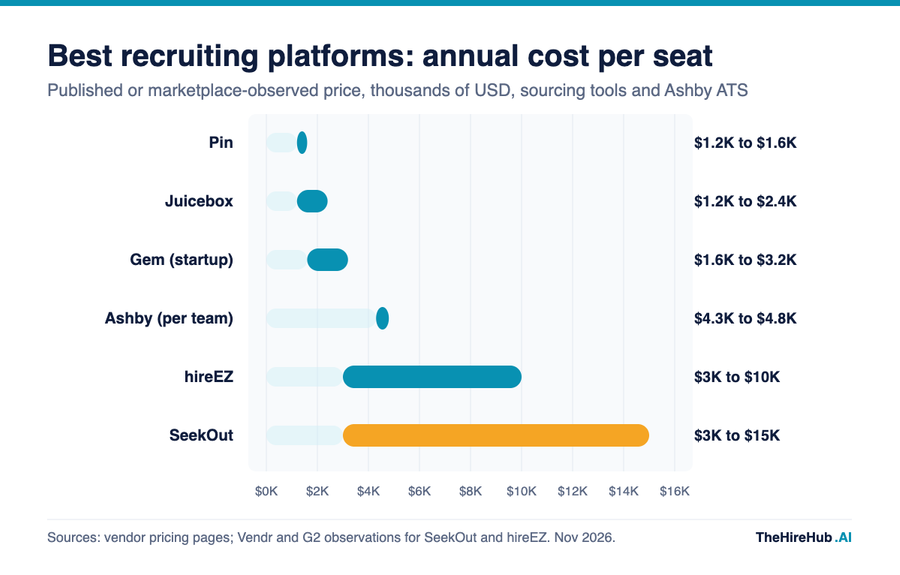
The chart shows annual cost per seat where a price is either published by the vendor or observed by a procurement marketplace. Ashby is the exception: its $400 a month Foundations plan is priced per company rather than per seat, so we show it as a single-team cost.
How to read this:
- Self-serve sourcing tools (Juicebox, Pin, Gem's startup plan) cluster at $1,200 to $3,200 a year per seat, and all three offer a free or trial tier, so the cost of a two-week pilot is close to zero.
- Enterprise sourcing seats (hireEZ, SeekOut) run $3,000 to $15,000 a year per seat on annual contracts, and the top of that range is a negotiation outcome rather than a list price.
- Everything else on this list is "contact sales," which in practice means a floor of $15,000 to $20,000 a year and a price that depends on how many candidates or employees you have.
How it actually works, and where it breaks
Every tool here does some combination of four things: find people (search across a profile database and enrich contact data), rank them (match against a job description or a skills model), talk to them (outreach sequences, chat assistants, AI interviews), and move them (scheduling, ATS sync, offer). The AI layer sits on top of each step and promises to do the first pass so a recruiter does the second.
The first failure mode is data quality. A sourcing tool is only as good as its profile database and its contact-finding rate, and both vary by country and by function. Pilot on your real requisitions in your real markets, because a tool that is strong for US software engineers can be weak for sales hires in Southeast Asia.
The second is ranking you cannot explain. If a tool scores candidates and you cannot see why, you cannot defend a rejection to a candidate, a regulator or your own hiring manager. Ask for the ranking rationale in the demo, and look at the bottom of the list as closely as the top, which is the point of our piece on AI screening false negatives.
The third is the integration tax. A sourcing tool that writes to your ATS, a scheduler that reads your calendars and an assessment tool that pushes scores back all need two-way sync that actually works. Half the "platform" cost in a real deployment is the time spent getting three vendors' integrations to agree on a candidate record.
"A platform list written by a vendor is a shortlist with the author at the top, not a ranking."
The 15 best recruiting platforms for sourcing and screening
Grouped by the job they do, not by rank. Prices are vendor-published unless marked as observed or estimated.
Full-lifecycle suites
1. Findem. Talent intelligence platform that claims to combine sourcing, screening, scheduling and workforce planning on a single data layer. Best for enterprise TA teams that want one vendor and one data model. Pricing is not published. Its own content ranks it first in the category, so treat its benchmark claims as marketing until you have seen them on your data.
2. Eightfold AI. Skills-based talent intelligence for large enterprises, strongest on internal mobility and workforce planning. Pricing is not published. The January 2026 FCRA class action is unresolved, and a buyer should ask directly how candidate rankings are disclosed to applicants.
3. Paradox (Olivia). Conversational AI that screens, schedules and answers candidate questions over chat and text, built for high-volume hourly and retail hiring. Pricing is not published, and the site segments by enterprise, mid-market and franchise rather than by plan. Less relevant for low-volume professional hiring.
4. TurboHire. Recruitment automation from sourcing to offer with configurable workflows, popular with mid-market teams in India and the Middle East. Pricing is not published. Strongest where you want workflow automation on top of an existing process rather than a new data model.
5. TheHireHub.AI. Agent-based platform for teams of roughly 50 to 500 that bundles sourcing, AI screening, AI interviews and scheduling, sold per job slot rather than per seat. Pricing starts at about $110 per job slot pay-as-you-go (published in INR), with a seven-day trial. It is our product, so weigh our description accordingly: it is not the right fit for enterprises that need a full workforce-planning layer.
Sourcing specialists
6. SeekOut. Deep sourcing for technical and hard-to-fill roles, with enrichment from sources such as GitHub and patents. Pricing is not published; Vendr observes a median of about $20,000 a year and per-seat annual costs of $3,000 to $15,000. The right choice when the search itself is the hard part.
7. hireEZ. Outbound sourcing with engagement sequences and analytics, suited to agency and corporate teams that run outreach at volume. Pricing is not published; third-party estimates put entry seats at roughly $169 to $250 a month on annual contracts and most deals at $6,600 to $25,000 a year.
8. Gem. Recruiting CRM with AI sourcing across 800M+ profiles, sequences, scheduling and analytics, available as a layer on your ATS or as an all-in-one. Enterprise pricing is based on employee count and not published. The published startup plan is $130 a month on annual billing for companies under 10 people, and companies under 30 get six months free.
9. Pin. Self-serve sourcing with a large profile network and a free mode that includes two active jobs and 20 lookup credits a month. Paid plans start at $99 a month billed annually and run to about $1,620 a year per seat on Professional. Strong for small teams; weaker on ATS integration at the free and solo tiers.
10. Juicebox (PeopleGPT). Natural-language candidate search that now holds Fetcher's assets. Free plan with limited searches, Starter at $99 to $119 a month, Growth at $179 to $199 a month per seat, and a Business tier on annual contract. A sensible replacement for Fetcher customers, but expect to rebuild sequences rather than import them.
Screening and assessment
11. HireVue. On-demand video interviewing and assessments at scale, widely used by large employers for first-round screening. Pricing is not published. Mature on compliance documentation, which matters more in 2026 than it did in 2024.
12. Sapia.ai. Chat-based structured interview that scores role-relevant traits from written answers rather than video. Pricing is not published. Better candidate experience for high-volume roles than video; less proven for senior hiring.
13. Ezra. AI-conducted screening interviews that produce a structured summary per candidate. Pricing is not published. It does one thing and needs to sit next to a sourcing tool and a scheduler, so budget for the integration work.
Scheduling and coordination
14. GoodTime. Interview scheduling for complex multi-interviewer panels, priced on candidates per year rather than seats, with all ATS integrations included. Pricing is not published. The right buy once you have more than one coordinator and interviewer loops longer than two rounds.
15. Ashby. Modern ATS with strong analytics and built-in scheduling, now with AI features. The Foundations plan is published at $400 a month per company with a 10% discount for annual billing, and there is a free plan for companies under 10 employees. The best-value ATS on this list for a startup that wants analytics without an add-on.
What this means for your team
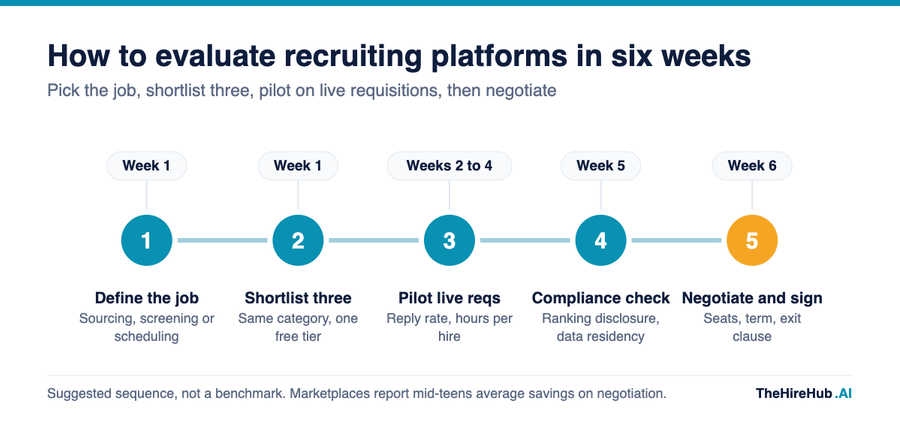
Do not evaluate 15 tools. Pick the job, shortlist three, and pilot on live requisitions for three weeks. The sequence below is how we see the best teams run it, and it works for a suite or a point tool.
- Write the job before the RFP. Decide whether you are buying for sourcing, screening, scheduling or all three, and name the two or three roles you will test on.
- Shortlist by category, not by list rank. Three tools from the same group above, including at least one with a free or trial tier.
- Pilot on live requisitions. Measure contact-find rate, reply rate and recruiter hours per qualified candidate, which is the method in our recruitment automation ROI guide.
- Run the compliance check before procurement. Ask how rankings are explained, what applicants are told, and where data is stored.
- Negotiate on seats and term. Every enterprise price on this list is negotiable; procurement marketplaces report average savings in the mid-teens.
Unified platform vs point tools
The suite pitch is one vendor, one candidate record and one invoice. The point-tool pitch is best-in-class at each step and the freedom to swap one without re-platforming. For teams under about 200 employees, the point-tool route usually wins because the free tiers let you try before you pay and the integration surface is small. Above that, the suite route starts to pay off because the integration tax grows faster than the licence cost.
A good test is to count how many systems a single candidate record passes through today. If the answer is more than three, a suite or a sourcing-plus-ATS pairing like Gem on Ashby is worth the migration. Our comparison of ATS vs AI recruiting software goes through the boundary in more detail, and our AI sourcing tools comparison covers the sourcing group head to head.
How to actually do this (and the four traps)
- Trusting a vendor's own ranking. Most "best platforms" posts are written by a vendor on the list, and the vendor is always number one. Read the methodology, if there is one, and check the publish date against the facts: a list that recommends Fetcher after October 2026 has not been maintained.
- Buying on a demo database. Demos run on curated data in the vendor's strongest market. Insist on a pilot with your requisitions, your geographies and your ATS connected, and check the integration setup guide in our recruitment platforms ATS integration guide before the pilot starts.
- Ignoring how rankings reach candidates. The Eightfold case turns on whether applicants knew a score existed. Whatever the outcome, decide now what you will tell candidates about automated screening and pick tools that make that easy.
- Paying enterprise prices for a startup problem. A five-person team does not need a $20,000 sourcing contract. Juicebox, Pin, Gem's startup plan and Ashby's free tier cover most of what a small team needs for under $5,000 a year.
"Buy for the job you have, prove it on your own requisitions, and insist the tool can explain itself."
The one thing every hiring leader should take from this
The best recruiting platform is the one that solves the job you actually have, proves it on your own requisitions, and can explain its decisions to a candidate. Rankings written by vendors, including this one, are a starting shortlist and nothing more. Pick the category, pilot three tools, measure recruiter hours per qualified candidate, and ask the compliance question before you sign. If you want a second opinion on your shortlist, we look at this stuff all day.
Frequently Asked Questions
It depends on volume and budget. For small teams, Juicebox, Pin and Gem's startup plan publish prices from $99 to $130 a month and offer free tiers. For enterprise technical hiring, SeekOut and hireEZ are the specialist choices, at observed costs of $3,000 to $15,000 a year per seat.
Self-serve sourcing tools cost $1,200 to $3,200 a year per seat. Enterprise sourcing seats run $3,000 to $15,000 a year. Most full-lifecycle suites and screening tools do not publish prices and typically start around $15,000 to $20,000 a year.
Juicebox, Pin, Gem's startup plan, Ashby's Foundations plan and TheHireHub's pay-as-you-go job slot are published on vendor sites. SeekOut, hireEZ, Findem, Eightfold, Paradox, HireVue, Sapia, Ezra and GoodTime require a sales conversation.
No. Fetcher sold its intellectual property to Juicebox in October 2026 and retired its platform on 16 October 2026. Former customers were offered a transition to Juicebox, and remaining account data was scheduled for deletion after 19 November 2026.
A sourcing tool finds and contacts people who have not applied. An ATS manages people who have. Some platforms now do both, but most teams still pair a sourcing tool with an ATS through a two-way integration.
Ask how candidate rankings are generated, whether applicants are told a score exists, whether they can see or dispute it, and where data is stored. The 2026 class action against Eightfold AI argues that undisclosed AI rankings are consumer reports under the US Fair Credit Reporting Act.
Usually not. Below about 200 employees, point tools with free tiers cover sourcing, screening and scheduling for under $5,000 a year, and the integration surface is small. Suites start to pay off when a candidate record passes through more than three systems.
Three weeks on two or three live requisitions is enough to measure contact-find rate, reply rate and recruiter hours per qualified candidate. Pilot in your real markets, because sourcing data quality varies by country and function.
Treat them as a shortlist. Most are written by a vendor on the list, rank the author first, and rarely cite sources. Check the publish date and whether retired tools still appear, then verify claims on your own data.

