
WhatsApp Recruitment Automation in India: Costs, Consent and Where It Breaks (2026)
What Meta charges per message, what India's data protection rules require, and the failure modes that cost you candidates.
WhatsApp recruitment automation costs a few rupees per thousand messages. Here is the rate math, the consent rules and the failure modes that leak candidates.

TL;DR
WhatsApp recruitment automation is cheaper than most hiring teams expect, and the money is rarely the problem. On Meta's India rate card as reported by business solution providers in October 2026, a utility template costs about ₹0.115 and a marketing template about ₹0.86 per delivered message before 18% GST, and replies inside the 24-hour window are free. The real constraints are consent under India's new data protection rules, template approval, and what happens when a human is needed and the automation does not know it. If you screen at volume, pair it with a clear plan for high-volume screening rather than just bolting a bot onto your inbox.
What is actually happening
Candidates in India already live on WhatsApp, and recruiters have used it informally for years: a personal number, a copied job description, a screenshot of a resume. What has changed is that teams now run it as a proper channel through the WhatsApp Business Platform, with approved message templates, structured screening questions, and scheduling links. The shift is from a recruiter typing the same message forty times to a flow that asks the same five questions of everyone and logs the answers.
The mechanics matter because they decide your costs. Since 1 July 2025, Meta bills per delivered template message instead of per 24-hour conversation. Templates fall into marketing, utility and authentication categories, and free-form messages are only allowed inside a customer service window that opens when the candidate writes to you and lasts 24 hours.
There is also a 72-hour free window when a candidate reaches you through a click-to-WhatsApp ad or a Facebook Page button and you reply within 24 hours. For a team running paid job ads for frontline or sales roles, that window is the cheapest way to start a conversation. For everyone else, the first message to a cold candidate is a paid template.
Most teams use a business solution provider (BSP) to access the platform, and the BSP adds its own monthly subscription and sometimes a per-message markup on top of Meta's rate. That means the number on your invoice is not the number on Meta's rate card. Ask for both figures before you sign anything.
Adoption is uneven. Mature use cases are interview reminders, document collection and first-round screening for high-volume roles. Weaker use cases are senior hiring and anything where the candidate expects a considered conversation rather than a quick form.
The numbers
The rates below are Meta's INR rates as reported by a BSP-side source dated 11 October 2026, so check Meta's downloadable rate card before budgeting. Marketing templates are ₹0.8631 per delivered message, and utility and authentication templates are ₹0.1150, all excluding 18% GST. With GST, that works out to roughly ₹1.02 and ₹0.14. Meta can only change rates on 1 January, 1 April, 1 July or 1 October, which at least makes them predictable.
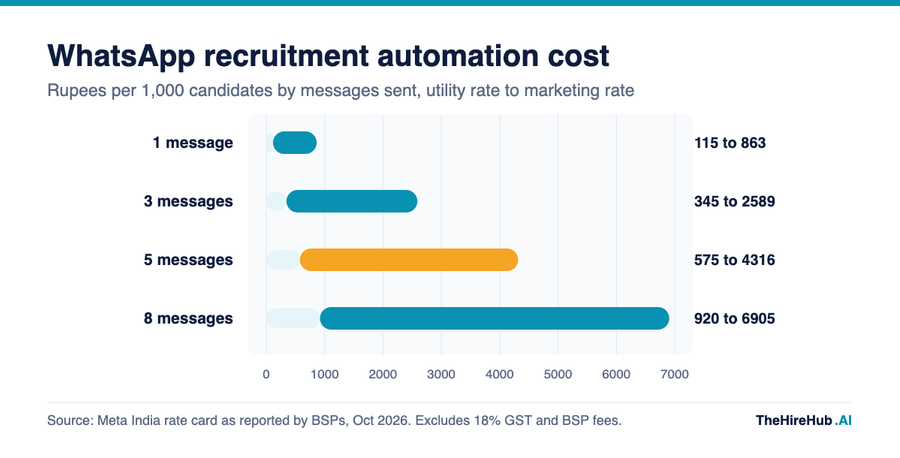
The chart multiplies those rates across a realistic range. The low end assumes every message is priced as utility, and the high end assumes every message is priced as marketing. Where your flow actually lands depends on how Meta categorises your templates, which you do not fully control.
One cost sits outside the rate card altogether, which is the recruiter time you save or waste. A screening flow that lets one recruiter handle three or four times as many first conversations changes the economics far more than a few paise per message. Measure it on your own funnel for a month before you believe any vendor deck, including ours.
How to read this:
- A five-message flow (invite, three screening nudges, one reminder) costs between ₹575 and ₹4,316 per 1,000 candidates before GST and BSP fees, which is small next to recruiter time.
- The spread between the low and high ends grows with every message, so template category discipline matters more as your flow gets longer.
- Replies inside the 24-hour window are free, so a flow that gets the candidate to write first is cheaper than one that pushes templates.
How it actually works, and where it breaks
A typical flow starts with an approved template, such as a role invite with a button. When the candidate replies, a 24-hour window opens, and the system can ask screening questions in free-form text, collect a resume, and offer interview slots. Answers are scored against rules or a model, and a recruiter sees a shortlist rather than a thread of chat.
The first failure mode is category drift. You can write a template you believe is a utility message, and Meta can classify it as marketing, which changes its price and, in some cases, how many people you can reach. Treat the category as something Meta decides, not something you declare.
The second is the closing window. A candidate who answers question three on Monday evening and question four on Wednesday has fallen outside the 24-hour window, and your flow now needs a paid template to continue. Flows that assume a patient, continuous conversation leak candidates here, and the leak is invisible unless you look for it.
The third is quality of judgement. A form-based screen works well for factual criteria such as notice period, location, shift availability and salary expectations. It works badly when a candidate's answer is nuanced, sarcastic, in a mixed language, or simply a voice note. Reading those is a human job, and a good flow knows when to hand off. Our piece on human-in-the-loop hiring covers where that handoff belongs.
A fourth issue is opt-out handling. A candidate who replies STOP or blocks the number expects that to stick across every role and every recruiter. If your tooling keeps separate lists per job, you will message people who asked not to be contacted, and Meta tracks those signals when deciding how much you can send.
"Automation should rank and route candidates, but a person should own every decision that closes a door."
What this means for your team
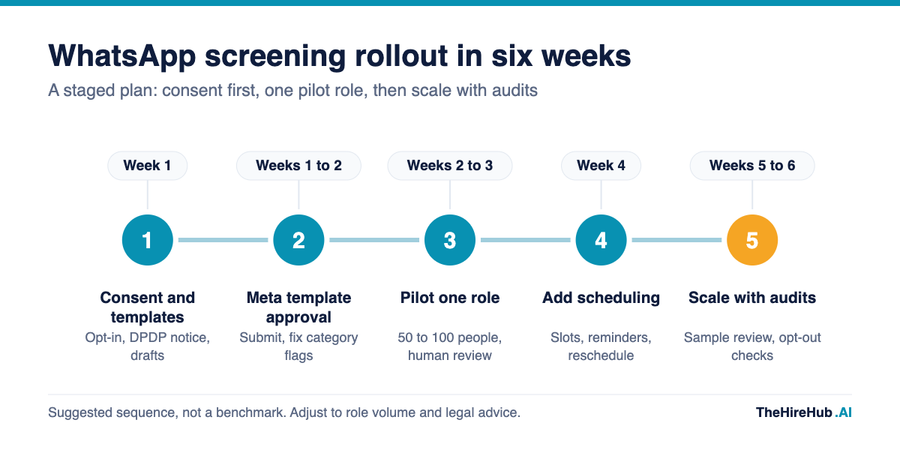
The sequence below works for most teams, and the order matters more than the speed. Start with the legal and message layer before you build a single question.
Start small and boring. The teams that get value from this channel in the first quarter are the ones that automate reminders and document collection before they automate any judgement.
- Define consent first. Write the opt-in wording, decide where candidates see it, and keep a record of when and how each person agreed.
- Draft and submit templates. Keep each one single-purpose and plain, and expect at least one to be recategorised or rejected on the first pass.
- Pilot one role. Run 50 to 100 candidates through the flow while a recruiter reads every score and compares it with their own judgement.
- Add scheduling and reminders. This is usually where the cheapest wins sit, because reminders reduce interview no-shows without any scoring risk.
- Scale with audits. Review a weekly sample of rejected candidates, check opt-out handling, and track cost per completed screen rather than cost per message.
The six-week shape above is a suggestion, not a benchmark. A team hiring 30 delivery executives a week can compress it, and a team hiring a handful of analysts a month probably should not bother with the channel at all.
WhatsApp recruitment automation vs the alternative
The nearest neighbour is the channel you already use: email, a job portal inbox and phone calls. Email is cheap and formal but easy to ignore. Phone calls are rich but do not scale, and candidates often decline unknown numbers. WhatsApp sits between them, with a low-friction reply and a record you can search.
Cost is the other axis. Email costs almost nothing per message but returns little signal, while a recruiter phone call costs minutes you cannot get back. WhatsApp sits at a few rupees per thousand messages plus a platform fee, and its real saving is the callbacks and chasers it removes. That saving only shows up if candidates actually answer, so test response on one role before you extrapolate.
It is not a replacement for a proper applicant tracking and screening layer. The chat channel collects and moves information, and the system behind it decides what to do with it. If you are also weighing wider tooling, our recruitment automation ROI guide shows how to judge payback across channels instead of arguing for one.
How to actually do this (and the four traps)
- Treating consent as a footer. India's Digital Personal Data Protection Rules were notified on 14 November 2025 with an 18-month phased compliance period, and they require a clear, separate notice explaining the purpose of collection. Penalties for failing to keep reasonable security safeguards can reach ₹250 crore. Build consent into the first message, and read our note on recruitment data privacy before launch.
- Optimising cost per message. The cheapest flow is not the best flow. Measure cost per completed and qualified screen, because a ₹0.115 message that nobody answers is more expensive than a ₹0.86 one that gets a reply.
- Letting the bot reject. Automation should rank and route, and a person should own rejections, especially for borderline answers. A silent auto-reject based on one badly parsed reply is how good candidates disappear.
- Ignoring the silence afterwards. A fast first message followed by weeks of nothing is worse than no message at all. Set a rule for status updates, and link it to your approach to candidate ghosting.
"The cheapest message is the one nobody answers, so measure cost per qualified screen instead."
The one thing every hiring leader should take from this
WhatsApp is a good channel for speed and a poor substitute for judgement. Use it to ask the factual questions, book the slots and send the reminders, and keep a human on every decision that changes someone's career. Get consent right on day one, measure the cost of a completed screen, and review what the system rejects every week. Hiring leaders sometimes ask whether this is the future of recruitment or a passing channel. The honest answer is that the channel will change and the discipline will not: ask for consent, keep messages useful, price them properly, and put a person where judgement is needed. A team that does those four things can move to the next channel without rebuilding its process.
If you want to pressure test your flow or your template plan, we look at this stuff all day.
Frequently Asked Questions
On Meta's India rate card as reported by business solution providers in October 2026, a utility template costs about ₹0.115 and a marketing template about ₹0.86 per delivered message, before 18% GST. Your provider adds its own subscription and sometimes a per-message markup, so ask for both figures.
Messages you send inside a 24-hour customer service window are free. The window opens when the candidate messages you and closes 24 hours after their last message. Outside it, you need a paid template.
If a candidate reaches you through a click-to-WhatsApp ad or a Facebook Page button and you reply within 24 hours, Meta opens a 72-hour window in which all message types are free.
Yes. India's Digital Personal Data Protection Rules, notified on 14 November 2025, require a clear notice that explains the purpose of collection, and the compliance period is phased over 18 months. Build consent into the first message and keep a record of it.
It can collect factual answers such as location, notice period and shift availability, and rank candidates. A recruiter should still review borderline cases and own every rejection, because forms handle nuance, mixed languages and voice notes poorly.
Meta decides a template's category, not you. Promotional wording in a message you meant as a utility update can be recategorised as marketing, which changes its price. Keep each template single-purpose and plain.
Keep it short enough that a candidate can finish inside one 24-hour window, usually five to eight plain questions. Longer flows leak candidates when the window closes and a paid template is needed to continue.
It usually gets a faster, lower-friction reply, but it is not a replacement for email or phone for senior roles. Test response on one role before you extrapolate to your whole funnel.
Track cost per completed and qualified screen, completion rate by step, window-expiry drop-off, opt-out rate and the share of rejections a recruiter overturns on review. Cost per message alone is a misleading number.

