Candidate Ghosting in 2026: Where Hiring Teams Actually Lose People, and What Closes the Gap
The stage where ghosting is costliest isn't the interview, it's the ten days after someone accepts your offer.
Interview no-shows get the headlines, but offer-to-joining is where candidate ghosting actually costs hiring teams the most. Here is what the 2026 data shows.

TL;DR
Candidate ghosting isn't rising because job seekers got ruder. It's rising because the average hiring process now has more silent gaps than a candidate is willing to sit through, and the costliest gap sits after they've already said yes. In the LHH 2026 TA survey, 39 to 60% of hiring teams reported candidates failing to show for scheduled interviews, and separate India data puts offer-to-joining dropout at 44%, nearly double the roughly 22% global rate for new hires who accept and then never appear on day one. The fix isn't a sterner follow-up email, it's closing the response-time gap at each stage, which is exactly where recruitment automation earns its budget line. For the stage that gets the most attention but costs the least, see our breakdown of interview no-shows.
What is actually happening
Ghosting used to mean a candidate skipping one interview. In 2026 hiring teams use it for a longer list: no-shows for scheduled calls, silence mid-process after multiple rounds, and, most expensively, an accepted offer that never turns into a first day. A Censuswide survey of 500 US HR and talent acquisition professionals run for LHH in June and July 2026 found 60% had seen candidates fail to show for scheduled interviews, and 39% had candidates vanish mid-process after the team had already invested real time. SHRM's 2025 Talent Trends Report put mid-process dropout at 41%, close enough to LHH's number that this isn't a one-survey anomaly.
It also goes both ways, and that matters for how you read the data. Indeed's original ghosting research, still the most cited baseline in this space, found candidates admit to ghosting employers at rates comparable to or higher than employers ghosting candidates, and both sides say the other started it. Job seekers report that unclear timelines, no feedback after interviews, and lowball or late offers are the top reasons they go quiet. Recruiters report that the volume of AI-generated and mass-submitted applications makes it harder to tell a serious candidate from a warm body, so response time to any single applicant naturally slips.
India shows a sharper version of the same pattern. AceNgage's 2026 candidate engagement data found the offer-to-joining window, which averages 42 days in Indian hiring, is the single highest-risk period, with 44% of candidates admitting they've ghosted an employer after accepting an offer. Fourteen percent cited a mismatch between what was discussed in interviews and what actually showed up in the offer letter, 12% cited poor communication during the process, and 11% said nobody followed up after the final interview. None of those are candidate character flaws. They're process gaps a recruiter didn't have time to close.
The knock-on effect is what should worry a TA leader more than the ghosting itself. LHH found 69% of hiring teams report heavier workloads than two years ago, 76% say they're spending more time sorting and screening applications, and 48% report hiring-related burnout in the past year. Ghosting doesn't just cost the req it happened on. It compounds, because every ghosted candidate is time a recruiter spent that produced nothing, on top of an already heavier caseload.
The Numbers
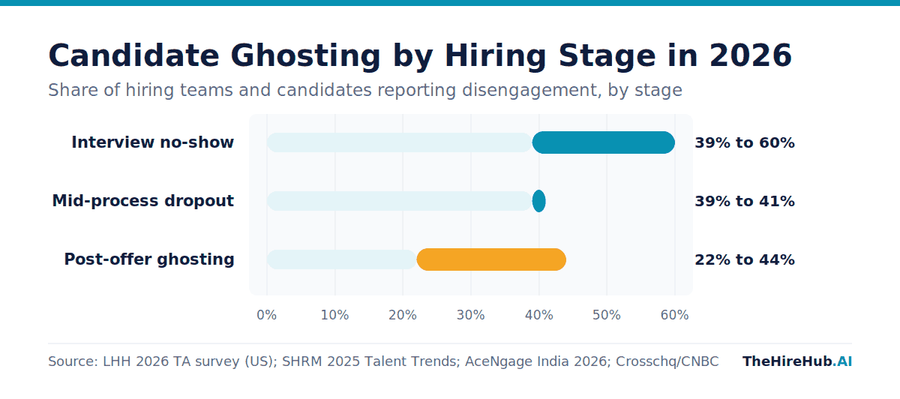
The gap between what "ghosting" means at each stage is wide enough that averaging them into one number would be actively misleading, which is why we're showing a range for each. Interview no-shows sit at 39 to 60% depending on the survey and industry mix. Mid-process disappearance, where a candidate has already completed at least one round, runs 39 to 41% across two independent surveys. Offer-to-joining ghosting is where the regional gap opens up: roughly 22% globally by Crosschq's aggregation of CNBC-reported data, and 44% in India per AceNgage, a gap we track alongside our own AI hiring metrics work.
How to read this:
- The ranges reflect different survey populations (US, UK, India) and time windows, not one funnel measured once, so treat them as directional, not a single company's expected loss rate.
- Offer-to-joining is the stage with the widest regional spread, which means a fix built for the US market may not travel to India without adjustment.
- Every stage's rate has risen two years running in every survey we checked, so this is a trend, not a one-year blip.
How it actually works, and where it breaks
Ghosting is fundamentally a latency problem wearing a motivation costume. A candidate who hears back in 48 hours behaves differently than one who hears back in 12 days, even when the job, the pay and the candidate are identical. Fast, specific communication signals that a role is real and a process is organized. Silence, or a templated non-answer, signals the opposite, and candidates respond to that signal by keeping their other options warm.
The mechanism breaks in three predictable places. First, the handoff between recruiter and hiring manager, where a candidate is technically "in process" but nobody owns the next message, so days pass with no action from either side. Second, the gap between a verbal offer and a written one, which averages far longer than either party expects and is exactly where 19% of candidates in one survey accepted verbally but never signed the paperwork. Third, the silence between a signed offer and the start date, which in India runs six weeks on average, long enough for a counteroffer or simple cold feet to take hold.
Automation fixes the first two failure modes cleanly because they're workflow problems: a scheduling tool that auto-confirms and reminds, an SLA that flags a candidate untouched for 48 hours, an e-signature step that collapses the verbal-to-written gap to hours instead of days. Teams that shorten the process end to end, per our time to hire benchmarks research, simply give a candidate fewer days in which to go quiet. None of this fixes the third failure mode by itself, which is why the traps section below treats communication cadence and actual deal quality as separate problems.
“Ghosting is not a candidate's character flaw. It is the itemized bill for every day your process left them guessing.”
What this means for your team
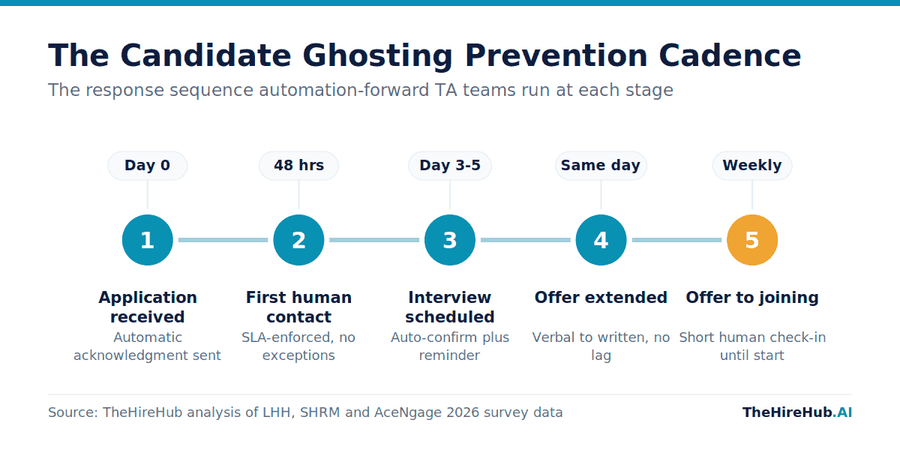
Fixing ghosting is a cadence problem, so the fix is a cadence, not a policy memo. The sequence most automation-forward teams converge on looks the same everywhere: automatic acknowledgment the moment someone applies, a hard SLA for first human contact, calendar tooling that removes the back-and-forth on scheduling, a same-day written follow-up after every interview stage, and a structured, human offer conversation instead of a one-way email.
The stage teams skip most often is the one after the offer is signed, because it feels like the deal is done. It isn't. A short, scheduled check-in once a week between signature and start date, even a two-line message, is the single highest-leverage move in the whole sequence, because it is the stage where India's ghosting rate diverges furthest from the global number.
Closing the ghosting gap: automation vs manual follow-up
Manual follow-up works when a recruiter has three open reqs and enough hours in the day to personally track every candidate's stage. It stops working past five or six reqs, which is most TA teams most of the year, because the SLA that prevents ghosting (contact within 48 hours, every time, no exceptions) is exactly the kind of consistency people are worst at under load. This is the same math behind our recruiter to hire ratio analysis: past a certain caseload, something gives, and historically it has been response time.
Automated engagement doesn't replace a recruiter's judgment on offer-stage conversations, where a human voice matters more, not less. What it replaces is the mechanical layer: the acknowledgment email, the interview reminder, the scheduling back-and-forth, the "just checking in" message during the offer-to-joining gap. Teams that automate only that mechanical layer and keep humans on the judgment calls see the biggest drop in ghosting at exactly the stages our interview no-show data shows are worst, without needing to hire more recruiters to get there.
How to actually do this (and the four traps)
Closing the ghosting gap doesn't require a platform migration. It requires four specific fixes, and most teams already own the tools to make at least three of them without buying anything new.
- The 48-hour rule, enforced by a system, not a to-do list. Every candidate gets a human response within 48 hours of any stage change: application, interview, or offer. Tracking this manually at scale is exactly the workload LHH found 69% of teams already can't keep up with, so the SLA needs to live in the ATS or scheduling tool, not a recruiter's memory.
- Verbal offer to written offer, same day. The gap between a verbal yes and a signed offer letter is where deals go cold and competing offers get accepted instead. An e-signature and templated offer-letter workflow collapses this from days to hours.
- A weekly touch after signature, every single time. This is the trap teams fall into most, because a signed offer feels finished. It isn't, and our candidate experience in AI hiring research shows disengagement compounds fastest exactly when communication stops.
- Don't automate the offer conversation itself. Automating acknowledgments and reminders is free efficiency. Automating the compensation negotiation or the "why us" conversation is where teams lose candidates who were never going to ghost, they were going to negotiate, and a bot answered instead of a person.
“The recruiters losing the fewest candidates aren't the ones messaging the most. They're the ones who never go quiet first.”
The one thing every hiring leader should take from this
Ghosting isn't a candidate integrity problem you can fix with a sterner tone. It's a latency problem, and the data at every stage points the same direction: teams that close response gaps lose fewer candidates, and the gap that costs the most, offer to joining, is the one most teams still handle by hand. The fix was never about messaging candidates more, it was about never leaving them waiting long enough to look elsewhere, which is the cadence TheHireHub's engagement automation is built around. If you want a second opinion on where your own funnel is bleeding candidates, we look at this stuff all day.
Frequently Asked Questions
Candidate ghosting is when a job applicant or new hire stops responding at any stage of the hiring process, from an unanswered screening call to signing an offer and never showing up on day one, without explanation.
Estimates vary by stage and region. LHH's 2026 survey found 39 to 60% of US hiring teams reported interview no-shows, while AceNgage's India data put post-offer ghosting at 44%, compared with roughly 22% globally.
The most cited reasons are a mismatch between what was discussed in interviews and the actual offer terms, poor communication during the process, a competing offer arriving during a long notice period, and simple discomfort with delivering bad news.
It reduces the mechanical causes, slow acknowledgment, scheduling delays, and silent gaps between stages, by automating response time. It does not fix ghosting caused by a weak offer or a bad interview experience, which still needs human judgment.
India's offer-to-joining window averages around 42 days, long enough for counteroffers, competing offers, or cold feet to take hold, which is why AceNgage's data identifies it as the highest-risk stage for ghosting in Indian hiring.
Yes. Multiple surveys, including Indeed's original ghosting research, find employers go silent on candidates at rates comparable to or higher than candidates ghosting employers, so the problem runs in both directions.
An enforced 48-hour response SLA at every stage change, paired with a scheduled weekly check-in between signed offer and start date, addresses the two stages where most ghosting concentrates.
Yes. Surveys of both candidates and employers consistently list a shorter process among the top fixes, because every extra day in process is another day a candidate can accept a competing offer.
No. Automation closes the mechanical gaps, acknowledgment, scheduling, reminders, effectively, but the offer conversation and any compensation negotiation still need a human, since those are the moments candidates actually disengage over.
Available 2026 survey data doesn't break ghosting rates out by industry with enough consistency to state a reliable ranking, though high-volume hourly and entry-level hiring is widely reported as most affected due to faster-moving competing offers.

