
Interview No-Show in India 2026: Why One in Four Never Turns Up
The no-show is a latency problem, not an attitude problem, and it is the cheapest loss in your funnel to recover.
Indian high-volume hiring loses 20 to 30 percent of booked interviews at peak. Here is what actually causes it, and the five step sequence that fixes most of it.

TL;DR
Interview no-show rates in Indian high-volume hiring run at 20 to 30 percent during peak cycles when the process is managed manually, and the cause is almost never candidate attitude. It is scheduling latency. Forty-two percent of candidates drop out because booking the interview took too long, which means most of your no-shows were lost days before the slot they missed. The fix is unglamorous: book inside 24 hours, confirm twice, and call the people who do not turn up, because most of them have not decided anything. If you are measuring the back half of this, pair it with your offer acceptance rate.
What is actually happening
The headline number depends heavily on who is hiring and how. In high-volume BPO, IT and BFSI staffing in India, agencies running manual coordination routinely report no-show rates of 20 to 30 percent during peak hiring cycles. A mid-sized tech firm that started tracking the metric properly found its own rate had climbed to 15 percent, which is the more typical picture for considered, lower-volume hiring.
The reason those numbers feel invisible is that most teams do not track them. A no-show is logged as a calendar gap rather than a funnel event, so it never appears in a hiring review and never gets a root cause. Teams discover the problem only when a recruiter mentions that half their Tuesday evaporated.
The behaviour is not one-directional, which is the part worth sitting with. Acengage found that 76 percent of Indian recruiters have been affected by candidate ghosting. In the same period, 61 percent of candidates report being ghosted by employers after an interview.
That symmetry matters because it explains the equilibrium. Candidates who have been dropped without a word by three employers stop treating a booked interview as a commitment, and they start running parallel processes as insurance. The no-show is a rational response to an unreliable counterparty, and the industry taught them that.
The structural driver sits earlier in the funnel than most people look. Forty-two percent of candidates drop out specifically because scheduling took too long. Every day between interest and slot is a day for a competing process to close, and in a market where the median candidate is running several applications, latency is the whole game.
The numbers
Interview no-shows do not sit in isolation, they compound an already narrow funnel. On 2026 benchmarks, roughly 3.6 percent of applications reach an interview for technical roles and 4.7 percent for business roles. Of those interviewed, 7.3 percent of technical and 10.4 percent of business candidates receive an offer.
Put a 20 to 30 percent no-show rate on top of that and the arithmetic gets unpleasant. Gem's 2026 analysis of 1.2 million hires puts overall applicant-to-hire conversion at around 0.5 percent, roughly one hire per 180 applicants, and technical roles need about 191 applicants per hire against 47 in healthcare.
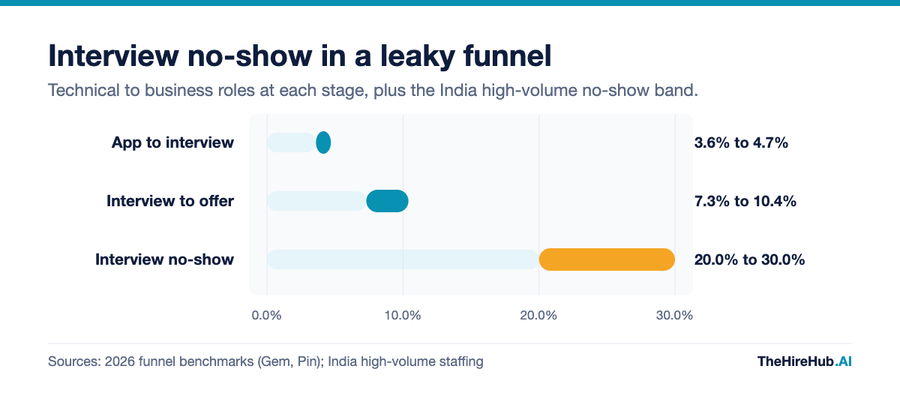
How to read this:
- The first two bars are global funnel benchmarks split technical to business. The third is the India high-volume no-show band, which is a different measurement, not a further stage of the same funnel.
- No-shows are the cheapest loss to recover, because the candidate already said yes once. Everything else in the funnel requires persuading someone new.
- A 25 percent no-show rate does not cost you 25 percent of your pipeline, it costs you 25 percent of your interviewers' time as well, which is the expense nobody books.
How it actually works, and where it breaks
The mechanism is mundane. A candidate expresses interest, a recruiter proposes times, the candidate replies, a slot lands, and somewhere in that loop the average Indian process burns three to seven days. Interest decays across that gap, competing offers land, and the booked slot becomes a low-priority obligation to a company that has not spoken to them in a week.
The first failure mode is treating confirmation as a formality. A single calendar invite sent at booking, with no follow-up, assumes the candidate's circumstances and intentions are static for a week. They are not, particularly for candidates who are employed and have to manufacture a reason to be unavailable.
The second is scheduling around interviewer convenience. Panels that only offer weekday-daytime slots are asking employed candidates to take leave for a first-round conversation, and a meaningful share will simply not show rather than decline, because declining feels like closing a door.
The third is the recruiter's own response. Most teams mark a no-show as a rejection and move on, which converts a recoverable miss into a permanent loss. A candidate who overslept, whose child was ill, or whose manager called an unexpected meeting has not withdrawn, and a same-day phone call recovers a surprising number of them. This is the same discipline that makes time to hire benchmarks worth watching, because the fix is nearly always speed rather than volume.
There is a tooling answer to the latency problem, and it is one of the few places in hiring where automation is unambiguously the right call. Self-serve booking removes the entire propose-and-reply loop, which is where most of the three to seven days go. It is worth being precise about what it fixes: it compresses time to slot, and it does nothing at all for the confirmation and recovery steps, which still need a human. Teams that install scheduling software and expect the no-show rate to fall on its own are usually disappointed, and our AI interview scheduling setup guide covers where the boundary sits.
"A no-show is rarely a verdict on your company, it is usually a verdict on how long you left the candidate waiting."
What this means for your team
The sequence below is the whole intervention, and it is deliberately boring. The only step most teams genuinely skip is the last one, and it is the one with the best return, because it operates on candidates who have already qualified themselves.
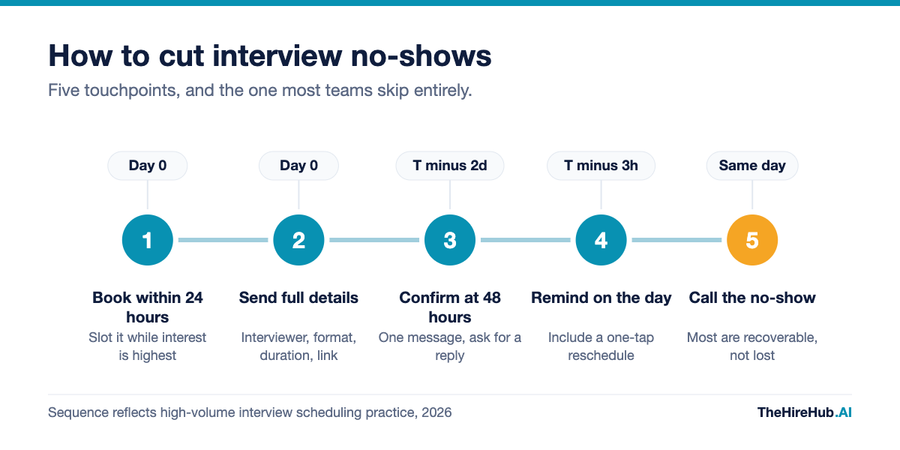
The operating rules that make it hold:
- Book inside 24 hours of the candidate expressing interest. This single change does more than the other four combined.
- Put the interviewer's name, the format, the duration and the joining link in the invite. Ambiguity reads as disorganisation and lowers the perceived cost of skipping.
- Ask for a reply to the 48-hour confirmation, not just a calendar acceptance. A calendar accept is passive and tells you nothing.
- Offer a one-tap reschedule in the day-of reminder. You want the easiest available action to be moving the slot, not abandoning it.
- Call every no-show the same day. Do not email, and do not wait until tomorrow.
Interview no-show vs candidate ghosting
These get used interchangeably and they are not the same problem. A no-show is a missed slot, usually recoverable, and frequently caused by something you control. Ghosting is a candidate who disengages entirely and stops responding, which is a later and harder failure.
The distinction matters because the remedies differ. No-shows respond to logistics: speed, clarity, reminders, and a phone call. Ghosting responds to communication discipline, mainly telling people where they stand and when, and there is a reciprocity to it given that 61 percent of candidates say they have been ghosted by employers after interviewing. If you treat a no-show as ghosting, you write off recoverable candidates. If you treat ghosting as a no-show, you keep chasing people who left weeks ago. Both are easier to see when your pipeline stages are instrumented properly, which is what our AI hiring metrics breakdown is for.
How to actually do this (and the four traps)
- Do not fix reminders before you fix latency. Teams buy reminder tooling and keep a seven-day booking cycle, then conclude the tooling failed. The 42 percent who drop out over slow scheduling never reach the reminder. Compress the gap first.
- Do not treat a no-show as a rejection. Marking it as declined and closing the record destroys your best recovery opportunity and corrupts your funnel data, because the stage now reports a decision the candidate never made.
- Do not schedule only for interviewer convenience. Employed candidates on long notice periods, which in India is most senior candidates, cannot always take daytime leave for a first round. Our notice period buyout guide covers why that constraint is heavier here than elsewhere.
- Do not blame the market before you have measured. Most teams asserting a candidate-quality problem have never logged no-shows as a funnel stage, so they have no idea whether their rate is 5 percent or 30 percent, or whether it moved when they changed something.
"Treat the first no-show as recoverable and you will recover most of them, because almost nobody who forgot has actually decided."
The one thing every hiring leader should take from this
A no-show looks like a candidate problem and is almost always a latency problem wearing a disguise. The gap between someone saying yes and someone sitting in the interview is the single most controllable variable in your funnel, and most teams have never measured it, let alone compressed it. Start logging no-shows as a stage this week, find your real number, then cut the booking window and watch it move. If you want help working out where your own process leaks, we look at this stuff all day.
Frequently Asked Questions
Under 10 percent is healthy for considered, lower-volume hiring. High-volume Indian staffing on manual coordination commonly runs 20 to 30 percent during peak cycles, and a mid-sized tech firm tracking it properly found 15 percent.
The dominant cause is scheduling latency. Forty-two percent of candidates drop out because booking took too long, so interest decays and competing processes close first. Unclear invites and interviewer-only scheduling windows add to it.
Book within 24 hours of interest, put the interviewer name, format, duration and link in the invite, ask for a reply to a 48-hour confirmation, send a day-of reminder with one-tap reschedule, and call every no-show the same day.
No. A no-show is a single missed slot and is usually recoverable. Ghosting is full disengagement where the candidate stops responding entirely. They have different causes and different remedies.
Usually yes. The candidate already qualified themselves by accepting, so recovery is cheaper than sourcing someone new. A same-day phone call recovers a meaningful share of people who simply forgot or had something urgent come up.
Acengage found 76 percent of Indian recruiters have been affected by candidate ghosting. The reverse is also widespread, with 61 percent of candidates reporting being ghosted by employers after an interview.
It reduces time to slot, which is the largest single driver, so it helps indirectly. It does not by itself fix confirmation or recovery, both of which still need deliberate human follow-up.
As their own funnel stage, not as a rejection or withdrawal. Marking them as declined destroys the recovery opportunity and records a decision the candidate never actually made, which corrupts conversion data.
Gem's 2026 analysis of 1.2 million hires puts applicant-to-hire conversion at roughly 0.5 percent, about one hire per 180 applicants. Technical roles need around 191 applicants per hire compared with 47 in healthcare.
Yes. The larger cost is interviewer time, which is senior and unrecoverable. A 25 percent no-show rate wastes a quarter of the panel capacity you scheduled, and most teams never book that against cost per hire.


