
Hiring Freeze in India 2026: Which Market Are You Actually In
The same quarter produced a near-total stop in IT services and the strongest hiring outlook of 42 countries.
India's top five IT firms added 17 net employees in nine months while India led 42 countries on hiring outlook. Both are true, and the difference matters.

TL;DR
A hiring freeze in 2026 India is not one thing, and the published data contradicts itself in a way that is worth understanding rather than averaging. A Genius Consultants survey found 63 percent of Indian companies had frozen hiring or were reducing headcount. In the same period, ManpowerGroup's Q4 2026 survey put India's net employment outlook at 54 percent, the strongest of the 42 countries it covers. Both are defensible, because the freeze is sector-specific rather than economy-wide: India's top five IT services firms added a net 17 employees across the first nine months of FY26, against 17,764 in the same period the year before. So the useful question is not whether there is a freeze, it is whether you are in the part of the market that has one. Either way, the restart takes longer than anyone plans for, as our time to hire benchmarks show.
What is actually happening
The IT services collapse is the sharpest data point available and it is worth stating plainly. India's five largest IT services firms added a net 17 employees in the first nine months of FY26. The comparable figure for the previous year was 17,764. That is close to an absolute stop.
Big tech in India has moved the same way. Google, Meta, Amazon and Apple have been running roughly 200 open positions in India between them, which reporting characterises as a 98 percent reduction against their typical volumes.
The stated reasons are consistent across sources: weak global demand, reduced discretionary spending by clients, and the growing use of AI-driven delivery models that reduce the headcount required per unit of work. The third reason is the one that does not reverse when demand returns.
And yet the aggregate picture is genuinely positive. India led all 42 countries in ManpowerGroup's Q4 2026 net employment outlook at 54 percent, with around 65 percent of employers planning to recruit. All nine surveyed sectors reported positive hiring expectations.
The resolution is that these measure different populations. Export-led IT services and global tech are frozen. Domestic BFSI, healthcare, manufacturing, logistics and GCC hiring are not. If your mental model of Indian hiring comes from IT services headlines, it is describing a minority of the labour market.
One structural response is already visible in the data: 15 percent of surveyed firms reported shifting toward contract or freelance roles. Permanent headcount is frozen while the work continues, which is a reclassification rather than a reduction.
The numbers
The clearest evidence of a freeze is not in employer surveys, it is in how many people are chasing each role. Application volumes reached an average of 257.6 per job posting in 2026, up from 207.2 in 2024, a 24 percent increase. Applications per hire have tripled since 2021 and now run above 300 per role.
The concentration by sector is stark. Technical roles require roughly 191 applicants per hire against 47 in healthcare, which tells you where the surplus candidates are and where they are not.
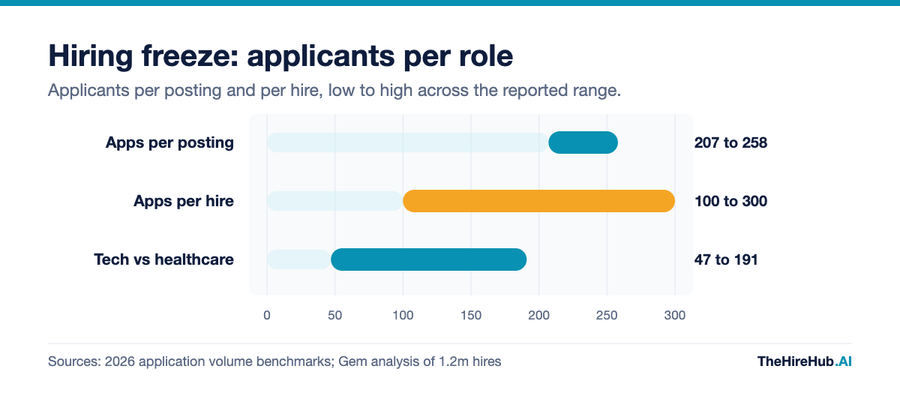
How to read this:
- Rising applicants per posting is the cleanest freeze signal available, because it moves when supply and demand diverge regardless of what employers say in surveys.
- The tech to healthcare spread is the sector story in one number. The same economy is producing a glut in one place and a shortage in another.
- More applicants is not more choice. Volume at this level degrades screening quality and increases the chance of rejecting qualified people by accident.
How it actually works, and where it breaks
A freeze is usually implemented as a requisition block: open roles are paused, new requisitions need executive sign-off, and backfills are scrutinised individually. The intent is to stop the run rate growing while keeping the option to restart.
The first failure mode is that pausing is not free. The pipeline you built decays: candidates you had warm take other jobs, your employer brand goes quiet in exactly the market where attention is cheapest, and the recruiters who hold the context get redeployed or leave.
The second is the restart lag, which almost nobody budgets. Refilling a permanent role in India realistically takes 102 to 160 days once you account for six to ten weeks of recruiting plus a 60 to 90 day notice period. A freeze lifted in April does not produce working people until well into the second half.
The third is silent scope creep into contract. Using contract headcount to keep a permanent need off the plan is a reasonable short-term move and a poor long-term one, because it carries a 15 to 35 percent markup indefinitely, a trade our contract staffing versus permanent comparison sets out in detail.
The fourth is over-reading the applicant surge. Three hundred applications per role feels like abundance and mostly is not: application volume rises fastest among candidates applying indiscriminately, so the ratio of qualified to total often gets worse even as the absolute number climbs.
"A freeze that pauses requisitions does not pause the decay, it just moves the cost from payroll to the pipeline you will need next."
What this means for your team
A freeze is the cheapest time in the cycle to fix everything that is not hiring. The sequence below assumes you cannot make offers and asks what is still worth doing, which is more than most teams realise.
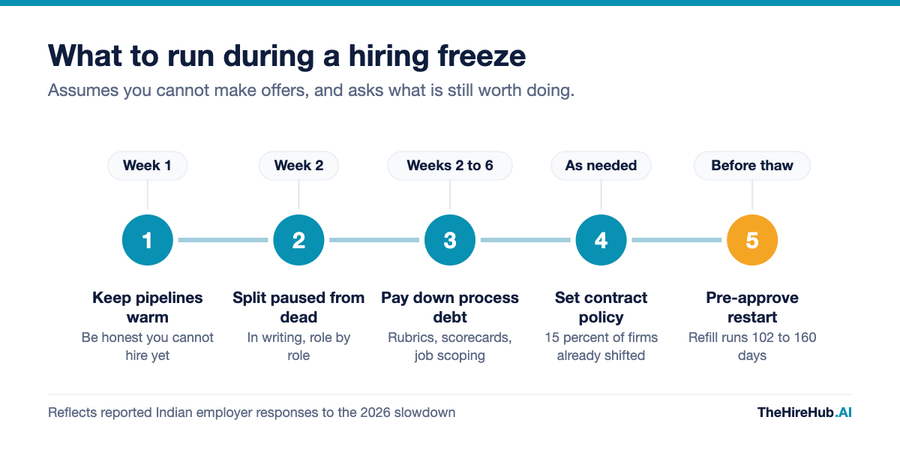
The rules that make a freeze productive:
- Keep talking to people you cannot hire yet, and be honest that you cannot hire yet. Candidates remember which companies were straight with them.
- Separate paused roles from dead roles in writing. Teams that leave everything ambiguous restart the wrong things first.
- Spend the time on process debt: interview rubrics, scorecards, job scoping, structured question sets. None of it needs headcount approval.
- Decide your contract policy deliberately rather than by drift, especially if you are among the 15 percent already shifting that way.
- Pre-agree what triggers the restart and who approves it, because a 102 to 160 day refill cycle means the decision has to precede the need by a full quarter.
There is one more thing worth doing while hiring is paused, and it is the least popular: work out what your recruiters are actually for. A freeze strips out requisition-filling and leaves everything else visible, which is the only time you get an honest look at how much of the function was reactive order-taking and how much was genuine talent work. Teams carrying far more open roles than recruiters during normal times rarely find out where the real constraint sits, and the recruiter to hire ratio is the number that usually reveals it.
Hiring freeze vs a genuine downturn
The distinction matters because the responses differ. A freeze is a liquidity decision: the work still exists, the budget is being conserved, and the intent is to resume. A downturn is a demand decision: the work has shrunk, and the headcount was built for a volume that is not returning.
Indian IT services in FY26 looks like the second wearing the clothes of the first. The stated reason includes AI-driven delivery reducing the headcount needed per unit of work, and that does not reverse when client spending recovers. Teams treating a structural change as a temporary pause will keep waiting for a thaw that arrives in a different shape, with fewer roles and a different skill mix, which is the shift our AI recruiting adoption analysis tracks. Domestic-demand sectors are in the opposite position and should be hiring into the surplus while it is cheap.
How to actually do this (and the four traps)
- Do not let the pipeline go cold. A freeze is the cheapest moment to build relationships, because everyone else has stopped. Standing down entirely means restarting from zero at the exact moment you need speed.
- Do not mistake applicant volume for talent availability. Three hundred applications per role includes a lot of indiscriminate applying. Volume without better screening produces more work and more accidental rejections, not better hires.
- Do not drift into contract as a workaround. If the need is permanent, contract at a 15 to 35 percent markup is a structural cost dressed as a temporary fix. Decide it on the merits and review it on a date.
- Do not forget the restart lag. Approval in month one produces a working person in month four or five. Build the approval decision a quarter ahead of the need, and check it against your cost per hire benchmarks so the restart is priced properly.
"Three hundred applications per role is not abundance, it is noise, and it makes rejecting the right person considerably easier."
The one thing every hiring leader should take from this
Find out which market you are actually in before you copy anyone's freeze strategy. The same quarter produced a near-total stop in Indian IT services and the strongest hiring outlook of 42 countries, and those are not contradictory reports, they are different sectors. If you are in the frozen part, spend the pause on process debt and pipeline warmth rather than waiting. If you are in the growing part, this is the cheapest hiring market you will see for a while. Either way, price the 102 to 160 day restart before you need it. If you want help working out which position you are in, we look at this stuff all day.
Frequently Asked Questions
It depends on the sector. A Genius Consultants survey found 63 percent of Indian companies had frozen hiring or were cutting headcount, while ManpowerGroup's Q4 2026 survey put India's net employment outlook at 54 percent, the strongest of 42 countries. Export-led IT services is frozen and domestic-demand sectors are not.
India's top five IT services firms added a net 17 employees across the first nine months of FY26, compared with 17,764 in the same period the previous year. That is effectively a complete stop.
The stated reasons are weak global demand, reduced discretionary spending by clients, and AI-driven delivery models that lower the headcount needed per unit of work. The third does not reverse when client spending recovers.
It is a pause on filling open roles, usually implemented as a requisition block where new requisitions need executive approval and backfills are reviewed individually. The intent is to hold the run rate while keeping the option to restart.
In India, refilling a permanent role realistically takes 102 to 160 days: six to ten weeks to recruit plus a 60 to 90 day notice period. A freeze lifted in April will not produce working people until the second half of the year.
Not necessarily. Applications reached 257.6 per posting in 2026, up from 207.2 in 2024, and applications per hire now exceed 300. Volume rises fastest among indiscriminate applicants, so the qualified proportion often falls.
Some are. Fifteen percent of surveyed firms reported shifting toward contract or freelance roles. That keeps the work moving while permanent headcount is frozen, but it carries a 15 to 35 percent markup for as long as it continues.
Keep pipelines warm and be honest about not hiring, separate paused roles from dead ones in writing, pay down process debt like rubrics and job scoping, set a deliberate contract policy, and pre-agree what triggers the restart.
All nine sectors in ManpowerGroup's Q4 2026 survey reported positive expectations, with BFSI, healthcare, manufacturing, logistics, e-commerce, renewable energy and Global Capability Centres among the stronger areas.
A freeze means the work still exists and budget is being conserved. A downturn means the work has shrunk. If the stated cause includes permanently lower headcount per unit of work, as with AI-driven delivery, it is structural rather than temporary.

