
Contract Staffing vs Permanent Hiring in India 2026
The markup is the number everyone argues about, and it is almost never the number that decides correctly.
Contract staffing costs a 15 to 35 percent markup and starts in two weeks. Permanent takes five months with notice but is cheaper from year two. How to choose.

TL;DR
Contract staffing versus permanent hiring is a speed and horizon decision, not a cost decision, and the cost comparison is where most teams get it wrong. Contract staffing in India carries a 15 to 35 percent markup on salary, and a contract IT professional can be at a desk in one to two weeks against six to ten weeks for an equivalent permanent hire. From year two onward, with no recruitment fee to amortise, permanent becomes marginally cheaper per head. So the honest rule is that contract wins when the need is under roughly twelve months or the start date is urgent, and permanent wins when it is not. Put the speed difference next to your time to hire benchmarks before deciding.
What is actually happening
The formal flexi workforce in India has become genuinely large. As of FY25 it stood at 7.2 million workers, which is about 1.3 percent of the country's total workforce, and it is projected to reach 9.16 million by FY27 on a 12.6 percent growth trajectory.
The money has followed. The industry is on track to reach ₹2.58 lakh crore by FY27, and the Indian IT flexi staffing market specifically was valued at 4.9 billion US dollars in FY24, projected to reach 5.6 billion by the end of FY26. Those two figures are in dollars because the source reports them that way.
Growth is concentrated rather than uniform, which is the useful signal. IT staffing grew 16.1 percent year on year in Q3 FY26, against overall staffing industry growth of 4.4 percent. Companies are not turning to contract labour broadly, they are turning to it for technical capability they need now.
The reason is structural, and it is specific to India. Permanent senior hiring in India runs into 60 to 90 day notice periods as standard, so a permanent requisition opened today may not produce a working person for four to five months. Contract sidesteps that entirely because contractors are generally available on days or weeks of notice.
What has changed is that contract work stopped being a downgrade. A decade ago contract roles in Indian IT attracted people who could not get permanent roles. The flexi market has matured to the point where experienced specialists choose it deliberately, which changes the quality calculation substantially.
The numbers
The cost comparison is more subtle than the markup suggests. Contract staffing runs a 15 to 35 percent markup on salary, which covers the agency's compliance, payroll and margin. Permanent hiring carries a one-time recruitment fee instead, conventionally 8.33 to 16.67 percent of annual CTC, plus the full employer benefit load every year.
That difference in shape is what drives the crossover. In year one, contract is often competitive or cheaper because the permanent hire is carrying its recruitment fee. From year two onward, with no fee to pay again, permanent becomes marginally cheaper per head.
Speed is where the gap is not subtle at all. A qualified contract IT professional can typically be deployed in one to two weeks. The equivalent permanent IT hire takes six to ten weeks to recruit, and that is before notice period.
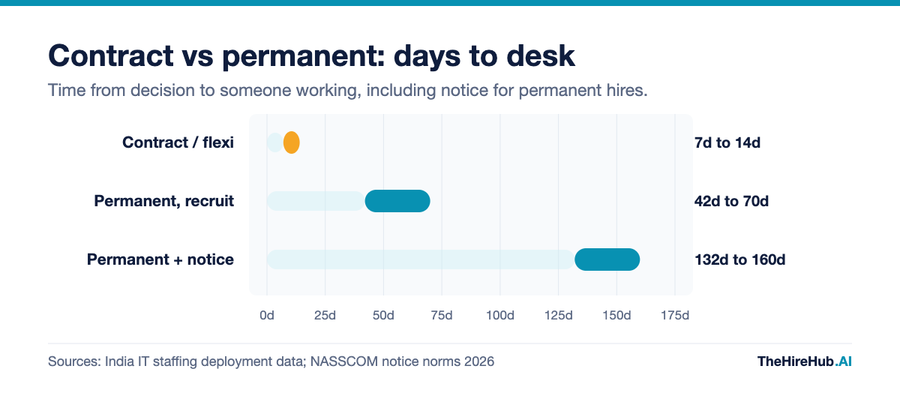
How to read this:
- The third bar is the one most plans ignore. It adds a standard 90 day notice to the permanent recruitment window, which is the realistic picture for a senior Indian hire.
- Speed is not a tiebreaker here, it is frequently the whole decision. Four months of a critical seat sitting empty usually costs more than any markup.
- The markup range is wide because it reflects very different things: a 15 percent markup is close to pass-through payroll, a 35 percent markup usually includes real sourcing and management work.
One more number is worth holding onto, because it reframes the whole comparison. A permanent senior requisition opened today, at six to ten weeks to recruit plus a 90 day notice period, produces a working person somewhere between four and five months out. Contract produces one in one to two weeks. If the work in question is worth anything at all per month, that gap dwarfs a 35 percent markup, and the markup argument only starts to matter once the horizon is long enough for the crossover to arrive. The reason India sits at the extreme end of this is the notice culture, which our notice period buyout guide covers in detail.
How it actually works, and where it breaks
In the standard arrangement the staffing agency is the legal employer. It runs payroll, makes statutory contributions, and carries the employment relationship, while you direct the work. That separation is the point, because it is what makes the engagement genuinely flexible.
The first failure mode is treating the separation as total. As the principal employer you retain obligations around the conditions in which contract staff work and around whether your agency is actually making its statutory contributions. Teams that pick the cheapest vendor without checking compliance discover the exposure later, and it lands on them.
The second is misclassification by behaviour. If a contractor sits in your standup every morning, reports to your manager, uses your equipment, has been there three years, and is indistinguishable from an employee in every respect except the paperwork, the arrangement starts to look like employment regardless of what the contract says. The risk grows with duration.
The third is the conversion problem nobody plans for. Teams hire a contractor for a six month need, the contractor turns out to be excellent, and there is no agreed mechanism or price for converting them to permanent. Agencies will usually charge a conversion fee, and if that was not negotiated at the start it gets negotiated at the worst possible moment. It is the same category of oversight as not reading the replacement terms in a search contract, which our India executive search fees breakdown covers.
"Contract staffing is a cheap way to buy twelve months and an expensive way to buy five years, and the paperwork will not tell you which one you are doing."
What this means for your team
The sequence below front-loads every decision that gets expensive later. The step teams reliably skip is the fourth one, and it is the cheapest thing on the list to get right.
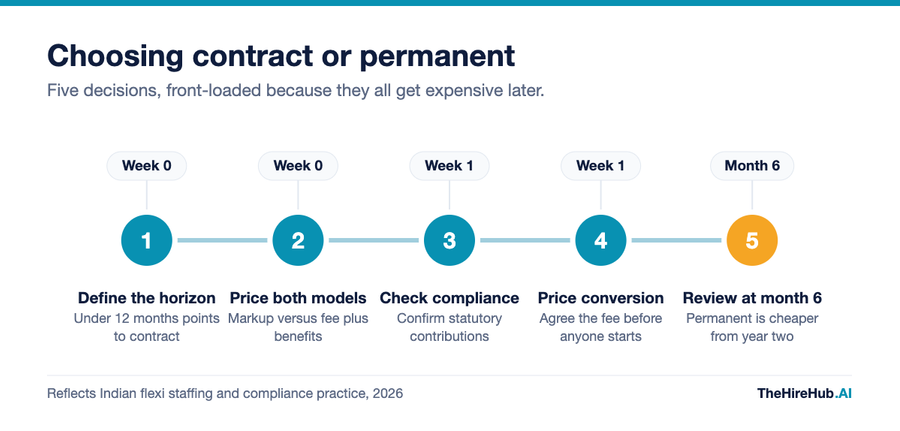
The operating rules worth holding to:
- Decide the horizon honestly. If the need genuinely outlasts twelve months, permanent is the cheaper structure and contract is just deferred cost.
- Price both models over the actual expected duration, not over year one. The crossover matters if the role persists.
- Verify that your agency is making its statutory contributions rather than assuming it. This is your exposure, not only theirs.
- Negotiate conversion terms before the first contractor starts, including the fee and the notice.
- Review the arrangement at month six. Contract roles have a way of becoming permanent in everything but structure.
Contract staffing vs permanent hiring, decided properly
The framing that works is not cost, it is certainty. Permanent hiring is the right instrument when you are confident the work persists, when you need someone to own outcomes across years, and when institutional knowledge is the point of the role. You are buying continuity and paying a fee once to get it.
Contract is the right instrument when the work has a defined end, when the start date matters more than the run rate, or when you are genuinely unsure the role is needed permanently. It is also the honest answer for capability you need to borrow rather than build, which is a different question from whether to build a function in-house at all, as covered in our executive search versus RPO comparison. What contract is not is a way to avoid the cost of a permanent hire you know you need, because that version shows up as a higher run rate and a misclassification risk.
How to actually do this (and the four traps)
- Do not pick contract to dodge headcount approval. Using contract staffing to keep a permanent need off the headcount plan produces a role nobody owns, at a 15 to 35 percent premium, indefinitely. It is a budgeting manoeuvre that becomes a structural cost.
- Do not compare year one and stop. Contract often looks cheaper in year one because the permanent hire is carrying its recruitment fee. Model the crossover across the real duration, or you will justify contract for roles that should never have been contract.
- Do not skip compliance diligence on the vendor. Verify statutory contributions are actually being made. A cheap markup that turns out to be cheap because obligations are not being met is your problem as principal employer.
- Do not leave conversion unpriced. Agree the conversion fee and notice before anyone starts. Doing it later means negotiating while the person you want to keep is listening, which is a bad position, in the same way that not tracking what hiring actually costs you distorts every decision downstream, as in our cost per hire benchmarks.
"Using contract headcount to avoid a permanent approval does not remove the cost, it just moves it somewhere nobody reviews."
The one thing every hiring leader should take from this
The markup is the number everyone argues about and it is almost never the number that decides correctly. What decides correctly is honesty about how long the work lasts, because contract is a genuinely cheaper way to buy twelve months and a genuinely more expensive way to buy five years. Write down the expected duration before you price anything, then let that pick the instrument. If you want help working out which model fits a specific role, we look at this stuff all day.
Frequently Asked Questions
Contract staffing typically carries a 15 to 35 percent markup on salary. The markup covers the agency's payroll processing, statutory compliance and margin. A 15 percent markup is close to pass-through payroll, while 35 percent usually includes real sourcing and management.
In year one it often is, because a permanent hire is also carrying a recruitment fee of roughly 8.33 to 16.67 percent of annual CTC. From year two onward, with no fee to pay again, permanent becomes marginally cheaper per head.
A qualified contract IT professional can usually be deployed in one to two weeks. An equivalent permanent IT hire takes six to ten weeks to recruit, and that is before the candidate serves a notice period of 60 to 90 days.
The formal flexi workforce stood at 7.2 million as of FY25, about 1.3 percent of India's total workforce, and is projected to reach 9.16 million by FY27. The industry is on track to reach ₹2.58 lakh crore by FY27.
Choose contract when the work has a defined end under roughly twelve months, when the start date matters more than the run rate, or when you are genuinely unsure the role is needed permanently. Choose permanent when the work clearly persists.
In the standard arrangement the staffing agency is the legal employer. It runs payroll, makes statutory contributions and holds the employment relationship, while the client company directs the work.
As the principal employer you retain obligations relating to the conditions contract staff work in and to whether your agency is genuinely making its statutory contributions. Choosing a cheap vendor that cuts those corners creates exposure for you, not only for them.
It arises when a contractor is indistinguishable from an employee in practice: same manager, same standup, same equipment, multiple years of tenure. At that point the arrangement can look like employment regardless of the contract, and the risk grows with duration.
Yes. Agencies generally charge a conversion fee, and if it was not negotiated at the outset you end up negotiating it at the worst possible moment, when you have already decided you want to keep the person.
Yes. IT staffing grew 16.1 percent year on year in Q3 FY26, against overall staffing industry growth of 4.4 percent, which suggests companies are using contract specifically for technical capability they need at short notice.


