
AI Recruiting for Small Business in 2026: What Works Without a Recruiter
What a sub-50-person team should automate, what to keep human, and what it costs.
Only 43% of firms with two to nine employees use AI at all. Here is the flat-rate stack that works without a recruiter, and the four traps that waste the budget.

TL;DR
AI recruiting for small business works, but not in the way vendors pitch it. The honest headline number: only 43 percent of firms with two to nine employees use AI for work tasks at all, against 59 percent of firms with 100 to 249 employees, according to the U.S. Chamber of Commerce Foundation's Main Street AI Monitor. The gap is not appetite. It is that small teams have nobody whose job it is to set the tooling up. If you have under 50 people and no full-time recruiter, the winning setup is narrow: one flat-rate tool between $49 and $199 a month, automation pointed only at sourcing reach, screening throughput and scheduling, and a human making every shortlist and offer decision. Before you shop, read our AI recruiting software cost breakdown so you know what the pricing models actually do to your bill.
What is actually happening
Small businesses are not behind on AI in general. Roughly half of all small business workers already use it, and among those who use it, 90 percent apply it to writing and editing, 88 percent to research. The tools are already in the building.
Hiring is where it stalls. The Main Street AI Monitor, fielded by Ipsos in May 2026 across 1,070 employees at U.S. firms with two to 499 staff, found that adoption tracks headcount almost linearly. The smallest firms are the least likely to have automated anything, and hiring is the function that most reliably gets deferred because it is episodic. You hire three people this year, not thirty.
That episodic quality is the whole problem. A company hiring three roles a year cannot justify a recruiter, cannot build a repeatable process from three data points, and cannot amortise a per-seat enterprise contract. So the founder does it in the gaps between everything else, and the process is whatever LinkedIn and a spreadsheet allow.
What has changed in 2026 is not the intelligence of the models. It is the pricing. Flat-rate plans now exist that do not charge per recruiter, which is the pricing model that historically made these tools irrational below about 20 hires a year. Zoho Recruit publishes a free tier and a $25 per user Standard plan. JazzHR charges roughly $75 a month flat with unlimited users but caps active jobs. Manatal starts near $15 per user.
The second change is scope discipline. The vendors who sell to small teams have largely stopped promising an autonomous recruiter and started selling three specific jobs: get the role in front of more people, rank the inbound pile, and book the calls. That is a much smaller claim, and it is the one that survives contact with a five-person company.
The numbers
Here is what a sub-50-person team actually pays, by plan type. All figures are monthly software cost in USD, since the vendor pricing in this category is set globally rather than per market.
The four routes are genuinely different products, not tiers of the same thing. A free plan is a filing cabinet. A flat-rate plan is a filing cabinet plus ranking and scheduling. A per-seat AI suite adds sourcing reach and outbound sequencing, and prices as if you have a recruiting team, which you do not.
For India specifically, the comparison that matters is not software against software. It is software against agency fees, which run 8.33 percent of annual CTC for entry-level and bulk roles and 12.5 percent for mid-level, per current India market rates. On a ₹12 lakh mid-level hire, that is ₹1.5 lakh for one placement, against roughly ₹1.2 lakh for a full year of a flat-rate tool.
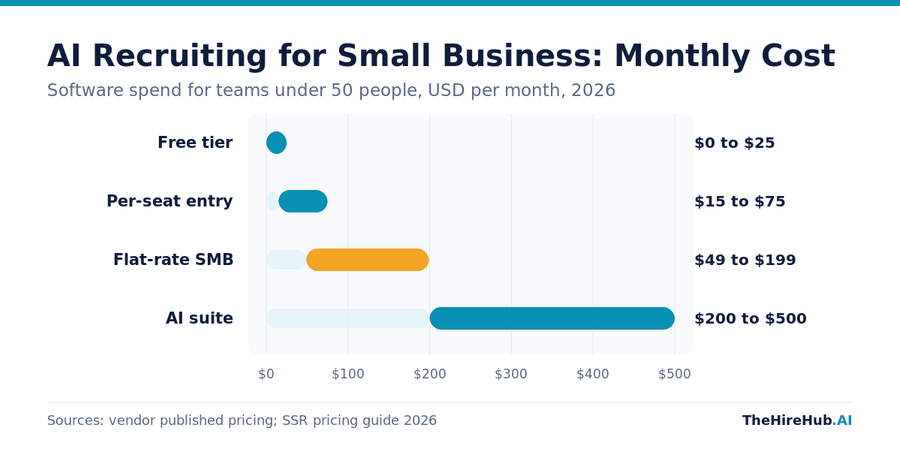
- Read the ranges as monthly commitments, not per-hire costs. Software is a fixed cost you pay in months you hire nobody, which is most months for a small team.
- Per-seat pricing is the trap at this size. Two founders and an office manager reviewing candidates is three seats, so a $50 per-seat plan is $150, not $50.
- The top band is mispriced for you, not overpriced in general. A $500 a month AI suite is good value at 40 hires a year and terrible at four.
How it actually works, and where it breaks
The mechanism is unglamorous. A model embeds your job description and each incoming CV into the same vector space, scores similarity, applies whatever hard filters you set, and returns a ranked list. Separately, a scheduling agent reads calendar availability and sends booking links. Neither step involves judgement about whether a person can do the job.
That matters because the ranking is a relevance score, not a prediction of performance. It tells you which CVs look most like the job description you wrote. If the job description is vague, the ranking is confidently vague, and you will never see the evidence of it.
The first failure mode is the silent rejection. Automated screening produces false negatives at a rate nobody on a small team is auditing, because auditing requires re-reading the CVs the system buried. Career changers, non-linear backgrounds and anyone whose CV uses different vocabulary than your posting get filtered out invisibly. Our note on AI screening false negatives covers how to sample the rejected pile.
The second failure mode is calibration drift on tiny volumes. These systems are tuned on large applicant pools. At 40 applicants per role, the difference between the candidate ranked third and the candidate ranked twelfth is mostly noise, and treating the ranking as a shortlist is treating noise as signal.
The third is the one small teams walk into hardest: automating the wrong end. Among small business workers using AI, just 6 percent use it to automate workflows with minimal human involvement. The 94 percent are right. The expensive mistakes in hiring are made at the offer and the reference check, and those are exactly the steps a small team is most tempted to speed up because they are the most uncomfortable.
"A relevance score tells you which CVs resemble your job advert, which is a very different thing from who can do the work"
What this means for your team
Do not start with a tool. Start with the scorecard, because the ranking quality is downstream of the job description, and a model cannot rank against criteria you have not written down.
The sequence below is a four to eight week rollout for a team with no recruiter. It is deliberately slow at the front and cheap at the back.
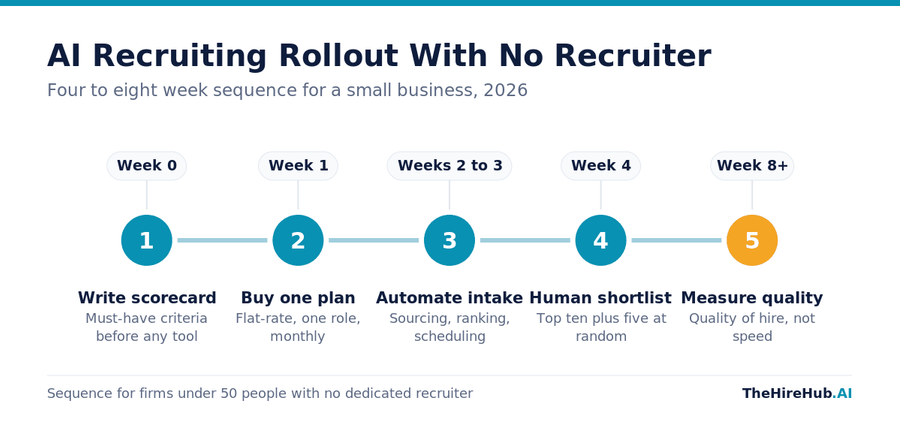
Two practical constraints. Run one role through the whole sequence before you buy an annual plan, because the monthly price is the cost of learning whether the ranking is any good on your actual applicant pool. And write down your time-to-hire before you change anything, since small firms already run 25 to 35 days against 45 to 65 for enterprise, which means speed is probably not your bottleneck and you should not buy for it.
AI recruiting for small business vs the agency
The comparison small teams actually face is not one tool against another. It is whether to run hiring in-house with software or hand the role to a contingency agency.
The agency is the right answer for a single senior or genuinely niche hire, because you are buying a network you do not have and paying only on placement. Software is the right answer for recurring, describable roles, because the cost is fixed and the pipeline stays yours. The break-even in India lands around two to three mid-level hires a year: below that, agency fees are cheaper than a year of tooling; above it, they are not. We go through this in detail in AI recruiting vs agency.
The other confusion worth clearing: an applicant tracking system and an AI recruiting tool are not the same purchase, and small teams routinely buy one thinking they bought the other. See ATS vs AI recruiting software for where the line sits.
How to actually do this (and the four traps)
- Buying per-seat when you hire in bursts. Per-seat pricing assumes continuous recruiting activity. A small team recruits in two-month bursts twice a year and pays for twelve months. Take the flat-rate plan even when the per-seat sticker looks lower, and check whether the cap is on seats, active jobs or candidates, because the cap is where the real price lives.
- Treating the ranked list as the shortlist. The ranking is a reading order, not a decision. Read the top ten and then read five at random from below the cut. If the random five are indistinguishable in quality from the top ten, your ranking is not working and you should fix the job description before you blame the model.
- Automating the offer stage. Sourcing, screening and scheduling are throughput problems and automate well. Reference checks, offer conversations and closing are judgement and relationship problems, and a small company's genuine advantage over a large one is that a founder does them personally. Human in the loop hiring is not a compliance box here, it is where your win rate comes from.
- Measuring speed instead of outcome. Time-to-hire is the metric these tools improve most visibly and the one that matters least to a company making four hires a year. One bad hire out of four is a 25 percent failure rate that no amount of scheduling automation offsets. Track quality of hire measurement from the first cohort, even with a sample size of three.
"At nine employees nobody owns the hiring system, so the only automation that survives is the kind you can set up in an afternoon"
The one thing every hiring leader should take from this
The reason 43 percent of the smallest firms have not adopted AI in hiring is not that the tools are bad or the price is wrong. It is that adoption requires someone to own the setup, and at nine employees nobody owns it. So the practical move is not to evaluate twelve vendors. It is to spend two hours writing one real scorecard, buy one flat-rate plan for one role, automate only the three throughput steps, and keep your own hands on the shortlist and the offer. That is a small enough commitment that it actually happens, which is the only property that matters at your size. If you want a second opinion on the stack before you commit, we look at this stuff all day.
Frequently Asked Questions
Yes, if you narrow the scope. Point automation at sourcing reach, CV ranking and interview scheduling, and keep a human on shortlisting, references and offers. Teams that try to automate the judgement steps get worse outcomes than doing nothing.
Free tiers exist at $0, per-seat entry plans run roughly $15 to $75 per user per month, and flat-rate small business plans sit around $49 to $199 per month. Budget guidance for firms under 50 people generally lands between $0 and $500 a month depending on hiring volume.
Flat-rate, almost always. Small teams recruit in bursts but pay every month, and several people usually need access to review candidates, so per-seat costs multiply while delivering nothing extra between hiring cycles.
In India, roughly two to three mid-level hires a year is the break-even against contingency agency fees of 8.33 to 12.5 percent of annual CTC. Below that, paying per placement is cheaper than paying for twelve months of software.
Probably less than you expect. Small companies under 250 employees already average 25 to 35 days to hire against 45 to 65 days for enterprise teams, because they have fewer approval layers. Speed is rarely the binding constraint at this size.
False negatives you never see. With 40 applicants rather than 4,000, the gap between the third and twelfth ranked candidate is largely noise, so a qualified person can be filtered out by vocabulary mismatch rather than capability.
Usually one product that does both. An applicant tracking system stores and moves candidates through stages; AI recruiting features add sourcing, ranking and scheduling on top. Most small business plans now bundle them, so buying separately duplicates cost.
No. These inferences are poorly validated, carry real legal exposure under emerging hiring regulation, and are the part of assessment where a small team's direct contact with candidates is already better than any model.
Sample the rejected pile. Read your top ten ranked CVs and five drawn at random from below the cut. If quality looks similar across both groups, the ranking is adding nothing and the job description is the thing to fix.
Quality of hire and offer acceptance, not time-to-hire. At four hires a year, one mis-hire is a 25 percent failure rate, which dwarfs any scheduling efficiency you gained. Track whether the people you hired are still performing at month six.

