
India Hiring Outlook 2027: What Five Employer Surveys Say, and How to Plan Around It
ManpowerGroup, TeamLease, Naukri, HAN Digital and Taggd data from late 2026, read together for anyone finalising a 2027 hiring plan.
India's hiring outlook for 2027 is the strongest in years: a 54% employer outlook and 5.4% projected workforce growth. Here is what it means for your hiring plan.

TL;DR
The India hiring outlook going into 2027 is strong at the headline and selective underneath. ManpowerGroup's survey of 3,055 Indian employers put India's Net Employment Outlook at 54% for October to December 2026, the highest of 42 countries, and TeamLease projects 5.4% workforce growth for October 2026 to March 2027, up from 4.7% in the half before. But IT services added fewer people, GCC hiring slowed, and Naukri's job index shows growth led by manufacturing and BFSI rather than software. If you are writing a 2027 hiring plan, budget for growth but plan for hard roles staying hard, and pair this with our recruitment budget planning guide before you lock numbers.
What is actually happening
Every large employer survey published in the second half of 2026 points the same way on direction: Indian employers intend to add people. ManpowerGroup's Q4 2026 survey found 65% of Indian employers expected to increase headcount, 24% expected no change and 11% expected cuts. That 54% net figure was up six points on the previous quarter and eleven points on a year earlier.
TeamLease's Employment Outlook Report for HY2 FY2026-27 tells a similar story in different units. It projects a 5.4% net employment change for October 2026 to March 2027, the highest of its last four half-year readings, with 60% of employers planning to expand. Large enterprises are the most bullish (66% planning to expand), while start-ups and small firms trail at 53%.
The actual job-posting data agrees, with a twist. Naukri's JobSpeak index for October 2026 stood at 2,836, up 14% on October 2025. The growth came from consumer durables (up 53%), auto and auto ancillary (up 36%), industrial products (up 32%) and banking and financial services (up 16%). IT software and services grew only 5%.
The softer signal comes from tech. HAN Digital's analysis, reported in August 2026, estimated India's IT-BPM sector added fewer than 70,000 net employees in H1 FY27, down more than 26% from about 95,000 a year earlier. GCC net additions in that period were estimated at 30,000 to 32,000, down from 45,000.
So the outlook is not "everyone is hiring". It is broad-based demand in manufacturing, BFSI, retail, travel and e-commerce, with technology hiring more selective than its 2021 to 2022 peak. That matters for how you plan, because the sectors growing fastest are often competing for the same sales, engineering and finance talent you are.
Which Indian cities are hiring most going into 2027?
Bengaluru leads on employer intent, with 68% of employers there planning to expand in TeamLease's HY2 FY27 survey, followed by Hyderabad (61%) and Pune (60%). On job postings, Naukri's October 2026 data shows the fastest year-on-year growth outside the metros: Jaipur up 26% and Ahmedabad up 23%. Among the metros, Hyderabad (up 15%), Pune (up 14%) and Delhi NCR (up 13%) led, while Kolkata was flat.
The city split matters more than it used to. If you hire for operations, manufacturing or BFSI roles, tier-2 cities are now competitive markets in their own right, not just cheaper alternatives. If you hire senior tech talent, Hyderabad and Pune are where GCC demand is concentrating.
Which roles are hardest to fill in 2027?
TeamLease's employers named IT (39%), sales and marketing (38%) and engineering (32%) as their hardest functions to hire for. Taggd's GCC survey adds a second layer: quality mismatch, not volume, is the biggest constraint, cited by 24% of GCC talent leaders. In practice, that means you will see plenty of applicants for these roles and still struggle to find ones who clear the bar.
The numbers
Here is how the main H2 FY27 signals stack up by sector, using TeamLease's net employment change figures (the share by which employers expect their workforce to grow over October 2026 to March 2027).
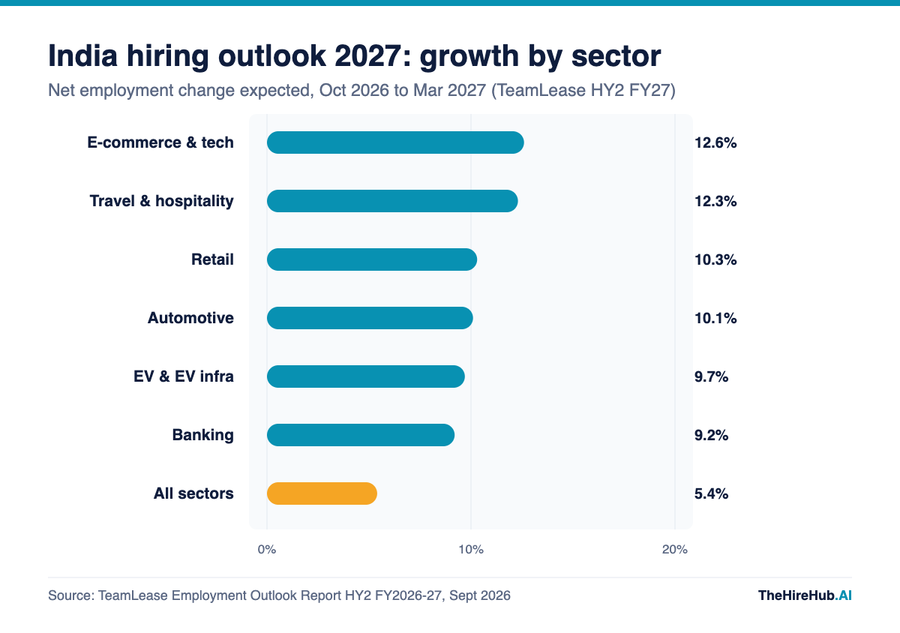
How to read this:
- The all-sector line is the planning baseline. If your business is not in a hot sector, 5.4% growth over six months is a reasonable ceiling for headcount plans, not a floor.
- Hot sectors raise everyone's salary floor. E-commerce, travel, retail and auto hiring at 10% to 13% pulls sales, operations and supply chain talent out of the market you hire from.
- Banking at 9.2% is the quiet one. BFSI growth shows up in both TeamLease and Naukri, which means finance, risk and analytics roles will be contested through 2027.
Sources and method
Figures come from ManpowerGroup's Employment Outlook Survey for Q4 2026 (3,055 Indian employers, fieldwork July 2026), TeamLease's Employment Outlook Report for HY2 FY2026-27 (released late September 2026), Naukri JobSpeak for October 2026 (Info Edge, job-posting index), HAN Digital's H1 FY27 IT-BPM estimate (August 2026) and Taggd's GCC Talent Lab Survey 2026 (August 2026). These measure different things: intent surveys, postings and net headcount. They should be read side by side for direction, never added together. None of them is a forecast for calendar 2027 as a whole; ManpowerGroup's Q1 2027 reading is due in December 2026.
How it actually works, and where it breaks
Employer outlook surveys work by asking a large sample of employers one question: will your headcount go up, down or stay flat next quarter or half-year? The net figure is simply the share expecting growth minus the share expecting cuts. That makes them good at catching direction early, often a quarter before posting data moves.
Is India's 54% outlook a hiring forecast?
No. A 54% Net Employment Outlook means 65% of surveyed employers expect to add staff and 11% expect to cut. It says nothing about how many people each will hire, and it is seasonally adjusted intent, not a count of jobs. Read it as a confidence gauge, and use TeamLease's 5.4% net employment change for sizing.
Where it breaks:
- Intent is not budget. An employer who says "increase" in July may hire two people or two hundred. Surveys weight both answers the same.
- Headlines hide sector splits. India's 54% sat alongside weaker IT services net additions in the same months. If you hire mostly engineers, the national number overstates how easy your year will be.
- Posting indexes count jobs, not hires. Naukri's index rose 14% year on year in October, but the month-on-month series fell from 3,053 in September to 2,836. Single months swing; trend lines across three to six months are what matter.
The practical rule: use outlook surveys to set your growth assumption, use posting data to sense competition for specific roles, and use your own funnel data to set timelines.
"An outlook survey tells you which way the market is moving, never how many people you will actually manage to hire."
What this means for your team
The outlook changes three things in a 2027 plan: how much buffer you build into timelines, which roles you start first, and how early you start.
How early should you start hiring for April 2027?
Earlier than feels necessary. TeamLease's employers report 35 to 45 days to fill a role, and 72% of those planning to grow expect moderate to significant difficulty hiring. Add candidate notice periods on top, and a role you open in February often does not start until after the new financial year begins. Our time to hire benchmarks break this down by role level.
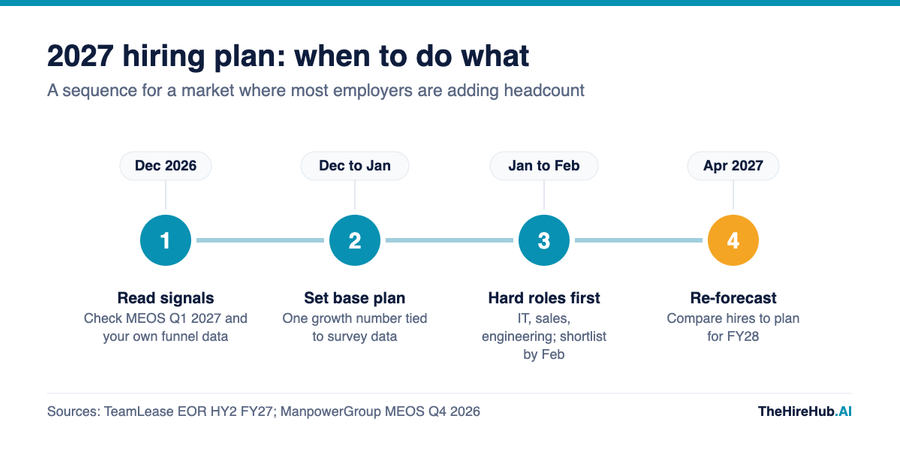
The fix is not to hire faster at every stage. It is to decide in December which roles are certain, open those first, and keep the uncertain ones behind a clear trigger such as a funding close or a signed customer. That keeps recruiters on the searches that will actually turn into hires.
Then sequence. The plan that works in a growing market looks like this:
A worked example
Take a 400-person company: at TeamLease's all-sector rate of 5.4%, that is about 22 net additions between October and March. If you sit in e-commerce or a tech start-up at 12.6%, it is closer to 50. Neither number includes backfills for people who leave, which in a hot market typically rises, so your recruiter capacity plan has to cover net growth plus attrition, not net growth alone. Size the team with our recruiter to hire ratio benchmarks, then turn the role list into a headcount planning template.
Outlook-led planning vs the rolling requisition
Most Indian companies still plan hiring as a rolling list of requisitions: a manager asks, finance approves, recruiting starts. That works in a flat market. In a market where 60% to 65% of employers say they are adding people at the same time, it means you start searching after your competitors have already locked the best candidates.
Outlook-led planning flips the order. You commit to a growth assumption for the year, build pipelines for the roles you know you will need, and release requisitions against a plan rather than one at a time. It costs more effort in December and January and saves weeks in March.
It also changes the conversation with finance: instead of approving roles one by one, they approve a growth number tied to published survey data, and you report hiring against it monthly. Rolling requisitions still have a place for genuine surprises, such as a resignation in a critical seat, but they should be the exception in a year like this one. If GCCs are part of your competitive set, our GCC hiring trends piece covers how they plan, and top recruitment trends in India covers the skills shifts behind the numbers.
How to actually do this (and the four traps)
Plan around three moves: set one growth assumption anchored to the survey data, rank roles by difficulty, and front-load the hardest searches. Then avoid these traps.
- Planning from the headline. India topping ManpowerGroup's table does not mean your roles are easy to fill. Check your sector line and your function before you set targets.
- Treating GCC hiring as a slowdown. GCC net additions fell in H1 FY27, but Taggd found 52% of GCCs expect to increase hiring in FY27, up from 47% a year earlier, and ANSR estimates new GCCs alone could add 30,000 to 35,000 jobs in 2027. They remain the toughest competitor for senior tech talent.
- Ignoring the AI skills premium. Taggd reports nearly half of GCC leaders say more than a quarter of open roles now need AI-related skills, and Naukri reported AI and ML postings up 20% year on year in September. Price those roles separately.
- Starting in March. With 35 to 45 days to fill plus notice periods, anything you want productive in Q1 FY28 needs a shortlist by February. Use cost per hire benchmarks to fund the early start.
"The strongest hiring year in India's recent surveys will feel like the hardest one to any team that starts planning in March."
The one thing every hiring leader should take from this
The 2027 outlook is the best India has posted in years, and that is exactly why it will be harder to hire, not easier. Every survey says more employers are chasing the same sales, engineering, finance and AI talent at once. The teams that come out ahead will be the ones that finished their plan in December, started their hardest searches in January, and used data rather than requisition queues to decide what to open first. If you want a second pair of eyes on your 2027 plan, we look at this stuff all day.
Frequently Asked Questions
Employer surveys published in late 2026 point to continued growth. ManpowerGroup put India's Net Employment Outlook at 54% for Q4 2026, the highest of 42 countries, and TeamLease projects 5.4% workforce growth for October 2026 to March 2027. Growth is strongest in e-commerce, travel, retail, auto and banking, and more selective in IT services.
No survey publishes a single 2027 hiring total. The best sizing signal is TeamLease's net employment change of 5.4% for October 2026 to March 2027, up from 4.7% in the previous half. Sector rates range from 9.2% in banking to 12.6% in e-commerce and tech start-ups.
On current data, hiring intent is higher and broader. ManpowerGroup's India outlook rose 11 points year on year to 54%, and Naukri's job index was up 14% in October 2026. The mix is shifting toward manufacturing, BFSI and AI-skilled roles, while IT services net additions fell in H1 FY27.
TeamLease's HY2 FY27 survey ranks e-commerce and tech start-ups (12.6%), travel and hospitality (12.3%), retail (10.3%), automotive (10.1%), EV and EV infrastructure (9.7%) and banking (9.2%) highest. Naukri's October 2026 postings show consumer durables, auto and industrial products growing fastest.
Partly. Naukri showed IT software and services postings up 5% year on year in October 2026, well below the overall 14%. HAN Digital estimated IT-BPM net additions fell more than 26% in H1 FY27. AI and ML roles are the exception, with Naukri reporting them up 20% in September 2026.
Yes, though more selectively. Taggd's GCC Talent Lab Survey 2026 found 52% of GCCs expect to increase hiring in FY27, up from 47%, and ANSR estimates new GCCs could add 30,000 to 35,000 jobs in 2027. Net GCC additions slowed in H1 FY27, according to HAN Digital.
It is the share of employers expecting to increase headcount minus the share expecting to cut it, seasonally adjusted. For India in Q4 2026, 65% expected increases and 11% expected cuts. It measures confidence and direction, not the number of jobs.
Employers in TeamLease's HY2 FY27 survey report 35 to 45 days to fill a role, before any candidate notice period. Among employers planning to grow, 72% expect moderate to significant difficulty, with IT, sales and marketing, and engineering named as the hardest functions.
ManpowerGroup's Employment Outlook Survey for Q1 2027 is due in December 2026. Naukri publishes JobSpeak monthly, and TeamLease publishes its Employment Outlook Report twice a year, so a refreshed reading for the first half of FY28 should follow in 2027.

