Campus Hiring in India for 2027: CTCs, Calendar and the Tier Math
What the 2026 data says about campus pay by tier, the hiring calendar for the 2027 batch, and where programmes lose their hires.
Campus hiring in India for 2027: median CTC by degree and tier, the month-by-month calendar for the 2027 batch, and the four traps that cost you hires.

TL;DR
Campus hiring in India for 2027 is a budget decision disguised as a recruiting event. Deloitte India's Campus Workforce Trends 2026 puts the median B.Tech CTC at ₹18.7 lakh from top-10 institutes against ₹5.75 lakh from Tier 3 campuses, a gap of more than 3x, while recruitment budgets rose 19%. TeamLease EdTech says 75% of employers intend to hire freshers in July to December 2026, but IT intent fell to 76%. The companies that win the 2027 batch pick their tiers deliberately, lock CTC bands before the season opens, and treat the months between offer and joining as part of hiring. If you are building the plan now, start from your headcount planning template.
What is actually happening
Campus hiring did not disappear when large IT services firms slowed down. It changed shape. Deloitte's 2026 study, covering 257 organisations and 505 campuses and published in late August 2026, found that 80% of organisations still run dedicated campus teams and that recruitment budgets grew 19% year on year. The money is going to fewer, better-targeted hires rather than mass drives.
The shift is visible in the sector data. TeamLease EdTech's Career Outlook Report for HY2 2026 (published 12 August 2026) shows overall fresher hiring intent rising to 75% from 73%, led by retail and e-commerce at 93% each and manufacturing at 89%. IT, the traditional anchor of Indian campus hiring, dropped from 81% to 76%. Bangalore leads cities at 89%, ahead of Mumbai at 75% and Chennai at 71%.
The other big change is skills over pedigree. Deloitte reports that AI and data skills now carry a 20% to 25% hiring premium at campus level, and analytical and problem-solving skills a further 10% to 15%. HirePro data cited in Unstop's 2026 campus report says 21% of employers have fully moved to skills-first fresher hiring, 42% are in transition, and 51% still weigh CGPA. That is why the old "top campuses only" playbook is breaking for anyone who does not have a top-campus budget.
Candidates have moved too. Unstop's Talent Report 2026, based on more than 37,000 students and over 500 HR leaders, found that 73% of undergraduates expect a starting salary above ₹5 LPA, while only 40% receive offers at that level. It also found that 95% are open to off-campus roles. Expectation gaps like that are where reneges and early exits start.
Finally, the reputational cost of getting it wrong is now public. In March 2026 People Matters reported that more than 1,000 engineering graduates selected by Tech Mahindra in 2025 were still waiting for offer letters close to a year later. Every student in the 2027 batch has heard stories like this, and they factor it into which offer they accept.
The numbers
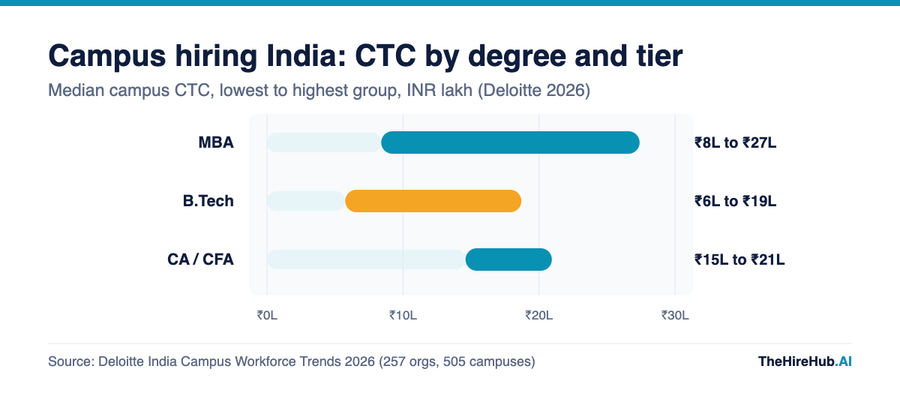
Here is the pay spread you are actually choosing between when you pick campuses. These are median CTC figures from Deloitte India's Campus Workforce Trends 2026, comparing the lowest and highest groups the study reports for each degree.
How to read this:
- The bar is your tier decision, not a salary band. An MBA hire costs ₹8.4 lakh from a Tier 3 campus and ₹27.4 lakh from a top-10 institute. Your budget, not your preference, usually decides where on that bar you sit.
- B.Tech is the widest relative gap. Top-10 engineering graduates cost about 3.3 times the Tier 3 median (₹18.7 lakh against ₹5.75 lakh), which is why tier mix matters most for tech-heavy plans.
- Rank still pays in finance. CA and CFA rank holders earn a median ₹20.95 lakh against ₹14.60 lakh for non-rank holders, roughly 43.5% more, excluding long-term incentives.
How much does campus hiring cost in India in 2027?
The salary is the largest line, and Deloitte's data shows pay growth has been modest: a compound annual rate of roughly 2% to 4% across major degrees from FY22 to FY26. For 2027 budgets, the honest starting point is the 2026 medians above plus a few percent, then the fixed costs of the programme itself: campus travel, assessment tooling, interviewer time, and joining or relocation support. Our cost per hire benchmarks cover how to price those non-salary lines.
Sources and method
CTC, budget, attrition and AI-adoption figures come from Deloitte India's Campus Workforce Trends 2026 (sixth edition, 257 organisations and 505 campuses, released 27 August 2026), as reported in Deloitte's press release and trade coverage. Hiring intent comes from the TeamLease EdTech Career Outlook Report HY2 2026, and student expectations from Unstop's Talent Report 2026. These are survey medians for participating employers and campuses; they do not cover every institute, and no published source gives a reliable all-India cost-per-campus-hire figure, so we do not quote one.
How it actually works, and where it breaks
A campus programme is a pipeline with an unusually long gap in the middle. You plan in spring, interview in late autumn and winter, and the person joins the following summer. Every month in that gap is a chance for the candidate to take a better offer, take a higher degree, or simply stop replying.
The first failure mode is tier mismatch. Teams budget for Tier 3 CTCs but recruit on Tier 1 reputation, then lose most of their offers to companies paying the top-10 median. Deloitte's figures make the cost of that mistake concrete: at B.Tech level the difference is roughly ₹13 lakh per hire.
The second is the offer-to-join gap. Deloitte reports first-year attrition for campus hires falling from 23% to 19%, and early attrition among top-10 and Tier 1 hires falling from 18% to 15%. Those numbers are better than they were, but on a cohort of 50 that is still around nine or ten people gone within a year. Most of that loss is set up before day one, by silence between offer and joining.
The third is over-trusting automation at the top of the funnel. Deloitte found 72% of organisations already use AI for resume screening and 48% for AI-based assessments. That makes screening fast, but if every employer filters on the same signals, you end up competing for the same narrow slice of candidates. Our guide to AI resume screening in India covers how to set the filters so they widen the pool rather than shrink it.
Claims check
Campus teams buying AI tools for 2027 will see speed claims. Here is how they compare with what independent data actually measures.
- Sourcing speed multipliers. Example: Findem's homepage claims "24x" "Faster sourcing" (findem.ai, checked 21 November 2026). No baseline or method is published on the page. In campus hiring, sourcing is rarely the constraint: the candidates are already on a placement cell list, and the losses Deloitte measures happen after the offer.
- Time-to-hire reductions. Example: hireEZ's site says "Hire 75% faster with hireEZ's agentic AI" (hireez.com, checked 21 November 2026). No sample or comparison period is shown on the page. Campus timelines are set by the placement calendar, so a tool can compress your internal steps but cannot move a campus day zero.
- What to ask instead. Ask any vendor for offer-acceptance and 12-month retention for campus cohorts, measured against your own previous year. Those are the metrics Deloitte tracks, and they are the ones that move your cost.
"In campus hiring the candidates are already found; what you lose them to is the silence between the offer and day one."
What this means for your team
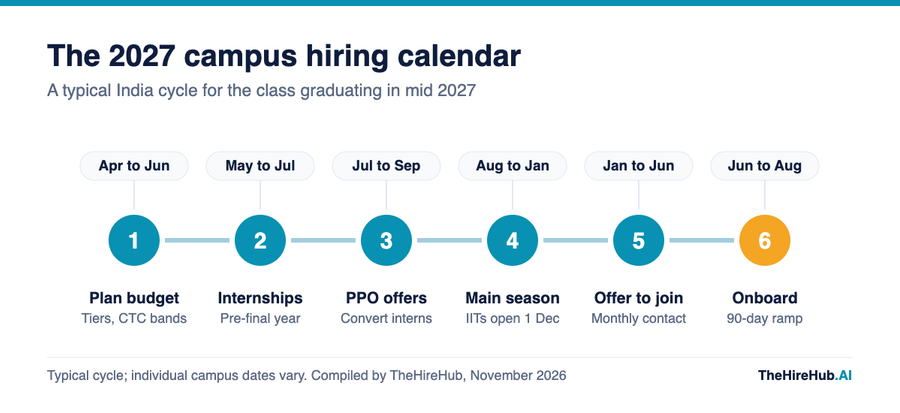
The practical answer is to run campus hiring as a fixed calendar with owners at each step, rather than as a winter scramble. For the class graduating in mid 2027, this is the sequence most Indian employers work to.
Stage by stage:
- Plan and budget (April to June). Fix the number of hires, the tier mix and the CTC band for each degree before you speak to a single placement cell. Tie it to your recruitment budget planning so the campus line is not raided mid-year.
- Internships (May to July). Pre-final-year interns are the cheapest way to see real work before you commit. Deloitte reports internship-to-PPO conversion improved about 6% year on year.
- Pre-placement offers (July to September). Convert the interns your managers rated highly, using a written rubric so decisions are consistent across teams.
- Main season (August to January). Most campus drives run in this window, and the IIT placement season opens on 1 December. Slot dates go to employers who registered early and have a clean record of honouring offers.
- Offer to join (January to June). Assign every offer holder a named contact and a monthly touchpoint. Silence in this window is where reneges come from, the same pattern behind candidate ghosting.
- Onboarding (June to August). A clear day one and a 90-day ramp plan are what turn the attrition numbers above in your favour.
Campus hiring vs off-campus fresher hiring
Campus hiring and off-campus fresher hiring look similar on paper but solve different problems. Campus programmes buy you a cohort: a batch that joins together, trains together and can be planned a year ahead. Off-campus hiring buys you flexibility, because you hire when the role opens and the candidate can usually join within weeks.
The trade-off is control versus timing. Unstop's data shows 95% of students are open to off-campus roles, so the pool exists, but you lose the structured assessment day and the placement cell's help with logistics. Many teams now run both: a smaller campus cohort for core roles and an always-on off-campus channel for the rest, measured with the same recruitment funnel conversion rates. For sector-specific trends on the IT side, see our IT fresher hiring in India breakdown.
How to actually do this (and the four traps)
Most campus programmes fail in predictable ways. These are the four we see most often when Indian companies plan their next batch.
- Choosing campuses by brand, not by budget. If your approved B.Tech band is ₹6 lakh to ₹8 lakh, recruiting at campuses where the median is ₹18.7 lakh guarantees a low acceptance rate. Match the tier to the band first, then pick the best campuses within that tier.
- Filtering on CGPA alone. With half of employers still weighing CGPA and AI or data skills earning a 20% to 25% premium, a hard cut-off screens out the candidates you most need. Use a short skills assessment instead, and keep the cut-off as a tiebreaker.
- Going quiet after the offer. The months between a December offer and a July joining date are when competitors and higher-studies plans pull candidates away. A monthly touchpoint costs almost nothing compared with re-hiring.
- Making offers you might not honour. Delayed onboarding becomes public fast, and placement cells remember. Only offer the number of seats your 2027 plan can actually fund, and give joining dates you can keep. Check the wider market signals before you commit, not after.
"Pick the tier your budget can win, then compete hard inside it, because a brilliant offer nobody accepts is the most expensive hire you never made."
The one thing every hiring leader should take from this
The biggest lever in campus hiring is decided before the season starts: which tiers you recruit from, at what CTC, and how you look after people between offer and joining. Deloitte's 2026 data shows a more than 3x pay spread between top-10 and Tier 3 graduates in the same degree, and first-year attrition still close to one in five. If your 2027 plan fixes the tier mix, the calendar and the offer-to-join routine now, the season itself becomes execution rather than improvisation. If you want a second pair of eyes on that plan, we look at this stuff all day.
Frequently Asked Questions
Campus hiring is recruiting final-year students directly through college placement cells, usually through on-campus drives, pre-placement talks and assessments. Employers make offers months before graduation and the hires join as a cohort, typically between June and August after the final exams.
For students graduating in mid 2027, internships ran in summer 2026, pre-placement offers followed from July to September, and the main placement season runs from roughly August 2026 to January 2027. The IIT placement season traditionally opens on 1 December. Joining is usually June to August 2027.
No source publishes 2027 salaries yet, so plan from current data. Deloitte India's Campus Workforce Trends 2026 puts median B.Tech CTC at ₹5.75 lakh from Tier 3 campuses and ₹18.7 lakh from top-10 institutes, and median MBA CTC at ₹8.4 lakh to ₹27.4 lakh. Pay grew roughly 2% to 4% a year from FY22 to FY26.
Based on 2026 data, the direction is more skills-first and more automated. Deloitte found 72% of organisations use AI for resume screening and AI and data skills carry a 20% to 25% hiring premium. TeamLease reports fresher demand shifting towards retail, e-commerce and manufacturing while IT hiring intent dipped.
Yes, if they can commit to a cohort and an onboarding plan. Startups rarely win at top-10 campuses on CTC, so the better play is strong Tier 2 and Tier 3 campuses matched to the approved salary band, a skills assessment instead of a CGPA cut-off, and internships that convert into pre-placement offers.
There is no single benchmark, but the trend is improving. Deloitte reports internship-to-PPO conversion rose about 6% year on year in its 2026 study, and Unstop's 2026 report found 16% of organisations convert more than 80% of interns. Track your own rate by team and use it to size next year's intern intake.
Most reneges come from silence and expectation gaps. Give every offer holder a named contact, check in monthly between offer and joining, share a fixed joining date, and avoid offering seats you may not fund. Unstop found 73% of undergraduates expect more than ₹5 LPA, so be clear about CTC early.
Deloitte's Campus Workforce Trends 2026 reports first-year attrition for campus hires falling from 23% to 19%, and early attrition among top-10 and Tier 1 hires falling from 18% to 15%. That still means close to one in five campus hires leave within a year, so onboarding matters.
Often, but less than before. HirePro data cited by Unstop says 51% of employers still weigh CGPA, while 21% have fully moved to skills-first hiring and 42% are in transition. Using a short skills test with CGPA as a tiebreaker widens the pool without lowering the bar.

