
UAE Work Permit Cost in Dubai: 2026 Fees and Your 2027 Budget
What a Dubai mainland employer pays MoHRE, GDRFA, DHA and ICP for one new hire, how long each step takes, and how to plan the 2027 line.
Every 2026 fee a Dubai mainland employer pays to hire from abroad, from MoHRE category fees to the AED 3,000 guarantee, plus the timeline and a 2027 budget plan.

TL;DR
The UAE work permit cost for a Dubai mainland employer is AED 300 to AED 3,500 per hire at MoHRE, depending on your establishment category, and roughly AED 2,000 to AED 10,100 once you add the guarantee or insurance, GDRFA visa fees, the medical, Emirates ID and basic health cover. For a typical Category 2 company hiring a skilled worker from abroad, government-listed fees come to about AED 2,390 before health insurance with worker protection insurance, or AED 5,250 if you lodge the refundable AED 3,000 bank guarantee instead.
As of November 2026, the government steps take days rather than weeks, thanks to MoHRE's Zero Bureaucracy changes and Dubai's Work Bundle. For 2027, we found no announced fee change. The swing factors are your MoHRE category and the renewal of every two-year permit you issued in 2025.
What is actually happening
Hiring a foreign worker onto a Dubai mainland licence means two approvals stacked on top of each other. The Ministry of Human Resources and Emiratisation (MoHRE) authorises the job, and GDRFA Dubai authorises the person to live here. The medical fitness test, Emirates ID and health insurance sit between them, and each authority prices its own step.
2026 changed the paperwork far more than the price. Under the federal Zero Government Bureaucracy programme, MoHRE reported in February 2026 that work permit processing time fell by 95%, that establishment quotas are now issued instantly instead of in up to 10 days, and that permit cancellation is a single procedure. In June and again this month, Gulf News reported that MoHRE had removed supporting-document requirements and cut mandatory data fields by about 75% to 97% across 13 permit types.
What did not change is the fee schedule. MoHRE fees still come from Cabinet Resolution No. 37 of 2022, which ties what you pay to how MoHRE classifies your company: Category 1 for top performers on Emiratisation and training, Category 2 as the default for compliant firms, Category 3 for violators. That classification is the biggest single variable in your budget, and it moves with your Emiratisation deadline record as much as with your payroll.
The numbers
Here is every line item for one new hire on a Dubai mainland licence, using the fee each authority publishes as of November 2026. The ranges reflect your MoHRE category, the protection option you choose, whether the hire is abroad or already in the UAE, and how fast you want the medical and ID done.
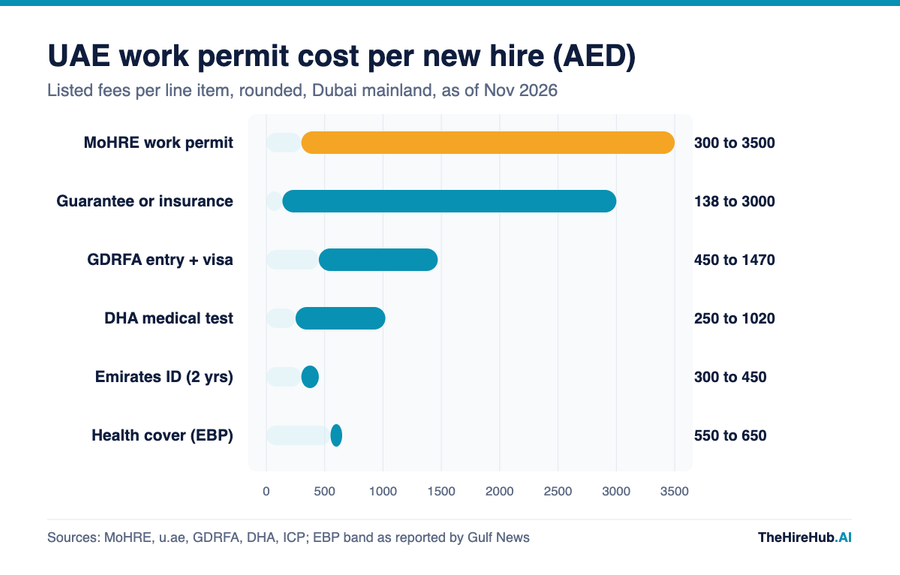
How to read this:
- The amber bar is the line most driven by your compliance record: AED 300 in Category 1, AED 1,250 in Category 2 and AED 3,500 in Category 3, each including the AED 50 application fee.
- The guarantee bar runs from AED 137.5 (insurance for a skilled worker) to AED 3,000 (bank guarantee), and the guarantee is refundable after cancellation, so treat it as working capital rather than cost.
- Health cover shows the Essential Benefits Plan band for staff earning under AED 4,000 a month; above that, the premium is whatever your insurer quotes for the plan you choose.
A worked example makes the spread concrete. A Category 2 company hiring a skilled sales manager from abroad on standard service pays AED 1,250 to MoHRE, AED 137.5 for protection insurance, AED 450 to GDRFA, AED 250 for the medical and AED 300 for a two-year Emirates ID. That is about AED 2,390, plus a health plan priced to the salary band, and a Category 3 company pays AED 2,250 more on the permit alone.
Sources and method
Each fee comes from the issuing authority's own service page, read in November 2026: MoHRE's new work permit service card for permit fees, u.ae for the guarantee and the worker protection insurance scheme, GDRFA Dubai for the entry and residence permits, ICP for the Emirates ID and DHA's published medical fitness catalogue. The health insurance band is as reported by Gulf News in July 2026, because we found no official published premium.
GDRFA notes its totals "may vary", so our GDRFA range runs from AED 450 for a hire abroad to AED 1,470 with every listed inside-the-country charge applied. We excluded typing charges except where an authority publishes a cap: MoHRE caps business service centre commission at AED 72 per service, and its own website and app charge only the federal fees.
How it actually works, and where it breaks
The sequence on the u.ae mainland recruiting guide is fixed: MoHRE establishment card and quota, signed offer, work permit, GDRFA company file and entry permit, then medical, Emirates ID and the residence visa. Dubai companies can run most of it through the Work Bundle, which MoHRE, GDRFA Dubai, ICP and Dubai Health built to cut onboarding from 30 working days to 5, documents from 16 to 5, and government visits from seven to two, as reported by Khaleej Times and Gulf News.
Where it breaks is rarely the portal. It breaks on the windows. Once MoHRE issues the permit, you have 60 days to pay the fees and the guarantee or insurance, or it is cancelled and you start again. Once the hire lands on the entry permit, they have 60 days to finish the medical, Emirates ID and residence.
It also breaks on documents the 2026 reforms did not remove from your side of the desk. MoHRE's own service card still asks for a passport valid for six months, a photo, the signed offer and academic certificates matched to the skill level. It does not treat anyone earning under AED 4,000 a month or without a degree as skilled, which changes the insurance premium (AED 137.5 skilled, AED 180 low-skilled) and how the role is recorded.
What is the difference between a work permit and a residence permit?
The work permit is MoHRE's authorisation for a specific worker to work for your establishment, valid two years for most permit types. The residence permit is GDRFA's authorisation for that person to live in the UAE (ICP handles it outside Dubai), also valid two years for private sector staff in Dubai. You need both, different authorities issue them, and cancelling one does not cancel the other.
That split matters for budgets because each renews on its own clock and carries its own fee. It also explains why employees talk about a "labour card" (the MoHRE permit) and an Emirates ID (the ICP identity card) as two separate things: they are.
"Your MoHRE category is a pricing decision you make every month through payroll and compliance, long before anyone files a work permit."
What this means for your team
For a 2027 hiring plan, multiply the per-hire figures by planned headcount, then add renewals for every two-year permit and residence visa issued in 2025 and annual health insurance renewals for everyone. As of November 2026 we found no announced change to MoHRE, GDRFA, ICP or DHA fees for 2027, so budget at current rates and revisit if the Cabinet amends Resolution No. 37 of 2022. The sequence for each hire looks like this:
- Confirm your MoHRE category before you budget. It sets the permit fee (AED 250, AED 1,200 or AED 3,450 for two years) and every renewal after it, and UAE and GCC nationals are exempt from these fees.
- Lock the quota and the signed offer. MoHRE says quotas now issue instantly, but the offer must be signed by both sides before the permit, so your offer acceptance rate and the job posting sites in the UAE you source from decide when this clock even starts.
- Apply for the work permit and pay inside 60 days. MoHRE lists two working days to process; you pay AED 50 plus the category fee and choose the AED 3,000 guarantee or the insurance policy.
- Open the GDRFA file and issue the entry permit. GDRFA lists AED 200 plus VAT and 48 hours, and the visa gives the hire 60 days from entry to complete residency.
- Book the medical, Emirates ID and health insurance together. DHA's regular medical is AED 250 in 24 working hours, ICP lists five days for the ID, and Gulf News reports the policy must exist before residency is issued.
- Issue the residence visa and diarise the renewal. GDRFA lists 48 hours and two-year validity; the next permit and visa renewal falls due in 2028 for anyone hired now.
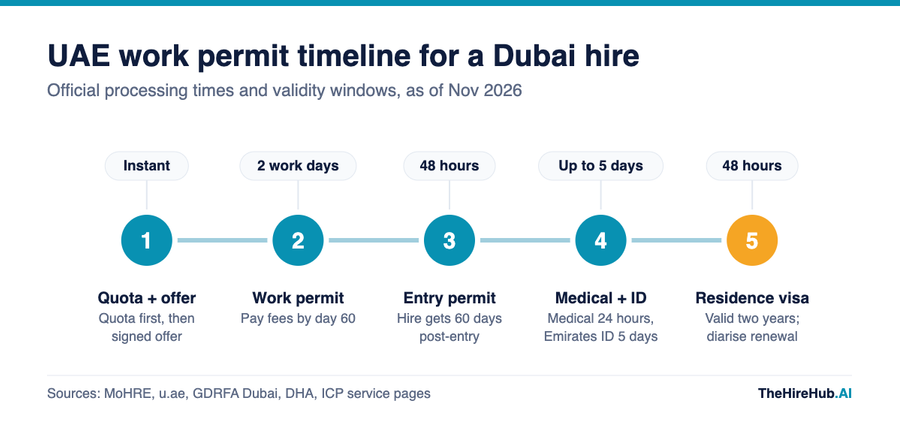
Run back to back, those published processing times add up to roughly two working weeks; the Work Bundle is designed to compress that to five working days. In practice the constraint is the hire, not the state: notice periods, flights and certificate attestation are where start dates slip, which is why time to hire benchmarks for Dubai roles should count from offer to residence, not offer to signature.
What happens on work permit cancellation in the UAE?
When employment ends, you settle final dues within 14 days under Article 53 (our guide to UAE labour law for employers covers the detail), file the cancellation with MoHRE, then cancel the residence with GDRFA. MoHRE needs your declaration that all entitlements were paid and, in most cases, the worker's signature; the service is free on MoHRE's website and app and takes about two working days, as reported by Gulf News in July 2026. Cancelling the work permit does not automatically cancel the residency, and the worker then has a 60-day grace period under GDRFA rules.
Two costs follow you out. Article 13 generally makes you pay the worker's return to where they were recruited from, and your AED 3,000 guarantee, if you lodged one, only comes back once the permit is cancelled and you claim it.
Sponsoring a hire vs the alternative
Three routes put someone to work for you in Dubai: sponsor a hire from abroad, hire someone already in the UAE, or have a third party employ them. A transfer permit costs the same category fee as a new one, and someone already in the country on a visit visa skips the flight but adds AED 520 in GDRFA inside-the-country charges to the entry permit. A local hire is not automatically cheaper in fees; it is usually faster.
The third route moves the paperwork off your licence but adds a provider fee on top. We cover those trade-offs in our guide to choosing a recruitment agency in Dubai and in AI recruiting vs agency; if you want to sponsor contractors as a business, the licensing questions sit in how to start a recruitment agency in Dubai.
The permit fees are rarely the expensive part of a hire; the weeks before the offer are. TheHireHub is an end-to-end AI recruitment platform covering the job description, sourcing, screening, AI interviews and interview scheduling across every channel an employer posts to, so the signed offer that starts this whole process arrives sooner. Compare your full spend against our cost per hire benchmarks, where government fees are usually a small slice.
How to actually do this (and the four traps)
Run each permit as a small project: one named owner, a fee budget per category, and a shared calendar holding every 60-day window and two-year renewal. Then avoid these four traps.
- Letting a hire start before the permit. Article 6 of the labour law bars employing anyone without a MoHRE permit, and employing a worker without one carries fines of AED 100,000 to AED 1 million, according to Gulf News in October 2026. A visit visa is not a trial period.
- Treating your category as fixed. Wage Protection System lapses, employing staff without permits or fake Emiratisation can push you into Category 3, where the same two-year permit costs AED 3,450 instead of AED 1,200. Across 20 hires that is AED 45,000 more per cycle, and renewals follow the same rate.
- Letting a 60-day window lapse. The permit is cancelled if fees go unpaid for 60 days, and the hire has 60 days from arrival to finish everything. Have the medical, biometrics and insurance policy lined up before the hire lands.
- Forgetting what cancellation costs. Final dues within 14 days, the return ticket and the claim to recover any AED 3,000 guarantee all land on you. Article 6 also bars charging the worker recruitment and employment costs, so permit, visa and guarantee costs cannot be clawed back from salary either.
"Budget the fees, but manage the calendar: a missed 60-day window costs far more than any line on the government price list."
The one thing every hiring leader in Dubai should take from this
The UAE work permit cost is set more by your compliance record than by the government price list. In 2026 a compliant Category 2 company pays about AED 2,390 in listed fees for a skilled hire from abroad on insurance, and the state side takes days; a Category 3 company pays more on every permit and every renewal. For 2027, budget at current rates, add your 2025 renewals, keep the Emiratisation line clean through the 31 December deadline, and if you want a second pair of eyes on the plan, we look at this stuff all day.
Frequently Asked Questions
For a Dubai mainland company in MoHRE Category 2, sponsoring one skilled hire from abroad costs about AED 2,390 in government-listed fees as of November 2026: AED 1,250 for the MoHRE permit, AED 137.5 for protection insurance, AED 450 to GDRFA, AED 250 for the medical and AED 300 for the Emirates ID. Add health insurance on top, or AED 3,000 if you choose the refundable bank guarantee.
The employer applies, not the worker. A Dubai mainland company needs a MoHRE establishment card and quota plus a job offer signed by both sides, then applies on the MoHRE website, app or at a business service centre, and MoHRE lists two working days to process. As of November 2026, fees and the guarantee or insurance must be paid within 60 days. This is general information, not legal advice.
For employers, it usually means the AED 3,000 bank guarantee MoHRE requires per worker, refundable after the permit is cancelled. As of November 2026 it is optional: under Ministerial Resolution No. 318 of 2022 you can buy worker protection insurance instead, from AED 137.5 per worker. Separately, u.ae says residents need AED 4,000, or AED 3,000 plus accommodation, to sponsor family. This is general information, not legal advice.
Budget at 2026 rates, because as of November 2026 we found no announced change to MoHRE, GDRFA, ICP or DHA fees for 2027. Plan AED 300 to AED 3,500 per MoHRE permit depending on your category and roughly AED 2,000 to AED 10,100 per hire all-in, then add renewals for every two-year permit issued in 2025 and annual health insurance for all staff.
No. Article 6 of Federal Decree-Law No. 33 of 2021 bars an employer from employing any worker without a MoHRE work permit, the document most people call the labour card. As of November 2026, MoHRE warns that employing a worker without one carries fines of AED 100,000 to AED 1 million, whatever the type of job. This is general information, not legal advice.
No. The labour card is the MoHRE work permit that lets a person work for one specific UAE employer, while the Emirates ID is the identity card ICP issues to residents, at AED 100 per year of residence plus an AED 100 service fee as of November 2026. You need the Emirates ID number to open the digital labour card in UAE Pass, but they are separate documents.
The quickest route is the MoHRE app: log in with UAE Pass and open your employee profile, which shows the labour card number with its issue and expiry dates. You can also add the digital labour card to UAE Pass using your Emirates ID number, or ask a Tas'heel business service centre for your employment details.
Check it in the MoHRE app after logging in with UAE Pass, which shows the labour card's issue and expiry dates, or through the digital labour card in UAE Pass. For a new application, Dubai employers using the Work Bundle get real-time request tracking, and as of November 2026 MoHRE lists two working days to process a new permit, with quotas now issued instantly.
A UAE work permit for recruiting from abroad or a transfer is valid for two years as of November 2026, and renews at the same MoHRE category fee of AED 250, AED 1,200 or AED 3,450. Before that, the employer has 60 days to pay fees and the guarantee or insurance, and the hire has 60 days from entry to complete residency. This is general information, not legal advice.
The MoHRE cancellation itself is free on the website and app, or up to AED 72 at a business service centre, as of November 2026. The real costs are final dues within 14 days under Article 53, the worker's return ticket under Article 13, and separately cancelling the residence with GDRFA; any AED 3,000 guarantee becomes refundable. This is general information, not legal advice.


