
UAE Labour Law for Employers: What Dubai HR Must Get Right in 2027
The 2026 rules on contracts, notice, leave, WPS pay and gratuity, plus what is and is not announced for 2027.
What UAE labour law requires of Dubai employers in 2026: contracts, notice, leave, the new WPS payday and gratuity with a worked AED example, plus what to fix before 2027.

TL;DR
UAE labour law for employers in Dubai still runs on Federal Decree-Law No. 33 of 2021: written fixed-term contracts, probation of up to six months, notice of 30 to 90 days, paid annual and sick leave, salaries through the Wage Protection System (WPS), and end-of-service gratuity of 21 to 30 days' basic wage per year of service. What changed in 2026 was enforcement, not the statute: salaries are now due on the 1st of each month, Emiratis must earn at least AED 6,000 a month, and work permit paperwork was cut.
As of November 2026, no new labour law rules have been announced for 2027. The 2027 job for HR teams is execution: payroll dates, offer letters, notice clauses and clean exits, because that is where fines of AED 100,000 to AED 1,000,000 and two-year claim windows bite.
What is actually happening
The core statute has barely moved since 2024. Federal Decree-Law No. 33 of 2021 governs private-sector employment, and its last major amendment, Federal Decree-Law No. 9 of 2024, raised fines for unlicensed hiring, permit misuse and fake Emiratisation to between AED 100,000 and AED 1,000,000, and gave employees two years after exit to file a claim, as Gulf News reported. DIFC and ADGM run their own employment laws, so employers licensed in those two zones should check which regime applies.
What did change in 2026 sits in ministerial resolutions and MoHRE systems:
- Payday is now the 1st. Under Ministerial Resolution No. 340 of 2026, in force since 1 June 2026, wages are due on the first day of the following month through WPS, and the old 15-day grace period is gone (Gulf News). An employer counts as compliant only if at least 85% of wages due are paid on time.
- An Emirati salary floor. MoHRE set a minimum of AED 6,000 a month for Emiratis in the private sector from 1 January 2026, with older contracts to be raised by 30 June 2026 (MoHRE). From 1 July 2026, an Emirati paid less does not count toward targets, and the company is barred from new work permits until it fixes the salary.
- Less permit paperwork. In November 2026, MoHRE removed supporting-document uploads for all 13 work permit types and cut required data fields by 75% to 97% for some permits under the Zero Bureaucracy programme (Gulf News). For the fee side, see our breakdown of UAE work permit cost.
For 2027, the honest position is that nothing new has been announced. The government's Emiratisation guidance, updated in October 2026, lists no quota rules beyond the current Emiratisation deadline of 31 December 2026. The one fixed point on the 2027 calendar is Ramadan, expected from about 8 February 2027 subject to moon sighting; in 2026 MoHRE cut private-sector hours by two a day for the month, so plan rosters for a similar announcement.
The numbers
Most of what goes wrong under UAE labour law is a count of days. This chart puts the statutory ranges on one scale.
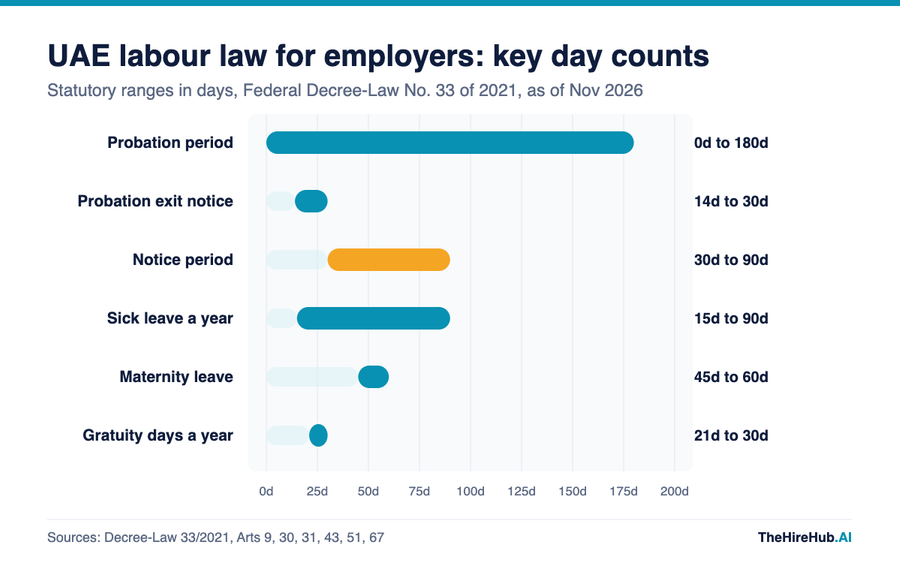
How to read this:
- Each bar is the range the law allows or sets, in days: probation can run up to 180 days (Article 67 counts a month as 30 days), probation exit notice runs from 14 days to one month, and notice must sit between 30 and 90 days.
- For leave, the low end is full pay and the high end is the total: 15 of the 90 sick days are on full pay, and 45 of the 60 maternity days.
- Gratuity is shown in days of basic wage earned per year of service: 21 for each of the first five years, 30 for each year after.
Sources and method
Every range comes from the official English text of Federal Decree-Law No. 33 of 2021 (Articles 9, 29 to 31, 43, 51 and 67), checked against u.ae and MoHRE announcements as of November 2026. Where a press report and an official page differed, we used the official page, and we cut any figure we could not confirm. DIFC and ADGM, which have their own employment laws, are outside this chart.
How it actually works, and where it breaks
On paper the rules are short. In practice they break at the handoffs: offer to contract, payroll to WPS, resignation to exit. These are the rules a Dubai employer runs every month:
- Contracts. Every contract must be written and fixed-term. The three-year cap was removed in 2022, and MoHRE's deadline to convert old unlimited contracts passed on 31 December 2023.
- Hours and overtime. Normal hours are capped at 8 a day or 48 a week (Article 17). Overtime is limited to two hours a day and pays the basic wage plus at least 25%, or 50% between 10 pm and 4 am (Article 19).
- Annual leave. At least 30 days a year after the first year, and two days a month between six months and one year (Article 29). Unused leave is paid out on exit.
- Sick leave. Up to 90 days a year after probation: 15 at full pay, 30 at half pay and the rest unpaid, with no paid sick leave during probation (Article 31).
- Family leave. Maternity leave is 60 days (45 on full pay, 15 on half pay), parental leave is five working days within six months of the birth, and bereavement leave is five days for a spouse or three for close family (Articles 30 and 32).
- Conduct. Discrimination on race, colour, sex, religion, nationality, social origin or disability is banned (Article 4), as are harassment and bullying (Article 14), withholding a worker's official documents (Article 13) and charging workers recruitment fees (Article 6).
The rule itself is rarely the problem. Things break when the basic salary in the offer is set low to save cost, when the contract's notice clause does not match the offer letter, or when payroll still runs on a pre-June 2026 calendar. Gratuity is where all three show up at once.
How to calculate gratuity and end of service benefits in the UAE?
Article 51 gives a foreign full-time employee with at least one year of continuous service 21 days' basic wage for each of the first five years and 30 days' basic wage for each year after that, capped at two years' wage. It is calculated on the last basic wage only, not allowances. Part years after the first year count pro rata, and days of unpaid absence are excluded; Emiratis are covered by the pension system instead.
Article 67 treats a month as 30 days, so the daily rate is basic salary divided by 30, the same method Gulf News uses. Worked example on a basic salary of AED 10,000 (daily rate AED 333.33):
- 3 years of service: 3 × 21 = 63 days, and 63 × (10,000 ÷ 30) = AED 21,000.
- 7 years of service: (5 × 21) + (2 × 30) = 165 days, and 165 × (10,000 ÷ 30) = AED 55,000.
- 3 years and 6 months: 3.5 × 21 = 73.5 days, so AED 24,500.
- The cap: two years' wage is AED 240,000 at this salary, reached only after about 25 and a half years.
Two points catch employers out. Resignation no longer reduces gratuity under the 2021 law, and all dues (wages, leave pay and gratuity) must be paid within 14 days of the contract ending (Article 53).
"The gratuity formula is the easy part. The hard part is the basic salary you agreed to years ago in an offer nobody reread."
What this means for your team
Seven fixes, in the order we would make them before January 2027:
- Re-paper the offer and the contract together. Same probation, same notice period for both sides, same basic salary, a fixed term. If your offer acceptance rate is healthy but disputes follow, check whether the offer letter promised what the contract delivers.
- Move payroll so it lands by the 1st. From day 5 of a late payment MoHRE suspends new work permits; from day 11, repeat offenders within six months face fines and a downgrade to the third classification category; from day 16, labour disputes are registered automatically; from day 21 come enforcement orders, asset attachment and travel bans, according to u.ae.
- Check every Emirati salary is at least AED 6,000. Below that, the hire does not count toward your target and new permits are blocked.
- Write the leave policy down. Carrying annual leave forward needs employer approval under your internal rules (Article 29), so set the rule before year-end balances pile up, and plan Ramadan 2027 rosters now.
- Accrue gratuity monthly on basic salary. A provision that tracks basic pay avoids an AED 55,000 surprise inside a single 14-day window.
- Run exits as a checklist. The employee signs the cancellation form confirming dues are received, MoHRE cancels the permit within two working days once requirements are met, and the employer pays the return ticket unless the worker caused the termination or joined another employer (Article 13).
- Keep records for at least two years after exit. That is the claim window, and WPS records are what disputes turn on; the same discipline applies to candidate files, covered in our guide to recruitment data privacy.
What does UAE labour law say about resignation?
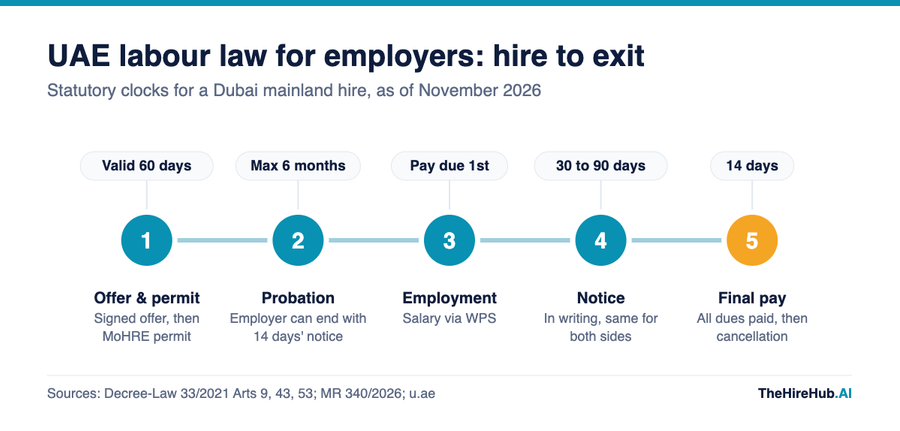
A resignation is termination by notice under Article 43: in writing, with the contract's notice period of 30 to 90 days, and the same period for both sides unless a difference favours the worker. The employee works and is paid in full through notice, and whoever skips notice owes the other side the wage for the period not served. During probation, an employee moving to another UAE employer gives one month's notice and the new employer compensates the old one for recruitment costs unless agreed otherwise, while an employee leaving the UAE gives 14 days (Article 9).
Notice is also the hidden part of your time to hire benchmarks. A candidate on a 90-day clause cannot start for three months unless their current employer agrees to release them early.
Compliance built into hiring vs the alternative
The alternative to building compliance into hiring is fixing it at exit, and exit is the most expensive place to fix anything. By then the basic salary is set, the notice clause is signed, and the employee has two years to file a claim. MoHRE decisions turn on the written contract and WPS records, not on what the hiring manager meant.
Front-loading it means the offer stage carries the legal checks: the right permit type, a basic-to-allowance split you can defend, probation and notice that match the contract, and a start date that respects the candidate's current notice. TheHireHub is an end-to-end AI recruitment platform that runs job descriptions, sourcing, screening, AI interviews and interview scheduling across every channel an employer posts to, so the record of who was assessed and offered what sits in one place. People still make the decision, which is why a human in the loop hiring model is the defensible one.
If you use a recruitment agency in Dubai, the same law binds them: recruitment needs a MoHRE licence, and nobody may charge the worker recruitment fees (Article 6). Owners who plan to start a recruitment agency in Dubai should build both into the model from day one. Your ads on job posting sites in the UAE are the first written statement of your terms, so keep them consistent with the offer and free of the grounds Article 4 bans.
How to actually do this (and the four traps)
Most of the work is a one-off audit of contracts, payroll and leave balances, followed by monthly discipline. Four traps to avoid:
- Treating basic salary as a cost lever. Gratuity (Article 51) and overtime (Article 19) are both calculated on basic wage, so a low basic looks cheap until someone challenges it. Set it at a level you can explain, and do not cut it in the run-up to an exit.
- One-sided or oversized notice clauses. Notice must be between 30 and 90 days and the same for both parties unless the difference favours the worker (Article 43). A 90-day clause for the employee and 30 days for the employer does not comply.
- Paying on the old calendar. A payroll that still clears on the 5th out of habit is now late. From day 5, MoHRE can freeze new work permits, which stops hiring until wages are settled.
- Stretching probation. Probation is capped at six months and allowed once per employer (Article 9). Extending it past six months or restarting it after an internal move is not allowed, and ending it still needs 14 days' written notice.
"In a MoHRE dispute, a policy you followed but never documented is worth about as much as a policy you never had."
The one thing every hiring leader in Dubai should take from this
UAE labour law in 2026 is less about new rules than about proof. The statute has barely moved, but MoHRE now monitors payroll electronically from the day after payday, checks Emirati salaries against a hard floor and settles disputes on documents. Going into 2027, the employers who stay out of trouble will be the ones whose offer letter, contract, WPS file and exit form all say the same thing, and if you want a second pair of eyes on yours, we look at this stuff all day.
Frequently Asked Questions
As of November 2026, the biggest change is Ministerial Resolution No. 340 of 2026: since 1 June 2026, salaries are due through WPS on the 1st of each month with no 15-day grace period. Emiratis must also earn at least AED 6,000 a month, and MoHRE has removed supporting documents for all 13 work permit types. This is general information, not legal advice.
Under Article 51 of Federal Decree-Law No. 33 of 2021, pay 21 days' basic salary per year for the first five years and 30 days per year after, capped at two years' wage. Divide monthly basic by 30 for the daily rate: on AED 10,000 basic, 3 years earns AED 21,000 and 7 years AED 55,000. This is general information, not legal advice.
Up to 90 days a year after probation, under Article 31 of the UAE labour law: the first 15 days on full pay, the next 30 on half pay and the rest unpaid. There is no paid sick leave during probation, and employees must report illness to the employer within three working days. This is general information, not legal advice.
As of November 2026, salary is late if it is not paid through WPS on the 1st of the month. MoHRE monitors from the next day, suspends new work permits from day 5, fines and downgrades repeat offenders from day 11, registers labour disputes from day 16 and can order asset attachment and travel bans from day 21. This is general information, not legal advice.
There is no general minimum wage for private-sector employees in the UAE as of November 2026; u.ae states the labour law sets no minimum salary, though Article 27 lets the Cabinet set one. The exception is Emiratis, who must earn at least AED 6,000 a month in the private sector from 1 January 2026. This is general information, not legal advice.
Since 1 January 2026, MoHRE requires private-sector employers to pay Emiratis at least AED 6,000 a month, with older contracts raised by 30 June 2026. From 1 July 2026, an Emirati paid less does not count toward Emiratisation targets. As of November 2026, no change for 2027 has been announced, so plan 2027 budgets on the AED 6,000 floor. This is general information, not legal advice.
Article 37 of Federal Decree-Law No. 33 of 2021 covers work injuries and occupational disease. The employer pays treatment, full wage for up to six months, then half wage for up to six more months; if the worker dies, the family receives 24 months' basic wage, at least AED 18,000 and at most AED 200,000. This is general information, not legal advice.
Up to six months, once per employer, under Article 9. A Dubai employer ending probation must give 14 days' written notice. An employee leaving for another UAE employer gives one month, and the new employer compensates you for recruitment costs unless agreed otherwise; an employee leaving the UAE gives 14 days. This is general information, not legal advice.
MoHRE says work permit cancellation takes two working days once requirements are met: fines settled, an employer statement that all dues are paid, and the employee's signature. The residence visa is then cancelled with GDRFA Dubai, and the grace period to leave or switch jobs depends on visa category, from 30 days to six months. This is general information, not legal advice.
As of November 2026, issuing or renewing a MoHRE work permit costs AED 250 to AED 3,450 depending on the company's classification, according to u.ae. Mainland employers also lodge a bank guarantee of AED 3,000 per employee. Cancelling a permit is free on the MoHRE website and app, with business centre commission capped at AED 72. This is general information, not legal advice.


