
The UAE Emiratisation deadline: what Dubai companies must do before 2027
Seven weeks before the 31 December 2026 cut-off, here is how your target is calculated, how MoHRE enforces it, what a miss costs in AED and what is still unknown for 2027.
Dubai mainland firms must reach 10% Emiratis in skilled roles by 31 December 2026. How the target is calculated, what a miss costs in AED and what 2027 holds.

TL;DR
The UAE Emiratisation deadline for 2026 is 31 December: Dubai mainland companies with 50 or more employees must add the second 1% of this year's 2% growth in Emiratis in skilled roles, taking the cumulative share to 10%. Miss it and the reported cost is AED 10,000 a month (AED 120,000 a year) for every Emirati you are short, and faking the hire costs more.
- Your target is your skilled headcount times the target rate, as MoHRE records it: 500 skilled staff means 50 Emiratis in skilled roles at the 10% benchmark.
- A hire only counts with a valid work permit, a genuine job, pay of at least AED 6,000 a month through WPS and pension registration.
- Real estate and retail firms with 20 to 49 staff sit in the 14 sectors that had to hire one Emirati in 2024 and a second in 2025, and keep them.
- For 2027, only sector-specific changes and the Nafis extension to 2040 are announced as of November 2026. No new general target or contribution rate has been published.
What is actually happening
On 30 October 2026 the Ministry of Human Resources and Emiratisation (MoHRE) urged private firms to hit their 2026 targets by 31 December, according to Gulf News. The rule covers mainland establishments with 50 or more workers: a further 1% of Emiratis in skilled roles in the second half, on top of the 1% due by 30 June. The ministry also told employers to offer genuine jobs, register Emiratis for pension and pay wages through approved channels. Free-zone companies remain outside the quotas.
Most firms are on track. MoHRE said in July that about 95% of covered companies met the first-half target, and that more than 190,000 Emiratis now work at nearly 32,000 private companies. That leaves a minority who missed June, and a larger group who scraped through and now need a second round of hires before year-end.
Smaller firms have their own tier. Since 2024, companies with 20 to 49 employees in 14 sectors, including real estate activities and wholesale and retail trade, had to hire one Emirati by end-2024 and a second by end-2025, per the UAE government portal. Missing those cost AED 96,000 (charged January 2025) and AED 108,000 (January 2026). As of November 2026 we found no published 2026 hiring target for this tier, but the existing Emirati hires must be kept.
What is known for 2027, as of November 2026:
- Private healthcare facilities with 50 or more staff will be assessed from 2027 on putting half of their annual 2% into specialised healthcare roles.
- Nafis, the federal Emirati hiring programme, runs to 2040, and since September 2026 it no longer covers the employer's share of Emirati pension contributions.
- Not yet published: a general target beyond 10%, a 2027 contribution rate, and the date MoHRE starts collecting on second-half 2026 shortfalls.
The numbers
The cost of missing the Emiratisation deadline is not one number. It depends on whether you simply fall short, or try to engineer your way past the target.
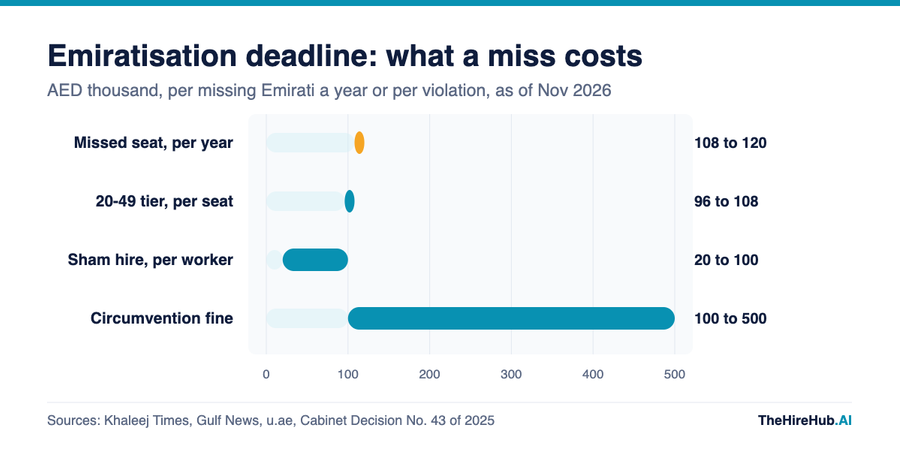
How to read this:
- The amber bar is the main risk for an honest shortfall: the contribution per missing Emirati rose from AED 108,000 for 2025 to a reported AED 120,000 a year in 2026, charged at AED 10,000 a month from 1 July 2026 for first-half misses.
- The two fine bars are for manipulation, not shortfalls: AED 20,000 to 100,000 per worker for sham hires, and AED 100,000, 300,000 and 500,000 for a first, second and third attempt to circumvent targets.
- The 20 to 49 bar shows what smaller firms in the 14 covered sectors, real estate and retail included, were charged in January 2025 and January 2026 for each missing hire.
Sources and method
The 2026 contribution is from Khaleej Times and Gulf News (June 2026); the 2025 figure is from Gulf News (December 2025); the 20 to 49 figures are from the u.ae portal. Fine ranges are from Cabinet Decision No. 43 of 2025, the rules on Nafis and Emiratisation violations. Values are in AED thousand, as of November 2026. The u.ae page still describes an older schedule of AED 6,000 a month rising AED 1,000 a year, so we use the 2026 rate as reported by the press, and the figures in MoHRE's systems for your establishment are what count.
How it actually works, and where it breaks
The target is measured on MoHRE's records, not your HR spreadsheet. An Emirati counts only when four things line up: a valid MoHRE work permit and contract, salary paid through the Wages Protection System (WPS), pension registration, and a real job with real duties. From 1 July 2026, an Emirati paid below the AED 6,000 monthly floor does not count at all, and the company's new work permits are suspended until pay is fixed, as Gulf News reported.
Timing is where companies get caught. The u.ae portal says employers must register an Emirati with the pension system and start contributions within one month of the work permit being issued. For the 2025 targets, MoHRE said it would verify compliance from January 2026 by checking whether new Emirati hires were registered for social insurance and whether contributions were paid regularly (Gulf News, December 2025). A hire signed on 28 December with no pension file is a risk, not a result.
This is lawful positive action. Article 4 of Federal Decree-Law No. 33 of 2021 says rules that enhance citizens' participation in the labour market are not deemed discriminatory, and our guide to UAE labour law for employers covers the rest of the code you hire under.
How are Emiratisation targets calculated for my company?
Start with skilled headcount, not total headcount. The rule is 2% growth a year in Emiratis in skilled jobs, 1% per half, reaching a cumulative 10% by the end of 2026, which puts the mid-year checkpoint at 9%. Khaleej Times' worked example is simple: a company with 500 skilled employees needs 50 Emiratis in skilled roles.
Two illustrative Dubai cases, using the same arithmetic:
- A mainland retail group with 300 skilled roles needs 30 Emiratis in those roles by 31 December. If it held 27 (9%) after June, its second-half gap is three hires, plus a replacement for anyone who resigns.
- A mainland real estate brokerage with 35 staff falls in the 20 to 49 tier: two Emiratis, hired by end-2024 and end-2025, kept on payroll and paid at least AED 6,000.
Your exact number, including rounding and which roles MoHRE classifies as skilled on each work permit, is the one in the ministry's systems. Check it through MoHRE's service channels or its call centre (600590000) before you plan around it.
"Emiratisation stops being a compliance chore the day the Emirati hire gets a real seat, a real manager and a reason to still be there next year."
What this means for your team
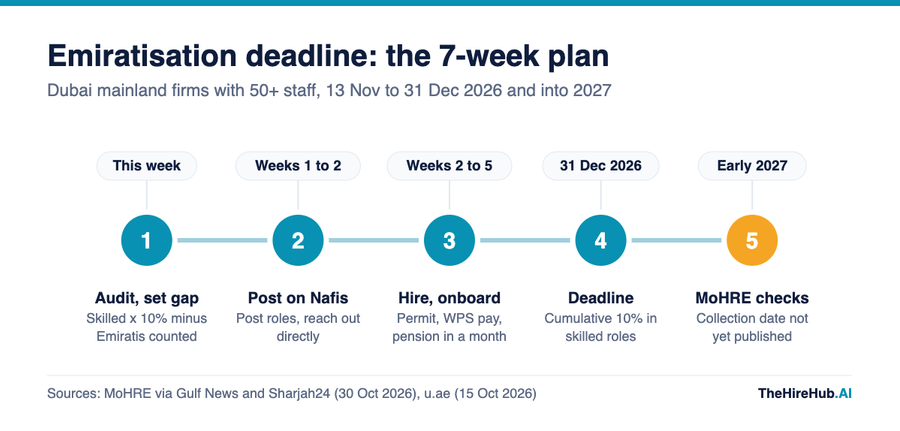
Seven weeks is enough for a small gap and too short for a large one, given typical time to hire benchmarks. Work backwards from 31 December:
- Audit this week. Pull skilled headcount and your Emirati list from MoHRE's records, and check every Emirati is paid at least AED 6,000 through WPS and registered for pension.
- Set the gap. Skilled headcount times 10%, minus the Emiratis who already count, plus a buffer of one if anyone is likely to resign.
- Post on Nafis now. MoHRE has told employers to advertise vacancies on Nafis and use its direct-contact features to reach candidates.
- Interview within days, not weeks. Book interviews quickly and confirm the day before, because each interview no-show costs you days you no longer have.
- Onboard by mid-December. Issue the work permit, put the hire on WPS payroll and register the pension within the month, and budget the permit using our breakdown of UAE work permit cost.
- Document the job. Keep the job description, reporting line, duties and attendance on file, because MoHRE uses field inspections and digital monitoring to test whether the role is real.
How can I find candidates for job opportunities specifically for UAE nationals?
Nafis is the first stop. It is the federal platform where MoHRE asks employers to post vacancies and contact Emirati jobseekers directly, and it now runs to 2040. Treat it as one channel next to the job posting sites in the UAE your recruiters already use, and post the same role everywhere so you are not waiting on one pipeline.
Sector programmes help. In real estate, the Dubai Land Department's Real Estate Empowerment Programme, run with MoHRE, Nafis and Dubai's Emirati human resources council, created more than 2,100 employment opportunities for Emiratis between 2023 and 2026, according to DLD. In retail, Khaleej Times reported that Alshaya expected to grow from about 50 Emirati employees to more than 420 by end-2026, using flexible contracts, head-office roles and cultural-awareness sessions for expatriate store managers.
Know the package before you make the offer. From September 2026, Nafis salary support for new beneficiaries is capped at AED 6,000 a month for bachelor's degree holders, AED 5,000 for diploma holders and AED 4,000 for secondary graduates, for salaries between AED 6,000 and AED 20,000, per Khaleej Times. That support goes to the employee, and the employer now pays its own statutory pension share, so explain the total clearly to protect your offer acceptance rate.
Emiratisation vs the alternative
The alternative to hiring is paying, and the maths is lopsided. A missing Emirati costs a reported AED 120,000 a year in contributions and adds nothing to the business. An Emirati hired at the AED 6,000 floor costs AED 72,000 a year in salary plus the employer's 12.5% pension share, and does a job; most skilled roles will pay more, but the contribution never turns into capability. Companies that beat their targets can also join MoHRE's Emiratisation Partners Club, worth up to 80% off ministry service fees.
The second alternative is to hand the search to a recruitment agency in Dubai with an Emirati desk. That can work for senior or specialist roles, but compare the fee against your own cost per hire benchmarks and check that the agency is screening for retention, not just for a December start date. If you run, or plan to start a recruitment agency in Dubai, the run-up to each Emiratisation deadline is the natural time to build an Emirati talent pool for clients.
The third alternative, faking it, is the expensive one. Sham Emiratisation draws AED 20,000 to 100,000 per worker plus a refund of Nafis benefits, and MoHRE found 377 fake cases at 266 companies in the first half of 2026 (Khaleej Times, September 2026).
The practical answer is to run Emirati hiring as a standing pipeline rather than a year-end sprint. TheHireHub is an end-to-end AI recruitment platform that writes the job description, sources, screens, runs AI interviews and schedules interviews across every channel an employer posts to, and lets recruitment agencies run many clients' mandates from one account.
How to actually do this (and the four traps)
The mechanics are simple. These four traps are where Dubai companies lose the target, or pay for it twice.
- Counting a hire before MoHRE does. An offer letter is not a counted Emirati. Until the work permit is issued, WPS salary is flowing at AED 6,000 or more and the pension file is open, assume the seat is still empty.
- Shrinking or relabelling your way to the number. Cabinet Decision No. 43 of 2025 treats cutting headcount or altering your workforce classification to dodge the target as circumvention: AED 100,000 for a first offence, rising to AED 500,000 for a third. You must still meet the target based on your position before the change.
- Paper Emiratisation. A work permit and contract with no real job is a sham hire, and the per-worker fine stacks for every name on the list. MoHRE has also said breaches can drop a company to the lowest tier of its establishment classification.
- Hiring for December instead of for March. The target is cumulative, so every resignation reopens the gap. Give Emirati hires a manager, a development plan and a real seat in the team; Alshaya says attrition fell after it added flexible contracts and head-office roles.
"A contribution cheque buys no employee, no capability and no goodwill. It is the price of a hiring plan that started too late."
The one thing every hiring leader in Dubai should take from this
Treat 31 December as a floor, not a finish line. Hit 10% with hires who will still be there in March, because no 2027 rule has been published yet and the safest assumption is that the position you build must be kept. The firms that will have an easy January are the ones that audited this month, posted on Nafis this week and onboarded with the pension file open before the holidays. If you want a second pair of eyes on your numbers or your Emirati hiring plan, we look at this stuff all day.
Frequently Asked Questions
Emiratisation is the UAE's policy of raising the share of Emirati citizens in private-sector jobs. As of November 2026, MoHRE requires mainland companies with 50 or more employees to grow Emiratis in skilled roles by 2% a year, reaching 10% by 31 December 2026, while firms with 20 to 49 staff in 14 sectors have smaller quotas. Free-zone companies are exempt. This is general information, not legal advice.
Dubai mainland companies with 50 or more employees must reach a 10% Emirati share of skilled roles by 31 December 2026. Firms with 20 to 49 staff in 14 sectors, including real estate and retail, had to hire one Emirati in 2024 and another in 2025. Each Emirati needs a MoHRE work permit, WPS pay of at least AED 6,000 and pension registration. This is general information, not legal advice.
Multiply your skilled headcount, as MoHRE records it, by the target rate: 9% by 30 June 2026 and 10% by 31 December 2026. Khaleej Times' example is 500 skilled employees needing 50 Emiratis in skilled roles. Only Emiratis with valid permits, WPS pay of at least AED 6,000 and pension registration count, so confirm your figure and rounding with MoHRE. This is general information, not legal advice.
The current UAE Emiratisation private sector deadline is 31 December 2026, when mainland companies with 50 or more employees must complete this year's 2% growth in Emiratis in skilled roles. The first 1% was due on 30 June 2026. As of November 2026, MoHRE has not published a 2027 deadline or the date it will collect contributions for second-half shortfalls. This is general information, not legal advice.
MoHRE enforces targets through its own records, field inspections and digital monitoring. Firms that fall short pay a contribution, reported at AED 10,000 a month per missing Emirati in 2026. Under Cabinet Decision No. 43 of 2025, sham hires draw AED 20,000 to 100,000 per worker, and circumventing targets draws AED 100,000 to 500,000. This is general information, not legal advice.
As of November 2026, MoHRE has not announced a general Emiratisation target or contribution rate for 2027. What is announced: private healthcare facilities with 50 or more staff will be assessed from 2027 on filling half of their annual 2% with specialised healthcare roles, and Nafis runs to 2040. Hold your 10% position and watch for MoHRE's announcement. This is general information, not legal advice.
Start with Nafis, the federal platform where MoHRE asks employers to post vacancies and contact Emirati jobseekers directly. Dubai real estate firms can also tap the Dubai Land Department's Real Estate Empowerment Programme, which created more than 2,100 employment opportunities for Emiratis between 2023 and 2026. Post the same role on your usual UAE job sites so you are not relying on one channel.
The main 2026 change is a minimum monthly salary of AED 6,000 for Emiratis in the private sector, applied to new, renewed or amended work permits from 1 January 2026. Existing contracts had to be raised by 30 June 2026. From 1 July 2026, Emiratis paid less do not count toward targets and the employer's new work permits are suspended. This is general information, not legal advice.
Effectively yes. The UAE's Ministry of Labour became the Ministry of Human Resources and Emiratisation (MoHRE) in 2016, and MoHRE now regulates mainland private-sector employment in Dubai and the other emirates, including work permits, contracts under Federal Decree-Law No. 33 of 2021 and Emiratisation targets. Free-zone companies do not report to MoHRE for Emiratisation. This is general information, not legal advice.
Yes, through Nafis salary support. From September 2026, new beneficiaries can receive up to AED 6,000 a month with a bachelor's degree, AED 5,000 with a diploma and AED 4,000 as secondary graduates, if their salary is between AED 6,000 and AED 20,000, plus AED 600 per eligible child. Nafis no longer pays the employer's pension share.


