Recruiting Tech Stack for 2027: What to Keep, Cut and Pay in India
What each layer costs in rupees, where stacks break, and the one-quarter audit to run before your 2027 renewals.
A recruiting tech stack in India costs ₹45,000 to ₹70 lakh a year. Here is what each layer costs, where stacks break, and how to audit yours before 2027 renewals.

TL;DR
A recruiting tech stack in India costs anywhere from about ₹45,000 a year (a three-seat entry ATS) to ₹70 lakh a year (the top of the range Vendr reports for a Greenhouse contract), before you add a single LinkedIn seat. The spend is rarely the problem; the problem is that most teams buy layers they never connect: HR.com's 2025-26 research found 78% of TA teams run an ATS but only 21% run a recruiting CRM, and only 43% rate their TA tech as good or excellent. For 2027 planning, the right recruiting tech stack is smaller than the one you have, with one system of record, two or three sourcing channels you actually measure, and an AI layer you pilot before you pay for it. If you are building the full plan, start with our recruitment budget planning guide and slot the stack in as one line.
What is actually happening
Recruiting software grew the way most software grows: one urgent problem at a time. A startup buys an ATS when spreadsheets break, a Naukri pack when a role goes unfilled, a LinkedIn Recruiter Lite seat when the founder gets tired of cold DMs. Three years later the team pays for seven tools and trusts two of them.
The research says this pattern is the norm, not the exception. HR.com's Future of Recruitment Technologies 2025-26 report lists stack penetration layer by layer: ATS 78%, job platforms such as Indeed 67%, onboarding automation 44%, referral tools 39%, recruitment analytics 35%, video interviewing 31%, skills assessments 31%, and CRM 21%. Satisfaction has barely moved, from 39% rating their stack good or excellent in 2023 to 45% in 2024 and 43% in 2025.
Integration is where the value leaks out. HR.com's 2026 State of HR Technology and Integrations study (121 HR professionals, surveyed in early 2026) found that 61% rate their HR tech stack as moderately developed or worse, even though 68% increased investment over the past two years. Among organisations with poor integration, 91% say it directly hurts their ability to hit HR goals.
AI has added a new layer on top of an untidy foundation. Sapient Insights' 28th HR Systems Survey, covered by HR Executive in November 2025, found AI used within HR processes at 31% of organisations, up from 24% a year earlier, while 80% of HR professionals use AI tools personally. The same survey found 57% are not interested in paying more for AI capabilities. Buyers want AI, but they want it inside what they already own.
India adds its own twist. Most Indian teams run two sourcing worlds side by side: Naukri for volume and mid-level roles, LinkedIn for senior, tech and passive candidates. Both price differently, both renew upward, and neither feeds your ATS cleanly by default. That makes the India recruiting tech stack question less about features and more about plumbing.
The numbers
Here is what each major layer costs in India as of November 2026. USD figures are converted at ₹94 to the dollar and every figure excludes 18% GST.
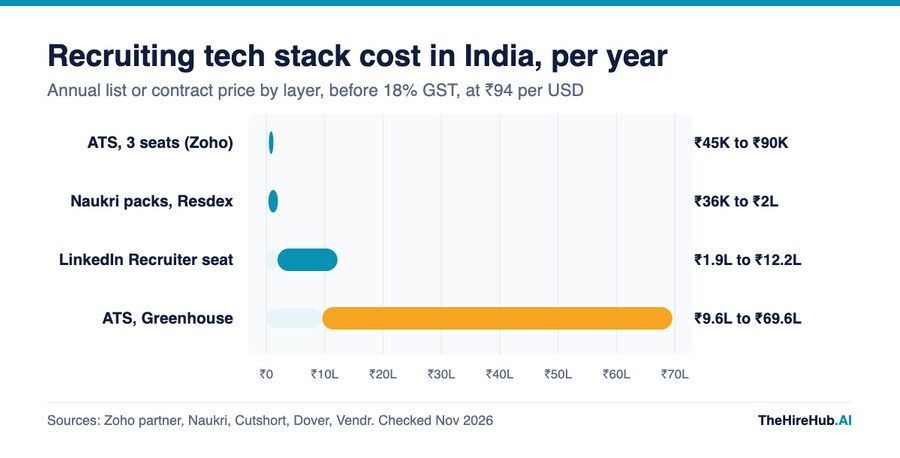
- Read the highlighted bar as a range, not a price. Vendr's Greenhouse data runs from $10,215 to $74,007 a year, with a median of $26,553 (about ₹25 lakh). Your number depends on headcount, modules and how hard you negotiate.
- LinkedIn is the layer that scales fastest with headcount. A single Recruiter Lite seat is about ₹1.9 lakh a year at Dover's quoted $170 a month, while third-party estimates for a full Recruiter Corporate seat sit around ₹10.2 lakh to ₹12.2 lakh. Three corporate seats can cost more than a mid-market ATS.
- The cheap layers are cheap on purpose. A three-seat Zoho Recruit plan and a year of Naukri SMB packs together cost less than one LinkedIn Lite seat, which is why small teams over-buy them and then pay for seats nobody logs into.
Sources and method
ATS figures come from a Zoho authorised partner's India price list (Standard ₹1,250 and Enterprise ₹2,500 per recruiter per month, billed annually) and Vendr's Greenhouse buyer guide (last updated February 2026). Naukri figures are from Naukri's own SMB package page (₹3,500 to ₹6,000 per plan), with Resdex annual quotes from Cutshort's October 2026 estimate of ₹50,000 to ₹2 lakh. LinkedIn figures use Dover's August 2026 update; LinkedIn India itself publishes no seat price. None of this covers implementation, integrations or internal admin time, which is where the hidden cost sits.
How it actually works, and where it breaks
A working recruiting tech stack has one job: move a candidate from first touch to signed offer without anyone retyping data. In practice that means four layers.
A system of record (the ATS) holds every candidate, stage and decision. Sourcing channels (Naukri, LinkedIn, referrals, careers page) feed it. Engagement tools (CRM, email, WhatsApp, scheduling) move people through it. Intelligence (analytics, assessments, AI screening) tells you what is working.
What should a recruiting tech stack include in 2027?
At minimum, an ATS that every hiring manager actually uses, two sourcing channels you can measure by quality of hire, and a scheduling tool connected to calendars. Add a CRM only when you run repeat hiring for the same roles, and an AI layer only after a shadow pilot proves it beats your current process on your own data.
The stack breaks in three predictable places. First, the ATS-CRM gap: with only 21% of teams running a CRM, most companies lose every silver-medal candidate the moment a requisition closes. Second, sourcing data that never comes home: candidates found on LinkedIn or Resdex get messaged outside the ATS, so you cannot tell which channel produced the hire. Third, seat sprawl: licences get assigned to people who left or changed roles, and renewals roll over automatically.
Claims check
Vendors in this category publish confident numbers. Here is how two of them read against independent data.
- Speed claims from consolidation platforms. Pin's tech stack report says teams using its workflow "report an average 14-day time-to-fill, the fastest of any AI recruiting platform." The page publishes no sample size, role mix or baseline for that figure. Independent data points the other way on maturity: HR.com finds 37% of TA teams use no AI at all, so "fastest" has no shared benchmark to be measured against.
- Time-saved claims from sourcing add-ons. LinkedIn says Hiring Assistant users "are saving 4+ hours per role." This is LinkedIn's own product data, not an independent study. Sapient's survey shows only 31% of organisations use AI inside HR processes at all, and 57% will not pay more for AI, so price the add-on against your own hours per role before you buy it.
- The question that exposes both. Ask any vendor for the baseline, sample size and role mix behind each number, and whether you can run it in shadow mode on your own last 50 requisitions. Our AI recruiting vendor checklist has the full list.
"A recruiting tech stack fails at the joins between tools long before it fails inside any one of them."
What this means for your team
The 2027 planning window is the cheapest moment to fix a stack: most Indian companies run an April to March financial year, so budgets and many annual renewals get decided between January and April, and every seat you cut before it renews is pure saving. The sequence below takes about one quarter and needs one owner, usually the head of TA or a TA ops lead.
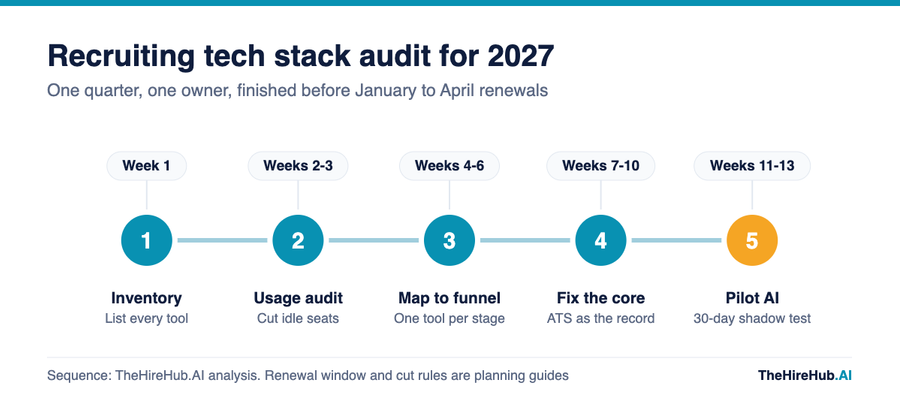
Start with an inventory: every tool, owner, seat count, renewal date and annual cost on one sheet. Then pull login data for the last 90 days. Any seat unused for 60 days is a cancellation candidate, and any tool used by fewer than half its seat holders is a consolidation candidate.
Next, map every surviving tool to one funnel stage. If two tools claim the same stage (two schedulers, two sourcing databases, an ATS with a built-in CRM plus a separate CRM), keep the one that writes data back to your ATS. Then fix the core: make the ATS the only place a candidate status changes, and connect calendars, email and your sourcing channels to it.
Only then pilot AI. Run any AI screening or sourcing tool in shadow mode for 30 days against decisions your recruiters already made. If it does not agree with your best recruiter more often than your average recruiter does, it is not ready for your 2027 budget.
A worked example: two stacks, real numbers
A 50-person startup with three recruiters might run Zoho Recruit Standard for three seats (₹45,000 a year), Naukri SMB packs year-round (about ₹36,000 to ₹42,000), and one LinkedIn Recruiter Lite seat (about ₹1.9 lakh). That is roughly ₹2.7 lakh a year before GST, or about ₹3.2 lakh with it.
A 400-person company with four recruiters might run Greenhouse at the Vendr median (about ₹25 lakh), two LinkedIn Recruiter Corporate seats (₹20.3 lakh to ₹24.4 lakh on third-party estimates) and a Resdex subscription (₹50,000 to ₹2 lakh). That lands between ₹46 lakh and ₹51 lakh a year before GST. In both cases, LinkedIn seats are the line most worth auditing first.
Recruiting tech stack vs an all-in-one platform
The alternative to a best-of-breed stack is a single platform that bundles ATS, CRM, sourcing and scheduling. It wins on integration, because there are no joins to break, and it usually wins on admin time. It loses when one module is weak and you cannot swap it out without leaving the whole system.
Should a startup buy an all-in-one recruiting platform?
Usually yes, until about 50 hires a year. Below that volume a startup has no recruiting ops person to maintain integrations, so a single platform with an ATS, a careers page and basic sourcing beats four best-of-breed tools glued together. Revisit the decision when you add a second recruiter or start hiring the same role repeatedly, because that is when a dedicated CRM or sourcing layer starts to pay back.
The honest test is whether your bottleneck is data flow or capability. If recruiters spend their day copying candidates between tools, consolidate. If your ATS works but you cannot find candidates, add a sourcing layer instead. Our comparison of recruitment CRM vs ATS covers when the CRM layer earns its keep, and ATS vs AI recruiting software covers when an AI layer should sit on top of your ATS rather than replace it.
How to actually do this (and the four traps)
Most stack projects fail for boring reasons, not technical ones. These four traps account for most of the waste we see.
- Buying before you inventory. Teams add a new tool to fix a problem an existing tool already solves, because nobody knows what the old contract includes. Read every current contract before any demo.
- Letting renewals run on autopilot. Cutshort's 2026 update reports Resdex renewals commonly rising around 15% a year and LinkedIn renewals around 10% to 15% on larger deals. Put every renewal date in a calendar 90 days ahead and negotiate from usage data.
- Measuring channels by volume, not hires. A Naukri pack that produces 400 applicants and zero hires is more expensive than a referral programme that produces three hires. Track source of hire inside the ATS, and compare against our ATS pricing in India benchmarks before you switch systems.
- Paying for AI you have not tested. AI pricing is often per seat or per requisition and scales quietly. Know your AI recruiting software cost per hire before you sign, and insist on a pilot clause.
"The best recruiting tech stack for 2027 is the one your hiring managers actually log into, not the one with the longest feature list."
The one thing every hiring leader should take from this
Your 2027 recruiting tech stack should be decided by your renewal calendar and your source-of-hire data, not by the next demo in your inbox. Inventory what you pay for, cut what nobody uses, make one system the source of truth, and pilot AI on your own requisitions before it gets a budget line. Do that in Q1 and you will likely free enough money to fund the one tool you actually need. If you want a second pair of eyes on your stack before renewals land, we look at this stuff all day.
Frequently asked questions
A recruiting tech stack is the set of software a hiring team uses to find, track, engage and assess candidates. In most Indian companies that means an ATS as the system of record, sourcing channels such as Naukri and LinkedIn, scheduling and messaging tools, and increasingly an AI screening or sourcing layer.
At minimum: an ATS your hiring managers actually use, two sourcing channels you measure by hires rather than applicants, and calendar-connected scheduling. Add a recruiting CRM only for repeat hiring, and add AI only after a 30-day shadow pilot on your own requisitions.
As of November 2026, a three-seat Zoho Recruit plan costs about ₹45,000 to ₹90,000 a year, Naukri SMB packs ₹3,500 to ₹6,000 each, a LinkedIn Recruiter Lite seat about ₹1.9 lakh a year, and Greenhouse contracts ₹9.6 lakh to ₹69.6 lakh a year on Vendr data, all before 18% GST.
No vendor has published 2027 list prices, so plan from current prices plus renewal uplifts. Cutshort's October 2026 update reports Resdex renewals commonly rising about 15% a year and larger LinkedIn deals about 10% to 15%, so budget at least that on renewals you do not renegotiate.
The shift is from adding tools to consolidating them. Sapient Insights found AI inside HR processes rose from 24% to 31% of organisations, while 57% are not interested in paying more for AI. Expect buyers to demand AI inside the ATS they already own rather than as another paid add-on.
Most teams need four to six: an ATS, two or three sourcing channels, scheduling, and possibly a CRM or assessment tool. HR.com's 2025-26 research shows ATS adoption at 78% but CRM at only 21%, which suggests most teams have more sourcing tools than engagement tools.
Only if you hire the same roles repeatedly or run long passive-candidate pipelines. An ATS tracks active applicants against open requisitions; a CRM nurtures people before a role opens. Many modern ATS products include basic CRM features, so check your contract before buying a separate tool.
Inventory every tool and renewal date, pull 90 days of login data, cancel seats idle for 60 days, and keep one tool per funnel stage. Then negotiate renewals 90 days early using usage data. LinkedIn seats are usually the largest line worth auditing first.
For senior, tech and passive hiring, often yes, but start with one Recruiter Lite seat (about ₹1.9 lakh a year at $170 a month) rather than corporate seats. Track hires sourced through it in your ATS for two quarters before adding seats.
Usually not. Most AI tools work best as a layer on top of an ATS that remains the system of record. Replace the ATS only if it cannot integrate with the AI layer or your team has stopped using it, and test any AI tool in shadow mode first.

