AI Phone Screens in 2027: What They Cost You in Candidates
Why a bot that saves recruiter time can still lose you qualified candidates, with a worked cost model and a 30-day audit.
Bots that screen candidates can cost more than they save. A worked model, the 2026 survey data and a 30-day audit to run before you buy an AI phone screen in 2027.

The short answer
Do not hand your first phone screen to a bot until you have measured how many candidates it loses. Our worked model says an AI screen saves recruiter time only while fewer than about 23% of qualified candidates walk away, and the best survey we found puts the share who have withdrawn from an AI interview at 38%.
That figure comes from one vendor-run, self-reported survey, so test it on your own pipeline. Candidates are not against AI: only 19% want less of it, and most ask for disclosure, an explanation of what is measured and a human option. Read our ai recruiting vendor checklist first, then run the 30-day audit below.
What is actually happening
The complaint arrives from both sides of the desk. Recruiters in an r/recruiting thread describe replacing the first human phone screen with an AI bot as a "huge waste of money" that drives away qualified applicants. Job seekers on r/recruitinghell and r/jobhunting say they abandon applications when they are forced to talk to a rigid screening bot. Forum threads are anecdotes, so the useful question is whether the surveys agree.
They largely do. The Greenhouse 2026 Candidate AI Interview Report surveyed 2,950 active job seekers, including 1,200 in the US, and found that 63% had been interviewed by an AI, up 13 percentage points in six months. Among US respondents, 38% had walked away from a hiring process because it included an AI interview, and another 12% said they would. Greenhouse sells hiring software, including a voice AI product, and the figures are self-reported, so read them as a strong signal and not a measurement of lost hires.
The reasons for leaving matter more than the headline. The biggest triggers were pre-recorded video interviews scored by AI with no human present (33%), companies not disclosing how AI would be used (27%), AI monitoring during the process (26%) and a required AI-led interview (26%). Seventy percent of candidates said they were never clearly told upfront that AI would evaluate them, and 21% found out only once the interview had started. Disclosure is a design choice, not a technology limit.
What happens after the bot is also a problem. Of candidates who completed an AI interview, 28% moved to the next round, 13% were formally rejected and 51% never heard back. Fortune notes that the report gives no human-interviewer comparison, so it cannot show that bots ghost more than people do. It does show that a screening step with no closing loop costs goodwill.
The trust gap is wider than the abandonment figure suggests. A Gartner survey of 2,918 candidates in the first quarter of 2025 found that only 26% trusted AI to evaluate them fairly, even though 52% believed AI screens their application. A quarter said they trust employers less when AI evaluates them. In the same release Gartner reports that 51% of candidates accepted their most recent job offer in the second quarter of 2025, down from 74% in the second quarter of 2023, which is a correlation and not proof that AI caused it.
None of these surveys splits abandonment by candidate quality. The argument that strong candidates leave first is a reasonable inference, because they have more offers and less patience, but it is an inference. That is why the audit later in this post measures it on your own pipeline.
"The loss nobody reports is the qualified candidate who never finished the screen."
The numbers
Vendors price an AI phone screen by recruiter minutes saved. The missing line is the qualified candidates who leave before or during the bot screen, and what it costs to replace them. The model below puts that line on the page. Every input is an assumption to replace with your own timings.
What does a lost candidate cost per role?
Take one role with 200 qualified candidates reaching the phone-screen stage. A human screen takes 15 minutes each, which is 3,000 minutes or 50 hours. With an AI bot, the recruiter reviews a 3-minute summary per candidate (600 minutes) and spends 1 hour on setup, exceptions and complaints, so the fixed cost is 660 minutes.
The variable is the share of those 200 candidates who walk away. Each one has to be replaced by sourcing, outreach, scheduling and a human screen, which we assume takes 50 minutes. The chart shows the minutes each scenario takes against the 3,000-minute human-screen baseline.
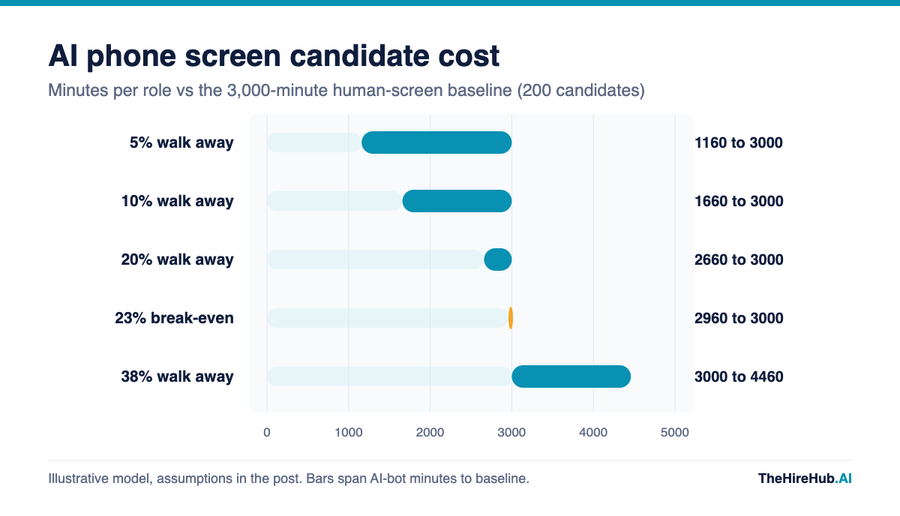
How to read this chart:
- Each bar spans the AI-bot minutes and the 3,000-minute baseline. If 5% of candidates walk away, the bot route takes 1,160 minutes, a saving of 61%. At 10% it takes 1,660 minutes, and at 20% it takes 2,660 minutes, a saving of 11%.
- The amber bar is break-even. At about 23% walking away, replacing lost candidates uses up the whole saving, at roughly 2,960 minutes. The exact break-even is 660 + (200 x share x 50) = 3,000, which is a share of 23.4%.
- At 38%, the Greenhouse withdrawal rate, the bot route takes 4,460 minutes, 49% more than human screening. Treat that as a stress test, not a forecast, because the survey covers AI interviews in general and not your process.
In money, at an assumed loaded recruiter cost of ₹800 an hour, the 38% case costs about ₹19,500 more per role than human screening. At 100 roles a year that is roughly ₹19 lakh, before any licence fee. The 5% case saves about ₹24,500 per role, which is why a good implementation can still win.
What the model leaves out
The model counts only recruiter minutes. It treats replacement as possible, which is true for volume roles and often false for niche or senior ones, where a lost candidate means a longer vacancy and not 50 extra minutes. It also ignores the brand effect Greenhouse describes: 34% of candidates who completed an AI interview came away with a more negative view of the employer, against 38% who came away more positive. Both effects make the real cost of a bad bot higher than the model shows, and the real benefit of a good one higher too.
Sources and method
The model is illustrative and built on stated assumptions, not measured data, and the ₹800 hourly cost is an assumption, not a benchmark. The survey figures come from the Greenhouse 2026 Candidate AI Interview Report, reported by Fortune and HR Dive, and from a Gartner candidate survey. None of them measures a specific vendor's phone-screen product.
How it actually works, and where it breaks
Candidate drop-off is not a sign that the technology is broken. It follows from how the screen is built and presented, and the research points to six causes you can design around.
Why do candidates walk away? Six mechanisms
- Surprise. Seventy percent of candidates said they were never clearly told AI would evaluate them, and 21% learned it only when the interview began. A candidate who feels ambushed has a reason to leave that has nothing to do with the questions.
- No human in sight. The top US trigger for withdrawing, at 33%, was a pre-recorded video interview scored by AI with no human present. A one-way screen cannot answer a candidate's question about pay, location or the role, so the candidate must commit time before learning whether the job is worth it.
- Silence afterwards. Half of the candidates who completed an AI interview, 51%, never heard back. A screen that asks for 15 minutes and returns nothing teaches candidates to skip the next one.
- Doubts about fairness. Only 26% of candidates in the Gartner survey trusted AI to evaluate them fairly, and only 21% of Greenhouse respondents believed most employers use AI responsibly. Greenhouse also found nearly identical perceived bias from AI and humans: 36% felt age bias and 27% felt race or ethnicity bias from both. The perception is the cost here, whether or not a given tool is biased.
- Performing for the machine. A 2025 study reported by HR Dive found that candidates who believe AI is assessing them stress analytical skills and downplay intuitive and emotional ones. A bot screen may therefore measure how candidates think a bot wants them to sound, which weakens the signal you bought it for.
- An arms race on both sides. Gartner found 39% of candidates used AI in their applications (4Q24), and 6% admitted to interview fraud (2Q25). Greenhouse's chief people officer calls the current state an "arms race, not a hiring process", with employers filtering faster and candidates applying wider to be seen.
Speech and accessibility deserve a separate line. A January 2026 arXiv paper argues, without new measurement, that speech recognition trained on standardized speech can fail atypical and diverse voices. Treat it as a reason to test your vendor on accented and non-standard speech in your own market, not as evidence about any product.
This is the same structural problem we describe in our piece on ai screening false negatives: the loss you cannot see is the one that hurts. A candidate who abandons the bot never appears in a reject pile, so no report shows them. The checking burden in our ai recruiting verification analysis is the cost on the recruiter side of the same coin.
Claims check
Vendor figures about AI screening are real data points, but they usually answer a different question from the one a buyer has. This is a note on what each type of figure measures, not a judgement on any company.
- Completion rate among people who start. A bot that reports 90% completion may be counting only candidates who clicked start. It cannot count the ones who read the invitation, saw an AI interview and left, which is the group the Greenhouse survey describes.
- Satisfaction scores from finishers. A survey sent to completers leaves out everyone who quit. Greenhouse's own finding is nearly split among completers: 38% had a more positive view of the employer and 34% a more negative one.
- Speed to screen. Time from application to screen measures the bot's throughput. It says nothing about how many of the invited candidates showed up or how many qualified ones were lost on the way.
- Conversational apply lifts. Figures such as completion rising from 50% to 85% with a conversational application, attributed to Paradox and relayed on a Pin analysis of application length drop-off that cites SHRM, show that good design can remove friction. They are vendor-reported, relayed through another vendor's blog, and measure completing an application, not the quality of a screening decision. We did not open the original sources.
- The cost of friction is well documented elsewhere. The same Pin analysis relays Appcast data showing apply rates of 12.47% for applications under 5 minutes against 3.61% for those over 15 minutes. Whatever the bot does, a long or unclear first step costs applicants.
Put these questions to any vendor before you sign: what share of invited candidates start the screen, complete it and advance? How many ask for a human instead, and what happens to them? Can you show drop-off by role, device and language, and will you support a pilot with a human-screen control group? A vendor confident in its product will agree to all of these.
What this means for your team
The practical answer is a 30-day audit that turns the model above into your own numbers. It needs a funnel report, a simple definition of "qualified" and a control group, and it works for any vendor. Our ai recruiting pilot plan covers the wider scorecard; this audit adds the candidate-loss line that most pilots skip.
Which metrics matter?
Six metrics cover it:
- Start rate: the share of invited candidates who begin the bot screen. Low start rates mean the invitation itself is putting people off.
- Completion rate: the share of starters who finish. This is the number vendors quote, so keep it, but never alone.
- Qualified walk-away rate: the share of candidates your recruiters would have advanced, based on their resumes, who did not complete the screen. This is the number in the cost model.
- Human-option rate: the share who ask for a person instead, and how long they wait for one.
- Response time: days from screen to a reply, including rejections. Greenhouse found 51% of completers got none.
- Net minutes: fixed recruiter time plus replacement time for lost candidates, against the manual baseline.
What does the 30-day audit look like?
The key design choice is a control group. Randomly route half of the invited candidates for the same roles to a human screen, so that the two groups see the same jobs in the same weeks. The chart shows the five stages.
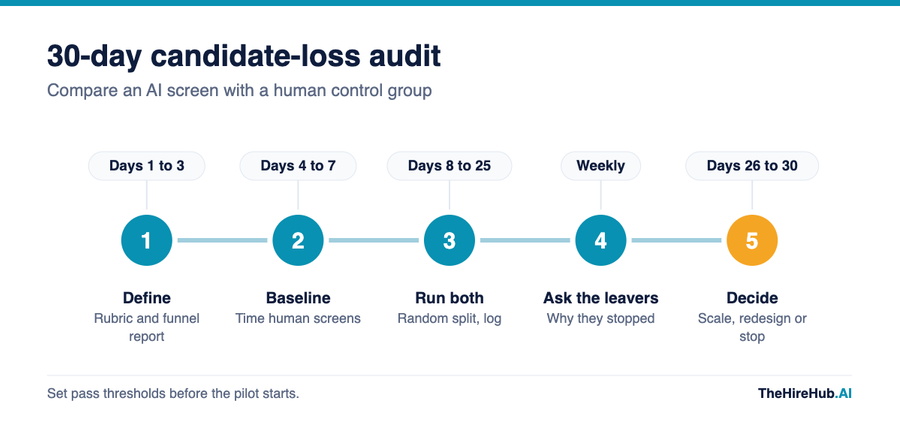
- Days 1 to 3: define and instrument. Write a one-paragraph rubric for "qualified" on two roles, and set up a report that counts invited, started, completed and advanced for each route.
- Days 4 to 7: time the human screen. Record minutes per screen, show-up rate and time to reply on the control route, so the comparison is not a guess.
- Days 8 to 25: run both routes. Assign candidates at random, tell every candidate what the screen is and offer a human option on both, and log minutes spent on summaries, exceptions and complaints.
- Weekly: ask the leavers. Send non-starters and non-completers a three-question message asking why they stopped, and sample the people the bot filtered out the way you would audit any reject pile.
- Days 26 to 30: compute and decide. Compare qualified walk-away rate and net minutes by role, then decide per role whether to scale, redesign or stop.
Set the pass thresholds before you start, using your own break-even from the model, because a metric chosen after seeing the result will always favour the purchase.
AI phone screen vs human screen vs hybrid
The choice is not a bot or nothing. Four set-ups sit on the spectrum, and each moves the trade-off between recruiter time and candidate loss.
- Human phone screen. Recruiter time is highest, and the main candidate risk is slow replies when recruiters are busy. Measure time to first contact and show-up rate.
- AI bot as the gate. Recruiter time is lowest, and the risk is walk-away before or during the screen and silence afterwards. Measure the qualified walk-away rate and response time.
- AI-assisted human screen. Recruiter time is medium, and candidate risk is low because a person still talks to the candidate. Measure the minutes saved on scheduling and notes.
- Candidate's choice of bot or human. Recruiter time is low to medium, and candidate risk is low if the human route is as fast as the bot. Measure the share choosing each route and the outcome by route.
The middle two set-ups are where most teams should start. Using AI for scheduling, note-taking and structured summaries removes recruiter minutes without removing the conversation. Offering a choice also gives you a natural experiment, since you can see who picks the bot and whether they advance.
For the licence side of the decision, the ai recruiting software cost guide sets out what these tools cost, which is the number your candidate-loss minutes should be added to.
How to actually do this (and the four traps)
Greenhouse asked candidates what would make AI interviews acceptable, and the answers read as design rules. In the survey, 46% wanted the option to request a human interview, 44% wanted upfront disclosure, 39% wanted an explanation of what AI is measuring, 38% wanted to know a human reviews the AI's evaluation and 29% wanted evidence of a bias audit. Five rules follow:
- Disclose before the invitation is accepted. Say that it is an AI screen, what it measures and how long it takes, in the invitation itself.
- Offer a human route in one click. Make it as fast as the bot route, or the option is decoration.
- Tell candidates about the job first. Pay range, location and next steps up front give a candidate a reason to spend 15 minutes.
- Close the loop. Commit to a reply with a date, including for rejections, and track whether you meet it.
- Keep a person accountable. A recruiter reviews the AI's evaluation before any rejection, and samples rejects on a schedule, as set out in our ai recruiting verification analysis.
The four traps
- Measuring only completers. Completion rate, satisfaction and speed all describe the people who stayed. The loss is in the people who did not.
- Calling drop-off self-selection. It is tempting to say weak candidates leave and strong ones stay. Nothing in the surveys supports that, so test it with the qualified walk-away rate.
- Averaging across roles. A volume role with many similar applicants can absorb a 20% walk-away, while a niche senior role cannot absorb 5%. If you run an ATS, the recruitment funnel conversion rates benchmarks show which stage to watch by role family.
- Treating the bot as free. The real cost is the licence plus recruiter minutes plus replacement work for the candidates you lose.
"A bot screen should be judged by the qualified candidates who still reach a human, not by the screens it completes."
The one thing every hiring leader should take from this
If you are about to sign an AI screening contract for 2027 on the promise of recruiter hours saved, add one line to the business case: qualified candidates lost, measured, by role, with a human-screen control group. The honest reading of the forum complaints is that they are partly right. A bot that surprises candidates, hides the human and never replies will lose people, and nobody's dashboard shows who left.
But it is also measurable and fixable. Candidates say what they want: disclosure, an explanation, a human option and a reply. Teams that build those in and measure the leavers have a far better chance of keeping both the saving and the candidates. If you want a second pair of eyes on how to run that audit, TheHireHub can help: we look at this stuff all day.
Frequently Asked Questions
Many say so. In the Greenhouse 2026 survey, 38% of US candidates had withdrawn from a hiring process because it included an AI interview, and another 12% said they would. The data is self-reported and vendor-published, so measure drop-off on your own pipeline.
It can be, and it can also pay off. In our illustrative model the bot saves recruiter time only while fewer than about 23% of qualified candidates walk away, because replacing lost candidates costs time. Run a pilot with a human-screen control group before you commit.
The biggest triggers in the Greenhouse survey were AI-scored recorded video with no human present (33%), no disclosure of how AI would be used (27%) and AI monitoring (26%). Most candidates, 70%, were never told upfront that AI would evaluate them.
Mostly no. Only 19% want less AI, and the rest want the same or more with guardrails: a human option (46%), upfront disclosure (44%) and an explanation of what is measured (39%). Fix the process before you blame the technology.
It is the safest design choice, and 57% of candidates in the Greenhouse survey think disclosure should be a legal requirement. Rules differ by jurisdiction and change quickly, so this is not legal advice. Ask counsel what applies where you hire.
Track start rate, completion rate and the qualified walk-away rate against a human-screen control group, then add response time and the share who ask for a person. Always report by role, not as one blended number.
Not automatically. Greenhouse found nearly identical perceived bias from AI and human interviewers, with 36% reporting age bias from both and 27% race or ethnicity bias from both. Audit outcomes by group and let candidates reach a human.
More candidate-side AI use and more concern about fraud. Gartner reported 39% of candidates using AI in applications in late 2024 and 6% admitting to interview fraud in mid-2025, and 62% said they were more likely to apply where in-person interviews are required. Plan for a hybrid process, not a bot-only one.
No verified 2027 price list exists for the category as of November 2026. Use current published prices plus a renewal scenario, and add your measured recruiter and replacement minutes at your loaded hourly rate to get the true cost.
Often, but test it. High-volume roles can absorb more walk-away because replacements are easy to find, while niche senior roles cannot. Report the qualified walk-away rate by role family, never as one blended number.


