
Job Portals in India for Employers: What Each Costs and Delivers in 2027
Naukri, LinkedIn, Indeed, Apna and the specialists, priced from their own pages and judged on the hires they produce, not the applicants they send.
Job portals in India cost ₹0 to ₹1,650 a post on Naukri and ₹546 to ₹699 on Apna. Here is how to build a 2027 portal mix that is judged on hires, not applicants.

TL;DR
The job portals in India that most employers actually use (Naukri, LinkedIn, Indeed, Apna, and a handful of specialists such as Cutshort) all let you start free, and the paid self-serve tiers are cheap: ₹400 to ₹1,650 for a Naukri post, ₹546 to ₹699 for an Apna post, and whatever daily budget you set on LinkedIn. That is the wrong number to plan around. For a 2027 hiring plan, the cost that decides which portals are worth it is the recruiter time spent screening what each one sends you, so pick two portals per role family, start on the free tier, and pay only where shortlists come from. If you are weighing the two biggest names head to head, start with our Naukri vs LinkedIn Recruiter breakdown.
What is actually happening
India's job portal market is not shrinking, it is consolidating around a few platforms and fragmenting at the edges. Info Edge, which runs Naukri, reported recruitment solutions billings of ₹613.8 crore for the quarter to 30 September 2026, up 12.6% on a year earlier. That is the clearest public signal that employers are still paying portals, and paying more each year.
Demand is uneven by segment. The Naukri JobSpeak index for October 2026 stood at 2,836, up 14% year on year, though Info Edge itself cautioned that part of that jump reflects a soft festive base in October 2025. Inside the index, AI and machine learning roles rose 32% and GCC hiring rose 18%, while education fell 16%. Portals feel these swings first, because they sit at the top of every funnel.
For the wider market picture, our recruitment statistics India page collects the verified numbers.
The pricing model has also shifted quietly. Three of the largest platforms now lead with a free tier. Naukri's January 2026 announcement puts free job posting for employers at the base, with paid tiers above it. LinkedIn allows one free job post open at a time, and Indeed India lets employers post free and then sponsor.
Below the general boards, a second layer has grown up around specific hiring problems. Apna and WorkIndia target frontline and blue-collar roles in volume. Cutshort, Instahyre and similar platforms target tech talent with matching rather than plain listings. Senior and niche hiring still runs through database access (Naukri's Resdex, LinkedIn Recruiter) rather than job posts.
The practical result for a founder or TA lead is that the line item "job portals" is small, but the choices inside it drive most of what happens downstream. The wrong portal does not cost you ₹1,650. It costs you two weeks of a recruiter reading the wrong applications.
The numbers
Here is what the main job portals in India charge on their public, self-serve pricing as of late November 2026. All figures are list prices per job post as published, unless stated.
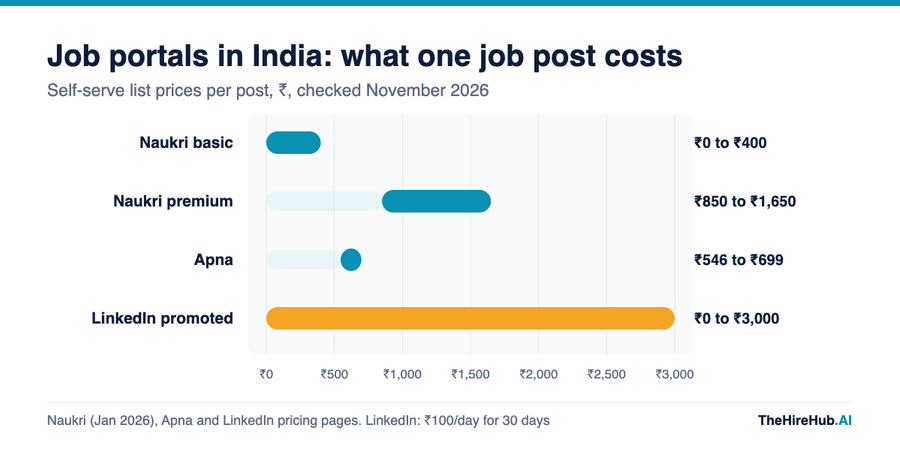
How to read this:
- Naukri runs from free through Standard (₹400), Classified (₹850) and Hot Vacancy (₹1,650), per its January 2026 announcement. Higher tiers buy visibility and placement, not a different candidate pool.
- Apna starts at ₹699 for a single post, and packs bring it down: 3 credits for ₹1,949 and 13 credits for ₹7,099, or about ₹546 a post.
- LinkedIn has no fixed post price. Its own example is a ₹100 daily budget for 30 days, which caps at ₹3,000; the chart uses that example, but your budget can be lower or much higher.
Two portals do not fit on this chart. Indeed India publishes no fixed minimum on its pricing page; it recommends a sponsorship budget per job and shows the floor at checkout. Cutshort prices a flat subscription instead of per post: ₹30,000 a month or ₹2.99 lakh a year on its public pricing page, with no seat limits.
How much does it cost to post a job in India?
You can post a job in India for ₹0 on Naukri, LinkedIn and Indeed. Paid self-serve posts typically cost ₹400 to ₹1,650 on Naukri and ₹546 to ₹699 on Apna, while LinkedIn and Indeed charge whatever sponsorship budget you set. Database access and subscriptions (Resdex, LinkedIn Recruiter, Cutshort) are priced separately and cost far more.
Sources and method
Naukri tier prices come from its press release of 20 January 2026. Apna, LinkedIn, Indeed and Cutshort figures come from each platform's own pricing page, checked on 28 November 2026. Market figures come from Info Edge's Q2 FY27 business update (October 2026) and the Naukri JobSpeak report for October 2026. These are list prices for self-serve posting; they exclude enterprise contracts, database access and negotiated discounts, and you should check whether GST is added at checkout.
How it actually works, and where it breaks
Every job portal sells the same thing in different packaging: attention from job seekers, plus some way of ranking your post against everyone else's. Paid tiers buy you a better slot in that ranking for a fixed period. Database products (Resdex on Naukri, Recruiter on LinkedIn) are a different purchase entirely, because you go to the candidate rather than waiting for them.
The first failure mode is volume without fit. A broad post on a large portal can draw hundreds of applicants for an entry or mid-level role, and someone has to read them. If your recruiter screens 300 applications at two minutes each, that is 10 hours of work for one requisition, which dwarfs a ₹1,650 posting fee.
The second is paying for visibility on the wrong board. Premium tiers amplify reach inside one portal's audience. A Hot Vacancy on a general board will not turn up a senior ML engineer who only answers on specialist platforms or through referrals.
The third is measuring the wrong thing. Most portal dashboards report views and applies, because those are the numbers they control. The number that matters is hires, and you only get it if you tag the source in your ATS and keep it through to offer.
Claims check
Portals publish confident numbers on their own marketing pages. Two examples checked on 28 November 2026, with what you should ask before relying on them:
- Talent coverage claims. Naukri's PremiumX page states "80% of India's premium talent available on PremiumX" (naukri.com). The page does not define "premium talent" or publish a source or baseline. Ask how premium is defined, how many profiles were active in the last 90 days, and what share respond to outreach.
- Savings claims. Cutshort's pricing page says it can "save you 60% or more on your current options" (cutshort.io). No baseline or method is published on the page. Ask which "current options" the comparison uses and whether it counts recruiter time or only subscription cost.
Neither claim is necessarily wrong. They are simply unverifiable as written, which means your own source-of-hire data has to do the job of proving them.
"A job portal is cheap to buy and expensive to use; the invoice is the posting fee, but the real bill is recruiter hours."
What this means for your team
The way to keep portal spend honest is to treat it as a sequence, not a subscription. Decide what each role family needs, test cheaply, then pay only where the evidence points.
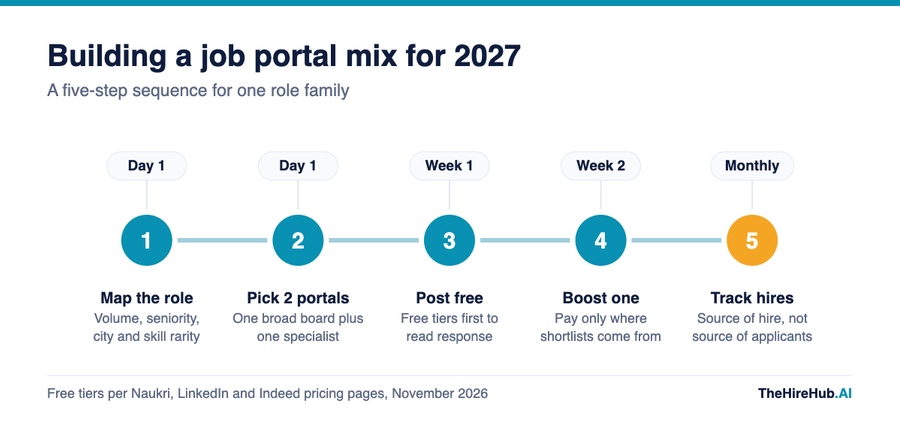
Stage by stage:
- Map the role. Volume, seniority, city and how rare the skill is decide everything else. Twenty delivery executives in Pune and one staff engineer in Bengaluru should never share a portal plan.
- Pick two portals. One broad board for reach and one specialist for fit is the right default. For frontline roles that might be Naukri plus Apna; for tech, LinkedIn plus Cutshort or Instahyre.
- Post free first. Use the free tiers for the first week and read the response honestly: how many applicants, and how many would you actually phone.
- Boost one. Put money behind the portal that produced shortlistable candidates, not the one that produced the most applicants.
- Track hires monthly. Report source of hire, not source of applicants, and cut any portal that has not produced a hire in a quarter.
A worked example: 20 frontline hires in one city
Say you need 20 delivery and field sales staff in Pune over a quarter. On Apna, a 13-credit pack costs ₹7,099, enough to post each of your five distinct roles twice and keep three credits in reserve. On Naukri, the same ten postings at Hot Vacancy would cost ₹16,500, or ₹4,000 at Standard, or nothing on the free tier.
Now the screening. If each posting draws 150 applicants and a recruiter spends two minutes on each, ten postings means 1,500 applications and 50 hours of screening. At that point the ₹7,099 or ₹16,500 is a rounding error next to the recruiter's time, which is why the portal that produces a tighter shortlist is the cheaper one even if its posting fee is higher. Those applicant numbers are illustrative assumptions; use your own last quarter's data to rerun them.
If your ATS cannot pull applicants from each portal automatically, fix that before you add a third board; our guide to job board integrations in India covers which connections exist.
Job portals vs sourcing tools
Job portals are inbound: you publish a post and wait for applicants. Sourcing tools and databases are outbound: you search profiles and contact people who never applied. Portals win on cost per applicant for high-volume, well-understood roles. Outbound wins for senior, niche or passive talent, where the best candidates are not looking at job ads at all.
Most growing companies need both, in different proportions by role family. The mistake is using a portal budget to solve an outbound problem, or paying for a database seat to fill roles that a ₹699 post would fill in a week. If you are setting next year's numbers, put the two in separate lines in your recruitment budget planning so neither hides the other, and compare both against cost per hire benchmarks rather than against each other.
How to actually do this (and the four traps)
Start with a one-page portal plan per role family: the two portals, the free test window, the boost budget, and the metric that decides whether the portal stays. Review it once a quarter with whoever owns hiring. Then avoid these four traps.
- Buying the premium tier on day one. Hot Vacancy and promoted posts buy reach, and reach is not the constraint for most roles. Test free for a week first; you will usually learn more from the free response than from the paid one.
- Counting applies as success. A portal that sends 400 applicants and zero hires is your most expensive channel, not your best one. Judge every portal on shortlists and hires, and make your recruiters log the source on every candidate.
- Using one portal for every role. A general board that works brilliantly for sales hiring can be useless for senior engineering. Match the portal to the role family, and accept that your mix will differ across teams.
- Ignoring the screening load. Every extra portal adds applicants, duplicates and follow-ups. If your recruiters are already stretched, the cheapest fix is often fewer portals with better screening, and a clean source of hire tracking setup to prove which ones earn their place.
"Judge every job portal by the hires it produces, never by the applicants it sends, or you will keep paying for noise."
The one thing every hiring leader should take from this
If you are finalising your 2027 plan, do not budget for job portals as one line. Budget for them per role family, start every new portal on its free tier, and give each one a quarter to produce a hire before it gets more money. The posting fees are small enough that the real decision is about where your recruiters spend their hours. If you want a second pair of eyes on that mix, or on how much screening an AI layer can take off your team, TheHireHub is happy to help: we look at this stuff all day.
Frequently asked questions
For most employers the core set is Naukri for broad white-collar reach, LinkedIn for professional and senior roles, Indeed for free volume, Apna or WorkIndia for frontline and blue-collar hiring, and Cutshort or Instahyre for tech. The best mix pairs one broad board with one specialist for each role family.
Naukri offers a free job posting tier, and its January 2026 announcement lists paid tiers at ₹400 for Standard, ₹850 for Classified and ₹1,650 for Hot Vacancy. Resdex database access is priced separately and usually through a sales quote.
Yes. LinkedIn allows one free job post open at a time. To promote a post you set a daily or total budget; LinkedIn's own example is ₹100 a day for 30 days, which caps spend at ₹3,000 for that post.
Yes, Indeed India lets employers post jobs for free. Sponsored Jobs are optional and budget based: Indeed recommends a budget for each job and shows the minimum price at checkout rather than publishing a fixed rate. Agencies are not eligible for free accounts.
No portal has published 2027 prices yet. As of late November 2026, self-serve posts run from free to ₹1,650 on Naukri and ₹546 to ₹699 on Apna, with LinkedIn and Indeed budget based. Plan 2027 using these current list prices and recheck each pricing page before you commit annual spend.
The clearest shift already visible is free tiers becoming standard on the biggest boards, which moves the cost from posting fees to screening time. Demand is also uneven: Naukri JobSpeak showed AI and ML hiring up 32% and GCC hiring up 18% year on year in October 2026, while education fell 16%.
Platforms built for frontline roles, such as Apna and WorkIndia, usually suit blue-collar and field hiring better than general white-collar boards. Apna's public pricing starts at ₹699 for a single post and drops to about ₹546 a post in its 13-credit pack.
Tech hiring usually works best on LinkedIn plus a tech-specialist platform such as Cutshort or Instahyre, which match candidates rather than only listing jobs. Cutshort publishes a flat plan at ₹30,000 a month or ₹2.99 lakh a year with no seat limits.
Tag the source of every candidate in your ATS and report hires by source each month, not applicants. A portal that sends many applicants but no hires is your most expensive channel once recruiter screening time is counted.
For senior and niche roles, outbound sourcing through databases, LinkedIn Recruiter or search partners usually beats job posts, because the strongest candidates are rarely applying to ads. Job portals remain the cheaper channel for high-volume, well-defined roles.

